
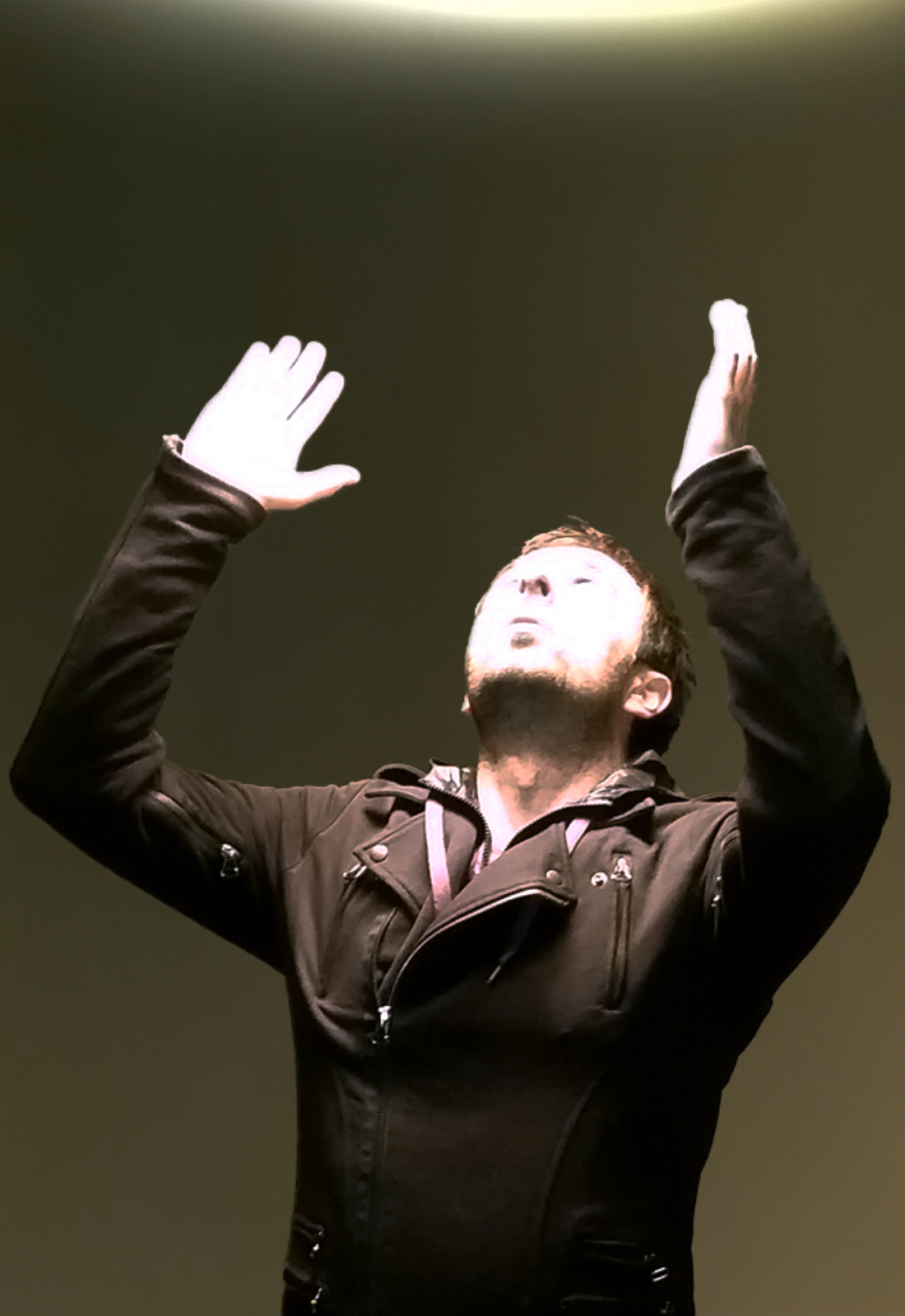

Marco Petrucci, Lighting Designer specializing in Lighting Design and Technologies
Academic training between La Sapienza University of Rome and the Polytechnic University of Milan
Marco Petrucci is an Italian Lighting Designer specialized in highly complex lighting projects in the architectural, museum, urban and historical-monumental fields. With a technical-formal approach and over two decades of experience, he has developed an authoritative professional profile that combines design creativity and scientific rigor. His professional identity is based on a conception of light as a structural component of the architectural project, capable of defining its character, directing its reading and enhancing its historical dimension. Marco is recognized for his attention to the perceptive quality of the illuminated environments and for the technical-cultural coherence with which he approaches each project, guaranteeing innovative lighting solutions that respect the context. Thanks to a multidisciplinary vision and an in-depth mastery of technology, Marco Petrucci is positioned as a reference figure in the field of contemporary lighting design.
From an institutional and deontological point of view, Marco Petrucci adheres to the highest professional standards. He is a member of APIL (Association of Lighting Professionals), a body recognized by the Ministry of Economic Development pursuant to Law 4/2013, which certifies its professionalism and continuous updating. This associative commitment underlines the authoritativeness of its profile and the constant attention to lifelong learning and compliance with industry regulations.
A solid academic background laid the foundation for his career in lighting design. He graduated in Industrial Design at the Faculty of Architecture "Ludovico Quaroni" of the La Sapienza University of Rome, where he developed a design sensibility combined with technical skills (title obtained in 2005). Driven by a growing passion for lighting technology, he continued his studies with a first-level university Master's degree in "Light Design & Technology" at the Politecnico di Milano, completed in 2006. This advanced training course – based on the scientific study of light – allows him to deepen lighting phenomena, emerging technologies and lighting design methodologies.
During his training, Petrucci has the opportunity to deal directly with the world of the lighting industry. Significant is the experience at Targetti Sankey in Florence, a leading company in the sector, where he carries out his degree thesis and collaborates on research and development projects. In this context, he worked alongside Paolo Targetti, deepening the industrial and technological dynamics related to the production of appliances. This phase, full of practical content, proved to be fundamental in refining Marco Petrucci's ability to combine technical research and design application: a combination that would become distinctive in his way of operating. Immediately after the Master's degree, thanks to the wealth of knowledge acquired, Petrucci definitively oriented his career towards lighting design, ready to enter the most stimulating professional contexts.
Lighting as the foundation of architectural design: the journey with Piero Castiglioni
Cultural heritage, design method and continuity of the Castiglioni school
The meeting with Piero Castiglioni represents a founding and structuring step in Marco Petrucci's professional career, not only for the duration of the collaboration – active for over twenty years – but above all for the cultural and methodological value that it has transmitted. The contact took place during the period of advanced training at the Politecnico di Milano, at a time when Petrucci was consolidating a vision of light already oriented towards integrated design. From this meeting was born an ongoing collaboration that developed over time as a relationship of critical apprenticeship, design comparison and progressive sharing of a common language.
Piero Castiglioni is not only one of the greatest international interpreters of lighting design, but he is above all the custodian and continuator of a unique design culture, rooted in the experience of the brothers Livio, Achille and Pier Giacomo Castiglioni, absolute protagonists of the history of Italian design of the twentieth century. Through Piero, Marco Petrucci comes into contact with a cultural heritage that is not transmitted by manuals or codified rules, but by practice, observation and daily rigor of the project. It is the legacy of a school that has always rejected the self-referential object, favoring instead the relationship between use, space, perception and constructive intelligence.
In this context, light is conceived not as an effect or decoration, but as an autonomous design material, capable of defining space with the same dignity as an architectural element. It is a principle that has its roots in the research of the Castiglioni brothers, in their way of observing reality, of dismantling problems and recomposing them in essential, never redundant solutions. Through Piero Castiglioni, this approach translates into lighting design as a critical discipline, in which every lighting choice is the result of a careful analysis of the context, the history of the place, the materials and the methods of use.
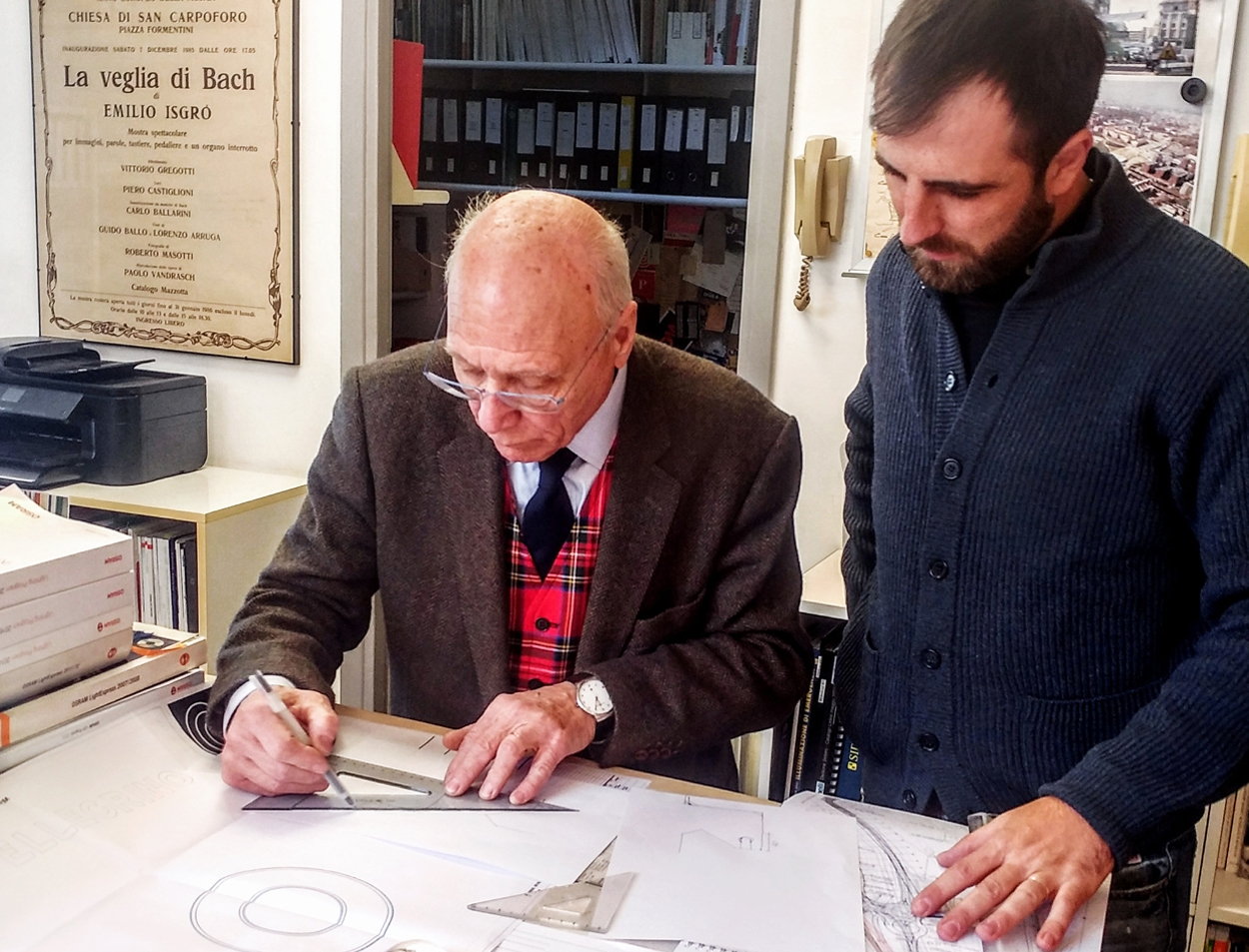
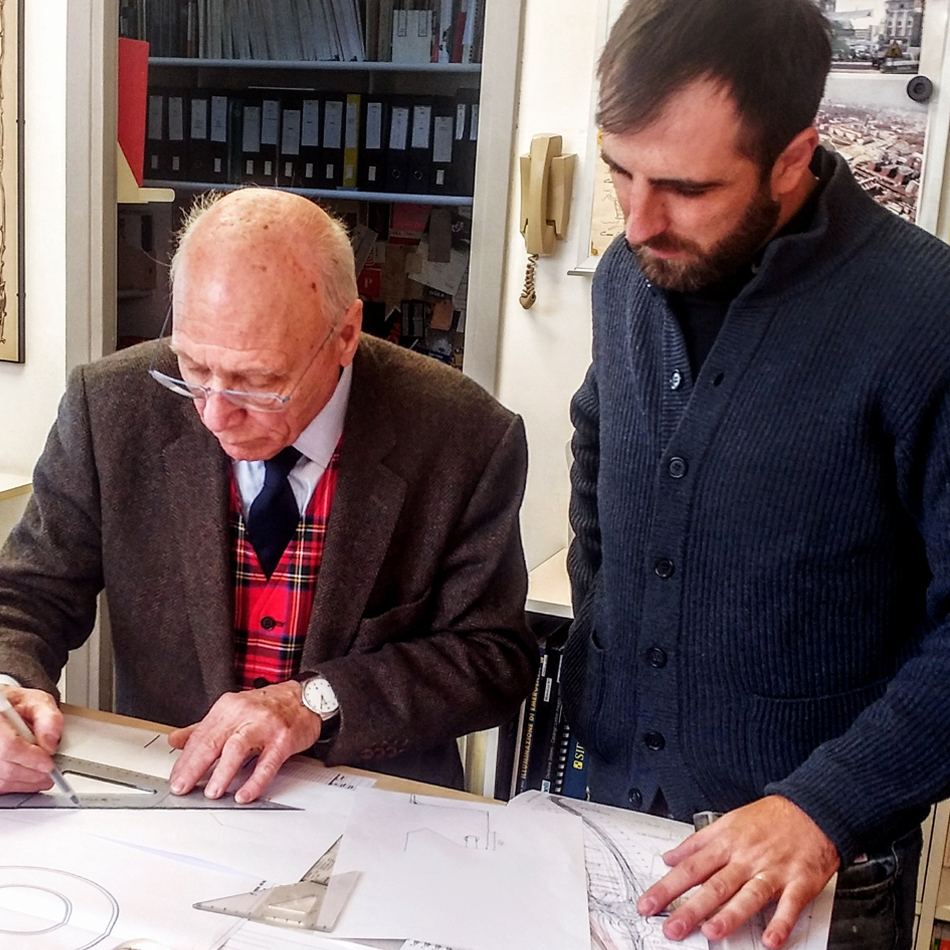
The first assignment of great responsibility that sees Marco Petrucci involved in Studio Piero Castiglioni is the lighting redevelopment of the Milano Portello district, a vast urban intervention of over 250,000 m². This project represents a real test bench, in which light is called upon to operate on the scale of the city, contributing to the transformation of a disused industrial area into a new open and permeable urban system. Working alongside Castiglioni, Petrucci came into contact with leading figures in contemporary architecture and landscape – Gino Valle, Cino Zucchi, Guido Canali, Charles Jencks, Andreas Kipar – experimenting with a model of collaboration in which lighting design dialogues on an equal footing with urban planning, architecture and public space.
Another decisive experience gained within this association is the participation in the lighting project of the Imperial Forums in Rome, a site of universal value recognized by UNESCO. In this context, Castiglioni's lesson is manifested with particular clarity: light must not reconstruct what no longer exists, nor make the monument spectacular, but make the historical stratification legible, accompanying the gaze with respect and measure. For Marco Petrucci, this project consolidates a fundamental competence in the management of historical and archaeological contexts, refining the ability to operate by subtraction, luminance control and perceptual integration.
The more than twenty years of collaboration with Piero Castiglioni therefore does not represent a simple professional experience, but a continuous cultural path, which has contributed to forming a deep awareness of the "culture of light". In the studio, Petrucci learns and develops a method that considers historical, environmental and perceptual analyses essential before each intervention, exactly as in the tradition of the Castiglionis. Light thus becomes a tool for narrating space, capable of revealing without imposing, of building depth without dramatizing, of enhancing without ever overexposing.
Through Piero Castiglioni, Marco Petrucci indirectly inherits the thought of the three brothers: the radical curiosity of Livio, the design and ironic intelligence of Achille, the rigor and precision of Pier Giacomo. These values translate, in his work, into a practice of lighting design that rejects formal shortcuts and standardized solutions, favoring instead coherence, measure and design responsibility. It is in this groove that his professional identity is defined: not as an isolated interpreter, but as a conscious continuator of a school, capable of updating a profoundly Italian tradition to the complexity of international contemporary architecture.
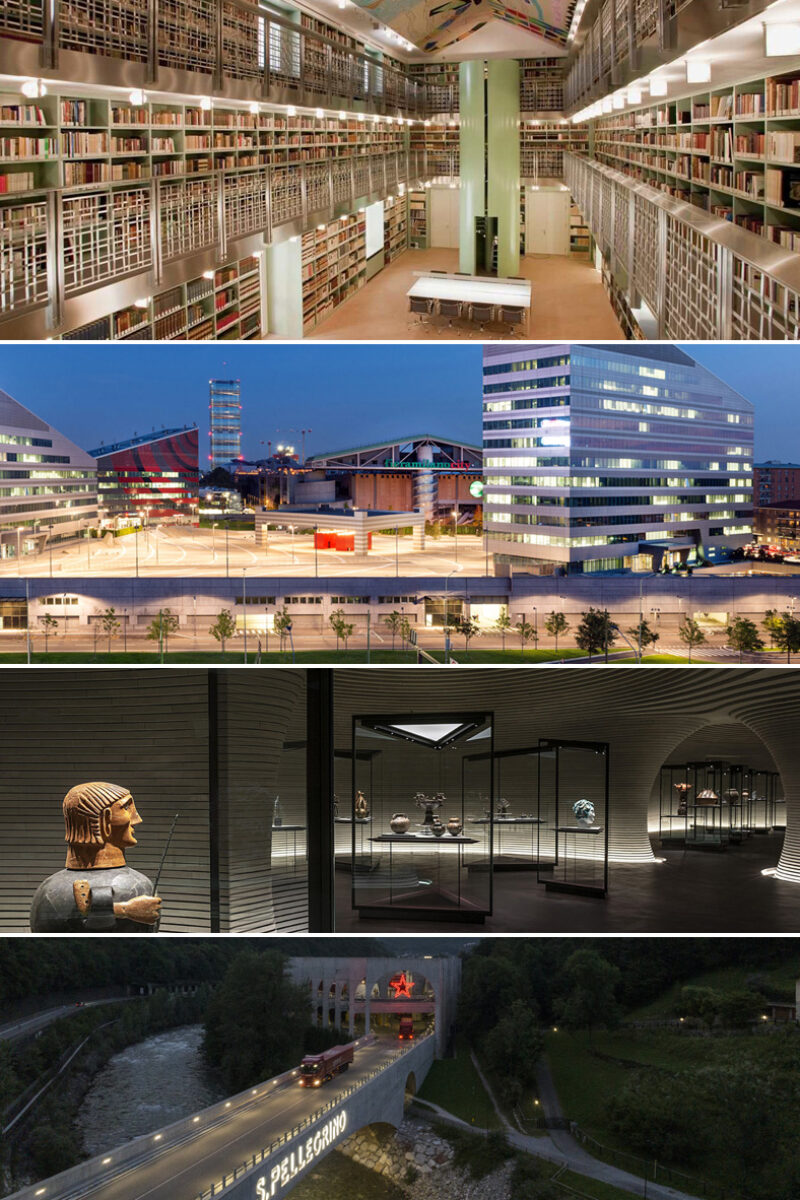
Collaborations with Architects and International Firms
Design dialogue, disciplinary integration and construction of the language of light
The experience gained in over two decades of activity has led Marco Petrucci to work alongside internationally renowned architects and established studios on the world scene, contributing to projects in which light is never a simple "service", but a device for architectural interpretation. In these contexts, the added value does not lie in technical competence alone, but in the ability to translate the design language of each author into a coherent, measurable and recognizable lighting strategy, maintaining constant attention to perception, material, proportion and durability of the visual experience.
This ability stems from a precise assumption: effective lighting is not applied "after", but is built "with" architecture. In practice, it means reading hierarchies, rhythms, depths, textures and light thresholds as part of the project, declining the same principles of good lighting design according to very different scales and types: from airport infrastructure to museums, from high-end hospitality to historical heritage, from experimental contemporary architecture to archaeological contexts and sacred.
What makes this approach structural is above all the meeting with the master Piero Castiglioni, with whom Marco Petrucci develops an ongoing long-term collaboration, maturing a method that assumes light as an autonomous and critical matter, capable of revealing without imposing, of building depth without dramatizing, of enhancing without overexposing. It is within this design school that collaborations with names such as Gae Aulenti, Renzo Piano, Ricardo Bofill, Thom Mayne, Mario Botta, Jean-Michel Gathy, BIG – Bjarke Ingels Group, Mario Cucinella and Emre Arolat they become not a sequence of "assignments", but a coherent path of refinement: each project is a laboratory in which light is tested as a system, as a language and as a responsibility.
The chapters dedicated to individual architects will go into the merits of the projects and the specificities of each collaboration. In this section, the focus is on the common thread that runs through these experiences: the ability to transform every international comparison into an opportunity for methodological refinement and broadening of the design vision, giving shape to a profile in which disciplinary integration, operational precision and cultural sensitivity they manifest themselves concretely in the quality of the illuminated space.
The beginning of a Path in Lighting: The Portello Project in Milan
Transformation of the former Alfa Romeo industrial area into a new urban district
The first major project that, between 2006 and 2015, sees Marco Petrucci work as Lighting Designer is precisely the renovation of the Milan Portello urban district, a regeneration intervention extended to the area of the former historic Alfa Romeo and Lancia factories along the Simplon-San Siro axis. The goal of the transformation is the "mending" of the urban fabric: from a closed and segregated space to a porous and traversable space, with a new relationship between architecture, public land and landscape. The added value of this experience also lies in the comparison with a constellation of figures who represent solid and recognized references on the international scene: Gino Valle, for his ability to hold together the rigor and measure of contemporary architecture; Cino Zucchi, for his attention to urban relations and the quality of collective space; Guido Canali, for the balance between detail, matter and compositional control; Charles Jencks, as a leading theoretical voice in the debate on architecture and the languages of design; Andreas Kipar, for the landscape approach and the construction of open systems between greenery, paths and public use. In such a stratified context, the design of light becomes an act of mediation: integrating functional needs and different architectural identities into a coherent system, capable of giving shape to the new nocturnal image of the Portello without losing discipline and control.
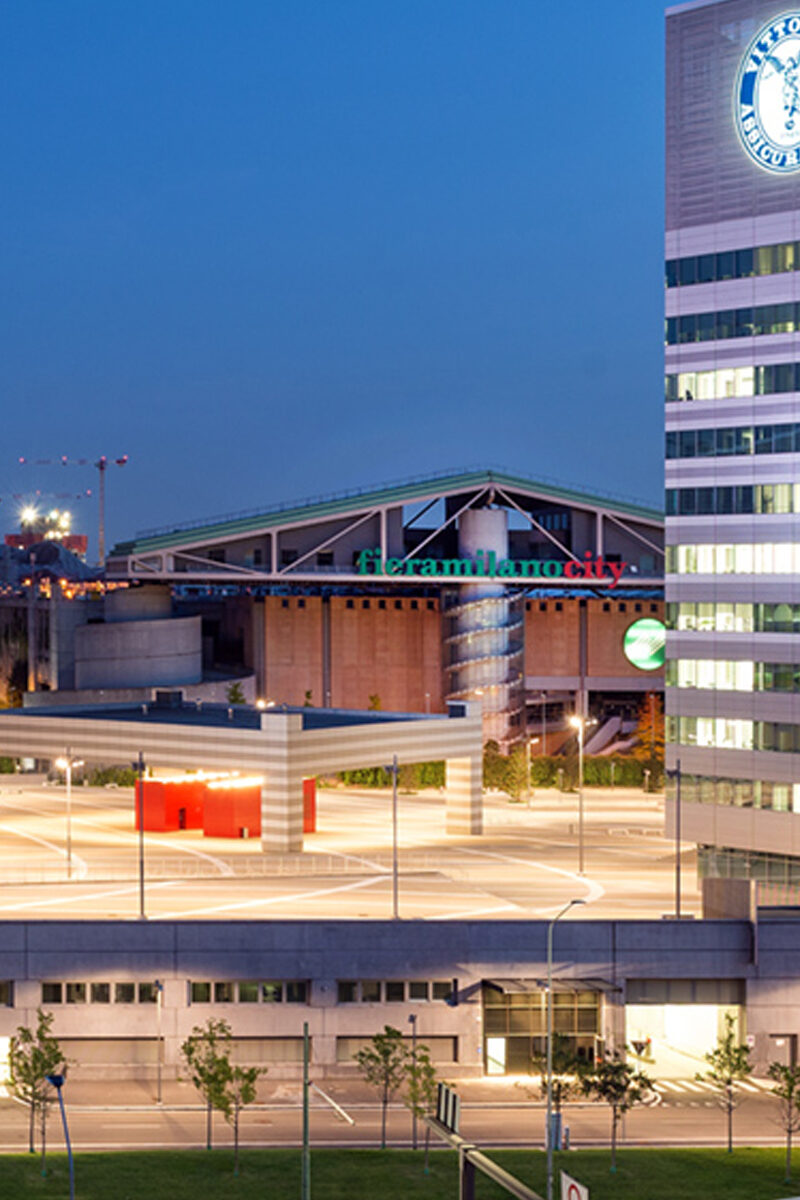

The image clearly conveys the urban outcome of the Portello redevelopment: a new system of office buildings and public spaces that, in the night reading, highlights the transformation of the area from a production enclave to a contemporary centrality. The composition is marked by clear architectural volumes, glazed facades and opaque surfaces with horizontal bands, while the large square and the relationship paths take on a primary role thanks to controlled lighting, capable of guaranteeing legibility, orientation and spatial continuity. In this framework, light is not limited to "illuminating" objects, but builds a unitary perceptual field that makes the space fluid, reconnecting crossings, heights and built fronts in a single urban design.
Collaboration with Gae Aulenti: Design Experiences between Architecture and Heritage
From Perugia Airport to the historic buildings of Palermo, an itinerary through architecture, light, and memory.
Between 2006 and 2012 a design season began marked by the comparison with the projects of Gae Aulenti, a central figure in Italian and international architecture, within interventions in which light takes on a structural role in the delicate balance between historical memory and contemporary transformation. After the initial experience on the lighting of the interiors of the San Francesco d'Assisi Airport in Perugia, the comparison deepens in the project of Palazzo Branciforte in Palermo, one of the most significant interventions of cultural refunctionalization of the last period. Here, the library becomes the fulcrum of a reflection on the space of knowledge: a place where light must guarantee functional precision, but also restore architectural dignity and visual silence to a building full of historical stratifications.
With Gae Aulenti, light becomes a factor of synthesis, never invasive, capable of dialoguing with architecture without overlapping it. This approach finds continuity in the subsequent interventions developed with Gae Aulenti Associati, from the Tilane Municipal Library in Paderno Dugnano, where lighting accompanies the urban transformation and public use of the cultural space, up to Palazzo Vetus in Alessandria, the oldest historic building in the city, for which the themes of façade lighting and façade lighting are addressed in a unified way. interiors. In this cycle of projects, Marco Petrucci consolidates a method that combines lighting discipline, respect for heritage and perceptive clarity, developing an approach that recognizes in the lesson of Gae Aulenti – sober, cultured and profoundly architectural – a decisive reference in the construction of its design identity.
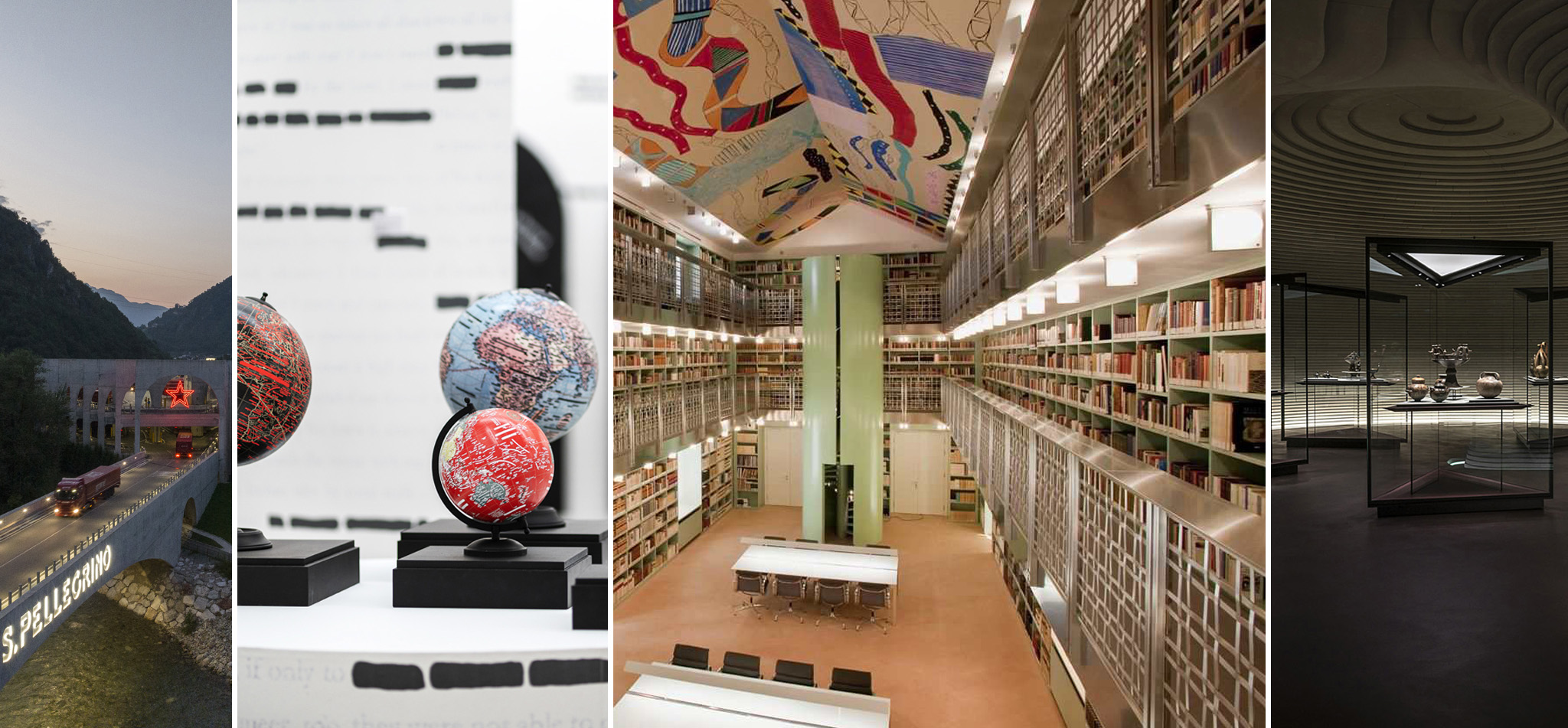
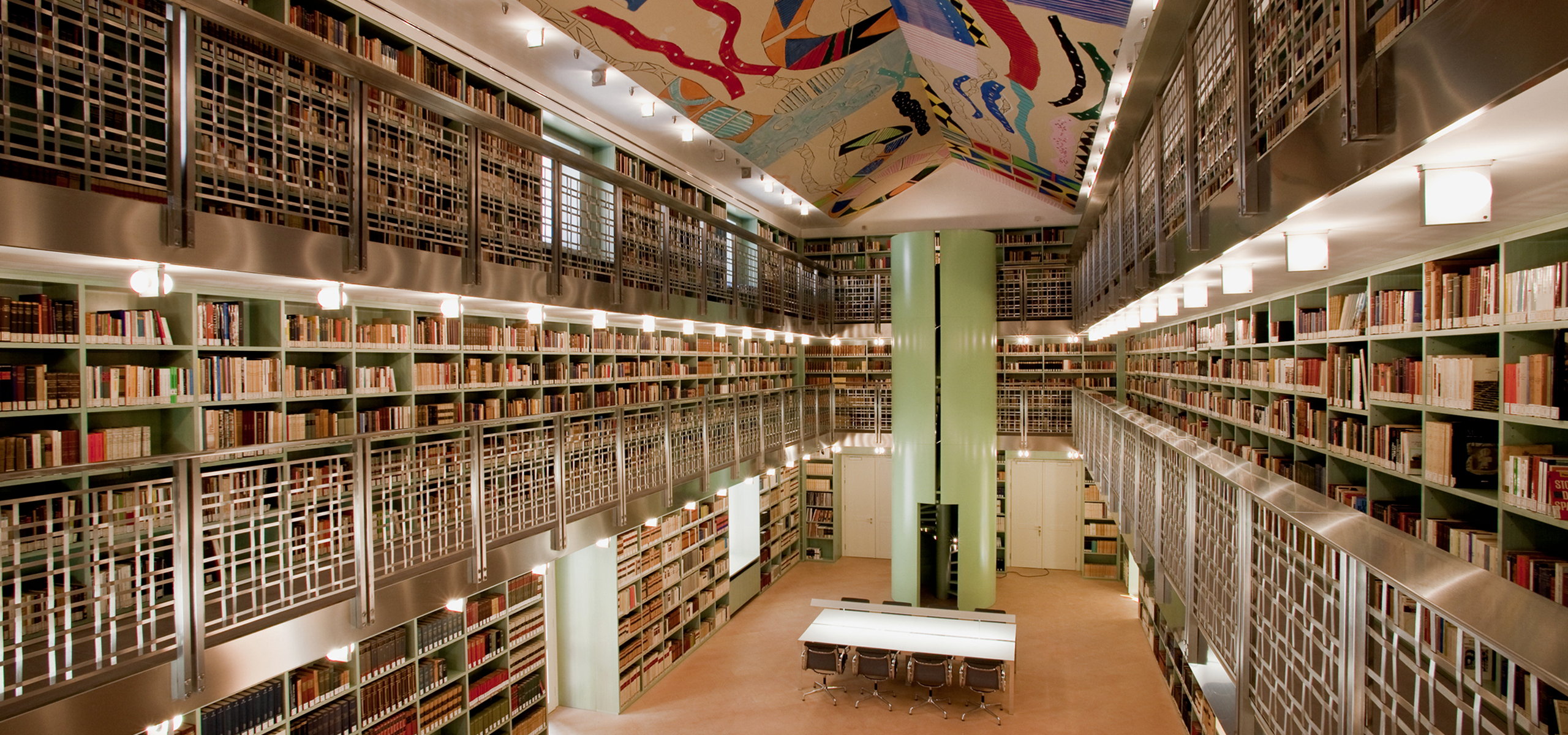
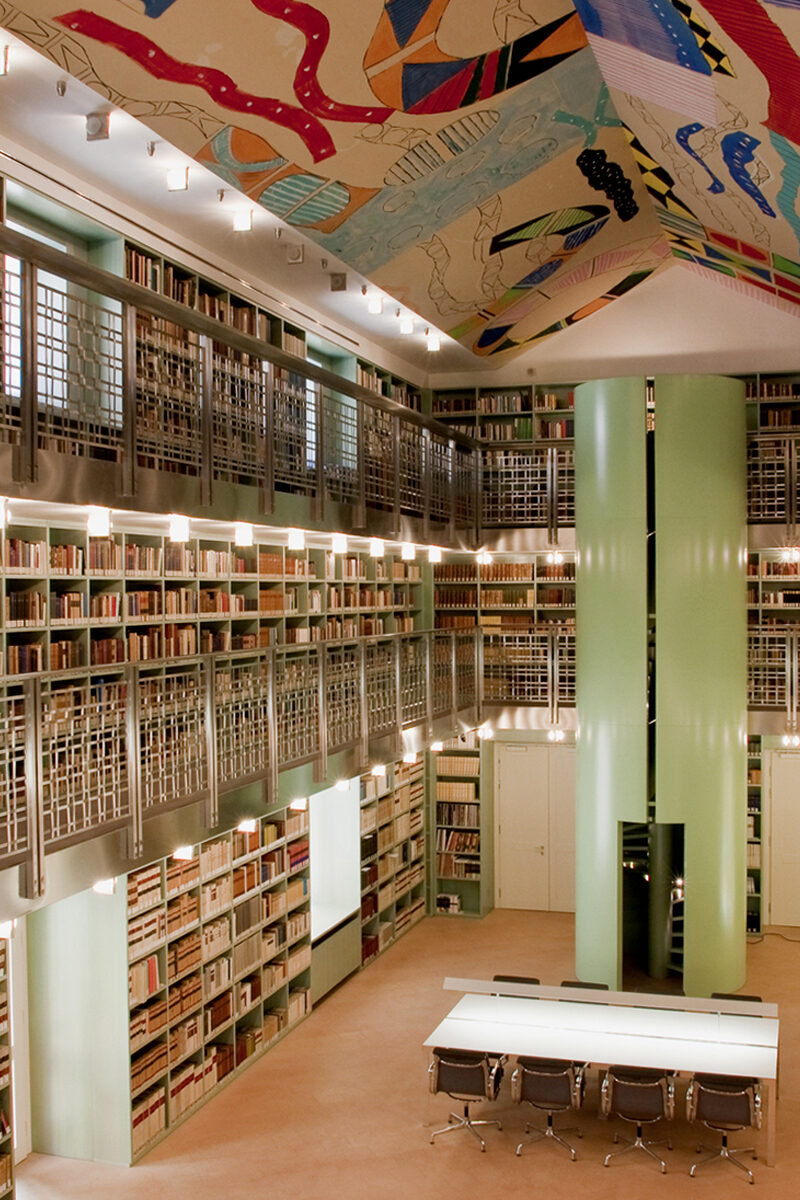
The image of the library of Palazzo Branciforte immediately restores the design figure of the intervention: a monumental, rigorously ordered space, in which architecture, furniture and light contribute to the construction of a study and conservation environment with a strong contemporary identity. The large vertical metal shelving units define a deep and rhythmic spatial section, while the artificial light is distributed in a regular and non-hierarchical way, ensuring a homogeneous reading of the spines of the volumes and constant visual comfort on the consultation surfaces. The lighting does not seek iconic effects, but works by measure, accompanying the gaze along the heights and making the real scale of the space perceptible without introducing unnecessary contrasts. The decorated surface of the ceiling emerges as a cultural and symbolic element, enhanced by a calibrated balance between direct light and controlled reflections.
Meeting Ricardo Bofill: Lighting Design for Barcelona's El Prat Airport
An international experience between light, architecture and design minimalism
Between 2007 and 2009, Marco participated in the lighting design project of the new Barcelona terminal, signed by the Catalan architect Ricardo Bofill, dealing with one of the most important European airport infrastructures. Bofill's project is based on principles declared with extreme lucidity by the architect himself: clarity, few materials, minimalism and simplicity, as tools to blend functionality and aesthetics, excluding any superfluous element. In this conceptual framework, light becomes a structural element of the architectural language, called upon to support the spatial order without ever overlapping the form.

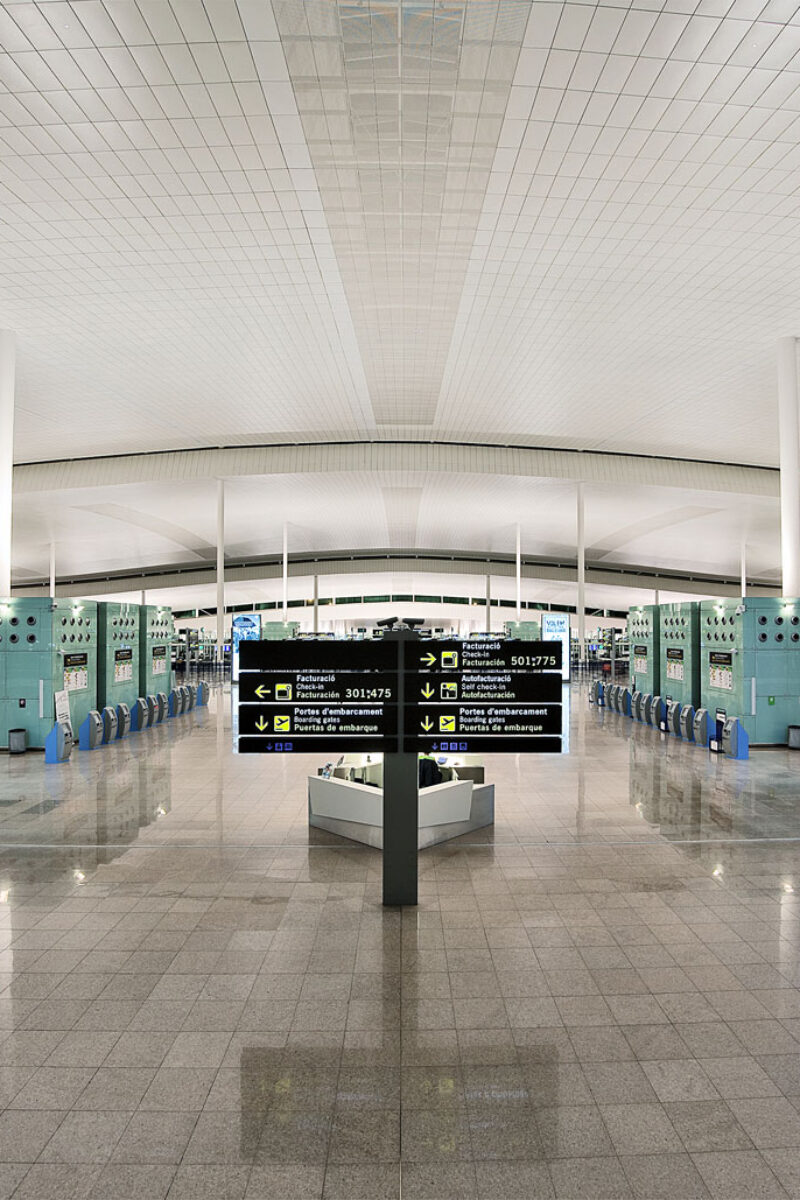
The airport project is a decisive moment in the approach to the infrastructural scale, reinforcing a reading of architecture as an articulated system of flows, temporalities and perceptions. The lighting of Terminal 1 is not conceived as the sum of local solutions, but as a unitary system, capable of guaranteeing light homogeneity, reduction of contrasts and perceptual continuity along extremely extended paths. The experience of El Prat consolidates Marco Petrucci's awareness that, in architectures of this scale, the quality of light is inseparable from the quality of the experience: intuitive orientation, absence of glare, prolonged visual comfort and immediate legibility become primary design parameters.
The opening of Terminal 1 marks a strategic moment for the city of Barcelona, strengthening its role among the main European airport hubs, but it also represents, for Marco Petrucci, an opportunity for fundamental methodological growth. The comparison with Ricardo Bofill's rigorous and anti-rhetorical vision helps to strengthen an approach to light based on discipline, measure and control, in which lighting design does not seek protagonism, but works silently to make architecture clear, legible and durable over time.
The image of Terminal 1 of Barcelona – El Prat Airport immediately conveys the spatial strength of the architecture: a large continuous hall, punctuated by a regular structure and an extended roof that seems to float above the ground. Artificial light makes a decisive contribution to this perception of clarity and continuity, distributing itself evenly and diffusely, without creating points of visual tension or arbitrary hierarchies. Reflective surfaces on the floor amplify the feeling of openness, while signage and information devices emerge with functional precision, readable from a great distance. In this context, the lighting is neither spectacular nor iconic, but builds a stable field of vision, which is essential for orientation, safety and comfort for millions of passengers.
Pierluigi Ghianda: Dialogue between Form, Light, and Material Memory
From private projects to museums: illuminating Pierluigi Ghianda's artisanal excellence
In 2010 the master cabinetmaker Pierluigi Ghianda marks a passage of particular cultural density in the path of growth. The first project was born in the private sector, with the lighting of a bookcase custom-made for a Milanese home, an occasion in which light is called upon to dialogue with the millimetric precision of the artisan gesture. Here, lighting does not have a decorative function, but becomes a tool for visual verification, capable of faithfully restoring the quality of the material, the depth of the joints and the coherence of the whole.
This relationship was consolidated in 2013 with the lighting project of the Ghianda exhibition at the Triennale di Milano, developed in collaboration with Pierluigi Ghianda and Studiolabo. The exhibition is built as a path of progressive revelation of craftsmanship: from the most elementary joints to those of maximum complexity, such as the famous Kyoto table, a work-manifesto also exhibited at the MoMA in New York, composed of 1705 joints and a weave of 1600 square holes. In this context, light takes on a critical role: it not only illuminates, but measures, makes visible the time of work, the structural logic, the tension between full and empty.
The lighting design is based on a rigorous balance between diffused light and punctual accents, avoiding glare and parasitic reflections, to allow the eye to linger on the micro-variations of the wooden surface. The shadows are not eliminated, but integrated as part of the story, becoming a tool for understanding three-dimensionality and constructive depth. In this experience, Marco Petrucci consolidates a design sensibility that recognizes light not as an autonomous means of expression, but as a cognitive device, capable of making the intelligence of matter visible. The discussion with Pierluigi Ghianda thus reinforces an idea of lighting design based on respect, precision and listening, where light is put at the service of the work and the memory of the artisan gesture.

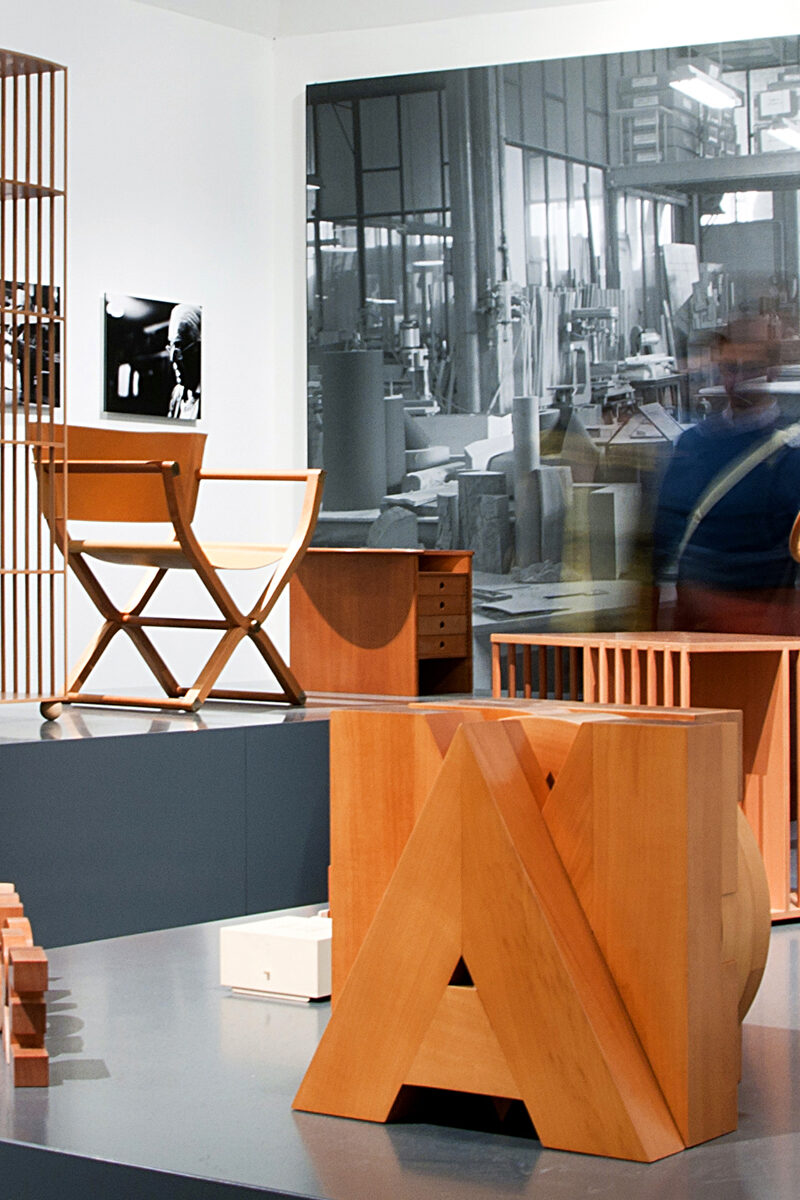
The image of the exhibition dedicated to Pierluigi Ghianda at the Triennale di Milano returns an exhibition space of great rigor and concentration, in which wood becomes absolute material and light acts as a silent and precise reading tool. The objects on display – seats, tables, bookcases, self-supporting structures – are arranged on continuous and neutral planes, which isolate the shapes and make their construction complexity immediately perceptible. The light is calibrated to never overwhelm the object, but to accompany its understanding: smooth wooden surfaces, sharp edges, curves and above all joints emerge through a controlled play of subtle shadows and luminous gradients, which make the craftsmanship legible without transforming it into a spectacle.
Illuminating History: A Lighting Design Project for the Imperial Forums in Rome
An intervention in the heart of the UNESCO heritage, in dialogue with the Capitoline Superintendency
Between 2010 and 2012, the lighting design of one of the most important archaeological contexts in the world, recognized as a UNESCO World Heritage Site: the Imperial Forums in Rome. The intervention develops in the heart of the historic city, along the axis between Piazza Venezia and the Colosseum, in continuity with the Roman Forum, addressing an urban and archaeological system of exceptional complexity. The project is directly confronted with the Capitoline Superintendence of Cultural Heritage, in a constant dialogue between the needs of protection, conservation and perceptive enhancement.
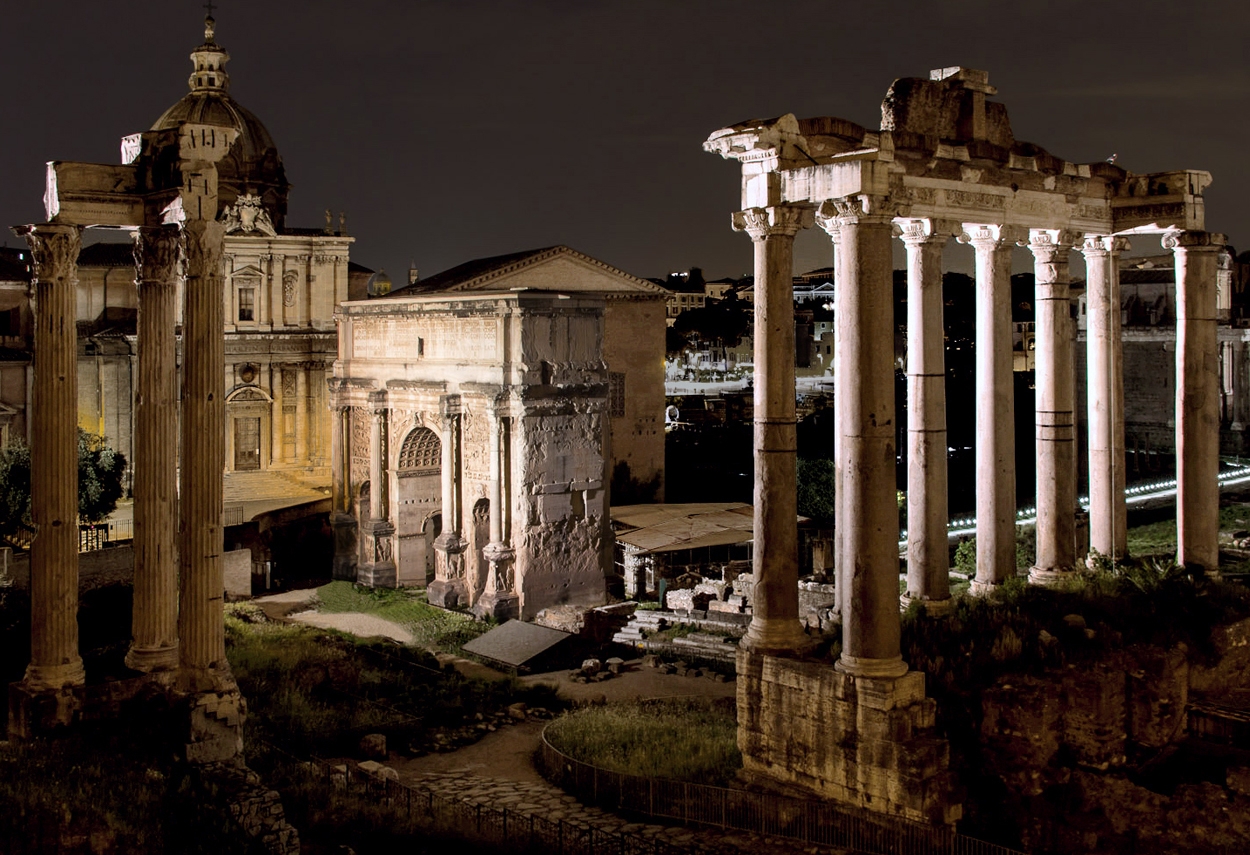
The illuminated path accompanies the visitor along a precise and highly symbolic spatial sequence: from the entrance at Trajan' s Column, through the remains of the imperial forums, to the exit from the Forum of Caesar in Via Bonella (Via dei Fori Imperiali). In this context, light does not have the task of "reconstructing" what no longer exists, but of making intelligible what remains, respecting the fragmentary and unfinished character of archaeology. The surfaces are illuminated with limited intensity, avoiding excessive contrasts, to preserve the nocturnal perception of the site and the relationship with the surrounding urban landscape.
This experience represents for Marco Petrucci a central step in the maturation of an approach to light applied to the historical-monumental heritage, based on principles of reversibility, non-invasiveness and rigorous control. The lighting of the Imperial Forums consolidates a vision in which light acts as a critical tool, capable of restoring dignity and legibility to one of the most emblematic places of collective memory, without altering its silence, scale and historical depth.
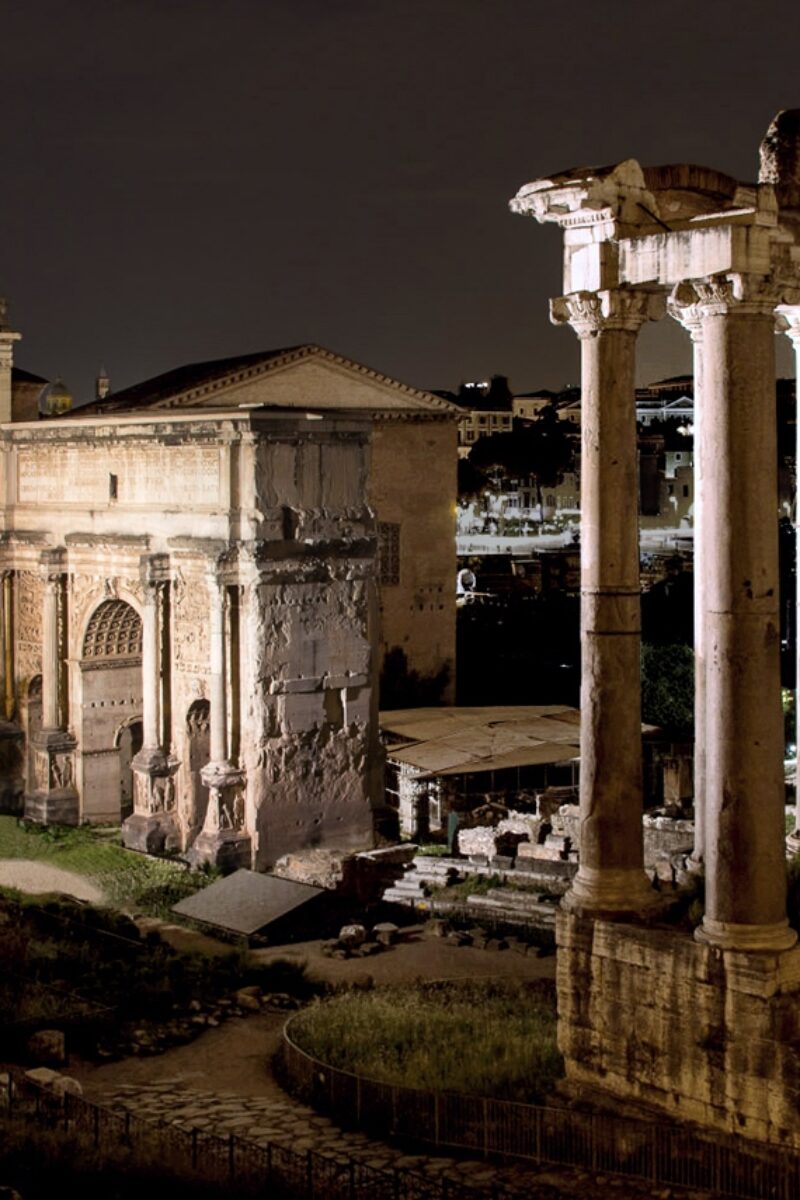
The nocturnal image of the Imperial Forums in Rome returns a vision of extraordinary historical and spatial density, in which light becomes an instrument of measurement, respect and revelation. The archaeological volumes emerge from the darkness with a silent presence: the columns, the wall fronts and the stone surfaces are not uniformly "washed", but modeled through controlled luminous gradients, which make their stratification, material discontinuities and the passage of time legible. The luminous scene avoids any spectacular or scenographic effect: the light is calibrated to accompany the gaze, restoring depth, orientation and perceptive hierarchy, without ever overlapping the symbolic and monumental value of the site.
Lighting and Spirituality in Türkiye: With Emre Arolat at the Sancaklar Mosque in Istanbul
Between Istanbul, Bodrum, and Antakya: a journey of light through identity, matter, and landscape
Between 2011 and 2013, the lighting design of the Sancaklar Mosque, designed by architect Emre Arolat, one of the most important figures in international contemporary architecture. The project is based on a constant and controlled tension between natural light and artificial light, where the latter never competes with the former, but prolongs and supports its meaning at night. Electric light thus becomes a device of perceptual continuity, capable of preserving the introverted and contemplative character of the architecture even in the absence of daylight.
The architecture of the Sancaklar Mosque rejects any traditional religious iconography, entrusting matter, section and light with the task of constructing the sense of sacred space. In this context, lighting design is not an added element, but an integral part of the architectural project, developed in strict coherence with the geometry, scale and symbolic meaning of the place. The grazing light on the stone walls, the discreet underlining of the paths and the rigorous control of the luminances contribute to creating an environment in which the sacred emerges by subtraction, not by accumulation.
The value of this work is internationally recognized: in 2015 the Sancaklar Mosque received the award from ArchDaily as the Best Religious Building of the Year and was included among the 40 best buildings selected by the Mies van der Rohe Award. At the same time, in the same period (2011–2013), Marco Petrucci collaborated with the Istanbul studio on the Bodrum Vicem project, a luxury compound in Bodrum, while between 2014 and 2019 he developed the lighting project for the Museum Hotel in Antakya, a unique complex in which a contemporary hotel is integrated with a public museum of restored archaeological finds. In this span of works, the dialogue with Emre Arolat consolidates a vision of light as a cultural and narrative tool, capable of relating contemporary architecture, historical memory and the spiritual dimension, always maintaining a rigorous balance between technique, perception and meaning.
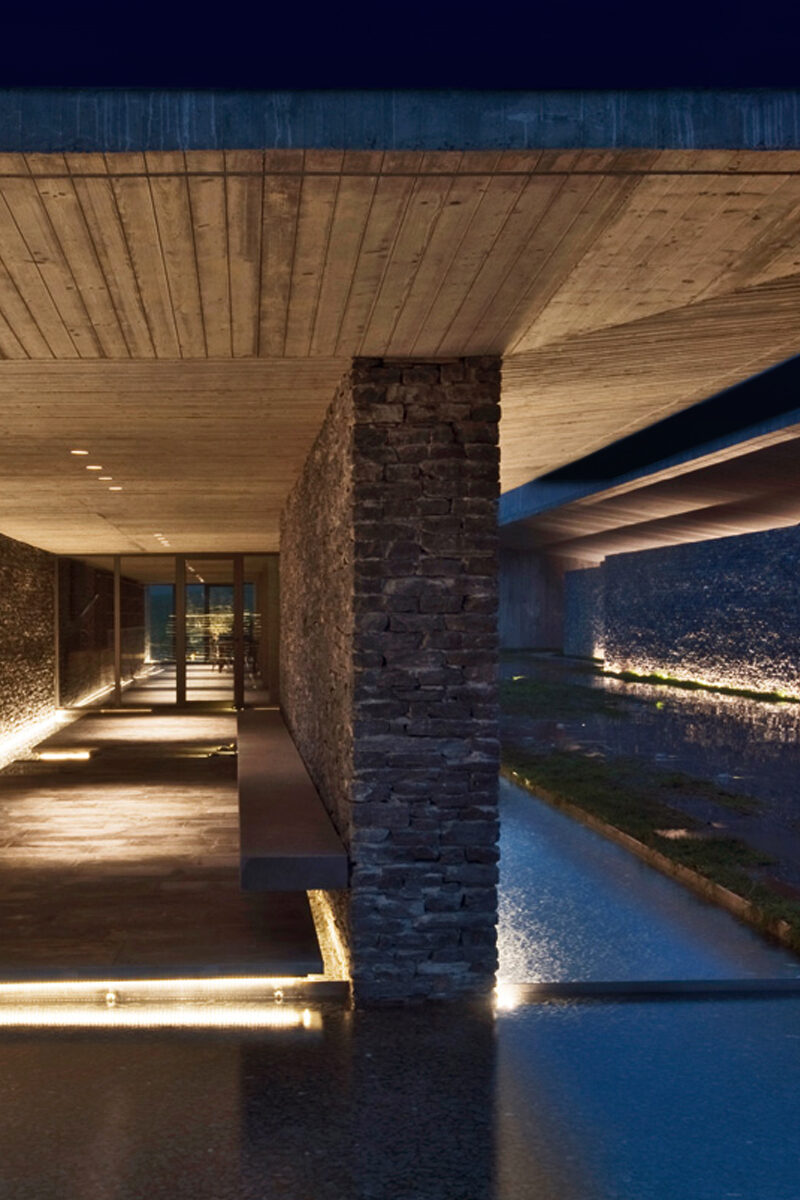

The image of the Sancaklar Mosque in Istanbul conveys a space of rare perceptive intensity, in which architecture, matter and light are inseparable. The path is carved into the earth, defined by rough stone walls, horizontal concrete surfaces and bodies of water that amplify the spatial depth. Artificial light is reduced to the essentials: integrated, grazing and continuous lines of light accompany the journey without ever declaring themselves as technical objects. The result is an environment in which light does not "illuminate" in the conventional sense, but slowly reveals the space, dialoguing with the darkness and letting perception be built by progressive adaptation. The absence of glare and violent contrasts favors a condition of recollection, in which time seems to dilate and the material emerges with an almost archetypal force.
With Renzo Piano at the MUSE: Illuminating Transparency between Architecture and Sustainability
A LEED Gold-certified museum project in the heart of the Le Albere district
Between 2011 and 2013, in the context of the masterplan of the Quartiere delle Albere in Trento, Marco Petrucci participated in the lighting project of the MUSE – Science Museum, the work of Studio Renzo Piano Building Workshop, dealing directly with the themes of museum lighting technology. Renzo Piano's architecture, based on openness, lightness and dialogue with the natural context, requires a light capable of interacting with the daytime supply, accompanying its variations and integrating without overlapping, supporting the perceptive continuity between space, architecture and landscape.
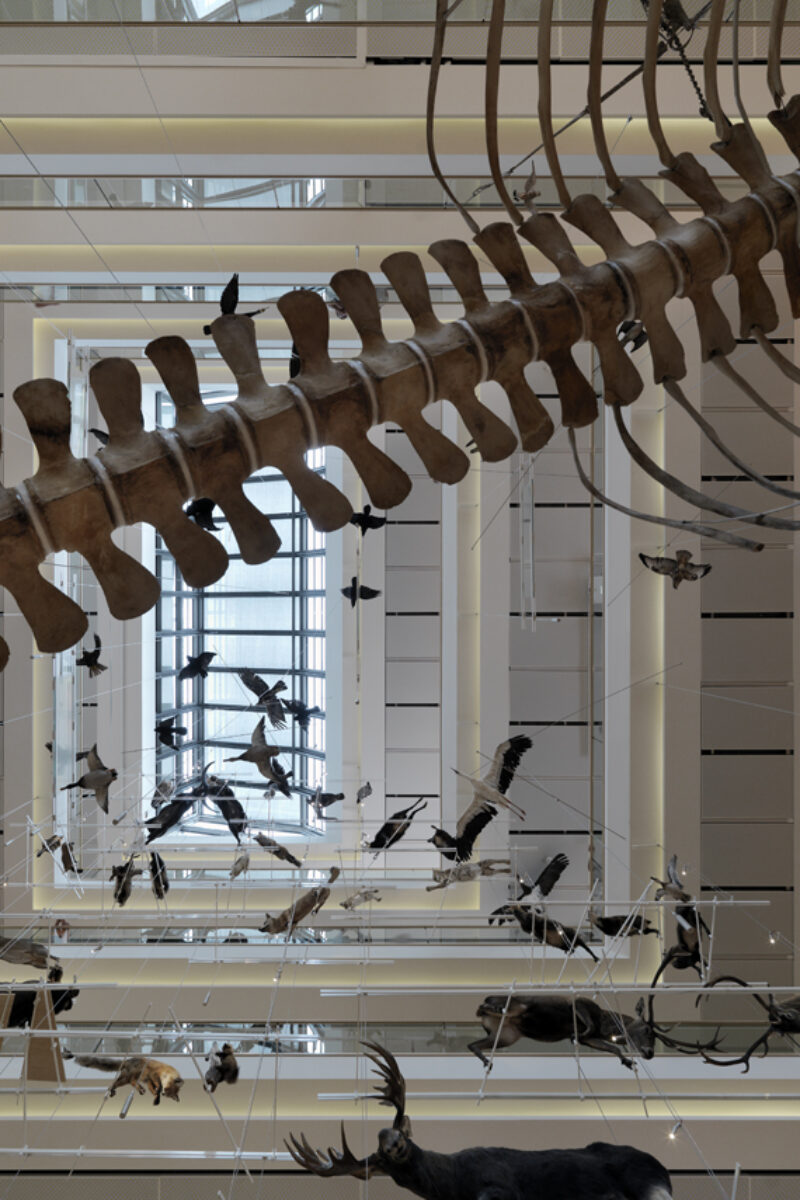
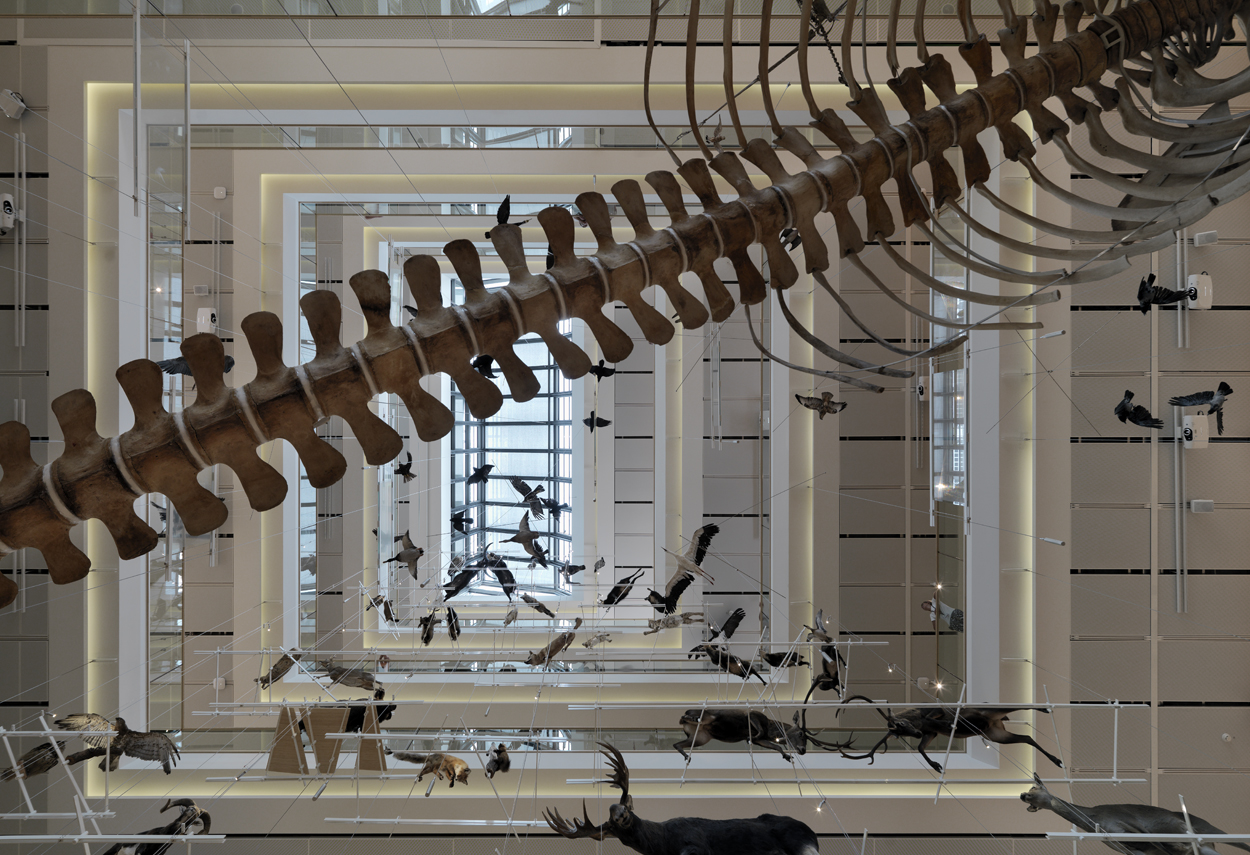
The comparison with Renzo Piano's studio plays a leading formative and methodological role. In the MUSE, artificial light is not called upon to create iconic effects, but to support an idea of the museum as a transparent, accessible and educational public space, in which the visitor's experience is constructed through perceptual gradualities and visual clarity. The lighting of the exhibition spaces, vertical paths and common areas is developed with particular attention to visual comfort, color rendering and flexibility, fundamental elements in a constantly evolving scientific museum.
The project is also part of a vision strongly oriented towards sustainability, a central theme in Renzo Piano's research and shared in the lighting work. The controlled use of artificial light, the integration with the contribution of natural light and the selection of high-efficiency solutions contribute to the achievement of LEED Gold certification, a recognition that attests to the overall environmental quality of the intervention. In this context, Marco Petrucci consolidates an approach to museum light as a silent infrastructure, capable of supporting architecture and scientific content without ever imposing itself, reinforcing a design vision in which technique, sustainability and perception are part of a single coherent system.
The image of the MUSE – Science Museum of Trento conveys an architecture strongly characterized by the theme of transparency and visual continuity with the external environment, in which the building stands as an open device between the Alpine landscape, urban space and scientific content. The large glass surfaces, the articulated roofs and the complex section build an architectural organism permeable to natural light, in which artificial lighting intervenes with measure and discretion, prolonging the legibility of the space in the evening hours without altering its balance. Light accompanies the internal paths, defines the vertical stratifications of the museum and guarantees a clear and comfortable use of the exhibition spaces, avoiding excessive contrasts and favoring a continuous and fluid perception.
Aman Venice: Lighting Design at Palazzo Papadopoli with Jean-Michel Gathy
Lighting Design amidst Tiepolo frescoes, patrician architecture, and seven-star hospitality on the Grand Canal
Between 2011 and 2014, the lighting design of Aman Venice, inside Palazzo Papadopoli, a sixteenth-century patrician building overlooking the Grand Canal, a few steps from the Rialto Bridge, embellished in the eighteenth century by frescoes by Giambattista Tiepolo. The project is developed in collaboration with the Denniston studio, founded by architect Jean-Michel Gathy, an absolute reference figure in the international panorama of high-end hospitality. The transformation of the building into a "seven-star" level hotel – with 24 suites all different in architecture and furnishings, spa, lounges and representative spaces – requires an extremely cultured and measured approach to light, capable of combining heritage protection, contemporary comfort and the identity of the place.
The design dialogue with the Denniston studio contributes decisively to the construction of the identity of the project. The vision, based on discreet luxury and the sensory experience of space, finds a decisive tool in light: lighting is designed as an invisible infrastructure, integrated into the architectural elements and furnishings, to avoid any visual intrusion. In the suites and historic halls, light accompanies the interpretation of the frescoed surfaces and boiserie, modulating intensity and color temperatures to ensure perceptive balance and legibility of the space, respect for materials and a consistent atmosphere at different times of the day and night.
For Marco Petrucci, this project represents a moment of synthesis between lighting design, interior design and conservation. The comparison with Gathy consolidates a method in which light becomes a narrative and emotional tool, capable of supporting the guest's experience without ever taking on a leading role. Aman Venice thus establishes itself as an emblematic example of how lighting, when guided by rigor and sensitivity, can transform a historic building into a place of contemporary hospitality, preserving its cultural depth and symbolic value intact.

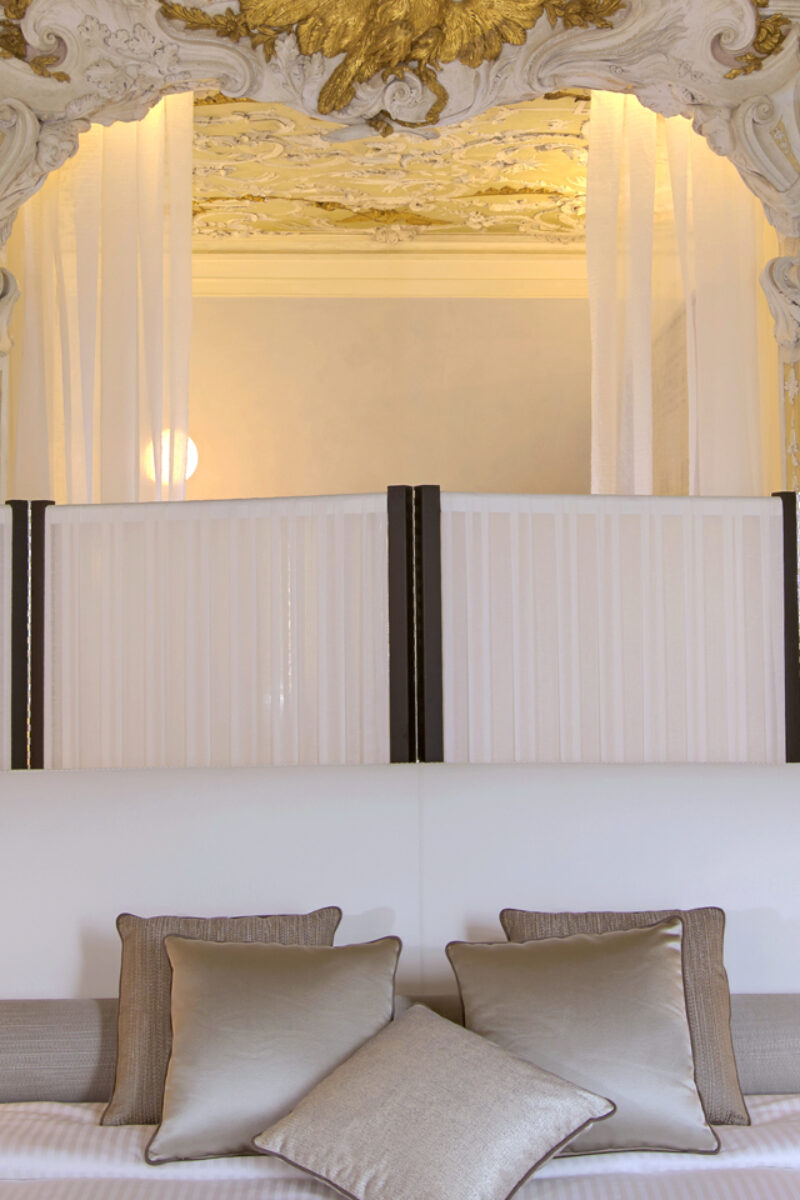
The image of Aman Venice at Palazzo Papadopoli conveys an interior of extraordinary refinement, in which light builds a subtle balance between historical memory and contemporary habitability. The decorated surfaces, the eighteenth-century stuccoes and gilding dialogue with essential furnishings and neutral fabrics, while the lighting acts by stratification: hot springs and screens define a cozy atmosphere, without ever competing with the material richness of the architecture. The light does not invade the space, but caresses it, enhancing the volumes, controlling the reflections on the golds and preserving an intimate and silent perception, consistent with the idea of non-ostentatious luxury that characterizes the Aman brand.
Lighting Masterplan for EXPO Milan 2015: Light as a Design Language
A scenographic approach to urban lighting between planning, art and landscape
Between 2011 and 2015, the definition of the Lighting Masterplan of the Universal Exposition in Milan, tackling one of the most complex urban and scenographic lighting projects of recent decades. In this context, light is conceived not as a simple response to visual tasks, but as a design language, capable of structuring space, hierarchizing paths and building a collective experience consistent with the themes of the event. The masterplan defines criteria, intensity, chromatism and logic of integration between architecture, open spaces and temporary installations, guaranteeing perceptive unity despite the multiplicity of pavilions and national identities.

The project "Itineraries of light EXPO 2015", a site-specific installation created in Bergamo on the occasion of the Exhibition, is also part of this strategic framework . The so-called "balls of light", different in size and chromaticism, are placed directly on the turf, in an apparent random arrangement, to form a luminous sculptural aggregate. Here light becomes plastic and narrative material: an element that invites pause, movement and relationship, transforming an open space into an experiential place. This project effectively summarizes Marco Petrucci's approach to urban and temporary lighting design: a light capable of orienting, telling and generating meaning, always maintaining a balance between technical control, expressive freedom and perceptive quality.
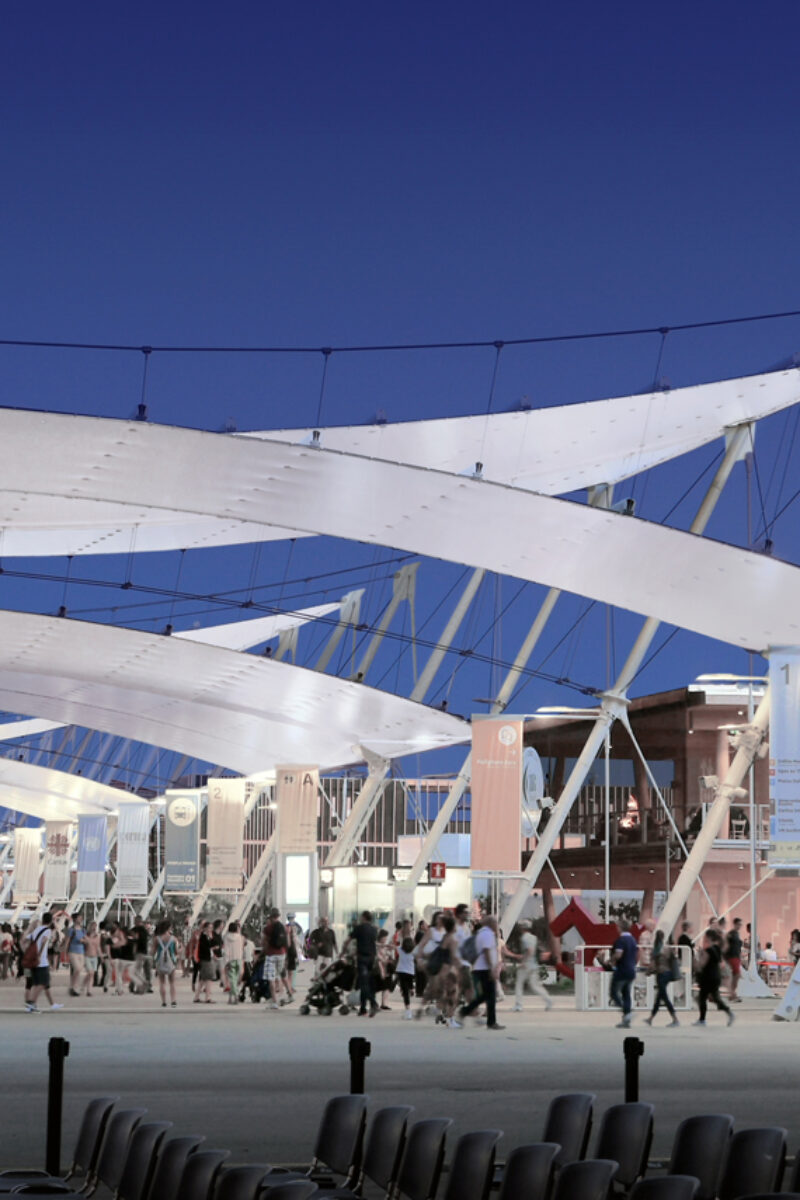
The image clearly conveys the evening atmosphere of EXPO Milano 2015, in which temporary architecture and large light structures become the support of a unitary lighting system, recognizable and legible on an urban scale. The textile covers, suspended and rhythmic, are crossed by a diffused and homogeneous light that defines the paths, accompanies the flows of visitors and builds a perception of spatial continuity. Light is not limited to ensuring visibility and safety, but helps to create an artificial nocturnal landscape, capable of orienting, welcoming and generating identity, transforming the exhibition area into a real temporary city.
With FAI for the Viboldone Abbey: A Project of Light between History, Spirituality and Conservation
La Luce sulla Pietra e sugli Affreschi: L'Abbazia di Viboldone come Luogo del Sacro e della Visione
Between 2013 and 2017, the lighting project of the Abbey of Saints Peter and Paul in Viboldone, in San Giuliano Milanese, a monastic complex dating back to 1176 and well protected by the FAI – Fondo Ambiente Italiano. The intervention is located in a context of very high historical and symbolic value, which includes the frescoed church and the Prior's House, now partly used as a guest house. The project requires an extremely measured approach, based on criteria of protection and reversibility of the intervention, in constant dialogue with the institutions responsible for conservation.
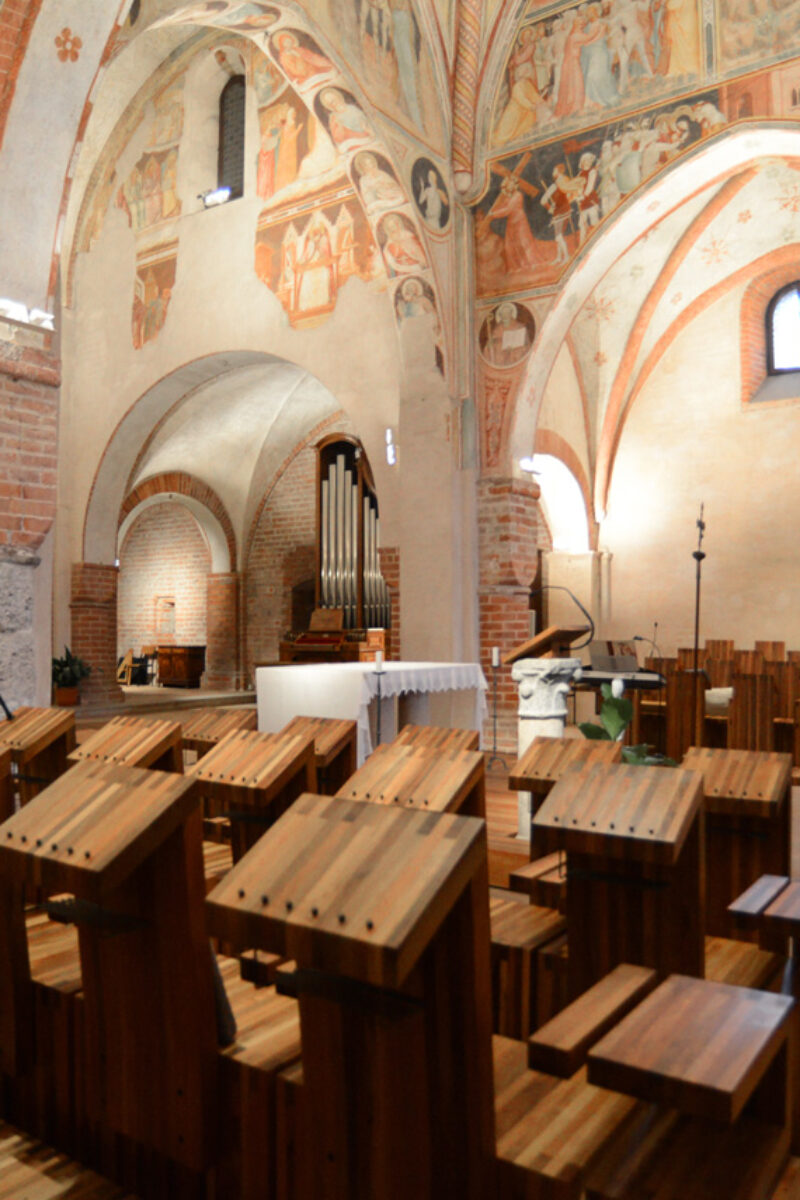
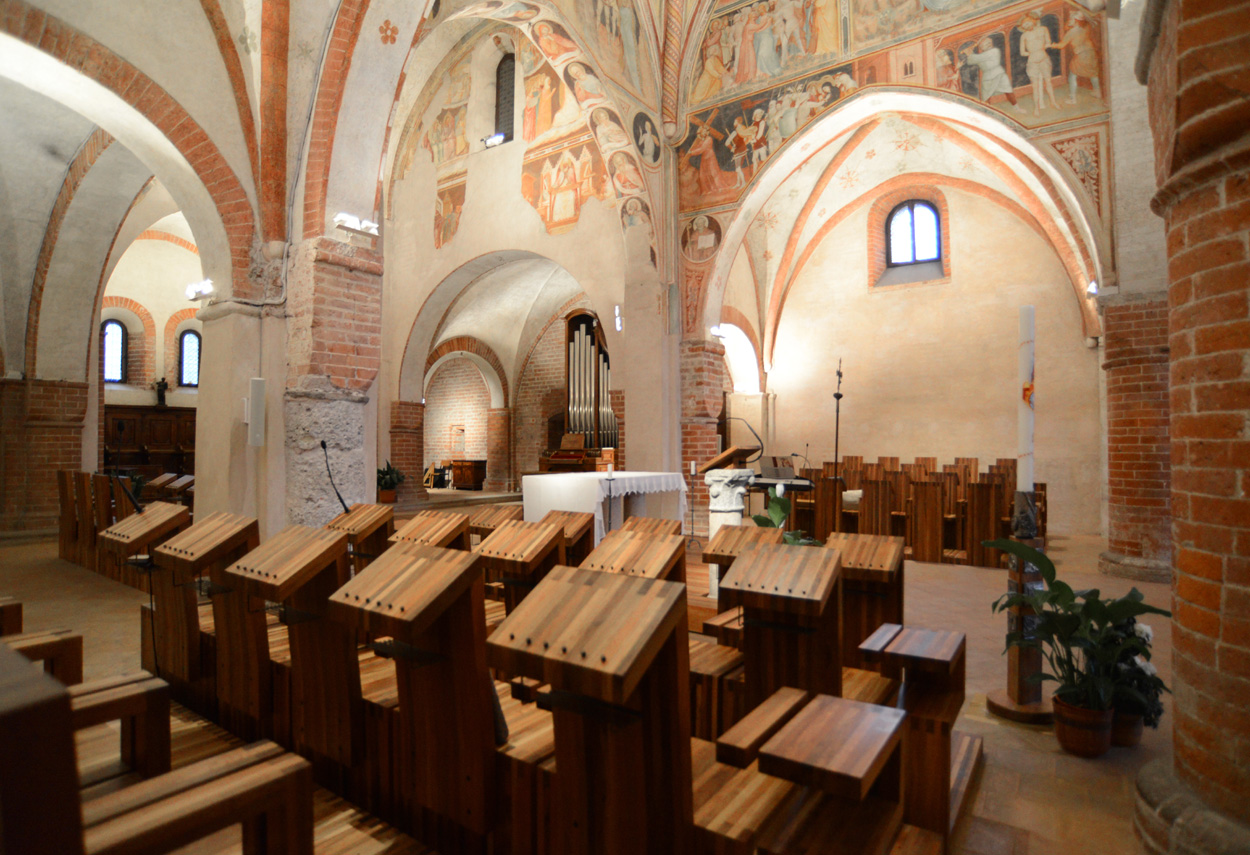
Within this framework, the comparison with Mario Botta, author of the liturgical arrangement, takes on a central role. The relationship with the Ticino architect represents a passage of great cultural importance: Botta's installation introduces new contemporary elements – seats, liturgical furnishings, ambo – conceived as measured presences, capable of dialoguing with the historic architecture without camouflage or rupture. In this delicate balance, light becomes an instrument of mediation between ancient and contemporary, called upon to support the spatial order of Botta's intervention and, at the same time, to respect the historical stratification of the abbey.
The lighting design works in layers of light, favoring soft, shielded and grazing emissions, capable of enhancing the texture of the walls, the color of the frescoes and the geometry of the installation. Shadows are not eliminated, but integrated as part of the language of sacred space, helping to preserve a dimension of silence and recollection. The dialogue with Mario Botta reinforces in Marco Petrucci a vision of light as a primary, non-decorative architectural element, capable of accompanying the liturgy, contemplation and historical reading of the place. The intervention in Viboldone is thus configured as an emblematic example of collaboration between lighting design, contemporary architecture and heritage conservation, in which light becomes an act of respect and a tool for cultural continuity.
The image of the Abbey of Viboldone restores a sacred space of extraordinary coherence, in which medieval architecture, wall painting and light combine to build an environment of strong spiritual intensity. The vaults, arches and brick pillars mark a cozy interior, entirely surrounded by fourteenth-century frescoes of the Giottian school, which cover the surfaces with a continuous narration. The artificial light is discreet, calibrated and deeply respectful: it does not impose a forced reading, but accompanies the gaze, allowing the frescoes to emerge gradually, without erasing the natural half-light that characterizes the place of worship.
Lighting Design per la Sede ENI di San Donato: Con Thom Mayne e Morphosis Architects
Illuminare l’Innovazione: Sede ENI a San Donato tra Architettura Integrata e Spazio Pubblico
In 2014, the theme of office lighting for the ENI Headquarters in San Donato, a project by Morphosis Architects, founded by Thom Mayne, a leading figure in international contemporary architecture and winner of the Pritzker Prize. Morphosis' architecture is characterized by a strong tension between form, structure and function, with dynamic volumes, technologically advanced envelopes and a conception of space as a complex and interconnected system. In this scenario, lighting design is called upon to deal with an architecture with a high conceptual density, in which light must support the legibility of the building organism without simplifying its complexity.
The collaboration with Morphosis Architects is configured as a direct experience of highly integrated architecture, in which structure, systems, envelope and light work together in the definition of the project. The lighting of the workspaces is developed with particular attention to the visual condition and prolonged use of the spaces, functional flexibility and the relationship with natural light, a central element in contemporary office buildings. The central square, understood as a space of relationship and crossing, becomes a perceptive node in which light helps to define hierarchies, depth and continuity between inside and outside.
Within the design team, SCE Project is involved in integrated design, ensuring coordination between disciplines and consistency between lighting, plant and architectural solutions. In this collaborative context, Marco Petrucci consolidates an approach to light as an invisible but strategic infrastructure, capable of improving the quality of the work environments, supporting the overall sustainability of the complex and enhancing the architectural identity of the project. The experience of the ENI Headquarters thus reinforces a vision of lighting design applied to executive spaces as a tool for balancing technological innovation, user well-being and the expressive power of contemporary architecture.
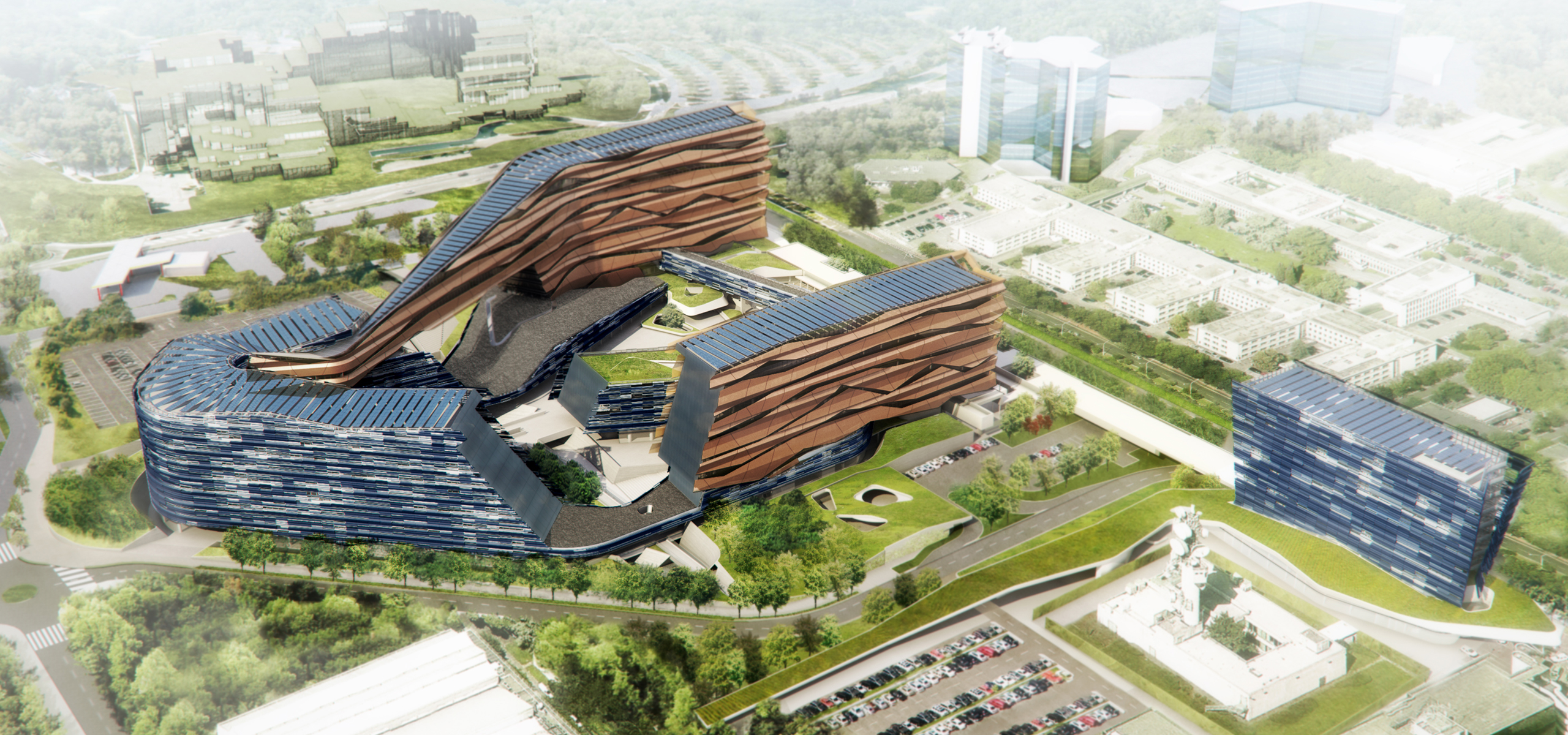
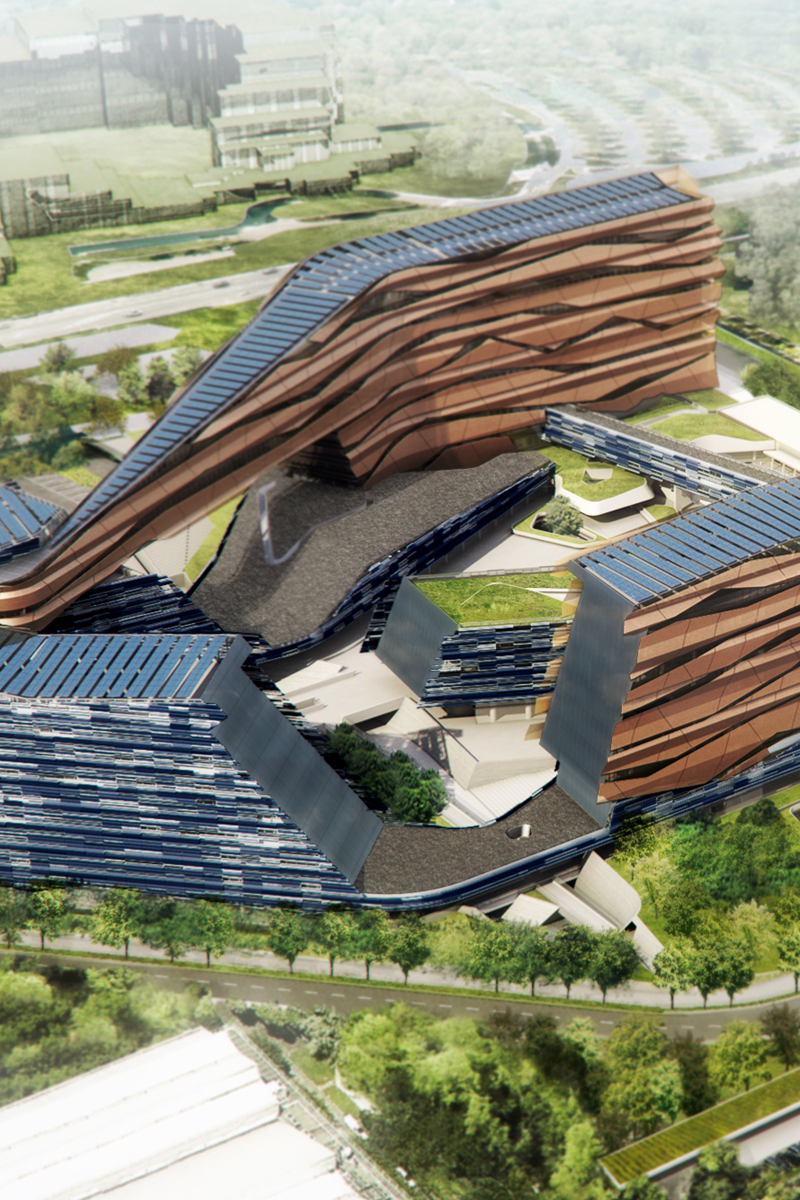
The image of the ENI Headquarters in San Donato Milanese clearly conveys the iconic and systemic strength of the project: an articulated complex of fluid volumes, developed horizontally and connected to each other, which are organized around a large central void, the square, the true symbolic and spatial heart of the intervention. The three office towers do not impose themselves as isolated objects, but dialogue with each other and with the surrounding green landscape, building a continuous relationship between architecture, public space and urban infrastructure. In this context, light plays a decisive role in making the formal complexity of the whole legible and in ensuring comfort, orientation and perceptive quality to the workspaces.
Lighting for Emilio Isgrò: A Dialogue Between Art, Architecture, and Visual Narration
Museum projects between Milan and Venice, with Marco Bazzini and Germano Celant
Starting in 2016, Marco Petrucci tackles the theme of museum lighting for a major anthological exhibition dedicated to Emilio Isgrò, divided into several Milanese venues of absolute importance – Palazzo Reale, Gallerie d'Italia in Piazza Scala and Casa del Manzoni – confronting the curator Marco Bazzini. This first cycle of projects marks the beginning of a profound dialogue with the work of one of the most important contemporary Italian artists, in which light is called upon to confront a language based on erasure, on the denied word and on emptiness as a critical device.
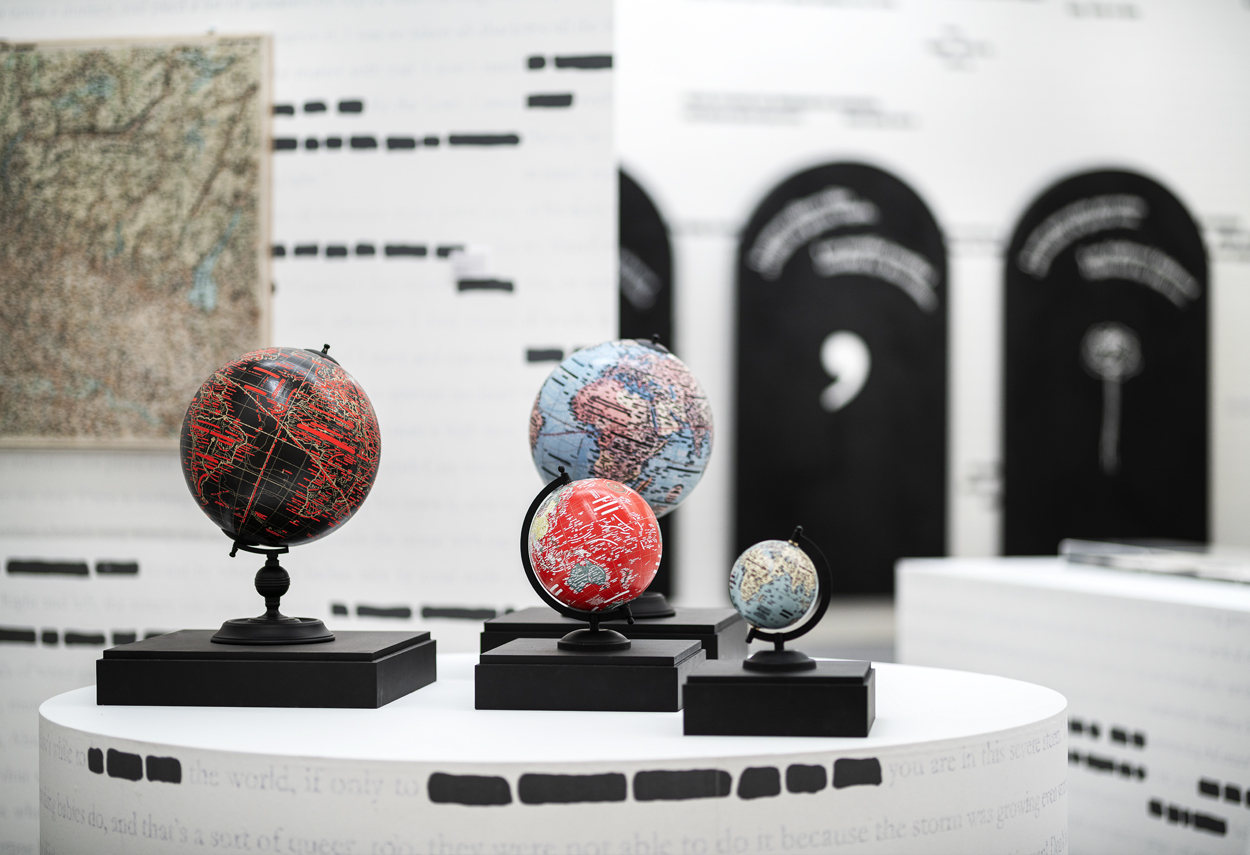
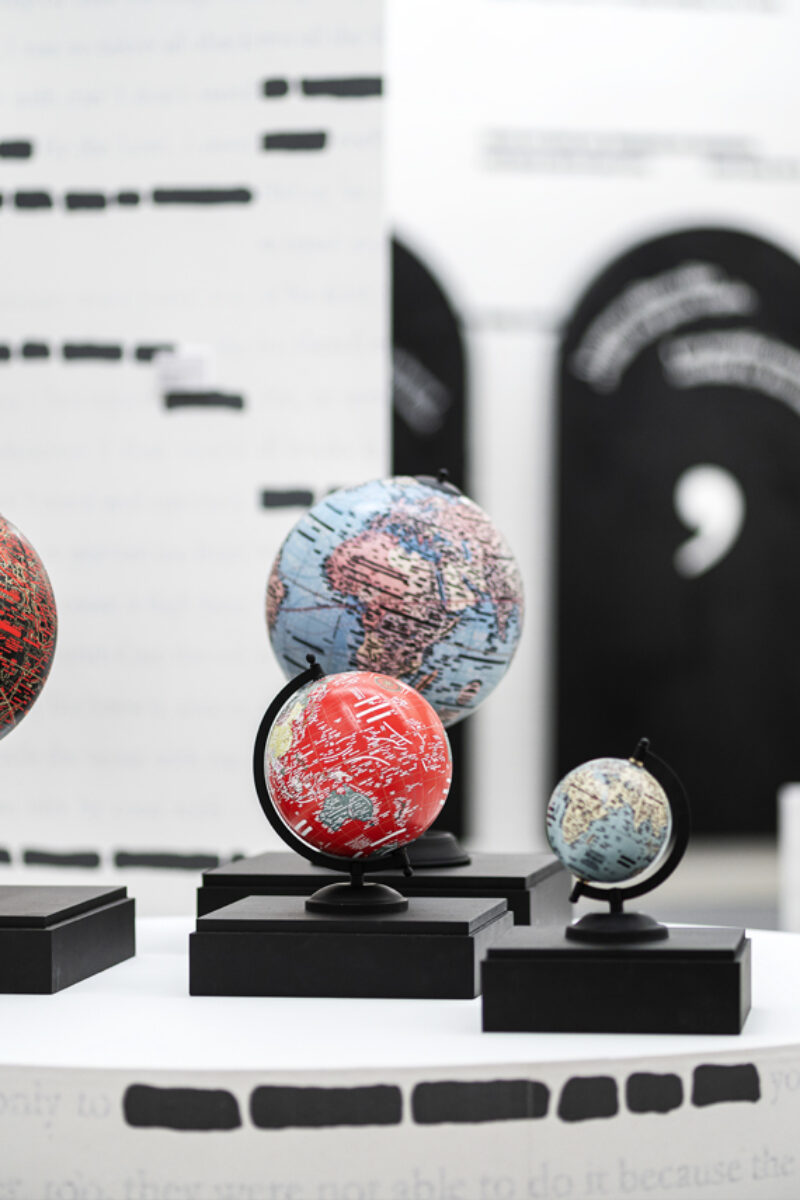
This was followed in 2018 by the lighting project of the Emilio and Scilla Isgrò Institute Private Museum, where the integration of lighting and architecture becomes the founding principle of the intervention. In this permanent context, light is not an accessory element, but a structural part of the museographic project, designed to ensure perceptive continuity, respect for the works and exhibition flexibility, in line with the artist's poetics.
The moment of maximum cultural intensity was reached in 2019, with the lighting project of the Isgrò Exhibition at the Giorgio Cini Foundation in Venice, developed in direct dialogue with Emilio Isgrò and the curator Germano Celant, a key figure in international art criticism. Here, lighting design becomes an exercise in extreme discipline: every lighting choice is filtered through the artist's thought, which requires a light capable of not adding meaning, but of preserving the conceptual strength of the work. The light accompanies the gesture of erasure, emphasizing its precision, but constantly retracts, avoiding any form of spectacularization.
The meeting with Emilio Isgrò represents for Marco Petrucci yet another fundamental step in the maturation of a vision of light as a critical act. In this dialogue between art and lighting technology, light becomes an instrument of cultural responsibility, called to respect the intelligence of the work and the silence that runs through it. The Venetian experience at the Giorgio Cini Foundation thus consolidates an approach to museum lighting design based on listening, precision and subtraction, in which light does not interpret, but makes possible a deep understanding of the artistic work.
The image of the Isgrò exhibition at the Giorgio Cini Foundation in Venice returns an exhibition space of great conceptual rigor, in which the work of art manifests itself through subtraction, silence and precision. The globes – iconic, reduced, isolated on neutral bases – emerge as objects of thought even before they are artefacts, suspended in a fragile balance between presence and absence. The light is measured, controlled, devoid of emphasis: it does not interpret the work, but makes it legible, leaving it to Isgrò's conceptual gesture to build the meaning. The white surfaces, the neutral backgrounds and the absence of harsh shadows favor a concentrated, almost meditative perception, in which every light variation is calibrated so as not to interfere with the semantic density of the work on display.
Rovati Etruscan Museum: With Mario Cucinella on the Hypogeum Project at Palazzo Bocconi
Lighting Design at the service of art, memory, and Milanese museum architecture
Between 2018 and 2021, he participated in the lighting design project of the underground museum of the Luigi Rovati Foundation, contributing to the definition of the lighting layout as part of the expansion and renovation of Palazzo Bocconi-Rizzoli-Carraro, in Corso Venezia, in the heart of the Milanese museum district. The architectural project, signed by Mario Cucinella, transforms a nineteenth-century historic building into a contemporary cultural complex dedicated to the Etruscan civilization, integrating exhibition functions, scientific activities and transdisciplinary educational programs. In this context, light takes on a structural role in the construction of the museum experience, called upon to mediate between the symbolic weight of archaeology and the innovative architectural language of the intervention.
The work with Mario Cucinella opens a significant passage on the theme of cultural and perceptive sustainability. The underground architecture of the museum, inspired by Etruscan tombs, requires lighting capable of evoking the depth of time without falling into scenographic reconstructions. The lighting design therefore works by layers of light, using low levels, highly controlled optics and careful management of color temperatures, to ensure at the same time the conservation of the works, the chromatic quality and the visual comfort of visitors.
The collaboration with MCA Architects reinforces an approach to light as a narrative and scientific device, in which every lighting choice is closely connected to the architecture and museum content. Light not only enhances the Etruscan finds, but helps to define the identity of the museum as a place of knowledge, research and dissemination. In this project, Marco Petrucci consolidates a vision of museum lighting design as a gesture of cultural responsibility, capable of relating past and present, scientific rigor and sensory experience, within one of the most significant recent museum interventions in the city of Milan.
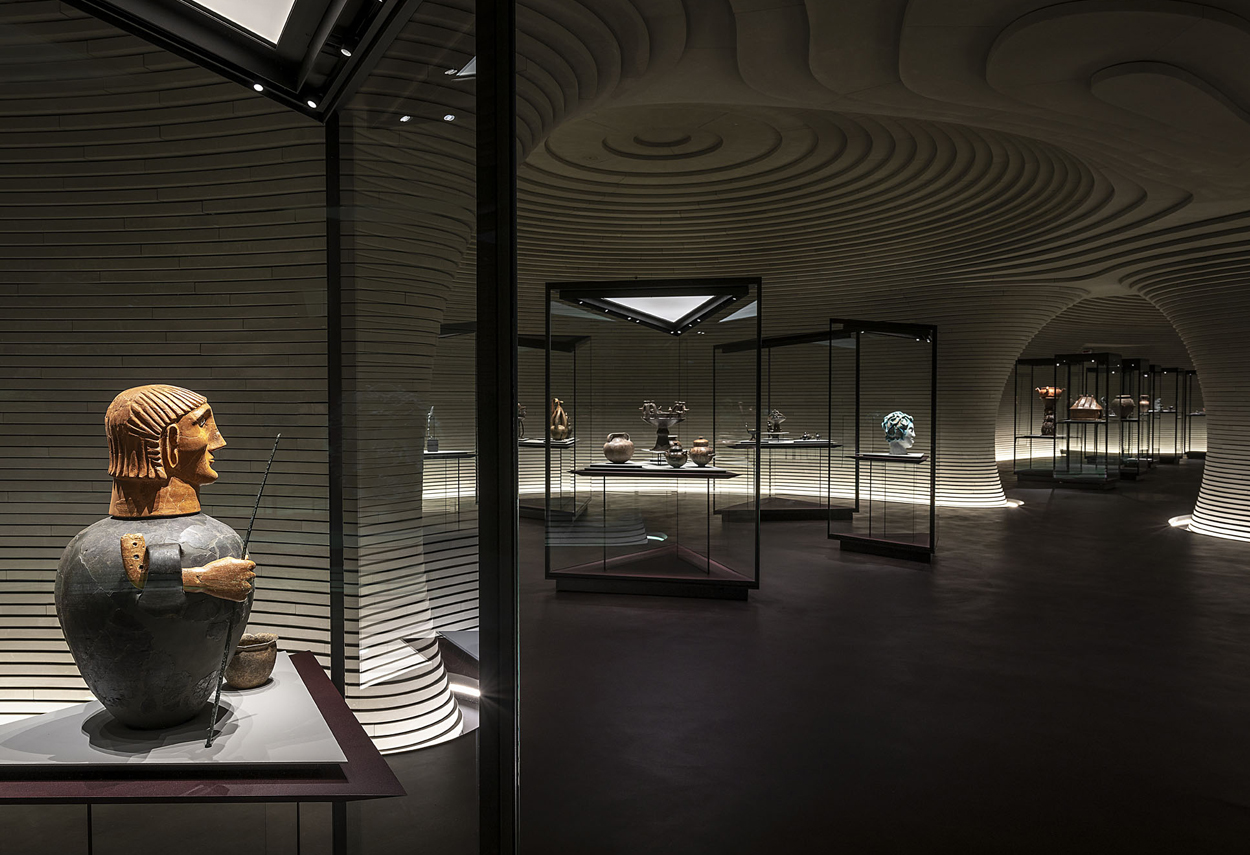
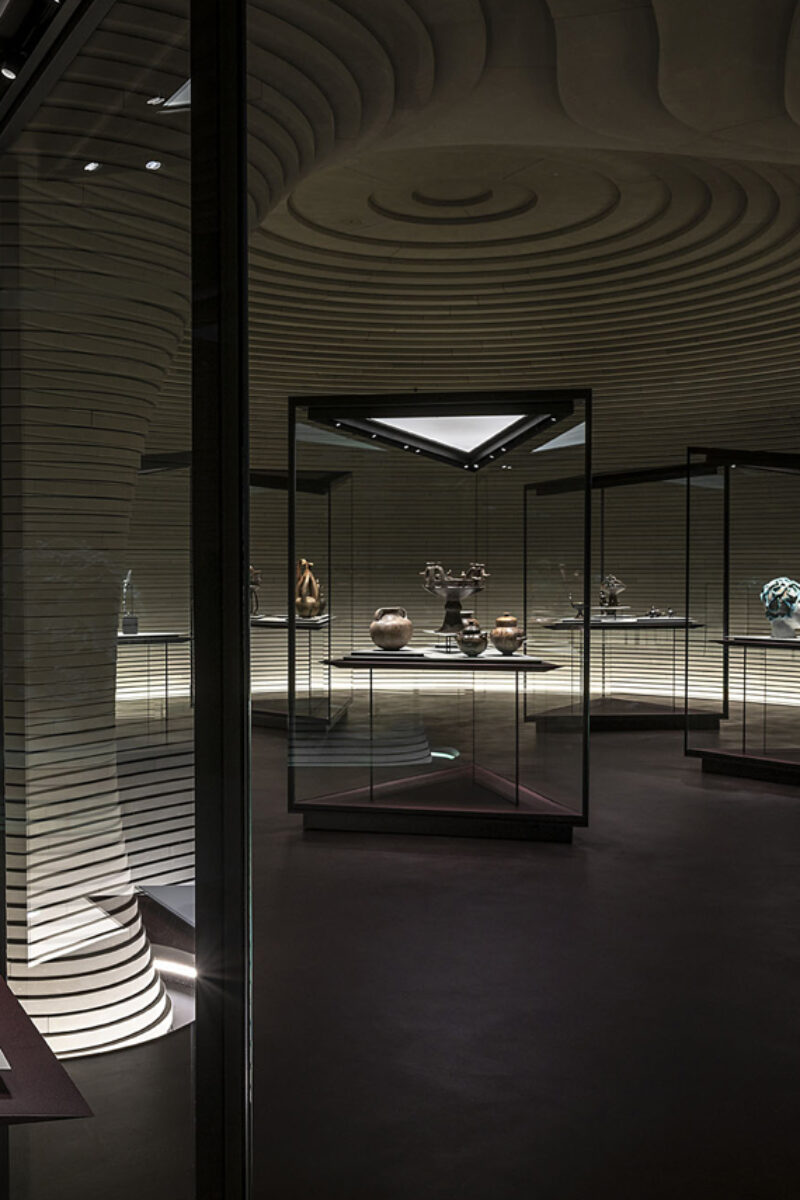
The image of the Etruscan Museum of the Luigi Rovati Foundation returns an underground space of great atmospheric intensity, in which architecture, matter and light combine to build an immersive and profoundly contemporary museum experience. The underground rooms, characterized by continuous surfaces and a fluid geometry, evoke an archaic and ritual dimension, while the display cases emerge as light presences, almost suspended in controlled darkness. The light is calibrated with extreme precision: punctual on the objects, soft and diffused on the architectural elements, always free of glare, so as to guide the eye and encourage a concentrated reading of the works without ever breaking the spatial continuity.
Illuminating the Saint-Pierre Cathedral in Geneva: A Light Project with Ruffieux Chehab
Lighting Design for the Grand Council Hall and Saint-Pierre Cathedral
Between 2013 and 2016, the lighting project for the Great Council Hall in Fribourg, located on the first floor of the Hotel Cantonal, a sixteenth-century building originally used as a grain market and now the seat of the Cantonal Grand Council. The intervention requires a calibrated search for a balance between representativeness, functionality and respect for the historical context, attributing to light the role of an instrument of institutional clarity and perceptive qualification of the space.

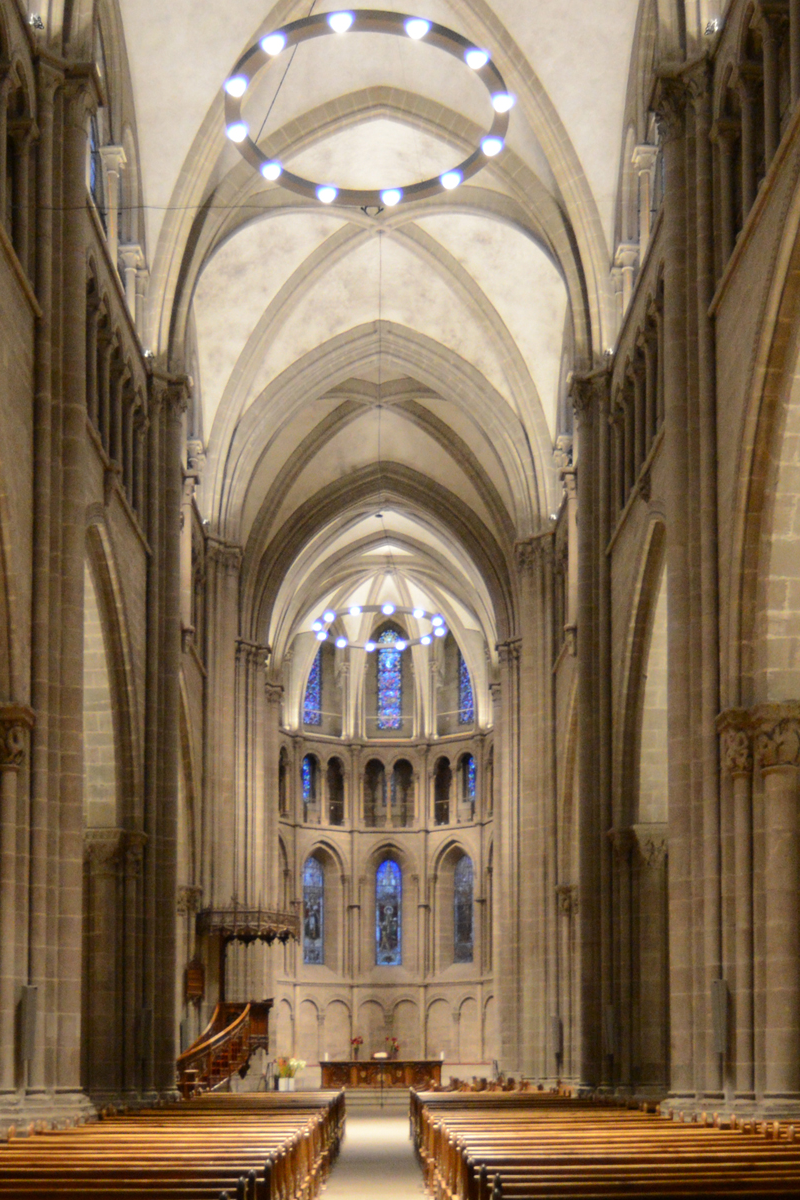
This was followed in the 2010-2025 period by an articulated series of interventions, including the interior and exterior lighting project of the Saint-Pierre Cathedral in Geneva, one of the symbolic places of the city and of the Swiss Reformed tradition. In this context, light takes on a strongly cultural and civic value: it is not called upon to amaze, but to make the architecture legible, to ensure continuity between sacred space, urban fabric and nocturnal perception of the city.
The approach of the Swiss studio, attentive to construction precision and formal sobriety, finds in light a design ally capable of reinforcing the character of architecture without overlapping it. In the project for Saint-Pierre Cathedral, lighting thus becomes a tool of historical and urban continuity, capable of accompanying the liturgical and civil life of the building, preserving its identity and restoring a coherent, respectful and profoundly contemporary nocturnal reading.
The image of the Saint-Pierre Cathedral in Geneva conveys a space of great solemnity and rigour, in which the Gothic verticality, the rhythm of the columns and the succession of vaults build an environment governed by proportion, rhythm and silence. Artificial light intervenes with extreme measure, following the structural order of the building: the naves are modeled through soft light gradients, the arches emerge without rhetorical emphasis and the overall perception remains balanced, legible and glare-free. The lighting does not alter the austere nature of the cathedral, but reinforces its spatial depth and contemplative character, accompanying the gaze towards the apse and enhancing the continuity of the architectural whole.
With BIG for Iconic Architecture: San Pellegrino Flagship Factory and CityWave in Milan
Integrated Lighting Design between industry, urban landmarks and international design
In the period 2017–2025, he began collaborating with the BIG – Bjarke Ingels Group, winner of the competition for the expansion of the historic San Pellegrino Flagship Factory in San Pellegrino Terme. The project represents one of the most significant interventions of contemporary industrial architecture in Italy, in which production, landscape and brand image are integrated into a single architectural organism. Within the multidisciplinary team, which includes Atelier Verticale, ARUP and GAD, the lighting contribution is an integral part of the architectural concept from the very beginning.
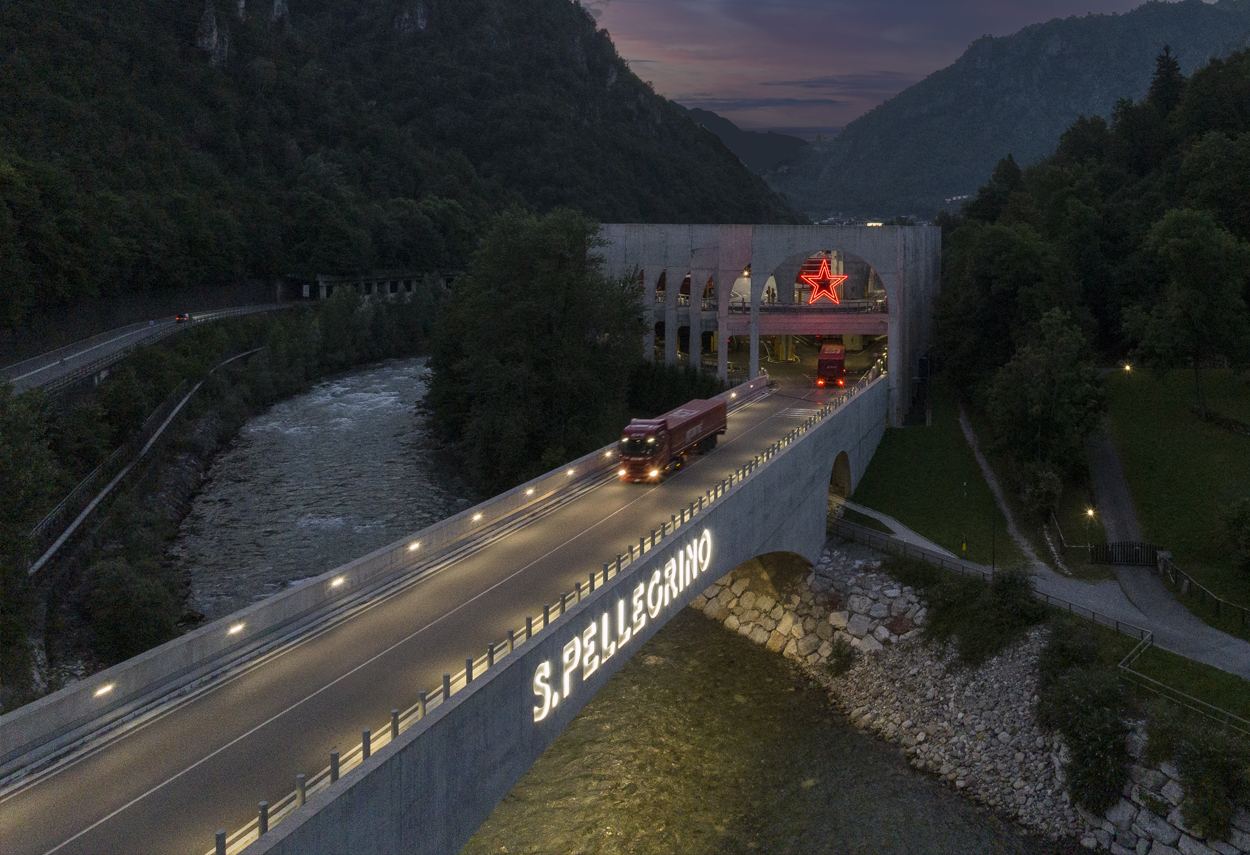
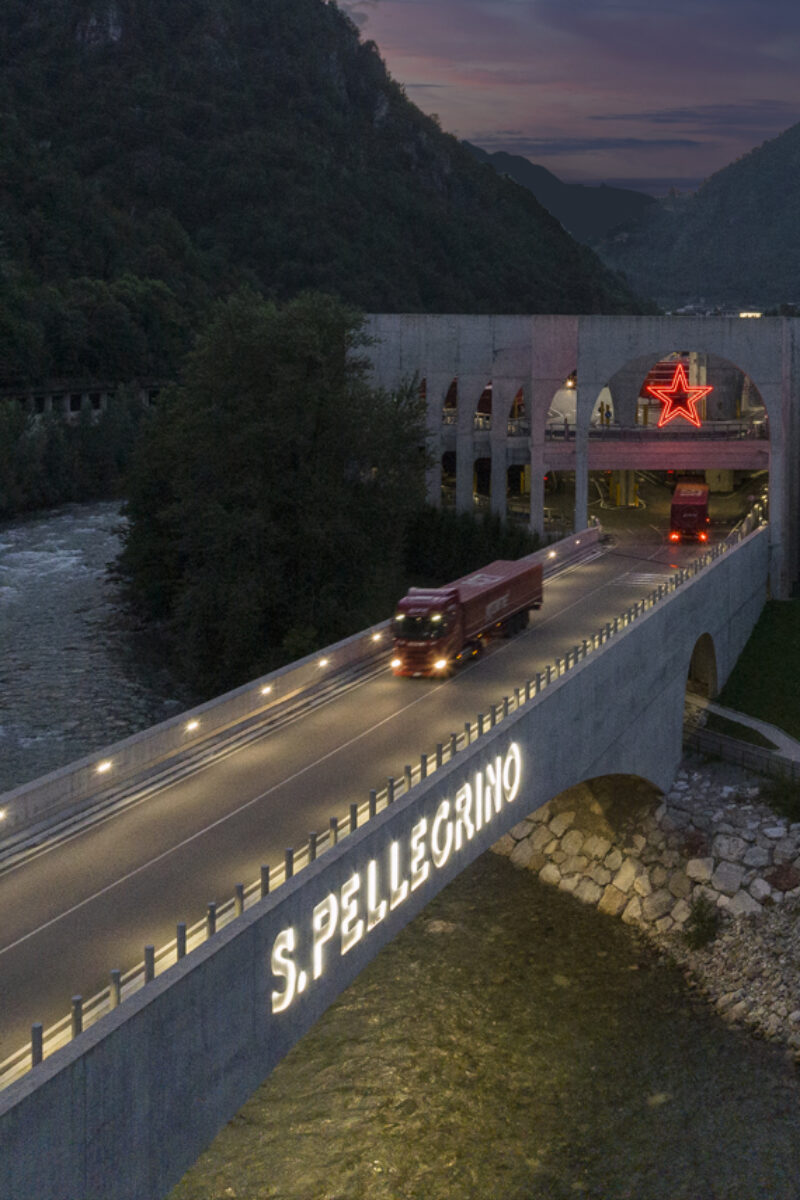
The dialogue with BIG is configured as a moment of particular importance. The approach of Bjarke Ingels' studio, based on the idea of "pragmatic utopianism", requires a lighting design capable of dialoguing with complex shapes, fluid geometries and advanced structural systems, without losing technical control and perceptual clarity. In the Flagship Factory, light helps to emphasize the sequence of arches, the continuity of the paths and the relationship between architecture and the Alpine landscape, reinforcing the industrial identity of the complex and its nocturnal legibility.
The work with BIG continues from 2020 to 2025 with the CityWave project in Milan, winner of the competition for the fourth tower of CityLife, developed by the London-based studio BIG. Also in this case, Marco Petrucci follows the lighting design by dealing with an iconic and highly expressive architecture, while for the plant engineering part the coordination takes place with the Manens-Tifs S.p.A. studio.tag. CityWave represents a further test bench on the theme of light applied to large urban landmarks, where lighting must support the architectural form, ensure energy efficiency and contribute to the quality of public space.
Overall, the collaboration with BIG Bjarke Ingels Group marks a decisive step in the confrontation with large-scale international architecture. In these projects, light is confirmed as a technical infrastructure, capable of integrating production, representative and urban needs, reinforcing a vision of lighting design as an active and structural part of the contemporary architectural project.
The image of the San Pellegrino Flagship Factory conveys an infrastructural space with a strong perceptive impact, in which light becomes structure and accompanies movement along a continuous path marked by monumental arches. The integrated light lines follow the rhythm of the architectural sequence, emphasizing its depth and curvature, while the controlled contrast between illuminated surfaces and shadow builds a dynamic and progressive perception of space. Light is not applied, but incorporated into the architecture, becoming an element of orientation, security and identity, capable of transforming a productive infrastructure into a recognizable spatial experience consistent with the character of the place.
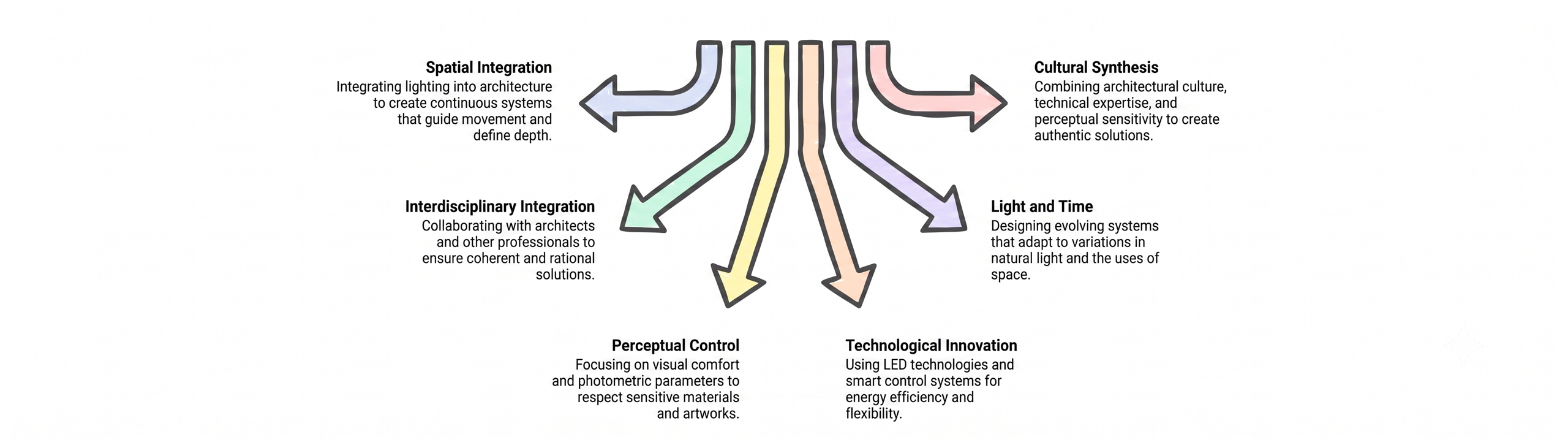
Interpreting space: Enhancing identity and improving usability
Method, architectural integration and perceptual control
Marco Petrucci's methodological approach is based on an integrated, critical and systemic vision of lighting design, understood as a design discipline capable of having a decisive impact on the architectural, perceptive and functional quality of space. Lighting design is conceived as a structural part of the architectural project, capable of reinforcing its legibility, hierarchy and identity.
Each project is the result of an in-depth analysis of the physical, historical and cultural context, the intended functions and the ways in which the space is used. Light is used as a tool for interpreting architecture, capable of revealing volumes, materials and proportions without altering their formal balance. This approach makes it possible to develop coherent, measured and durable lighting solutions, applicable to complex contexts such as museums, historic buildings, religious architecture, infrastructures, public spaces and large urban interventions.
- Light as an Integrated Spatial System The methodology adopted goes beyond the concept of lighting as a simple distribution of illuminance levels, to develop instead continuous lighting systems, integrated into architecture and space. Light contributes to the construction of the perceptual sequence, accompanies movement, defines depth and controls visual contrast, favoring a clear and non-redundant reading of the environments. In this sense, lighting design operates as an invisible infrastructure, capable of orienting, qualifying and making the space recognizable, without resorting to spectacular or self-referential solutions. The goal is always to serve architecture, amplifying its spatial and symbolic contents.
- Interdisciplinary integration and the design process The central element of the approach is the early integration of lighting design into the architectural process. Lighting design is developed in close collaboration with architects, engineers, curators, artists and landscape designers, actively participating in the spatial, material and plant engineering choices. This method makes it possible to avoid corrective or overlapping solutions, favoring instead coherent, rational and perfectly integrated lighting systems, in which technology, architecture and perception operate as a single design organism.
- Perceptual control, visual comfort and technical rigor The design is based on a rigorous control of photometric and perceptual parameters, with particular attention to luminance, glare, uniformity, color rendering, color temperature and spectral distribution. Visual comfort is a fundamental criterion, especially in museums, exhibitions and historical environments, where light must respect sensitive materials, ancient surfaces and works of art. The technical choices are always supported by advanced lighting simulations and quantitative checks, ensuring regulatory compliance, perceptive quality and sustainability of the intervention.
- Technological innovation and sustainability Technological innovation is adopted as a design tool and not as an end, favoring high-quality LED solutions, intelligent control systems and dynamic light management strategies. The goal is to optimize the energy efficiency, flexibility of use and durability of the systems, reducing the environmental impact and management costs over time. Lighting design thus becomes an integral part of a vision oriented towards environmental and cultural sustainability, in which energy efficiency, quality of light and design responsibility coexist in balance.
- Light and time A distinctive aspect of the approach is the attention to the time factor. The projects are conceived as evolutionary systems, capable of adapting to variations in natural light, different times of the day and uses of space. The relationship between natural and artificial light is managed in a calibrated way, avoiding visual competitions and favoring a dynamic and controlled dialogue. This vision makes it possible to create non-static lighting environments, capable of accompanying the user experience and enhancing the architecture over time.
- Synthesis between culture, technique and design The methodological approach represents a synthesis between architectural culture, technical competence and perceptive sensitivity, matured through a continuous comparison with complex architectures and contexts of high cultural value. Each project is approached as an opportunity for research, with the aim of building authentic, coherent and long-lasting lighting solutions. Light, in this perspective, is never the absolute protagonist, but a conscious element, capable of giving shape to space, enhancing the architectural work and improving the human experience, respecting the place, function and time.
In this vision, lighting design becomes a critical design tool, capable of connecting architecture, technology and perception in a coherent and durable system. Through a defined, interdisciplinary and sustainability-oriented methodological approach, light is used to interpret the space, enhance its identity and improve its use, without ever overlapping with the architecture. Each intervention is configured as a conscious synthesis between technical innovation, perceptive control and design culture, in which the quality of light contributes decisively to the construction of the architectural experience over time.
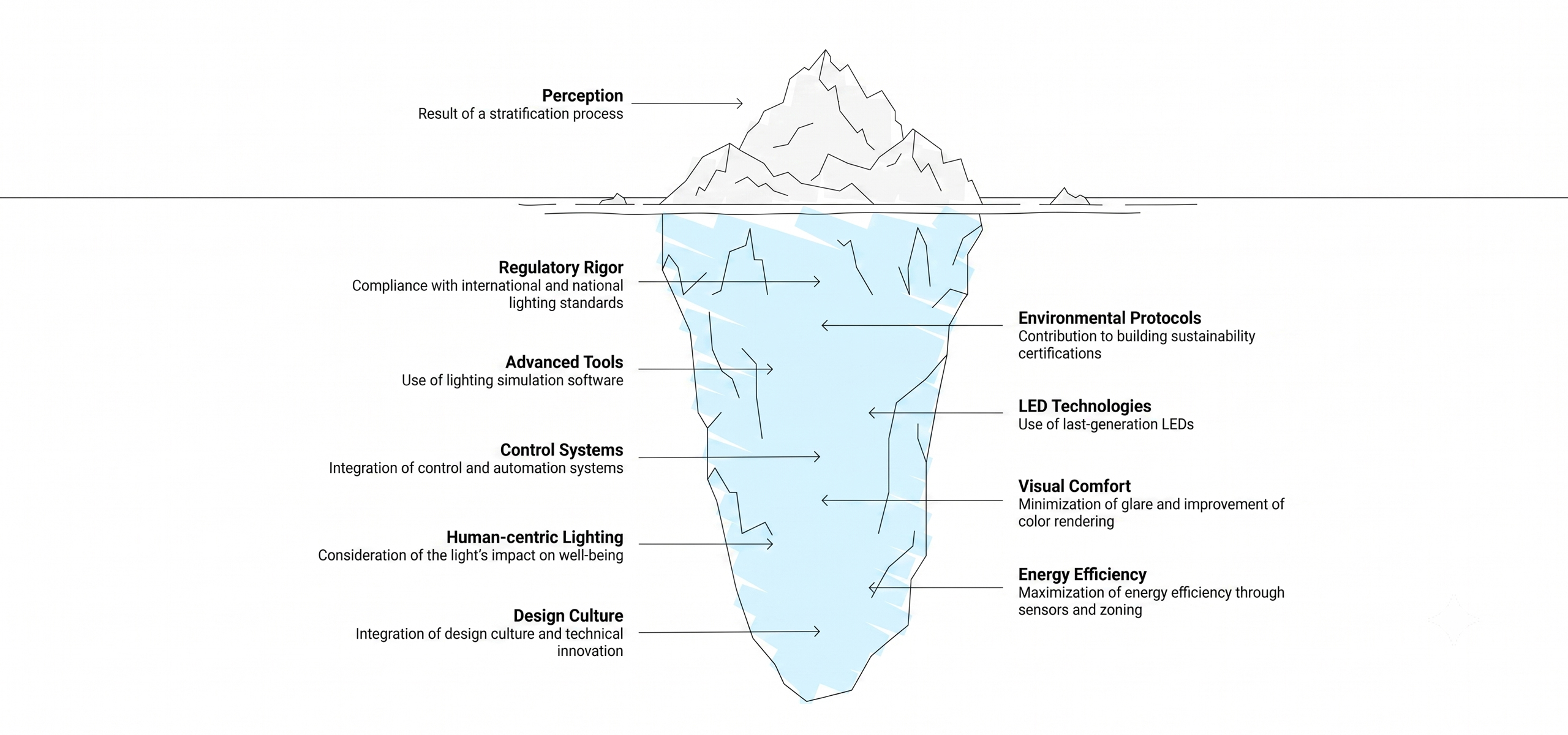
Regulatory Rigour, Technology and Sustainability
International Standards, Lighting Control and Quality of Light
At the basis of Marco Petrucci's design activity there is a structured methodological approach, based on compliance with technical regulations and the use of the most modern lighting technologies. Each intervention is developed in accordance with international and national lighting standards: Petrucci follows the recommendations of the CIE (Commission Internationale de l'Éclairage) and adopts the UNI, EN, CEI, ISO and IES standards as an obligatory reference to guarantee the quality and safety of the systems. Whether it is the lighting of offices, museums or public spaces, each parameter (illuminance levels, uniformity, UGR glare, color rendering, etc.) is calibrated to meet or exceed the regulatory requirements in force, ensuring optimal visual comfort for users. At the same time, the projects take into account the main environmental protocols in the building sector, so that light contributes to the achievement of sustainability certifications such as LEED, BREEAM or WELL. For example, in the projects developed with Renzo Piano and Mario Cucinella, lighting played a key role in the LEED score, thanks to high-efficiency solutions and control strategies that minimise consumption and dispersed light emissions. This attention to the environment is an integral part of the methodology that sees sustainable lighting not only as a technical requirement, but as an ethical duty towards the community and the planet.
Advanced tools and constant technological updating are other pillars of the working method. In the executive design phase, he uses professional lighting simulation software such as DIALux, Relux and Litestar 4D, which allow him to virtually model spaces and make accurate lighting calculations (distribution of luminous candles, analysis of photometric curves, photorealistic renderings). Through these tools, each choice is verified and optimized in advance: different configurations of luminaires, optics and color temperatures are tested, evaluating their visual and energy impact, so as to select the best solution before actual installation. The use of the latest generation LED technologies is a distinctive feature of the projects: LED sources with high luminous efficiency and excellent colour rendering are favoured, which guarantee energy savings and long service life on the one hand, and quality light on the other, capable of enhancing materials and colours in a natural way. LEDs, combined with advanced optical systems (lenses, reflectors, diffusers), also make it possible to obtain lighting effects that were previously unthinkable with the old sources, expanding the expressive language available to the lighting designer.
Another central aspect is the integration of state-of-the-art control and automation systems, which make lighting systems flexible, intelligent and user-centered. Depending on the needs of the project, he implements standard digital protocols such as DALI-2 (Digital Addressable Lighting Interface) for the precise management of groups of lamps and programmable lighting scenarios, KNX and BACnet for interfacing with home automation systems and BMS (Building Management System) of the building, or DMX (often used to control dynamic and chromatic effects in facades or scenographic installations). In historical or retrofit contexts, advanced wireless solutions such as Casambi are also adopted, which allow networks of lighting fixtures to be controlled via Bluetooth without the need for invasive wiring, preserving listed buildings. For high-end retail or residential environments, proprietary systems such as Lutron are integrated, guaranteeing reliability and fine tuning of the lighting. Thanks to these control tools, the designed light becomes dynamic and adaptive: light levels, shades of white (with tunable white LED systems) and even colors can vary throughout the day or according to usage scenarios, optimizing visual comfort and efficiency. For example, in offices it is possible to automatically adjust artificial light according to the supply of natural light (Daylight Harvesting), improving well-being and saving energy; in museums, different scenarios can be set up for daily visits, evening events or maintenance, always ensuring the correct conservation of the works; In urban squares, the brightness can be dimmed at night to reduce light pollution and then increased in case of need or public events.
Attention to visual comfort and sustainability remains the common thread of every technical choice made by Marco Petrucci. He conducts in-depth analyses to minimize direct and reflected glare phenomena, controlling the intensity and distribution of the luminances emitted by the lighting fixtures. It prefers luminaires with shielded optics and anti-glare accessories (dark-light dishes, anti-glare lights, lens visors) especially in environments where people stay for a long time, such as open-plan offices or museum halls, in order to prevent visual fatigue. At the same time, the lighting is designed in a human-centric key, also considering aspects such as high colour rendering (CRI/Ra >90) for a natural perception of colours and, where relevant, the impact of blue light and respect for the circadian rhythm in the evening hours (e.g. in wellness or hospital projects, where it applies the principles of the WELL Building Standard to ensure the well-being of the occupants). On the sustainability front, each project is designed to maximize energy efficiency: this is done through the selection of high-performance lm/W luminaires, the use of presence and brightness sensors to avoid waste, and the division of the systems into zones and scenarios to illuminate only where and when needed. The results are lighting systems that, with the same comfort, consume significantly less energy than traditional solutions, contributing to the reduction of CO₂ emissions and management costs for customers.
Ultimately, Marco Petrucci's methodology combines design culture and technical innovation into a coherent whole. As evidenced by his career, he constantly integrates cutting-edge technologies and international standards with a sensitivity to the historical-artistic context and the human needs of illuminated space. Its professional mission is to offer each project a "tailor-made" light, which is both highly performing and poetically immersed in the environment. Thanks to this philosophy, the goal is to create excellent lighting experiences, in which the end user perceives not only adequate lighting, but a real perceptive added value: light becomes comfort, atmosphere, orientation and beauty. Projects such as cathedrals, monumental complexes, museums, public and private spaces are recognizable for the balance between functionality and aesthetic enhancement. In conclusion, the profile of Marco Petrucci – Lighting Designer – is characterized by consolidated experience, authority in the field of light and a technical-cultural coherence that is reflected in every detail of his works: a professional capable of lighting up the architectural space with innovative, sustainable lighting solutions that are deeply respectful of the genius loci.
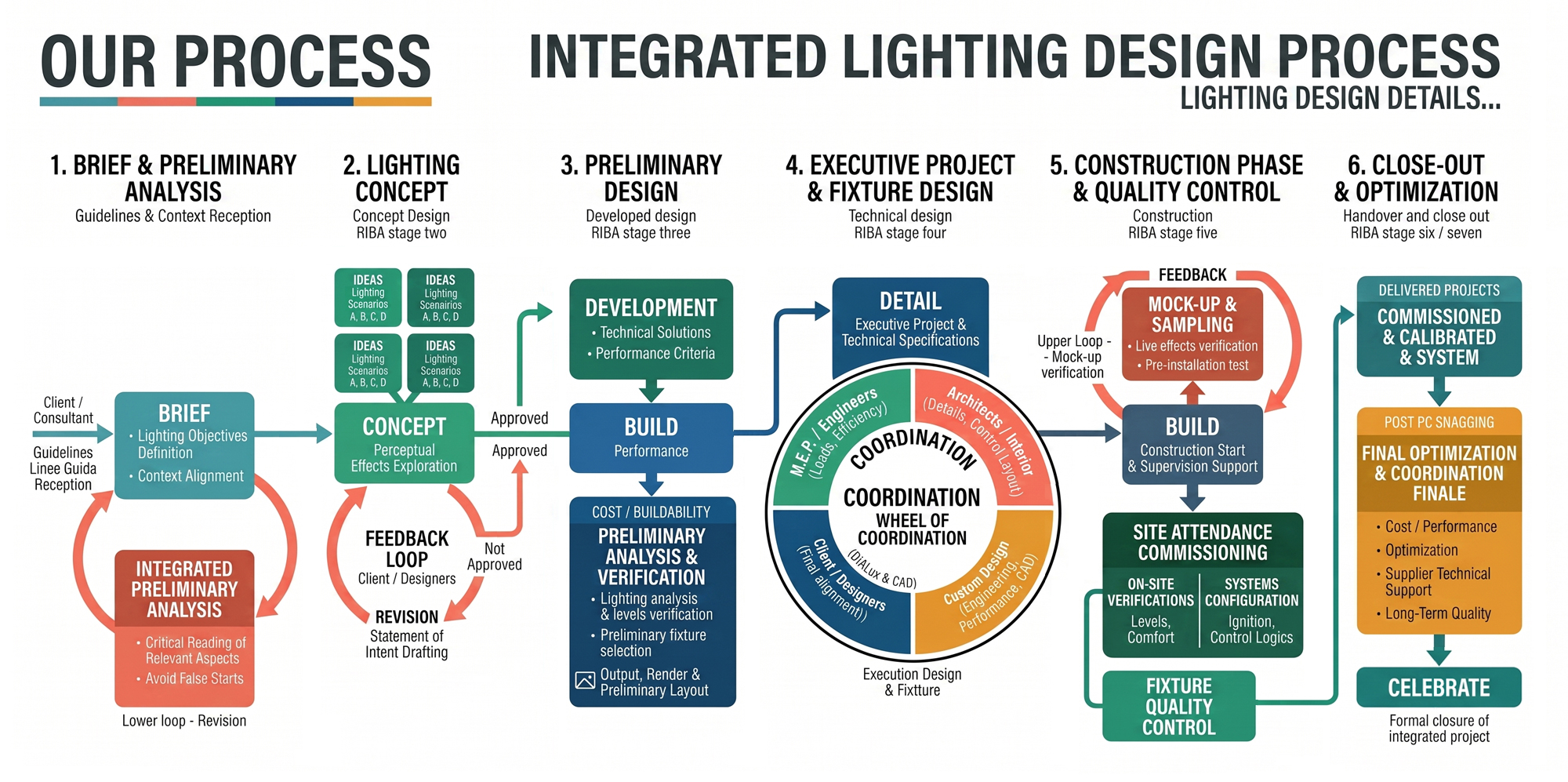
Integrated Lighting Design Service
Scope of intervention, contents and methods of carrying out professional services
The lighting design service is aimed at ensuring structured, coherent and continuous management of the conceptual, perceptive, performance and technical aspects of lighting throughout the entire design process, through constant interaction with the Client and the multidisciplinary design team. This interaction is oriented towards sharing the lighting objectives and aligning the qualitative, functional and economic expectations of the intervention, in line with the architectural, urban and environmental context, with the methods of use of the spaces and with the regulatory framework of reference.
The contribution of the lighting designer is configured as a specialist and consultative contribution, aimed at defining the lighting design criteria, the expected performance levels, the lighting hierarchies and the architectural integration strategies, as well as their progressive translation into verifiable and measurable lighting solutions. The activity develops from the lighting concept phase, through the analysis of the context and the development of design guidelines, up to the preliminary and executive design phases of lighting expertise, ensuring methodological continuity and consistency between concepts, technical solutions and expected results.
The objectives of the service include the definition of the performance of lighting fixtures and control systems, the performance of lighting analyses and numerical simulations, the drafting of technical lighting documentation and the contribution to the preparation of tender and authorization documents, limited to aspects of lighting expertise. Where required, the service also includes design activities for custom lighting fixtures, developed in response to specific architectural, perceptual and performance needs of the project, without assuming production, certification or commercial responsibilities.
During the construction phase, the lighting designer supports the construction process through specialized technical consultancy activities, support for sampling, adjustment and calibration of fixtures and control systems, as well as verification of on-site lighting performance, carried out without taking on construction management tasks, continuous operational control of the construction site or executive responsibilities, in order to verify consistency between what was designed and what was built.
The lighting designer works in coordination with the designer of the electrical system, with the installation company and with the other figures involved, contributing to the correct integration of the lighting solutions into the overall project. The activities of electrical design, operational management of the construction site, procurement of lighting fixtures and conduct of authorization and administrative procedures are carried out by the competent figures according to their respective attributions. The contribution of the lighting designer remains limited to the lighting, perceptual and performance aspects, in order to ensure technical feasibility, cost control, design consistency and quality of the final result.
Lighting Concept
Definition of lighting objectives in relation to the architectural and urban context of the intervention and the methods of use of the spaces, considering the different conditions of use, perceptual sequences and significant visual relationships. The objectives are formulated in line with the general approach of the project, with the compositional intentions and with the identity values of the place, identifying the roles attributed to light in terms of orientation, recognizability, spatial hierarchy and perceptive quality, without anticipating detailed technical solutions.
Development of an integrated preliminary analysis, intended as a critical and selective reading of the historical, architectural, urban, environmental and functional aspects relevant to lighting design. The analysis is aimed at identifying emerging elements, physical and regulatory constraints, significant materials and surfaces, relationships between solids and voids, as well as existing lighting conditions, constituting the knowledge base for the concept setting. This phase makes it possible to define a coherent interpretative framework, useful for guiding subsequent design choices in a conscious and motivated way.
Elaboration of the lighting concept using representation and pre-verification tools, such as concept sketches, principle diagrams, functional diagrams, study visualizations and images of lighting tests, where available. These tools are used to explore and evaluate perceptual effects, volumetric relationships, light hierarchies and the behavior of light on architectural and spatial elements, allowing a first qualitative feedback of design intentions. The concept retains a strategic and non-prescriptive character, defining a coherent and recognizable lighting language.
Drafting of the report of intent, as a document of direction of the lighting project, in which the design criteria, lighting priorities and development lines of the subsequent phases are formalized in a clear and structured way . The report explains the role of light within the overall project, clarifies the conceptual choices adopted and constitutes a shared reference for the continuation of the design activity, ensuring methodological continuity and consistency between concept and subsequent technical translations.
Preliminary Design
Transposition of the lighting concept into coherent, verifiable and measurable technical solutions, through the definition of the reference performance criteria and their application to the different spatial areas of the intervention. In this phase, the concept is translated into preliminary operational choices, maintaining consistency with the perceptive, compositional and functional intentions expressed in the initial phases, and ensuring compatibility with architectural, regulatory and economic constraints.
Production of photographic renderings to support the spatial understanding of the project, aimed at the qualitative evaluation of lighting effects, visual hierarchies, light-matter relationships and overall perceptual conditions. The representations have an analytical and communicative function, with no executive value, and are used as a tool for verifying design hypotheses and comparing them with the client and the project team.
Carrying out preliminary lighting technical analyses, through numerical simulations aimed at verifying illuminance levels, contrast ratios, uniformity and the first conditions of visual comfort, in relation to the intended use and the applicable regulatory references. The analyses make it possible to validate the initial conceptual choices and to identify any critical issues already in the preliminary phase, directing subsequent design optimizations.
Definition of the first distribution hypotheses of the luminaires, divided into lighting functions (general, accent, functional or scenographic lighting), with attention to spatial legibility, the hierarchy of architectural elements and consistency with the overall design language. At this stage, no definitive solutions are set, but coherent and comparable technical scenarios.
Preliminary selection of luminaires, based on the analysis of photometric performance, optical and chromatic characteristics, installation methods and architectural integration, as well as compatibility with the estimated budget and known maintenance constraints. The selection is indicative and constitutes a reference for subsequent checks, without committing supply choices.
Drafting of the preliminary lighting layout using simulation software and technical drawing (DIALux and CAD), including the arrangement of the luminaires, the main functional dimensions and the indications necessary for reading the project. The layout represents the technical basis of interdisciplinary coordination with the other projects involved (architectural, plant engineering, structural), ensuring spatial coherence and feasibility of the solutions proposed in the subsequent phases.
Executive Project
Complete, coordinated and definitive development of the lighting project, aimed at translating conceptual and preliminary choices into punctually defined and workable technical solutions. In this phase, the project is consolidated in terms of performance, regulations and economics, ensuring consistency between lighting objectives, design constraints and construction conditions, in coordination with the other disciplines involved.
Processing of ordinary and emergency lighting calculations, through certified simulations, with timely verification of performance requirements, illuminance levels, uniformities, contrast ratios and visual safety conditions, in accordance with applicable regulatory references. The checks include the expected operating conditions and emergency configurations, ensuring that the project complies with the standards required for the different intended uses.
Drafting of the technical data sheets of the lighting fixtures, including the main photometric, electrical and installation characteristics, as well as installation details and installation indications, useful for the correct interpretation of the project during the construction phase. These documents unequivocally define the methods of integration of the luminaires with the architecture and with the other plant systems, reducing executive ambiguities.
Definition of the electrical loads of lighting expertise and contribution to the quantification of the energy needs of the lighting system, to support the estimated metric calculation and the verification of consistency with the project budget. In this phase, energy efficiency strategies are also developed, through the optimization of sources, optics, regulation levels and usage logics, including possible integration with environmental sustainability protocols (e.g. LEED), limited to the lighting aspects.
Functional and performance definition of lighting fixtures and light control systems, with specification of the lighting logics, adjustments and lighting scenarios envisaged, in line with the methods of use of the spaces and with the lighting objectives of the project.
The lighting scenarios are described in a clear and structured way, providing all the information necessary for their correct implementation and operational management, to support the development of electrical layouts and plant diagrams, which remain the responsibility of electrical engineering.
Preparation of tender documentation, limited to lighting drawings, including technical descriptions, performance specifications and useful indications for the correct evaluation of bids, without binding references to brands or suppliers, except as permitted by current legislation.
Drafting of the technical-regulatory report and the executive lighting layout using simulation software and technical drawing (DIALux and CAD), as an essential support for the correct implementation of the intervention. The executive documentation is a unique reference for the construction phase, ensuring design clarity, verifiability of performance and continuity between the project and the work carried out.
Luminaire design
Design and prototyping of custom lighting fixtures, developed in response to specific architectural, performance and perceptual needs of the project, if the solutions on the market are not adequate. The activity focuses on the definition of the lighting principle of the luminaire, the lighting behaviour and its formal and functional integration into the reference context, in compliance with the applicable dimensional, installation and regulatory constraints.
Photometric development of the luminaire, including the definition of the light distribution curves, the chromatic characteristics and the relevant performance parameters, aimed at verifying the expected performance and subsequent integration into the lighting simulation models. Production of photographic renderings and studio visualizations, used for the evaluation of the lighting effects, the visual impact and the formal coherence of the luminaire with respect to the architectural language and the project concept.
Product engineering activities, conducted in collaboration with the technical figures involved, aimed at transforming the concept into a technically feasible and reproducible object. This phase includes the definition of construction solutions, dimensional tolerances and assembly methods, while maintaining control over the lighting and perceptual aspects that qualify the project.
Definition of electrical and electronic components of lighting expertise, with particular attention to the choice of light sources, optics, power supply and light management systems, in line with performance and energy requirements. Development of CAD layouts of the device and of the main technical details, to support the verification, prototyping and production phases.
Support for the industrialization phases, limited to lighting design aspects, through technical comparison with production partners and validation of the solutions adopted in terms of light quality, reliability and repeatability of the product. Carrying out research and experimentation activities on emerging materials and technologies, with attention to the quality of light, energy efficiency and integration with architecture, as qualifying elements of the luminaire design.
Construction Phase
Specialist technical consultancy activities to support the supervision of works, aimed at verifying the correct application of the lighting project in its qualitative and performance components. The lighting designer supports the construction process by checking the consistency between the executive drawings and the works in progress, pointing out any deviations or critical issues relevant to the maintenance of the design objectives, without assuming management or coordination functions of the works.
Control of the lighting values on site, through punctual checks of the installation conditions and expected performance, with particular attention to the correspondence of lighting levels, light distributions and visual comfort conditions with respect to what has been designed.
Support in the verification of the sampling of lighting fixtures, with reference to the optical, chromatic and construction characteristics, as well as the consistency with the design intentions and the defined architectural integration criteria .
This activity is aimed at the qualitative validation of the project solutions and the provision of the elements necessary for the subsequent procurement and installation phases, which remain the responsibility of the figures in charge.
Support for setting switch-ons, regulation logics and light control systems, in line with the lighting scenarios defined in the project and with the ways in which the spaces are used. This activity includes assistance in the initial test and calibration phases, aimed at ensuring the correct perceptual and functional performance of the lighting system, in compliance with the expected performance.
Carrying out value engineering activities, limited to lighting aspects, through the analysis of any technical alternatives proposed during the construction phase, with an assessment of their performance, economic and regulatory compatibility with the approved project. The goal is to preserve the overall quality of the intervention, maintaining the balance between costs, performance and design consistency.
Support for the creation of mock-ups and on-site samples, as tools for preventive verification of lighting effects, light-material relationships and integration with the architectural context. Technical assistance in relations with suppliers, plant engineers and local authorities, for aspects of lighting expertise, in order to guarantee executive quality, design consistency and compliance with technical and regulatory constraints throughout the entire construction process.
Electrical System Designer and Qualified Installation Company
In the context of lighting design, the involvement of the designer of the electrical system is an essential technical prerequisite for the safety, reliability of the system, compliance with current regulations and the correct management of the electrical infrastructure serving the lighting. This figure, identifiable as an engineer or industrial expert qualified according to current legislation, can operate as a professional appointed by the Customer or be part of the organization of the installation company. If the company does not have this competence internally, the appointment of an external electrical system designer, formally appointed, is necessary before the start of executive activities.
The electrical system designer is responsible for the design and sizing of the power supply network serving the lighting system, including the definition of the general and secondary electrical panels, the correct sizing of the lines, the selection of protective devices and the design of the wiring routes. In historical or architecturally sensitive contexts, particular attention is paid to reducing the impact of plant works, ensuring respect for protected surfaces, materials and pre-existing buildings.
The figure of the electrical designer also takes care of the design of the power supply, command and control systems of the lighting fixtures, defining the plant architectures necessary for the implementation of the lighting logics, regulation and management. These systems, based on control protocols such as DALI, DMX, KNX or equivalent, are functional to the implementation of the lighting scenarios envisaged by the lighting project, to the containment of energy consumption and to an efficient management of maintenance over time. The electrical design is developed in close coordination with the lighting designer, respecting the performance and perceptive choices defined by the lighting project.
It is also the responsibility of the electrical system designer to verify the compliance of the project with the applicable technical and safety regulations, with particular reference to the CEI standards and the legislation in force on electrical systems. This activity includes the preparation of the technical documentation necessary for authorization purposes and the definition of the documents useful for the issuance of the mandatory certifications for the commissioning of the plant. The Declaration of Conformity pursuant to Ministerial Decree 37/08, although drawn up by the installation company, is based on consistency between design and execution and represents an essential element for final testing.
The correct implementation of the lighting project requires the involvement of a qualified installation company, with proven experience in the sector and technical skills appropriate to the complexity of the intervention. The company is responsible for the execution of the works in accordance with the approved project and the regulations in force, working in coordination with the lighting designer, the designer of the electrical system and the other professionals involved.
The installation company provides for the drafting of the construction and detailed drawings necessary for the executive phase, illustrating in a timely manner the methods of installation of the lighting fixtures, the plant arrangements, the wiring routes, the fixing systems and the technical solutions adopted. These documents must be consistent with the design specifications provided and constitute an operational reference for the correct execution of the works.
The operational management of the installation includes the execution of the installation and fixing of the lighting fixtures, the implementation of any complementary civil works, the laying of ducts and power lines, as well as the installation of electrical panels, technical cabinets and control devices. The company guarantees that all work is carried out in a workmanlike manner and in compliance with design and regulatory requirements.
At the end of the works, the installation company is required to issue the Declaration of Conformity of the electrical system, certifying that the execution of the works has taken place in accordance with the project, the applicable technical standards and the provisions of the law. This requirement is a necessary condition for the commissioning of the plant.
If the installation company is also in charge of the purchase of lighting fixtures, it assumes full responsibility for managing relations with the supplier or manufacturer, including the management of any malfunctions, manufacturing defects, returns or replacements, in compliance with the contractual and warranty conditions. This responsibility remains distinct from the role of the lighting designer, who maintains exclusive technical control over the compliance of the luminaires with the project specifications.
The continuous presence of specialized technical staff of the installation company on site allows us to ensure constant assistance in the installation, adjustment and testing phases of the lighting fixtures. In collaboration with the lighting designer, who intervenes according to the procedures provided for by the professional assignment, with the designer of the electrical system and with the other figures involved, the installation company contributes to the verification of the full final functionality of the system, ensuring consistency between the project and the work carried out and the correct management of any technical criticalities, until the completion of the intervention.
Lighting Fixtures Procurement and Responsibility
In relation to the methods of procurement of lighting fixtures, purchasing responsibilities may be assumed directly by the Client or attributed to the installation company in charge, depending on the agreements defined in the initial stages of the design process and the procedures adopted by the contracting authority. The choice of the method of purchase affects the operational organization of the construction site and the management of relationships with suppliers, without changing the technical and performance requirements established by the lighting project.
In the case of direct purchase by the Customer, this method allows direct control of costs and a punctual verification of the correspondence of the lighting fixtures to the technical, performance and aesthetic requirements defined in the lighting project. The Client retains responsibility for the contractual relationship with the supplier and the related administrative procedures, ensuring that the equipment supplied complies with the project specifications and the approved technical documentation.
If the purchase is entrusted to the installation company, the management of the supply falls within the scope of the operational activities of the construction site, with the advantage of greater integration between supply and installation and a simplification of overall logistics. In this configuration, the company assumes responsibility for the purchase and supply of the equipment, in compliance with the design indications and the defined technical specifications , ensuring the correct execution of the works in accordance with the approved project.
Regardless of the method of purchase adopted, relations with the manufacturer or supplier of the lighting fixtures are the exclusive responsibility of the person in charge of procurement. Any malfunctions, manufacturing defects, non-conformities or the need to return and replace the luminaires are handled directly by the buyer, according to the contractual terms and warranty conditions established by the supplier, without direct involvement of the lighting designer in commercial, contractual or administrative procedures.
In both cases, the lighting designer provides for the delivery of a detailed list of materials, including precise technical indications, official technical data sheets of the selected products, expected quantities and identification codes. This documentation constitutes a unique technical reference for the procurement phase and makes it possible to verify the full compliance of the lighting fixtures supplied with the performance, aesthetic and functional characteristics defined by the lighting project, ensuring the consistency of the final result with the design objectives and applicable regulatory requirements.
The procurement of lighting fixtures must take place through companies operating in the lighting sector that are able to guarantee adequate quality standards, technical reliability and compliance with current regulations. The selection of qualified manufacturers, or companies of the same technical level, is particularly suitable for public lighting interventions and in projects for the enhancement of listed cultural heritage, as it allows the use of fixtures characterized by suitable photometric and chromatic quality, adequate energy efficiency, durability over time, construction robustness and availability of the required documentation and certifications by the technical regulations and the prescriptions of the bodies responsible for protection.
Authorizations Required for Public Lighting Interventions
The lighting design of interventions in the public sector, and in particular on urban spaces, historic buildings or contexts subject to protection, requires a prior and timely verification of the applicable authorization and regulatory framework. The correct identification of the necessary authorizations is an integral part of the design process and an essential condition for the technical, administrative and temporal feasibility of the intervention. The lighting designer contributes to this process through the preparation of documentation of lighting expertise, coordination with other design disciplines and technical support to the relevant bodies, without assuming any investigative, decision-making or authorisation roles.
Authorization of the Superintendence pursuant to Legislative Decree 42/2004 In the case of interventions on protected cultural heritage or on buildings declared of historical-artistic interest, the execution of the works is subject to obtaining the authorization of the competent Superintendence, pursuant to art. 21 and 22 of Legislative Decree 42/2004 – Code of Cultural Heritage and Landscape. The authorisation application must be accompanied by an adequately detailed lighting project, including a technical-descriptive report of the lighting objectives and the design criteria adopted, a description of the methods of installation of the luminaires and any interference with the architectural surfaces, as well as graphic drawings and functional schemes suitable for representing the impact of the intervention. Any supplementary documentation may be requested by the body in charge depending on the specificity of the protected asset. The authorisation may contain binding requirements relating to the methods of execution, the materials, the technologies used or the perceptual characteristics of light. If the works are not started within the period of validity of the authorization, the intervention is subject to a new assessment, also in relation to the evolution of protection criteria and conservation practices.
Landscape Authorization pursuant to Article 146 of Legislative Decree 42/2004 For public lighting interventions falling within areas subject to landscape constraints, the landscape authorization is mandatory, issued pursuant to Article 146 of Legislative Decree 42/2004. This authorization is required for all interventions that may affect the perceptive, aesthetic or visual structure of the protected context, including the installation of new lighting fixtures, the modification of existing lighting conditions and the introduction of architectural or scenographic lighting systems. The assessment is aimed at verifying the landscape compatibility of the intervention, with particular attention to the visual insertion of the lighting elements, chromatic coherence, glare control and limitation of light pollution. The contribution of the lighting designer consists in the definition of design solutions consistent with the principles of protection, supported by adequate technical and representative documentation.
In addition to the cultural and landscape authorizations, the intervention is subject to obtaining the municipal building titles provided for by current legislation, depending on the type and extent of the works. According to Presidential Decree 380/2001 – Consolidated Building Act, the intervention may require the Building Permit in the case of works involving significant urban-building transformations, or the Certified Notification of Commencement of Activity (SCIA) for interventions attributable to the cases provided for by the legislation, as well as any simplified procedures where applicable. It should be noted that, even in cases attributable to free construction, if the intervention involves buildings or areas subject to constraints, the acquisition of the protection authorizations provided for by Legislative Decree 42/2004 remains mandatory. The lighting designer provides technical support to the definition of the lighting content of the necessary documents, in coordination with the architectural designer and the person in charge of the procedure.
Involvement of the Electricity Grid Operator In cases where the public lighting intervention involves new connections to the electricity grid, upgrades of the existing supply or infrastructural adjustments to the distribution network, the involvement of the local Electricity Grid Operator is required , in accordance with the procedures provided for by the technical and contractual regulations in force. The role of the operator assumes technical and operational importance in relation to the availability and configuration of the distribution network, as well as the conditions of connection and supply. The lighting designer contributes to the correct definition of lighting and energy needs, providing the data necessary for the sizing of the supply and ensuring consistency between design solutions, expected performance and available infrastructures.
2022 | Italy | Milan | Visconti Palace | Private Foundation
Team members: Maria Olgiati Architect
2022 | Switzerland | Zurich | New Rock Showroom
Team members: Ferruccio Robbiani Architect
2022 | Italy | Ponte di Legno | Private House
Team members: Alberto Bonecco Architect
2021 | Italy | Plan de Corones | Hotel & Wellness Olangerhof
Team members: Sifola & Sposato Architects
2021 | Spain | Barcelona | Showroom Philipp Plein
Team members: Savi srl
2021 | Italy | Trento | Intesa Bank
Team members: Savi srl
2021 | Germany | Berlin | Private House
Team members: Giacomo Scarabello
2021 | Italy | Ponte di Legno | First Aid Hospital
Team members: Faustinelli Architet - Sandrini Engineer
2021 | Oman | Ioc Centre
Team members: Savi srl
2020 | Italy | Como | Banca Intesa branch
Team members: Savi srl
2020 | Italia | Milano | Abitazione privata
Team members: Savi srl
2020 | Italy | Milan | City Life
Team members: Bjarke Ingels Group – BIG Engineering – Ramboll – GAD - Atelier Verticale Architects - Systematica - Manens Tiff
2020 | Italy | Sardegna | Private Villa
Team members: Francesca Fenaroli Architect
2020 | Switzerland | Losanna | Private House
Team members: Doutaz Architecture SA
2019 | Italy | Robecco sul Naviglio | Bessana Farmhouse
Team members: Luca Bergo Architect
2019 | Italy | Fidenza | European Cultural Center Sigerico | Ex Jesuit College
Team members: Canali Associati - Del Boca Partners
2019 | China | Hong Kong | Chi Lin Nunnery | The Main Hall
Team members: Formandi srl
2019 | Italy | Rome | Trastevere | Hotel & Spa La Cisterna
Team members: Macall srl
2019 | Switzerland | Geneva | Saint-Pierre Cathedral
Team members: Ruffieux-Chehab Architects
2019 | Italy | Finale Ligure | Hotel Cynthia
Team members: Chiara Peghini - Davide Travaglino
2018 | Switzerland | Geneva | International Congress Center
Team members: GM Architects Associès
2018 | Italy | Milan | Private House
Team members: Andrea Cozzi
2018 | Italy | Milan | Private Museum Emilio and Scilla Isgrò Institute
Team members: Emilio Isgrò
2018 | Italy | Milan | Luigi Rovati Foundation
Team members: Mario Cucinella Architects – Goppion spa design
2018 | China | Hong Kong | Chi Lin Nunnery | Pagoda
Team members: Formandi srl
2018 | Italy | Milan | Via Cino Del Duca | Private Office
Team members: Maria Olgiati Architect
2018 | Lighting Device | T-Line LED
Team members: Francesco Schiavella
2017 | Lighting Device | Mitic
Team members: Riccardo Follaro - Francesco Idini - G.R.A.M. snc of Antonio and Maurizio Rosamilia
2017 | United Arab Emirates | Abu Dhabi | National Oil Company
Team members: Savi srl
2017 | Italy | Colleferro | Miticauto Showroom
Team members: Riccardo Follaro - Francesco Idini - G.R.A.M. snc of Antonio and Maurizio Rosamilia
2017 | Italy | Milan | Private House
Team members: Elena Borghi Architect
2017 | Italy | San Pellegrino | San Pellegrino Headquarter
Team members: Bjarke Ingels Group - Arup - Atelier Verticale Architects
2017 | Switzerland | Geneva | Saint-Pierre Cathedral
Team members: Ruffieux-Chehab Architects
2017 | Italy | Viboldone | Viboldone Abbey
Team members: Elisabetta Michelini Architect
2016 | Uniter Arab Emirates | Dubai | Private home
Team members: Studio D.A.
2016 | Switzerland | Geneva | Music Conservatory
Team members: GM Architectes Associés
2016 | Switzerland | Lausanne | ECA Headquarter
Team members: Architram Architects
2016 | Italy | Milan | Royal Palace | Italy Galleries | Manzoni House | Isgrò Exhibition
Team members: Mondadori Electa - Emilio Isgrò
2016 | Switzerland | Friborg | Great Council Hall
Team members: Ruffieux-Chehab Architects
2016 | Switzerland | Brig | Station Square
Team members: Pedrazzini Guidotti Engineers
2016 | Switzerland | Ursy | School Complex
Team members: Ruffieux-Chehab Architects
2015 | Italy | Bergamo | Routes EXPO 2015
Team members: Alessandro Riva Engineer
2015 | Italy | San Donato | SNAM Headquarter
Team members: Morphosis Architects - S.C.E. Project
2015 | Italy | Milan | Portello District
Team members: Gino Valle Architects - Cino Zucchi Architects - Guido Canali Architects - LAND srl
2015 | Lighting Device | Tarsius
Team members: Platek Architectural Lighting
2015 | Italy | Milan | Private House | Light Fall
Team members: Erna Corbetta Architect
2015 | Turkey | Istanbul | Mecidiyekoy - Liqueur and Cognac Factory
Team members: Emre Arolat Architects
2015 | Italy | Pistoia | Chapel of the Villa di Celle
Team members: Chiara Baldacci
2014 | Turkey | Antakya | Museum Hotel
Team members: Emre Arolat Architects - Studio Lighting Design
2014 | Italy | Venice | Papadopoli Palace | Aman Resorts
Team members: Gathy Denniston Architects - R&S Engineering - Dr. Group
2014 | Italy | San Donato | ENI Headquarter
Team members: Morphosis Architects - S.C.E. Project
2014 | Switzerland | Stabio | Private House
Team members: Ferruccio Robbiani Architect
2014 | Switzerland | Fribourg | CFF de St Leonard
Team members: Ruffieux-Chehab Architects
2013 | Turkey | Istanbul | Sancaklar Mosque
Team members: Emre Arolat Architects
2013 | Italy | Mantova | Te Palace | Civic Museum
Team members: iGuzzini Lighting
2013 | Italy | Milan | Brera Botanical Garden
Team members: INTERNI - Matteo Vercelloni Architect
2013 | Italy | Trento | MUSE | Science Museum
Team members: Renzo Piano Building Workshop - MTSN - IURE
2013 | Switzerland | Cossonay | Ensemble Scolaire
Team members: Ruffieux-Chehab Architects
2013 | Italy | Milan | Triennale Palace | Gae Aulenti Exhibition
Team members: Gae Aulenti Associated
2013 | Switzerland | Lugano | Edifici Ex-Chiattone
Team members: Ferruccio Robbiani Architect
2013 | Italy | Milan | Triennale Palace | Pierluigi Ghianda Exhibition
Team members: Pierluigi Ghianda - Studiolabo
2013 | Iran | Ahvaz | Bridges Lighting
Team members: MLD 360 - iGuzzini Lighting
2013 | Italy | Milan | Via Cappuccio | Private House
Team members: Gae Aulenti Associated
2013 | Principality of Monaco | Monaco | Private Office
Team members: Erna Corbetta Architect
2013 | Principality of Monaco | Monaco | Private House
Team members: Erna Corbetta Architect
2013 | Saudi Arabia | Riyadh | ITC
Team members: Gruppo Industriale Tosoni spa
2013 | Italy | Milan | Via Cino del Duca | Private House
Team members: Gae Aulenti Associated
2012 | Italy | Rome | Imperial Forums
Team members: Capitoline Superintendent to Cultural Heritage
2012 | Italy | Palermo | Branciforte Palace
Team members: Gae Aulenti Associated
2012 | Italy | Paderno Dugnano | Public Library Tilane
Team members: Gae Aulenti Associated
2012 | Italy | Como | Ex St. Francis Church | Silvano Bulgari Exhibition
Team members: IBT Lighting
2012 | Hungary | Budapest | Klotild Palace | Facade Lighting
Team members: Mattioli Architects
2012 | Italy | Alessandria | Vetus Palace
Team members: Gae Aulenti Associated
2012 | Italy | Perugia | San Francesco D'Assisi Airport
Team members: Gae Aulenti Associated
2012 | Italy | Arona | Villa Tonsi
Team members: IBT Lighting
2011 | Italy | Fossò | Iris Shoes Factory
Team members: CLS Architects
2011 | Italy | Rome | Venezia Palace
Team members: SPSAE Superintendent and Museums City of Rome
2011 | Italy | Rome | Barberini Palace
Team members: SPSAE Superintendent and Museums City of Rome
2011 | Italy | Milan | Royal Palace | Artemisia Gentileschi Exhibition
Team members: Volume srl
2011 | Italy | Milan | Expo 2015 | Lighting Masterplan
Team members: EXPO 2015 spa
2011 | Italy | Milan | Jil Sander Showroom
Team members: CLS Architects
2011 | Turkey | Bodrum Vicem | Luxury Compound
Team members: Emre Arolat Architects - Studio Lighting Design
2011 | Yacht | Sailing Boat | Mandrake
Team members: Gae Aulenti Architects - Adriasail
2011 | Turkey | Istanbul | TBWA Advertising Agency
Team members: Studio Lighting Design
2011 | Italy | Merate | Private House
Team members: Archilabo
2010 | Italy | Milan | Pierluigi Ghianda | Library
Team members: Bottega Ghianda
2010 | Italy | Modena | Sant'Agostino Cultural Center
Team members: Gae Aulenti Associated
2010 | Italy | Rome | Planetarium | Baths of Diocletian
Team members: Alessandro Grassia Architect
2010 | Mexico | Veracruz | Fortaleza de San Juan de Ulua
Team members: Gustavo Aviles Architect - Lighteam
2010 | Italy | Rome | Baths of Diocletian | I Segreti del Cielo | Cascella Exhibition
Team members: Alessandro Grassia Architect
2010 | Iran | Teheran | Grand Hotel Azadi
Team members: MLD 360
2010 | Italy | Como | Private House
Team members: Apostoli & Rigamonti Architects
2009 | Italy | Bogogno | Golf Club
Team members: Carlo Lamperti Architect
2009 | Morocco | Marrakech | Tourist Residential Settlement
Team members: Caputo Partnership
2009 | Italy | Rome | Ara Pacis | Magnum Exhibition
Team members: Fabertechnica sas
2009 | Yacht | Mangusta 130 | MAO
Team members: Erna Corbetta Architect
2009 | Italy | Ferrara | Schifanoia Palace | The Months Hall
Team members: iGuzzini Lighting
2009 | Spain | Barcelona | El Prat Airport
Team members: Ricardo Bofill Architects
2009 | Italy | Milan | Via Dante | Showroom
Team members: La Scala Architects
2009 | Italy | Milan | Largo Corsia dei Servi
Team members: Studio Zoppini
2009 | Africa | Angola | SKY Residence II and SKY Business
Team members: Manuel Salgado Architects
2009 | Italy | Forlì | Santa Sofia | "Mentore" Theater Complex
Team members: Gae Aulenti Associated
2008 | Italy | Milan | Church of Santa Maria Rossa
Team members: Fontana Arte Lighting
2008 | Albania | Tirana | Mezuraj Museum
Team members: Mezuraj Museum
2008 | Switzerland | Bironico | St. Martin and St. John Church
Team members: Renzo Richina Architect
2008 | USA | Chicago | Gansevoort Hotel
Team members: Ricardo Bofill Architects
2008 | Italy | Venice | Danieli Hotel
Team members: Intertecno Ingegneria e Project Management
2008 | Switzerland | Comano | RSI | Italian Radio Television Switzerland
Team members: Ferruccio Robbiani Architect
2008 | Switzerland | Fribourg | St. Pierre Church
Team members: Ruffieux-Chehab Architects
2008 | Russia | St. Petersburg | Konstantinovsk Palace
Team members: Ricardo Bofill Architects
2008 | LED Street Light | Raff IBT Group
Team members: Macchi Cassia Architect
2008 | Lighting device for Loro Piana | Light Shed iGuzzini Special Execution
Team members: iGuzzini Lighting
2007 | Italy | Pordenone | Holy Trinity Church
Team members: Franco Raggi Architect
2007 | Switzerland | Sankt Moritz | Private Houses
Team members: Gae Aulenti Associated
2007 | Italy | Pordenone | St. Mark's Bell Tower
Team members: Franco Raggi Architect
2007 | Omikron | Palio device
Team members: Omikron Design Production
2007 | Switzerland | Comano | RTSI Restaurant
Team members: Ferruccio Robbiani Architect
2007 | Italy | Imola | Observance
Team members: Gae Aulenti Associated
2007 | Cina | Shanghai | Loro Piana Showroom
Team members: Misa Poggi Architect
2006 | France | Pays d’Aix | The Pays d’Aix Theatre
Team members: Gregotti Associated Architects
2006 | Italy | Varenna | Lake’s course pedestrian walk
Team members: iGuzzini Lighting
2006 | Italy | Monza | Commercial Gallery
Team members: Ongaro Progetti
2006 | Italy | Milan | Home Textile Emporium
Team members: Ferrari Architects
2006 | Switzerland | Fribourg | Grand Council Hall | Special Device
Team members: Ruffieux-Chehab Architects
2006 | Italy | San Benedetto Po (MN) | Monastery of San Benedetto in Polirone
Team members: Maffei Architects
2006 | Spain | Madrid | Private House
Team members: Studio A-cero