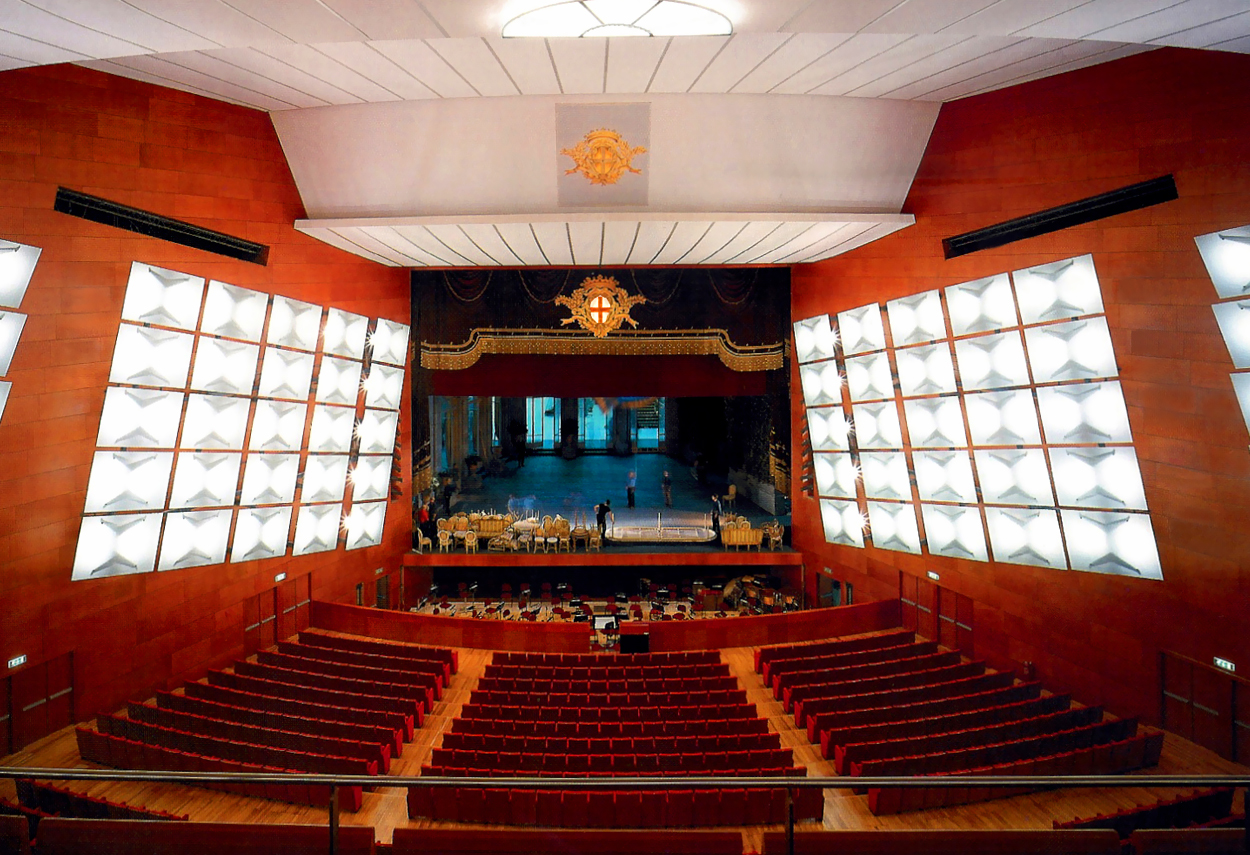
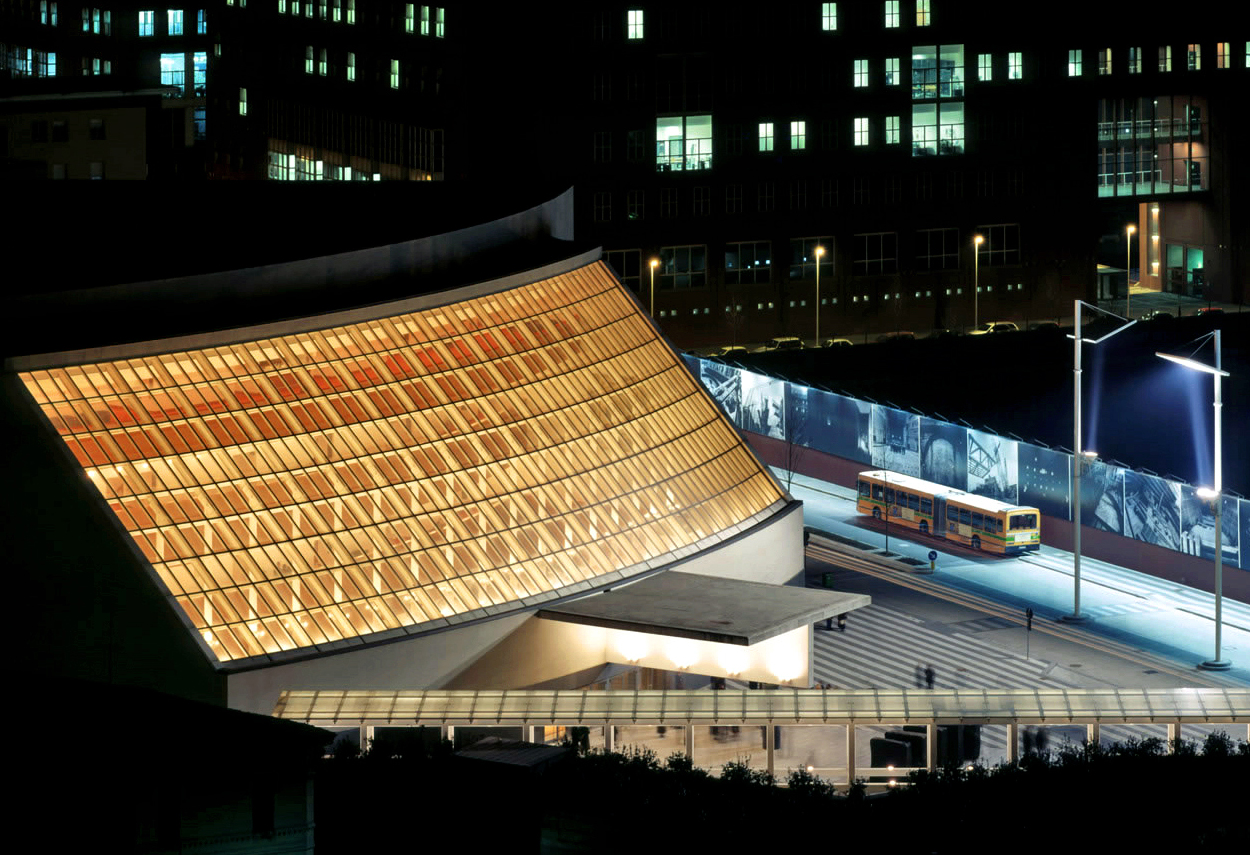
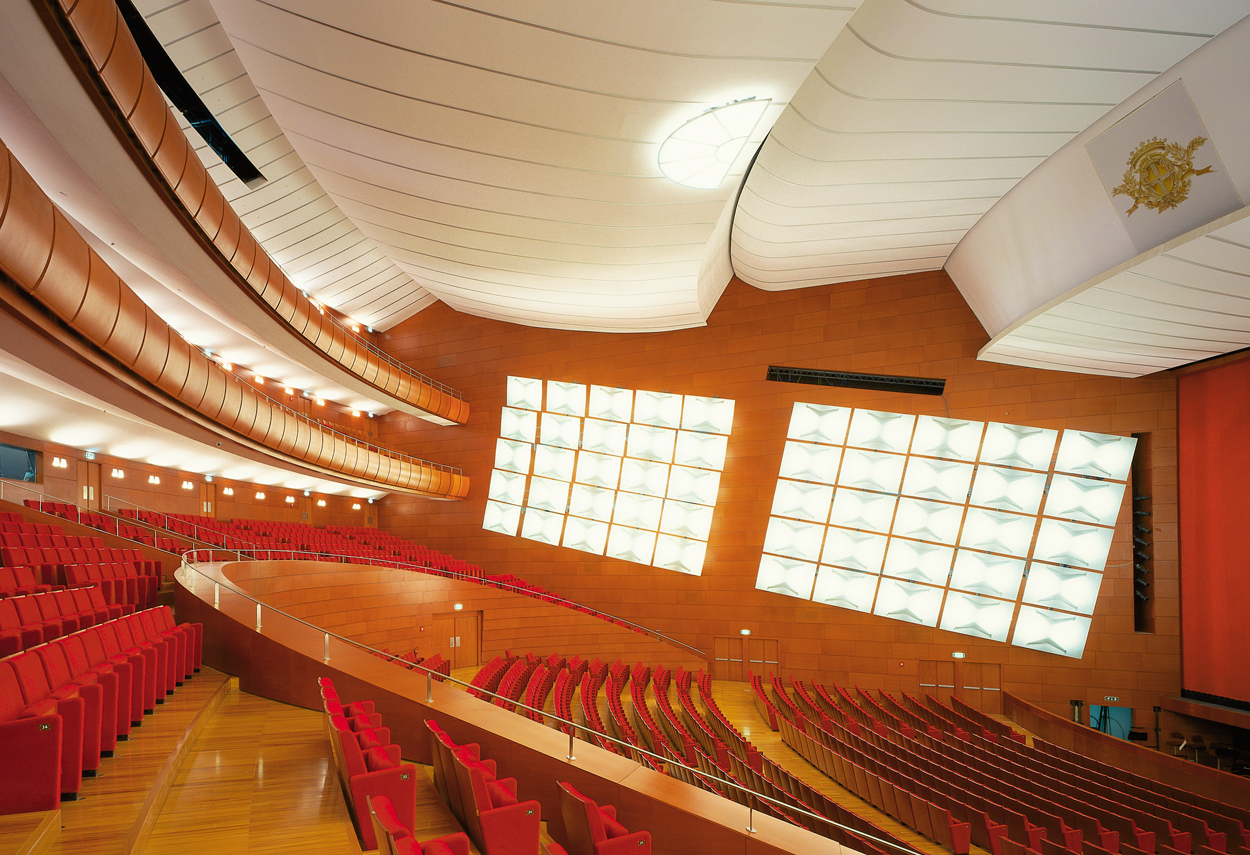
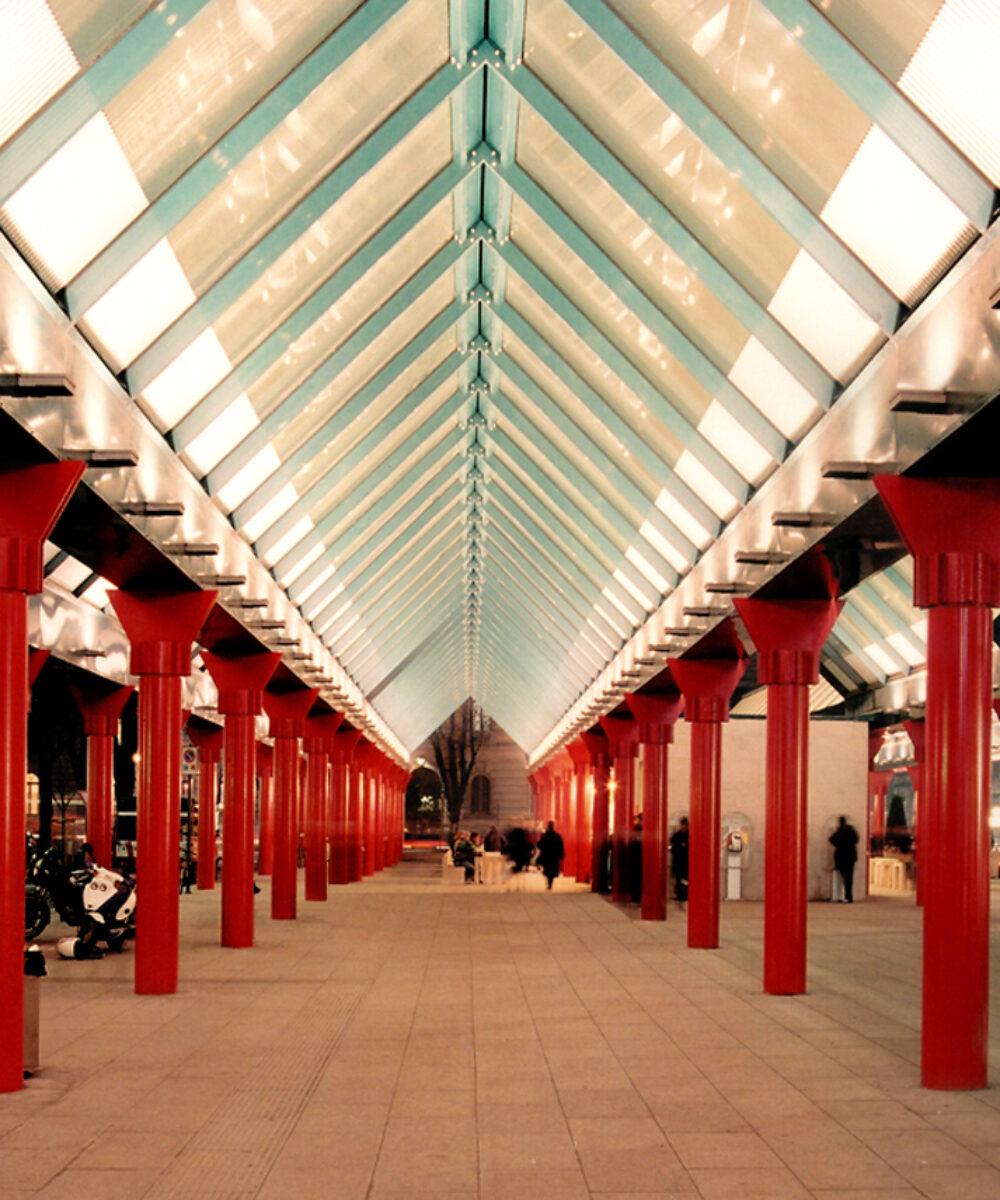
The new Teatro degli Arcimboldi, in the former industrial area of La Bicocca, a suburb of Milan, was inaugurated at the beginning of 2002. The building's structure is divided into three clearly recognisable volumes: the common areas (entrance, ticket office and foyer), the auditorium and the stage tower. Composed of a large curved and sloping glass wall, with a canopy that marks the entrance for the public, the new project fits into a square. Inside, the large glass wall rises to its full height: steel pillars mark out the hall that houses the ticket office, bookshop, cloakroom and stairwells. The balconies of the stalls and galleries overlook this area. The lighting design is provided by luminaires incorporated or integrated into the architectural elements, equipped with low-voltage lamps with various wattages and beam emissions. Custom lighting design consisting of a crown of 12 dichroic lamps surround each steel column in the entrance hall and the first level of the balconies: they provide the architectural lighting of the rooms and create a brilliant series of reflections in the large glass wall. For architectural lighting, "Radius" type luminaires were installed on the central beam of the entrance canopy to give a strong and uniform light to the surface of the canopy, creating a strong and inviting sign. Glass panels, used both to regulate sound reflection on the stalls and to diffuse light, provide some of the light in the concert hall. The wooden walls of the balconies house recessed luminaires with compact fluorescent lamps, while hanging in the centre of the hall, a large semi-circular chandelier specially designed with five sections of laminated glass panes, supported by a metal structure, uses 118 halogen lamps to provide general and overhead lighting for the stalls. This work was the result of close collaborations between the two professionals, the many meetings at the table between lighting designer Castiglioni and Gregotti led to a project integrating light and architecture.
Project:
Lighting Design Piero Castiglioni
Collaborations:
Gregotti Associated Architects
Photo Courtesy:
Piero Castiglioni
Year:
2002
The new Teatro degli Arcimboldi, in the former industrial area of La Bicocca, a suburb of Milan, was inaugurated at the beginning of 2002. The building's structure is divided into three clearly recognisable volumes: the common areas (entrance, ticket office and foyer), the auditorium and the stage tower. Composed of a large curved and sloping glass wall, with a canopy that marks the entrance for the public, the new project fits into a square. Inside, the large glass wall rises to its full height: steel pillars mark out the hall that houses the ticket office, bookshop, cloakroom and stairwells. The balconies of the stalls and galleries overlook this area. The lighting design is provided by luminaires incorporated or integrated into the architectural elements, equipped with low-voltage lamps with various wattages and beam emissions. Custom lighting design consisting of a crown of 12 dichroic lamps surround each steel column in the entrance hall and the first level of the balconies: they provide the architectural lighting of the rooms and create a brilliant series of reflections in the large glass wall. For architectural lighting, "Radius" type luminaires were installed on the central beam of the entrance canopy to give a strong and uniform light to the surface of the canopy, creating a strong and inviting sign. Glass panels, used both to regulate sound reflection on the stalls and to diffuse light, provide some of the light in the concert hall. The wooden walls of the balconies house recessed luminaires with compact fluorescent lamps, while hanging in the centre of the hall, a large semi-circular chandelier specially designed with five sections of laminated glass panes, supported by a metal structure, uses 118 halogen lamps to provide general and overhead lighting for the stalls. This work was the result of close collaborations between the two professionals, the many meetings at the table between lighting designer Castiglioni and Gregotti led to a project integrating light and architecture.
Project:
Lighting Design Piero Castiglioni
Collaborations:
Gregotti Associated Architects
Photo Courtesy:
Piero Castiglioni
Year:
2002
Other Projects
This section presents a representative selection of lighting design projects by Piero Castiglioni, developed across architectural, museum, urban, cultural, retail, hospitality, and infrastructural contexts, both in Italy and internationally. The gallery documents a range of interventions differing in scale, function, and context, united by an approach to light as a tool for interpreting space—capable of engaging with architecture, artworks, landscape, and contemporary use.
The featured projects span museums, foundations, and temporary exhibitions, as well as historic buildings, places of worship, public spaces, and urban complexes, extending to corporate headquarters, private residences, yachts, and lighting masterplans. In each project, light is conceived as a design material—carefully controlled and calibrated in relation to the specific characteristics of the site, functional requirements, and the perceptual quality of the experience.
Taken together, these works outline a vision of lighting design as an integrated process, where technical rigor, cultural sensitivity, and contextual awareness contribute to shaping identity, orientation, and spatial value. The gallery thus becomes a design map, illustrating how light can assume different roles—subtle or expressive—while consistently maintaining coherence, precision, and design awareness.
Other Projects
This section presents a representative selection of lighting design projects by Piero Castiglioni, developed across architectural, museum, urban, cultural, retail, hospitality, and infrastructural contexts, both in Italy and internationally. The gallery documents a range of interventions differing in scale, function, and context, united by an approach to light as a tool for interpreting space—capable of engaging with architecture, artworks, landscape, and contemporary use.
The featured projects span museums, foundations, and temporary exhibitions, as well as historic buildings, places of worship, public spaces, and urban complexes, extending to corporate headquarters, private residences, yachts, and lighting masterplans. In each project, light is conceived as a design material—carefully controlled and calibrated in relation to the specific characteristics of the site, functional requirements, and the perceptual quality of the experience.
Taken together, these works outline a vision of lighting design as an integrated process, where technical rigor, cultural sensitivity, and contextual awareness contribute to shaping identity, orientation, and spatial value. The gallery thus becomes a design map, illustrating how light can assume different roles—subtle or expressive—while consistently maintaining coherence, precision, and design awareness.