
The Castiglioni Brothers: Masters of Italian Design, Amidst Invention, Irony, and Rigour
From 1930s Milan to industrial design: the cultural and design journey of the Castiglioni family
The three Castiglioni brothers—Livio, Pier Giacomo, and Achille—are firmly established within the Italian design tradition, making a decisive contribution to the definition of a design culture that, between the 1930s and the late 1900s, evolved from an emerging phenomenon into a mature, internationally recognized language. Sons of the sculptor Giannino Castiglioni, a leading interpreter of twentieth-century plastic art, the brothers grew up in an intellectually fertile environment, inheriting an artistic and industrial sensibility that ran through the family. This context also shaped the figure of Piero Castiglioni, Livio's son, born in Lierna in 1944. He focused his research exclusively on light, making this material the subject of in-depth theoretical and experimental exploration that placed him among the protagonists of contemporary lighting thought.
The three brothers graduated from the Polytechnic University of Milan, becoming part of the generation of designers entrusted with the interpretation of the new concept of the integral architect, developed by Gustavo Giovannoni as part of the reform of architecture education. This new model envisioned a combination of technical rigor and humanistic training, reinforced by the practice of composition and drawing. This approach allowed them to address the various scales of design—from urban to domestic—with methodological consistency.
The Castiglioni brothers' identity of thought stems from the interaction of three distinct personalities rooted in a shared vocation for experimentation. It is in this synthesis that the stylistic signature of the Castiglioni brothers is discernible, whose work has profoundly influenced both the practice and the imagination of Italian product design.
During Italy's transition toward the industrialization of design, the three brothers—Livio, Pier Giacomo, and Achille Castiglioni—established themselves as pioneers of a new way of conceiving everyday objects. A photograph taken in November 1961 shows them with some of their most iconic projects: a table and wall radio, and a set of cutlery created in collaboration with Luigi Caccia Dominioni, dating back to the pre-war period. These seemingly simple artifacts embody the founding essence of Italian industrial design, in which technical innovation, formal research, and attention to everyday use are harmoniously intertwined. The radio, in particular, represents a modernist reflection on the aesthetics of household appliances, while the cutlery represents one of the first cases in which function is translated into a design language that can be industrially replicated. The Castiglioni brothers' approach anticipates the logic of design as an autonomous discipline, shaping a methodological approach that will become a model for subsequent generations. It is in this period, suspended between analytical rigor and creative freedom, that the complex figure of the Italian designer begins to emerge, a synthesis between engineer, architect, and craftsman of modernity.
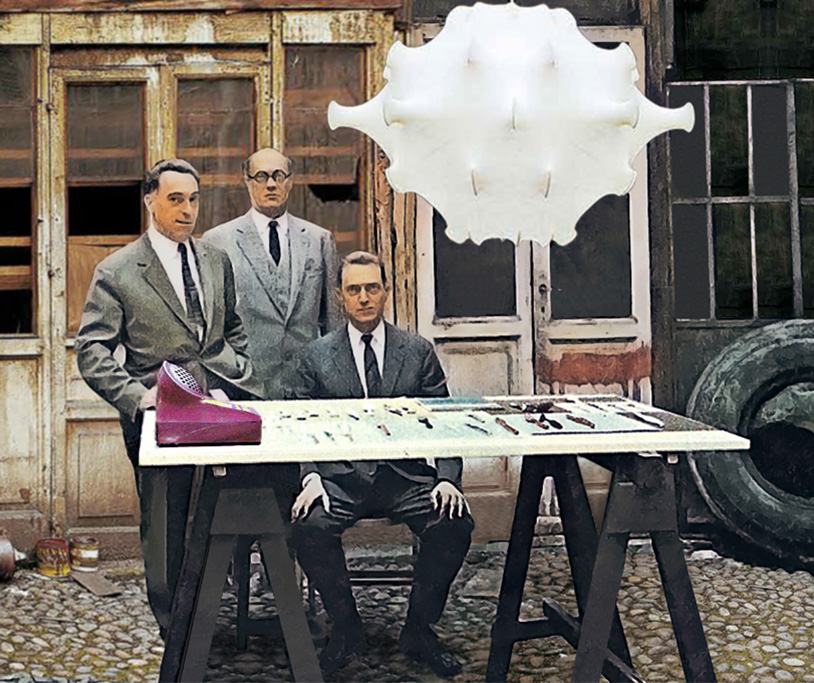
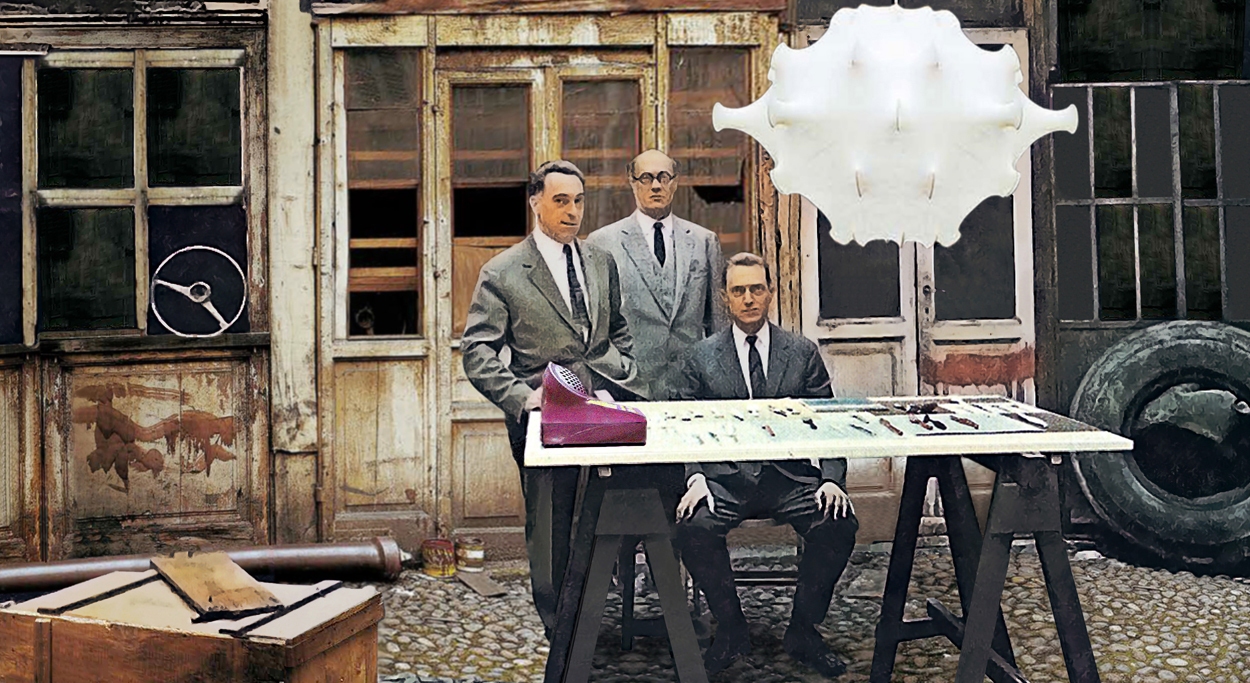
In Evaristo Fusar's famous 1961 photograph, the three brothers are portrayed in the courtyard of their Porta Nuova studio, behind a worktable with some of their early prototypes. Above, the Cocoon Taraxacum lamp, recently designed for Flos, softly illuminates their faces.
Livio Castiglioni's academic career ended in 1936, followed the following year by Pier Giacomo's, while Achille, the youngest, graduated in 1944, during the height of the war. The three worked together in the same studio until 1952; subsequently, Livio's professional career took a different direction, focusing primarily on consulting for companies such as Phonola and Brionvega, specializing in the design of electroacoustic technologies. The collaboration between Achille and Pier Giacomo intensified, culminating in an extraordinarily fruitful design season. After the premature death of Pier Giacomo in 1968, and that of Livio in 1979, Achille would continue his brothers' legacy, building on their wealth of experience and transposing it into his professional practice and teaching until the 1990s.
In the urban fabric of Milan, where the Martesana Canal once lapped the Porta Nuova Bastion, a street was recently named after the Castiglioni brothers, winding discreetly between the new vertical architecture. This recognition, though inserted into a now-altered landscape, restores continuity to a memory rooted in that very area: it was there that the brothers grew up and took their first steps as professionals. The area, already home to Milan's first railway station, experienced significant industrial development between the 19th and 20th centuries, with the presence of companies such as Grondona (later OM), Ernesto Breda's Elvetica, and the first Pirelli factory, later relocated to Bicocca.
The Milan where the Castiglioni family trained and worked was a booming metropolis, surpassing one million inhabitants in the early 1930s, becoming a central hub for European economic and cultural dynamics. The industrial landscape was diverse: mechanical engineering, metallurgy, textiles, publishing, chemicals, wood, and leather. Added to this was a network of small workshops and laboratories, especially in the central areas. In this context, the construction of the Trade Fair in 1923 and, ten years later, the inauguration of the Palazzo dell'Arte della Triennale designed by Giovanni Muzio, offered new opportunities for a generation of architects who identified with the magazines Domus and Casabella, edited respectively by Gio Ponti and Giuseppe Pagano with Edoardo Persico.
In both contexts—the Fiera and the Triennale—the Castiglioni brothers were key figures, shaping a design practice capable of combining experimentation and technical rigor, and forging significant relationships with manufacturing companies. The Porta Nuova area, where the brothers began their first collaborations, was densely connected to cultural institutions and cutting-edge businesses: from the Permanente, rebuilt after the war, to the Montecatini offices designed by Gio Ponti in 1938, equipped with the most modern communications technologies. A lasting relationship was forged with Montecatini, resulting in numerous trade fair displays. A short distance away, on Via Palermo, the Olivetti Advertising Office was established, a transit hub for Italy's finest graphic designers. The BBPR group also had its headquarters nearby. In 1936, the group won a competition sponsored by Domus for a new radio, championing the need to give the technological object an appearance consistent with its intended purpose, far removed from the logic of home furnishings.
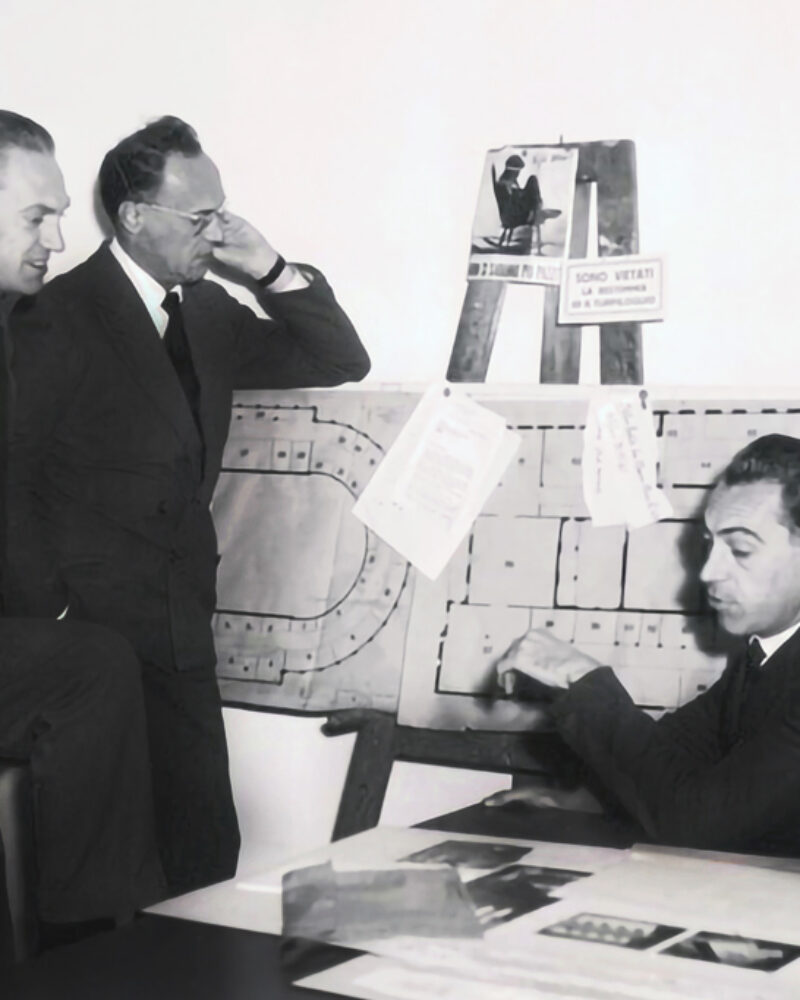
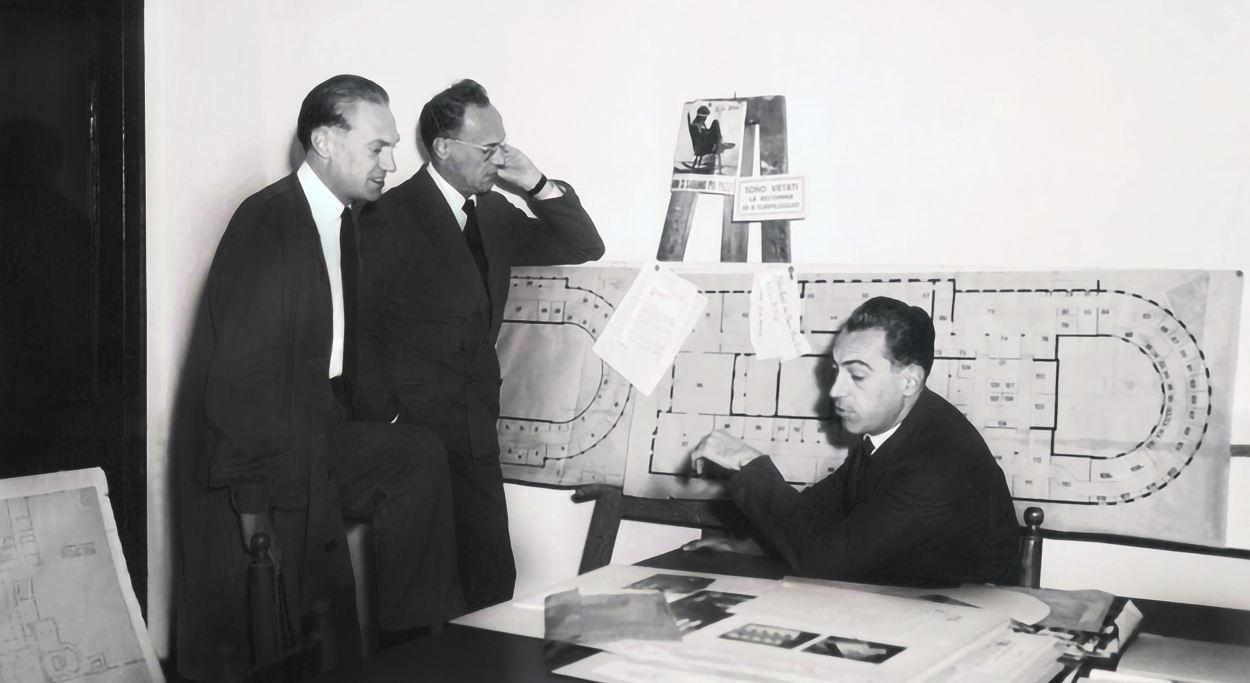
Under the supervision of BBPR, in 1936, Livio, together with Caccia Dominioni and Pier Giacomo, then still a student, designed the "Priorità italiche in arte" room at the VI Triennale di Milano. The light and sophisticated project introduced an original lighting solution, anticipating themes that would be central to their future research. In Lierna, at his father's second sculpture studio, the group developed their first projects for public buildings and private homes, drawing inspiration from the masters of Como rationalism, such as Giuseppe Terragni and Pietro Lingeri. At the same time, Livio, a passionate amateur radio operator, independently built radio sets, developing the idea that design should arise from a synthesis of functionality, construction, and interaction. This reflection led him, from 1938 onwards, to write for leading magazines in the field, contributing to the redefinition of the aesthetics of technological objects.
Within this design trajectory, Livio and Pier Giacomo decisively introduced an interest in sound and lighting technologies into the studio, laying the foundation for an increasingly close collaboration with the manufacturing industry. A concrete opportunity to explore the relationship between aesthetics and technology arose at the VII Triennale in 1940, with the Radio Equipment Exhibition. For that occasion, together with Luigi Caccia Dominioni, the two brothers created twenty working models of radios and radio-phonographs, anticipating the forms and languages of industrial design through devices that combined technical functionality and expressive rigor. It was during this phase that Fimi-Phonola of Saronno acquired two of the developed designs, transforming them into compact devices intended for serial production, available in numerous color variations. These experiments are in perfect harmony with other contemporary examples, such as the Summa Olivetti calculating machine by Marcello Nizzoli, and are welcomed by critics as archetypes of nascent Italian industrial design, in which form, function and mode of use are integrated into a coherent unity.
"The concepts expressed and implemented by the Milanese group of the VII Triennale," Livio writes, "were too far ahead of current taste, compared to the production techniques of the time [...]. More than a decade passed, partly due to the war and the difficulties of reconstruction, before the market's production structure incorporated the proposals being put forward at the time."
After the interruption caused by the war, the brothers reunited in Lierna, where the family had taken refuge following the bombing of Milan. At this point, their collaboration with Caccia Dominioni ended, and he would embark on his own path. With Achille's official entry into the studio, following his graduation in 1944, the specific aptitudes of the three brothers became clearly defined: Achille and Pier Giacomo jointly dedicated themselves to the design of spaces and objects, prioritizing the integration of form, function, and communication; Livio, on the other hand, focused his research on immaterial aspects such as sound, light, and technological interaction, anticipating many of the reflections that would characterize the design of the 1960s and 1970s.
It is in this climate of intense industriousness that one of the studio's most emblematic atmospheres was born: a disciplined and monastic place, described years later by Massimo Vignelli, then a young collaborator. He remembered Livio isolated in a side room, intent on listening to radio signals through headphones, surrounded by his instruments; while Achille and Pier Giacomo, seated at the large drawing table, enthusiastically and humorously discussed their ideas. The space was illuminated by white enameled industrial lamps and dominated by Lips Vago bookcases overflowing with prototypes and materials: among them, the Phonola radio, now a symbol of Italian style, and the legendary Moretti camp chairs.
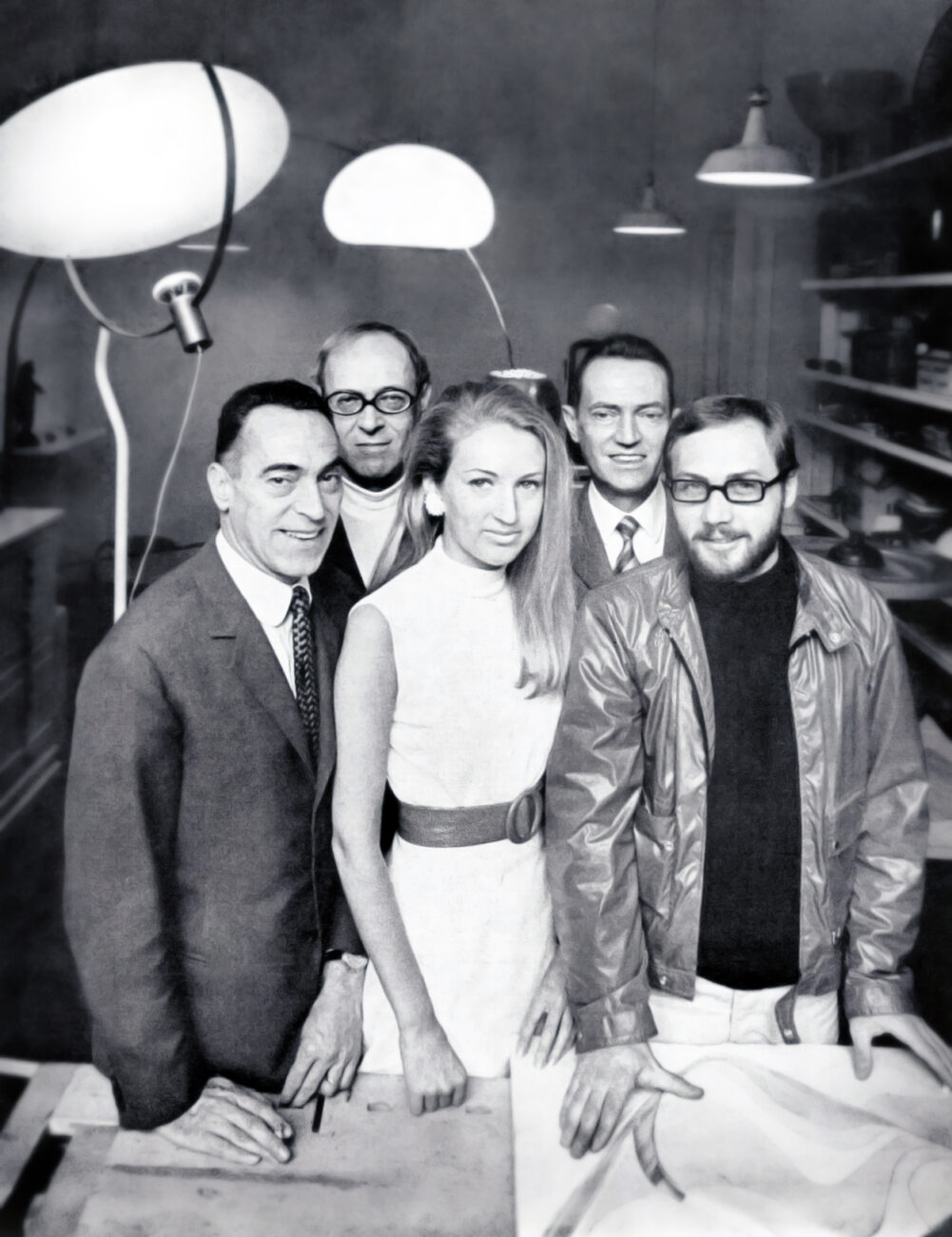
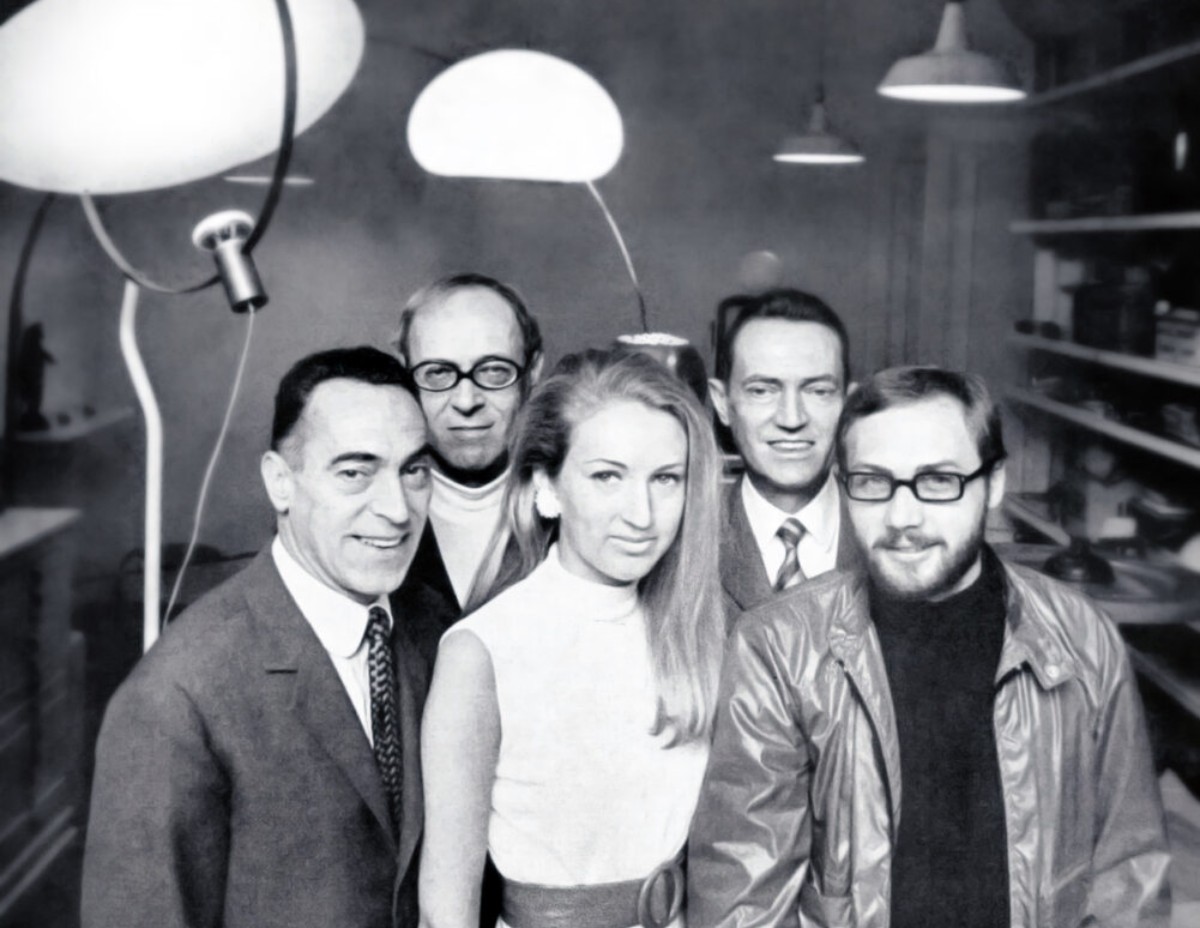
Milan, 1968 – In their studio in Piazza Castello, from left: architects Achille Castiglioni, Livio Castiglioni, Giorgina Castiglioni, Pier Giacomo Castiglioni, and Piero Castiglioni. A rare family portrait that captures three generations of designers, key figures in the birth of Italian design and the culture of lighting.
Pier Giacomo, a thoughtful and measured figure within the studio, and Achille, gifted with an ironic and irreverent creative streak, engaged in a constant dialogue about their creations, alternating between bursts of enthusiasm and moments of conscious sobriety, always guided by an attitude free from ostentation. Their exchange unfolded as a continuous dynamic, based on collaborative design and emblematic gestures, including that characteristic tilt of the face to the left, almost a reserved expressive code, a sort of nonverbal language that established the understanding and unity of purpose in their daily practice.
After World War II, the studio's activities expanded into various fields: urban planning, architecture, trade fair design, and corporate consulting. In particular, Pier Giacomo developed a theoretical reflection that led him to found the MSA – Movimento di Studi per l’Architettura (Movement of Studies for Architecture) in 1945, together with Ernesto Nathan Rogers, whom he would later serve as assistant to at the Milan Polytechnic, after working alongside Piero Portaluppi and Gio Ponti. In 1958, he earned a teaching position in Architectural Composition, and in 1964, a chair in Drawing and Surveying. His architectural projects, often in collaboration with Achille, reflect the dialectic between internationalism and regionalism, interpreting the tension between the legacy of the Modern Movement and Rogers's call—expressed in the pages of Casabella—to emancipate oneself from a rigidly Central European rationalist vision.
The studio's versatility is particularly evident in temporary installations, which became a favored field of experimentation from the 1950s onward. Their initial experiences stemmed from their relationship with ANIE – the National Association of Electrotechnical Industries – but quickly expanded to include companies operating in the chemical, energy, and communications sectors. The ephemeral nature of their installations, combined with the potential for abstract figuration, allowed the Castiglioni brothers to freely explore languages and formal solutions. This context led to collaborations with some of Italy's leading visual designers: Erberto Carboni, Bruno Munari, Max Huber, Pino Tovaglia, Heinz Waibl, Michele Provinciali, and Giancarlo Iliprandi.
The success achieved through the installations and participation in the 1951, 1954, and 1957 Triennales attracted the attention of a growing number of companies. It was in these projects that lighting solutions emerged as distinctive elements, prefiguring some of the lamps that would later be mass-produced. The first significant commission in the household appliance sector came from REM, a vacuum cleaner manufacturer, for which Pier Giacomo and Achille designed the Spalter model in 1956, an innovative solution in terms of both shape and technology.
During the same period, the Castiglioni family consolidated their partnership with entrepreneur Dino Gavina, promoted by Lucio Fontana, which would lead to long-lasting collaborations in the fields of furniture and lighting. Also in 1956, the Castiglionis participated in the founding of the ADI – Association for Industrial Design, where they held active roles in its steering committees. Livio Castiglioni served as its president between 1959 and 1960. The ADI was founded with the aim of promoting the professional recognition of designers and promoting design as a tool for economic and cultural growth. Among its most significant initiatives was the creation of the Compasso d'Oro Award, designed to recognize the excellence of Italian industrial products.
In 1955, Achille and Pier Giacomo received their first Compasso d'Oro for the Luminator lamp, followed by numerous other awards in subsequent years. Another key moment in this cultural era was the magazine Stile Industria, founded in 1954 by Alberto Rosselli, Gio Ponti's studio partner, which for nearly a decade served as an important platform for discussion between Italian design and the European and American contexts.
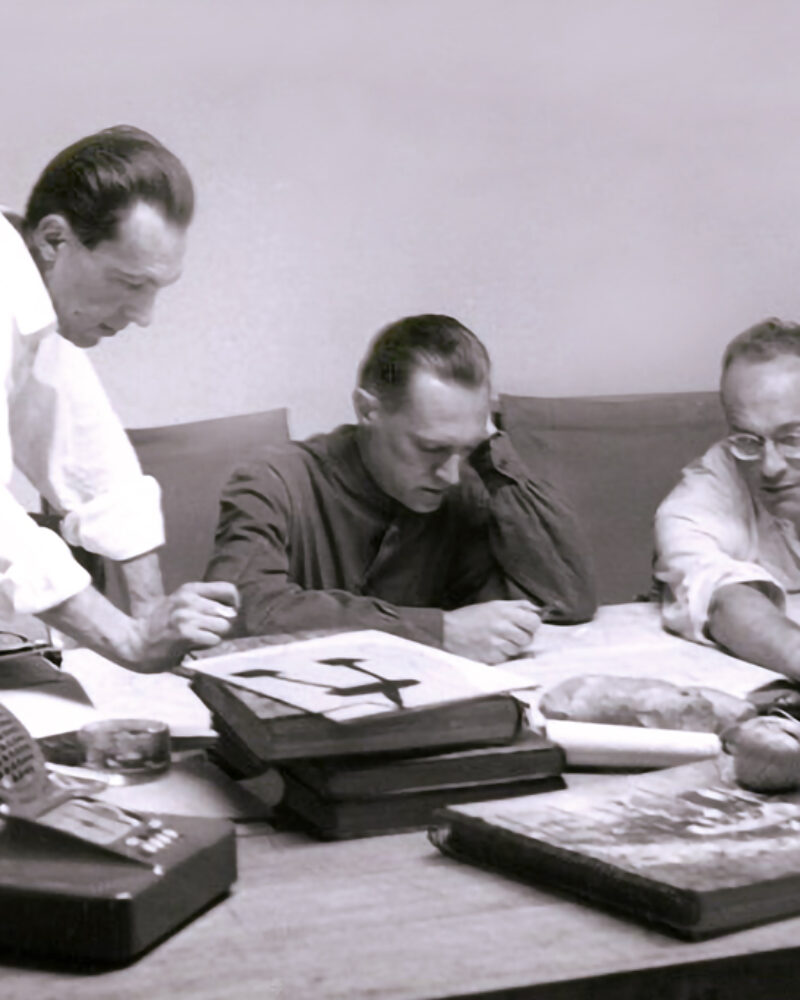
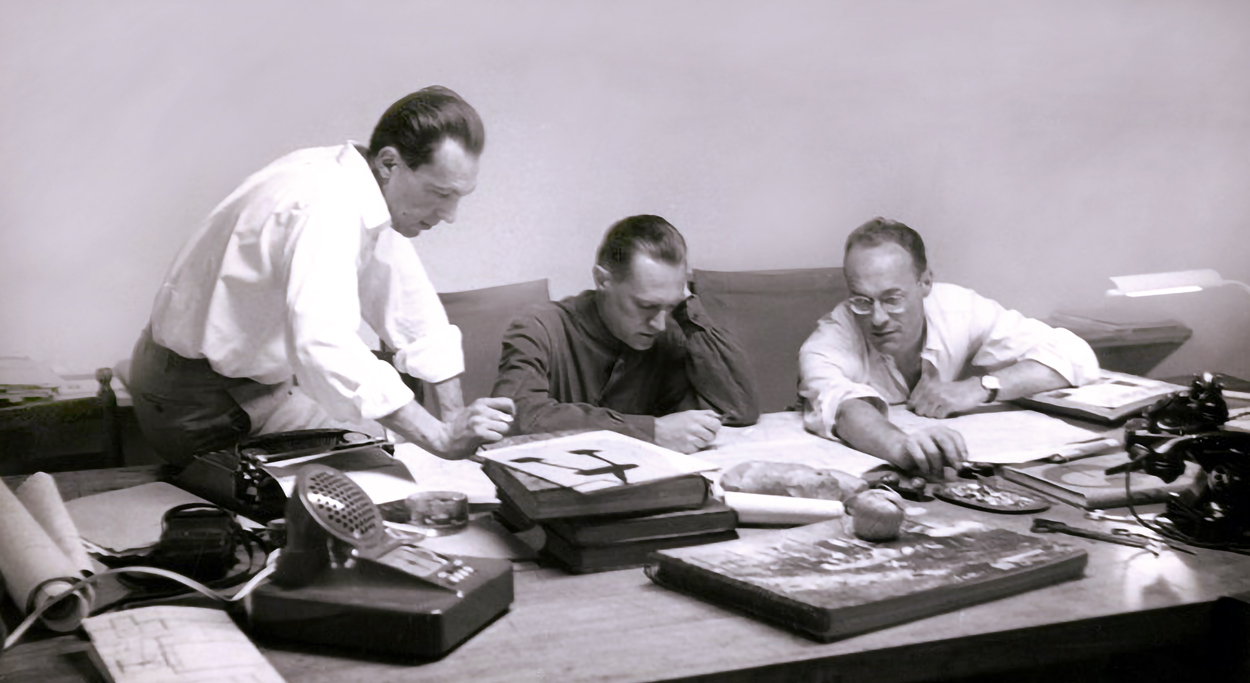
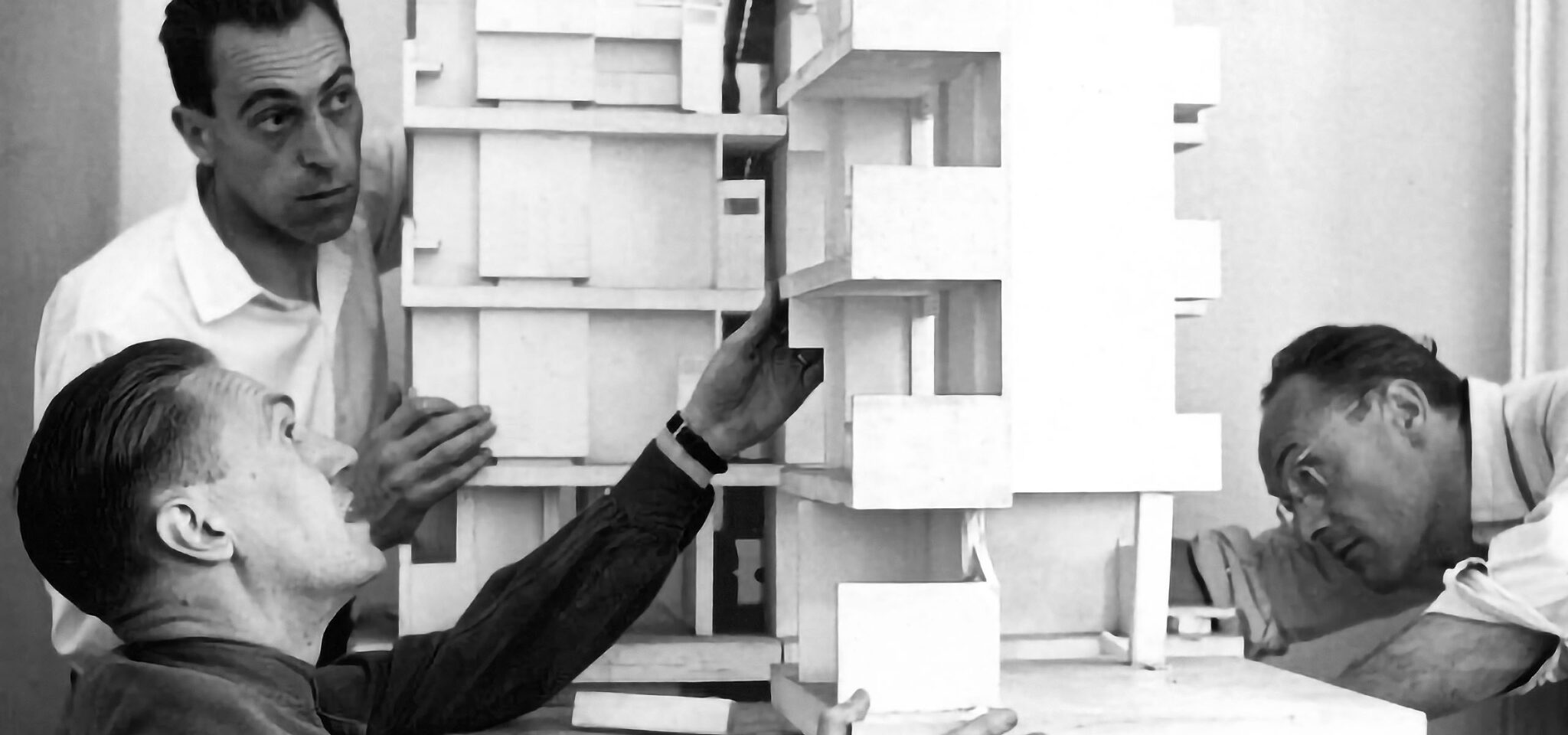
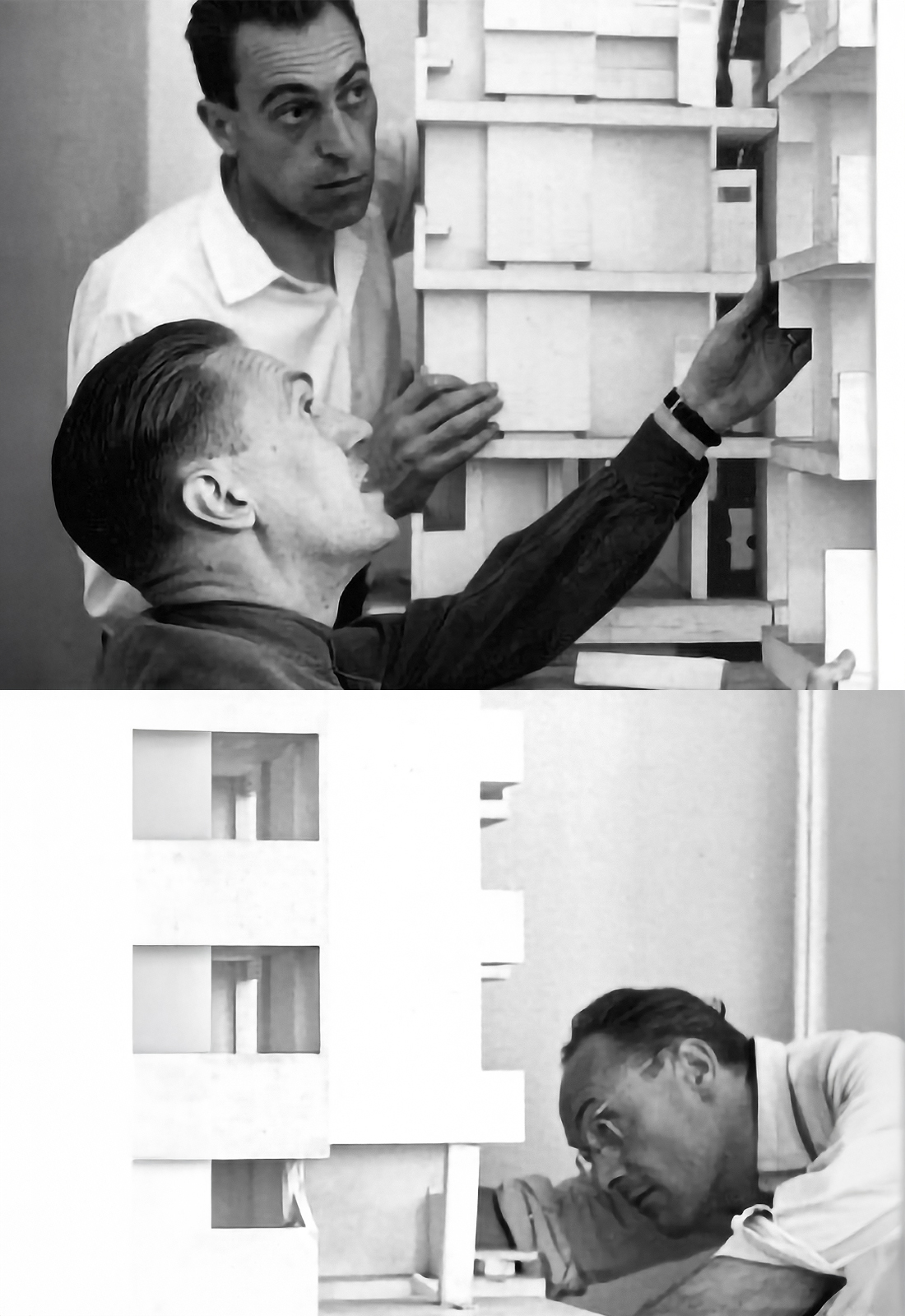
Milan, 1952 – Achille, Pier Giacomo, and Livio Castiglioni in their Porta Nuova studio. The image conveys the intense and industrious atmosphere of their shared method, founded on experimentation, direct comparison, and the integration of design, technology, and the artist's vision.
In 1959, during a trip to the United States organized by the College of Architects of Milan, the Castiglionis visited the Chicago Institute of Technology, where they presented their projects to students and faculty. That same year, they won the Design Competition for Italy, sponsored by the American firm Reed & Barton, with two sets of cutlery—Secco and Dolce—in which they applied industrial techniques such as extrusion profiling and punching, giving traditional forms a new functional and aesthetic coherence.
Towards the end of the 1950s and then in the early 1960s, the Castiglioni brothers' research took shape in the definition of a true design poetics, based on principles of reassembly, a plastic relationship with the human body, the recovery of anonymous design, and a strong playful component, intended as a strategy for engaging the user. In 1957, in the exhibition Colori e forme della casa d’oggi at Villa Olmo (Como), and in the subsequent installation of the Splügen Bräu restaurant (1960), they developed a grammar of prototype objects that would give rise to iconic products: among these, the Mezzadro stool, the Sella seat, the Pensile bookcase, the Cubo armchair, the Splügen Bräu lamp, the Spluga stool, and the first elements of the Servo system: Servofumo and Servopluvio. Starting from this intense creative season, the Castiglioni brothers also translated their design principles into the field of lighting, designing a series of lamps that became symbols of twentieth-century Italian design, many of which are still in production today.
Among the most emblematic is the Arco lamp (1962), designed by Achille and Pier Giacomo for Flos, inspired by street lamps and conceived to illuminate a table without the bulk of a ceiling lamp: the steel arch and the solid Carrara marble base represent a perfect balance between function and material. The Taccia (1958-1962), also for Flos, was born from a provocative idea: an inverted diffuser that acts as a reflector, returning an indirect and sophisticated light. The Toio (1962), a hybrid between a car headlamp and a minimal structure, embodies the poetics of functional reuse, just as the Luminator (1954), awarded the Compasso d'Oro, stands out for its essential form and technical innovation in the cooling of the source. Also of great importance is the Lampadina (1972), which deliberately exposes the luminous element, making fun of the lamp-object; Fuchsia (1996), later created by Achille alone, represents a mature reflection on the luminous effect and formal lightness.
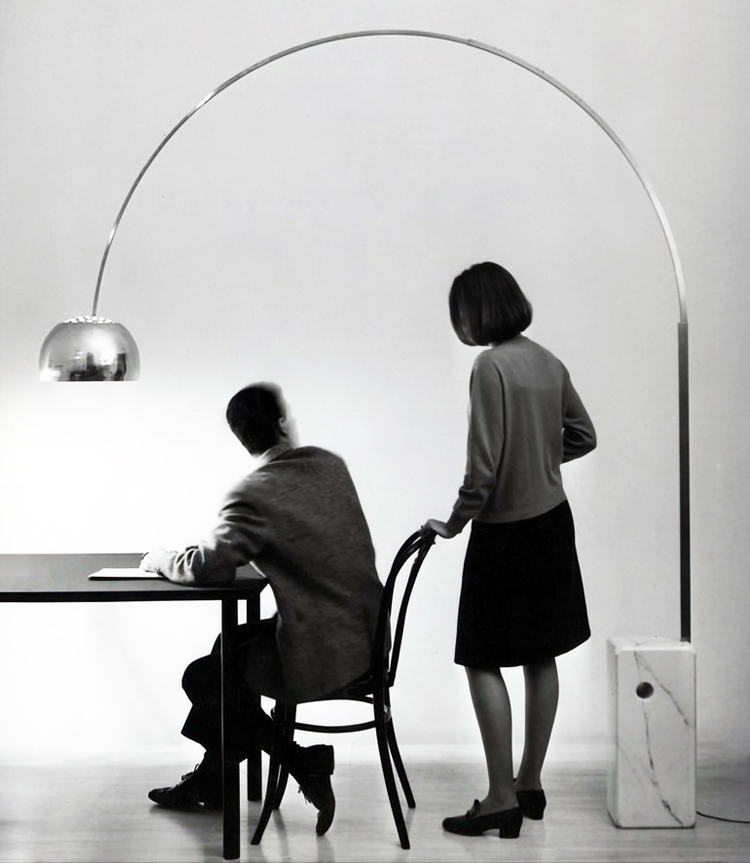
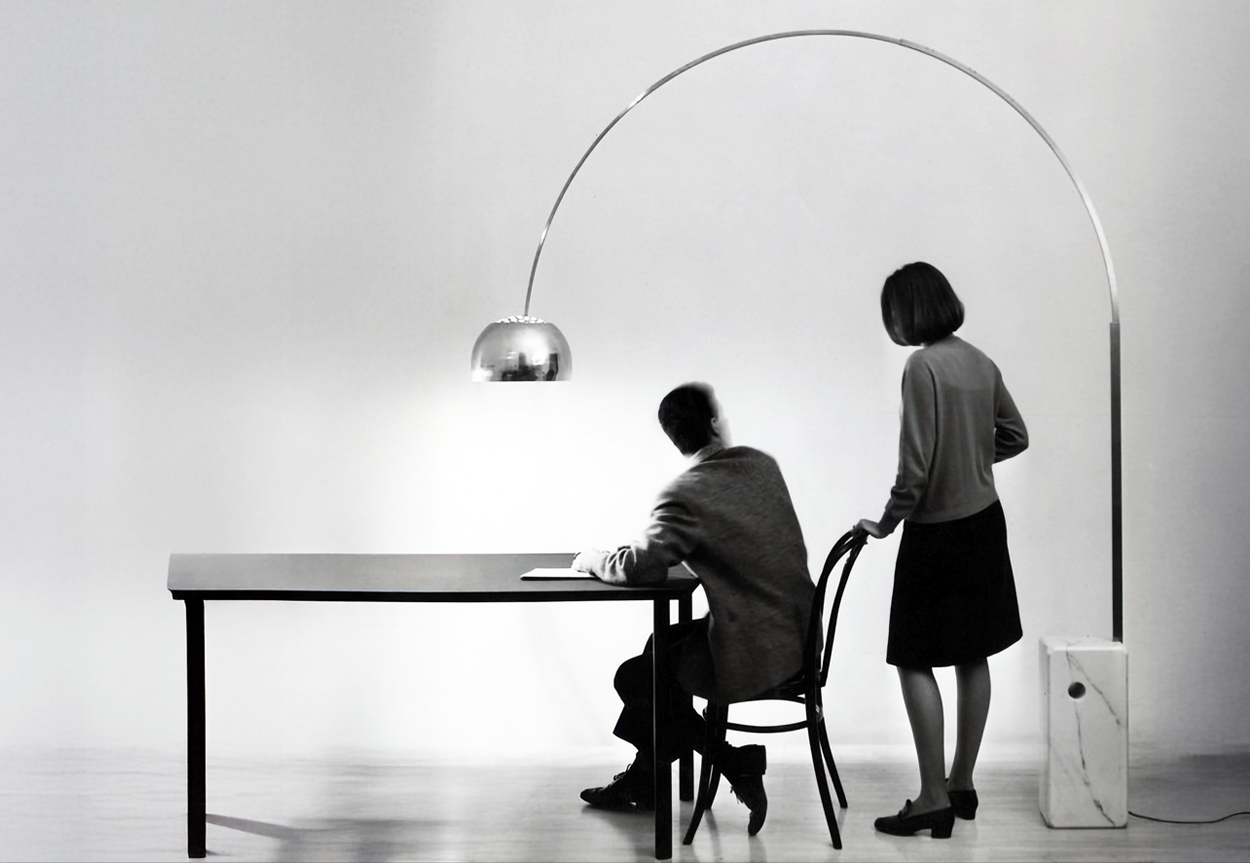
The Arco lamp, designed by Achille and Pier Giacomo Castiglioni in 1962 for Flos. Designed to provide pendant lighting without a ceiling installation, it features a Carrara marble base, an arched stainless steel stem, and an adjustable aluminum reflector. An icon of Italian design, it combines technical ingenuity and understated formal elegance.
These seemingly simple projects express a sophisticated compositional intelligence and a radically functionalist vision, capable of elevating light to a narrative and cultural device. According to architect Vittorio Gregotti, the question of the lighting designer, as well as the treatment of light and, even more so, the interest in electricity and its conduction and diffusion techniques, held a fascination for the Castiglioni brothers that was not only technical but also symbolic and evocative. Their approach, Gregotti states, is rooted in a Futurist sensibility: not so much in aesthetic rendering as in the conception of light as a technical miracle, flexible and radiant, capable of embodying the expressive potential of modernity.
In 1962, following the demolition of the historic Porta Nuova studio building, Achille and Pier Giacomo moved their studio to Piazza Castello 27, now the headquarters of the Achille Castiglioni Foundation. Livio, however, continued his work in the workshop on Via Presolana, where his son Piero Castiglioni now works.
Other Master pages
This section brings together a series of historical, critical, and cultural insights into the figures and contexts that contributed to the birth and establishment of lighting design as an autonomous discipline. The content explores Piero Castiglioni's role in defining a design approach in which light becomes a structural part of architecture, and the experimental origins of Italian lighting design through the research of Livio Castiglioni, in which light and sound are configured as immaterial languages of the project.
The section also explores the contribution of the Castiglioni brothers, tracing their cultural journey from 1930s Milan to the development of Italian industrial design, and analyzes the central role of the Studio on Via Presolana as a laboratory for experimentation and training for generations of lighting designers.
The overview is rounded out with a reflection on the great masters of design, from rationalism to postmodernism, highlighting the cultural and methodological legacy that has redefined the relationship between light, space, and living in contemporary design.