
Interpreting space: Enhancing identity and improving usability
Method, architectural integration and perceptual control
Marco Petrucci's methodological approach is based on an integrated, critical and systemic vision of lighting design, understood as a design discipline capable of having a decisive impact on the architectural, perceptive and functional quality of space. Lighting design is conceived as a structural part of the architectural project, capable of reinforcing its legibility, hierarchy and identity.
Each project is the result of an in-depth analysis of the physical, historical and cultural context, the intended functions and the ways in which the space is used. Light is used as a tool for interpreting architecture, capable of revealing volumes, materials and proportions without altering their formal balance. This approach makes it possible to develop coherent, measured and durable lighting solutions, applicable to complex contexts such as museums, historic buildings, religious architecture, infrastructures, public spaces and large urban interventions.
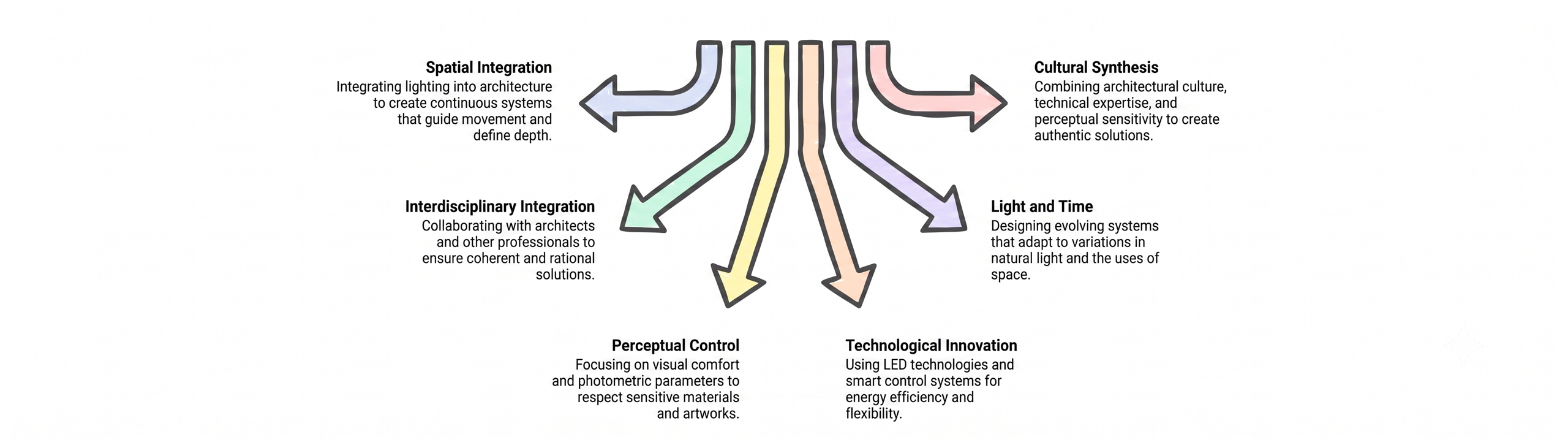
- Light as an Integrated Spatial System The methodology adopted goes beyond the concept of lighting as a simple distribution of illuminance levels, to develop instead continuous lighting systems, integrated into architecture and space. Light contributes to the construction of the perceptual sequence, accompanies movement, defines depth and controls visual contrast, favoring a clear and non-redundant reading of the environments. In this sense, lighting design operates as an invisible infrastructure, capable of orienting, qualifying and making the space recognizable, without resorting to spectacular or self-referential solutions. The goal is always to serve architecture, amplifying its spatial and symbolic contents.
- Interdisciplinary integration and the design process The central element of the approach is the early integration of lighting design into the architectural process. Lighting design is developed in close collaboration with architects, engineers, curators, artists and landscape designers, actively participating in the spatial, material and plant engineering choices. This method makes it possible to avoid corrective or overlapping solutions, favoring instead coherent, rational and perfectly integrated lighting systems, in which technology, architecture and perception operate as a single design organism.
- Perceptual control, visual comfort and technical rigor The design is based on a rigorous control of photometric and perceptual parameters, with particular attention to luminance, glare, uniformity, color rendering, color temperature and spectral distribution. Visual comfort is a fundamental criterion, especially in museums, exhibitions and historical environments, where light must respect sensitive materials, ancient surfaces and works of art. The technical choices are always supported by advanced lighting simulations and quantitative checks, ensuring regulatory compliance, perceptive quality and sustainability of the intervention.
- Technological innovation and sustainability Technological innovation is adopted as a design tool and not as an end, favoring high-quality LED solutions, intelligent control systems and dynamic light management strategies. The goal is to optimize the energy efficiency, flexibility of use and durability of the systems, reducing the environmental impact and management costs over time. Lighting design thus becomes an integral part of a vision oriented towards environmental and cultural sustainability, in which energy efficiency, quality of light and design responsibility coexist in balance.
- Light and time A distinctive aspect of the approach is the attention to the time factor. The projects are conceived as evolutionary systems, capable of adapting to variations in natural light, different times of the day and uses of space. The relationship between natural and artificial light is managed in a calibrated way, avoiding visual competitions and favoring a dynamic and controlled dialogue. This vision makes it possible to create non-static lighting environments, capable of accompanying the user experience and enhancing the architecture over time.
- Synthesis between culture, technique and design The methodological approach represents a synthesis between architectural culture, technical competence and perceptive sensitivity, matured through a continuous comparison with complex architectures and contexts of high cultural value. Each project is approached as an opportunity for research, with the aim of building authentic, coherent and long-lasting lighting solutions. Light, in this perspective, is never the absolute protagonist, but a conscious element, capable of giving shape to space, enhancing the architectural work and improving the human experience, respecting the place, function and time.
In this vision, lighting design becomes a critical design tool, capable of connecting architecture, technology and perception in a coherent and durable system. Through a defined, interdisciplinary and sustainability-oriented methodological approach, light is used to interpret the space, enhance its identity and improve its use, without ever overlapping with the architecture. Each intervention is configured as a conscious synthesis between technical innovation, perceptive control and design culture, in which the quality of light contributes decisively to the construction of the architectural experience over time.
Other About pages
This section contains the index of in-depth biographical and professional pages dedicated to Marco Petrucci, a Lighting Designer specializing in Lighting Design and Technologies. The contents trace his academic training at La Sapienza University of Rome and the Polytechnic University of Milan, the role of light as the foundation of architectural design, with particular reference to the path he developed alongside Piero Castiglioni, and the cultural and methodological legacy of the Castiglioni school.
The index continues with collaborations with international architects and studios, analyzed as forums for design dialogue and disciplinary integration, and with an in-depth look at the interpretation of space, understood as enhancing architectural identity and improving enjoyment through the perceptual control of light. The section concludes with a focus on regulatory rigor, technology, and sustainability, highlighting the application of international standards, lighting control systems, and light quality criteria as structural elements of the design process.