
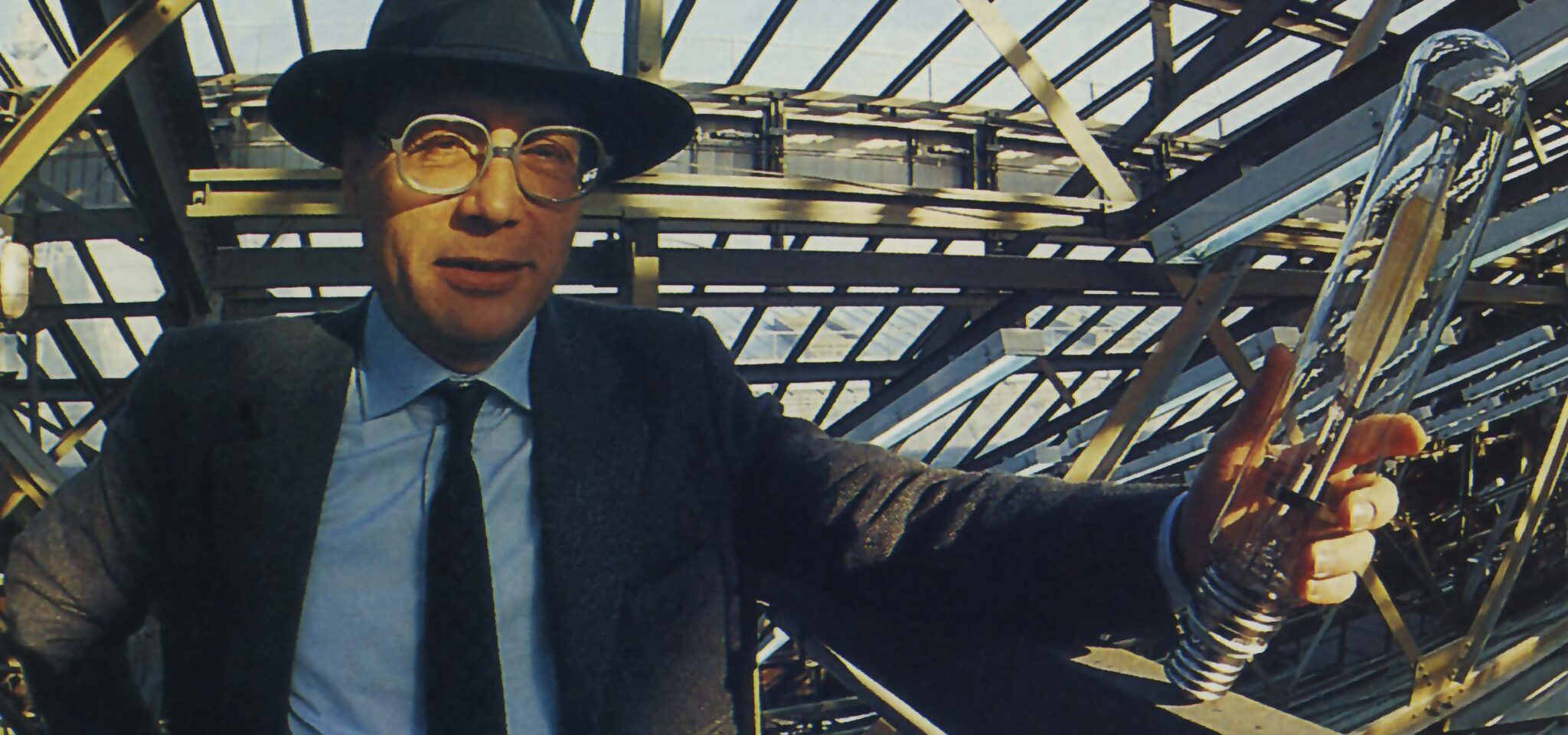
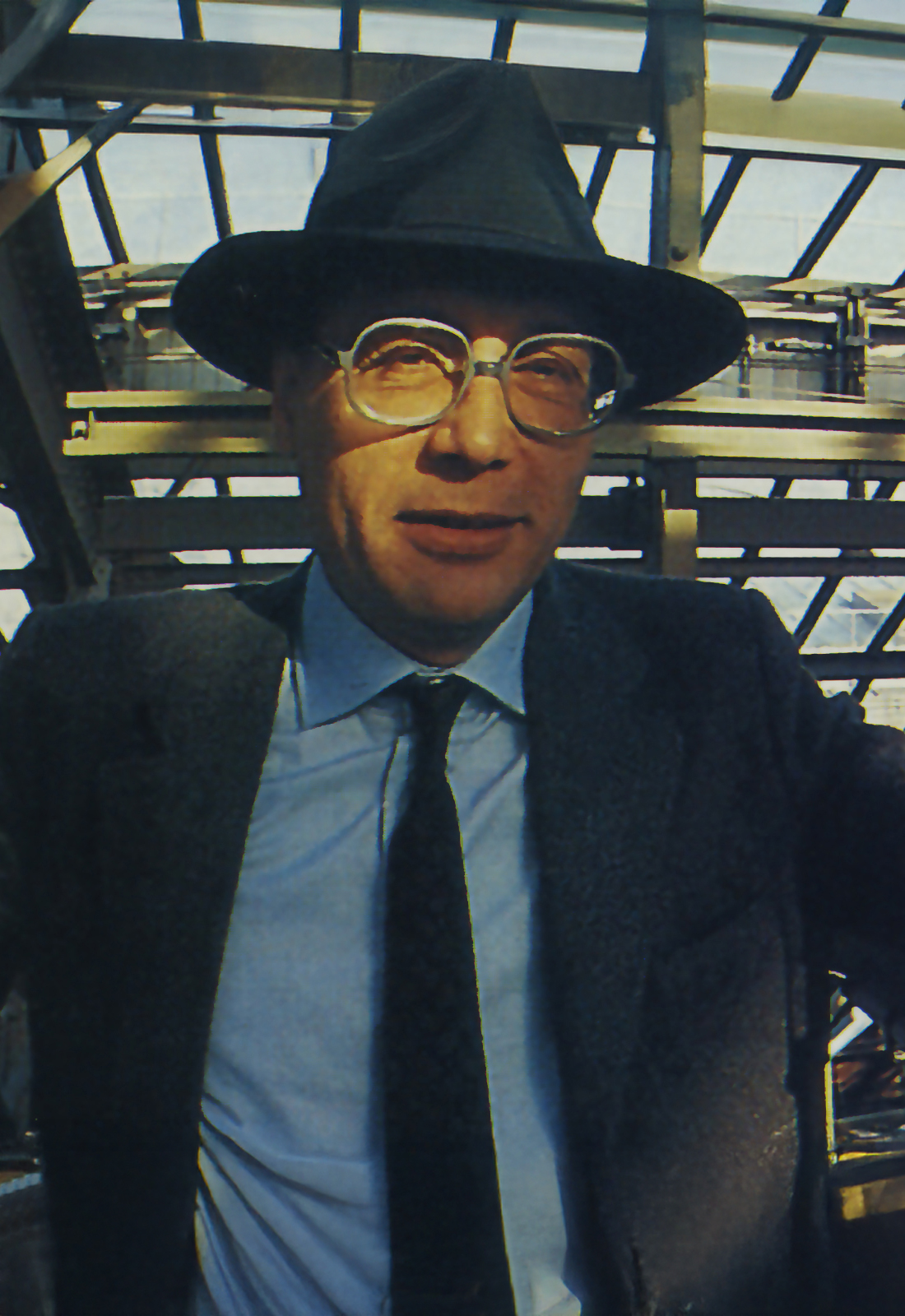
Piero Castiglioni: Architect and Lighting Designer
When design meets light: the affirmation of lighting design as an independent discipline
Design meets light and creates, for the first time in Italy, the role of the lighting designer. Piero Castiglioni's career began in the late 1960s and early 1970s, a time of profound transformation in the conditions that had fueled and supported the development of the Italian design system for at least two decades. It was a time of crisis and redefinition, in which the role of the designer, the function of the client, the mass market, and industrial logic came into conflict. In 1970, Marco Zanuso, in one of his most lucid reflections, bitterly summarized the designer's condition at that time, emphasizing how the complexities of the issues to be addressed—sociological, economic, technological—were far beyond the operational capabilities of individual designers or traditional corporate structures. His perspective highlights the growing rift between production and society, between advertising and genuine consumer engagement, between modern objects and collective needs. Modern furniture, once an elitist phenomenon, is becoming a mass-produced object, and precisely for this reason it demonstrates its disconnect with the expectations and experiences of the user.
In the 1970s, this fracture manifested itself on multiple levels: in the relationship between industry and emerging markets, in the disconnect between designers and businesses, and in the growing self-criticism that architects themselves directed at their own profession. New generations of designers sought to interpret new needs and often found themselves in open conflict with corporate strategies. The design landscape diversified and fragmented: from the futuristic and utopian visions of Joe Colombo to the ethical and radical distance of Enzo Mari, from the Situationist provocations of Ugo La Pietra to the conceptual explorations of Gaetano Pesce, and even the experience of radical design in Florence. A new design approach emerged that sought its own discursive autonomy, even at the cost of isolation from the commercial and media system of design. The 1972 exhibition at MoMA in New York, Italy: The New Domestic Landscape, on the one hand celebrated the vitality of Italian research, but on the other it confirmed the dispersion of languages and the distancing of the new generations from a productive condition perceived as inadequate.
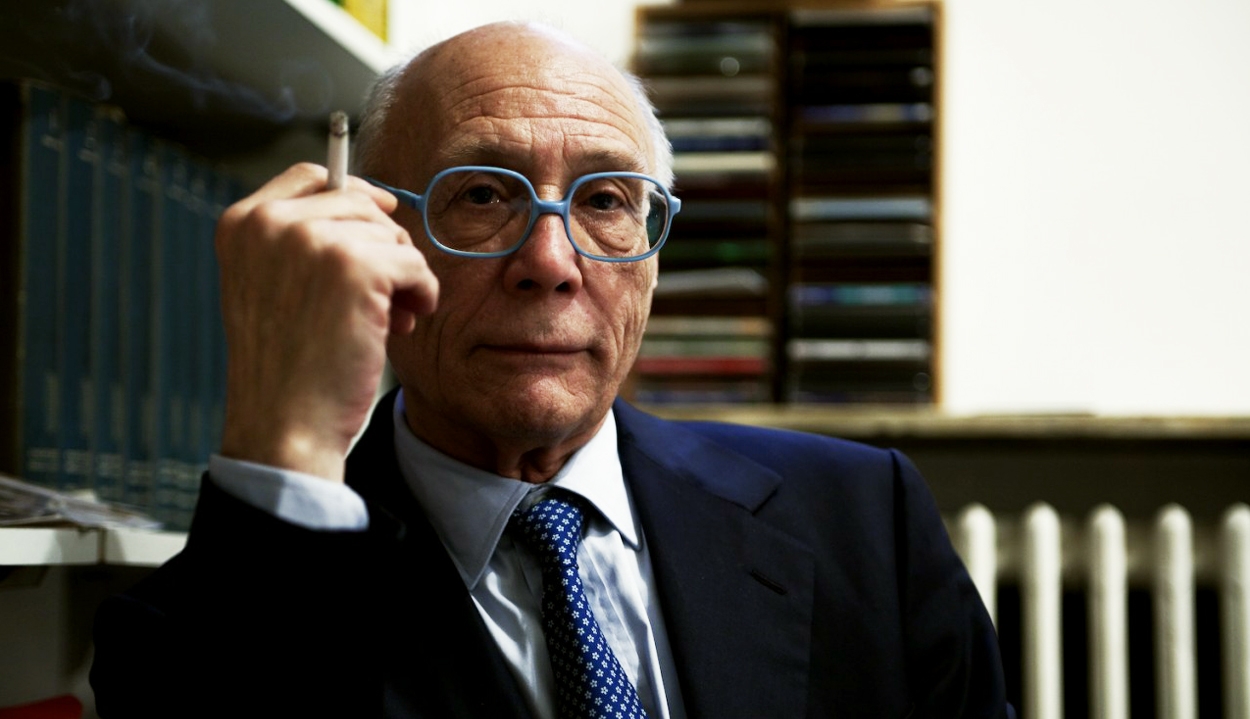
Video: "Pier Giacomo 100 Times Castiglioni," produced by ISAI Design Academy, curated by Piero Puggina. Video interview with Piero Castiglioni, architect and lighting designer, son of Livio Castiglioni - Milan, June 2013, produced for the exhibition: 1913-2013. Event of "The City of Architecture No. 1," September 6 - October 6, 2013, Vicenza, Basilica Palladiana. Photo courtesy: Andrea Vailetti
In this scenario, the designer's ability to present himself as the guarantor of project complexity comes into crisis, especially within the construction and industrial production systems. Humanism in design gives way to a growing fragmentation of skills, a stratification of technical specializations that struggle to communicate with each other. Added to this, starting with the 1973 energy crisis, is a renewed focus on the relationship between technology and resources, and a renewed centrality to the social dimension of space, also fostered by the emergence of new audiovisual media that shifted design attention from the domestic to the collective sphere.
These themes, already present in design culture, resurface forcefully in the early work of Piero Castiglioni. After training in the studio of his uncles Pier Giacomo and Achille Castiglioni, he began collaborating with his father Livio in the late 1960s on lighting projects for private homes, showrooms, and exhibitions. In 1972, together with Ugo La Pietra, he participated in the historic New York exhibition Italy: The New Domestic Landscape, considered the international manifesto of Italian design, which marked the critical and experimental turning point of the designer's project.
In those years, lighting technology was also seeking its own disciplinary recognition, attempting to redefine its scope and broaden its cultural legitimacy. Piero Castiglioni clearly chose to work on lighting design, transforming an initially playful and inventive approach into a critical practice of space. His focus was not on the lamp as an independent object to be catalogued, but on the manifestation of light in relation to architecture. In this sense, each lighting fixture was born as a response to a specific design requirement: it was not a formal exercise, but a device designed to display light, or to make it perceptible through different modalities—direction, intensity, diffusion, color, reflection.
For the designer, "displaying light" meant knowing how to select and modulate the lighting behavior in relation to the architectural context, the type of space, and the desired visual experience. Light can thus take on different characteristics: it can be diffused and enveloping, direct and bold, grazing, reflected, or dynamic, becoming an active part of the narrative of the space. Each technical choice therefore becomes an expressive form that defines the way in which light makes itself present, articulates itself and interacts with surfaces.
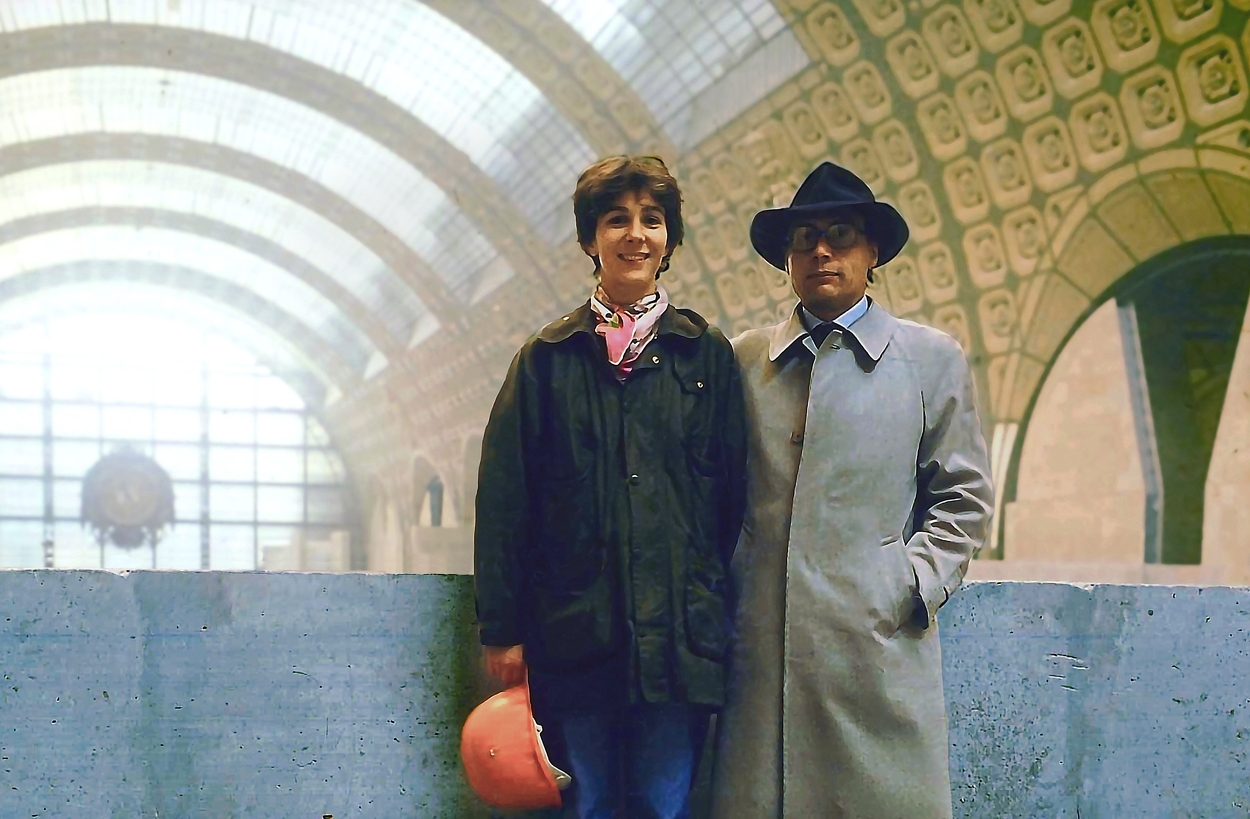
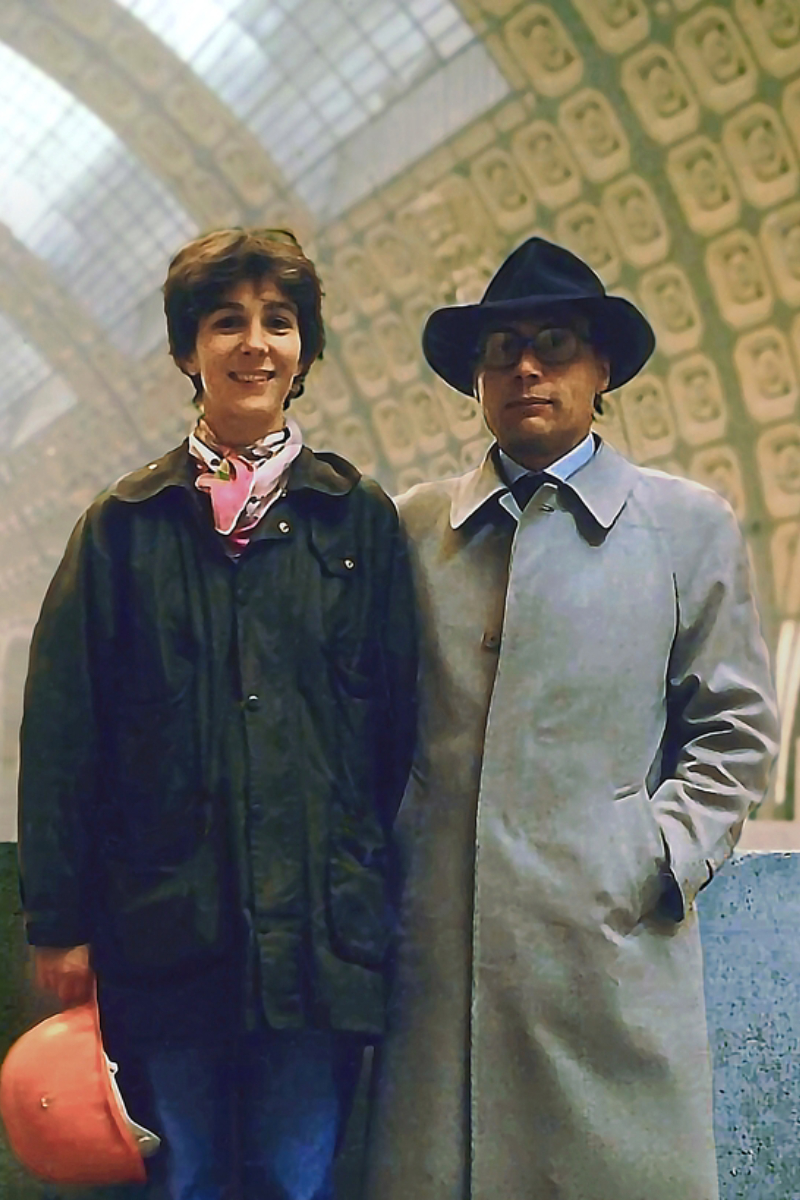
Paris, 1983 – Piero Castiglioni and Monique Bonadei, portrayed during the construction phase of the Musée d’Orsay, inside the historic Parisian railway station currently being transformed into a museum, as part of the architectural project designed by Gae Aulenti.
Unlike other specialists in the field, Piero Castiglioni consistently works on other people's projects, in a collaborative approach that represents a direct legacy from his father. Both Livio and Piero reject the idea of problem solving as an autonomous practice and instead advocate an attitude of adherence and integration with the profound meaning of architectural design. The notion of integral design that Livio applied in his relationships with industry is transferred by Piero to his relationship with built spaces and their creators.
Over the course of the twentieth century, lighting design evolved from a simple technical application to a conscious cultural practice, capable of influencing the way we inhabit, perceive, and construct space. Parallel to the evolution of light sources and available technologies, a broader reflection on the significance of light in architectural design developed. On the one hand, the experiments of the first modernist architects with the naked light source paved the way for an expressive and unmediated use of electric light; on the other, lighting technology sought its own disciplinary status, emancipating itself from a merely functional role. It is within this dual historical-technological and critical-design trajectory that the work of Livio and Piero Castiglioni is situated. From the 1950s for Livio and the late 1960s for Piero, their work on light was not limited to the creation of luminaires, but presented itself as a true investigation into the manifestation of light in space. Light is no longer an accessory or complement, but becomes a design material, the object of a thought integrated with architecture.
The true innovation of the Scintilla system lies not simply in leaving the light source bare—a move already explored by others, as we'll see later—but in repeating it sequentially and giving it different types of application, transforming the space itself into an optical device. It is this rhythmic multiplication that defines a new paradigm: the environment does not host light, it generates it. Surfaces become reflectors, architecture becomes a luminous structure, and the space, as a whole, becomes the lighting fixture. This design gesture marks a turning point, shifting the focus of design from the form of the fixture to the immaterial construction of light itself.
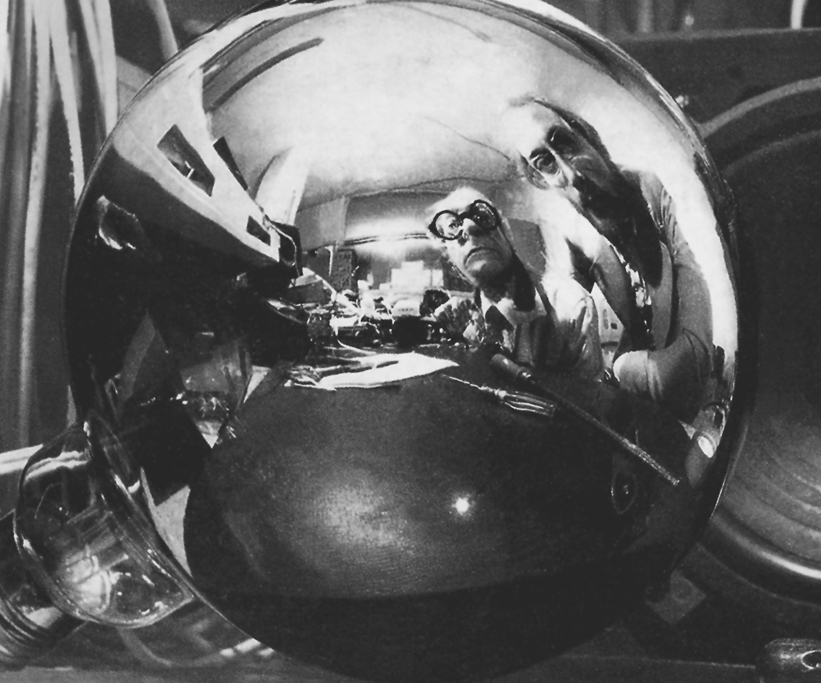
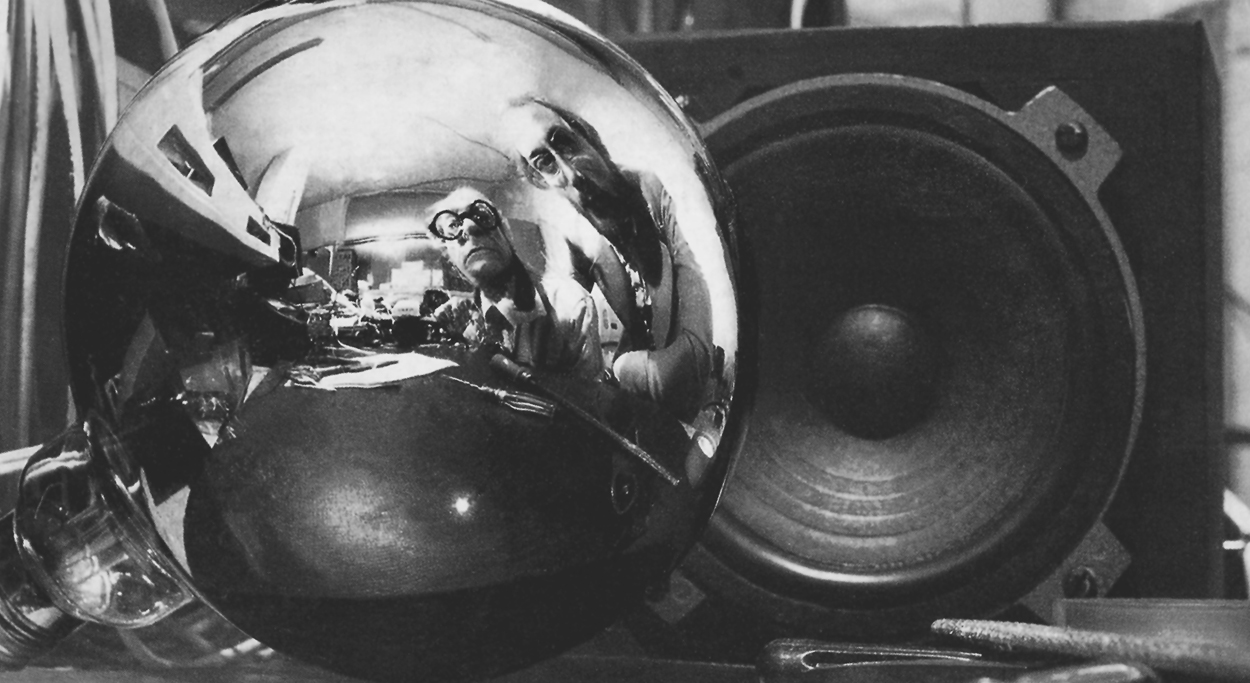
1975: Livio and Piero Castiglioni in their studio at Via Presolana 5, Milan. Reflected in the mirrored surface of a lamp, father and son appear immersed in the heart of their experimental laboratory, surrounded by instruments, sources, and speakers.
To fully understand this shift, it's necessary to return to the earliest insights developed between the late nineteenth and early twentieth centuries, when some pioneers of modern architecture began to consider the exposed light source not just as a technical element, but as an integral part of the aesthetic and spatial composition. It was in this context that the foundations were laid for a poetics of light that would find full expression in the following century.
At the end of the nineteenth century, with the introduction of the incandescent lamp, some modernist architects began to grasp the expressive potential of the light source, deliberately left uncovered, enhanced by its technical and essential presence. Henry van de Velde praised its formal purity, while Charles Rennie Mackintosh in the Glasgow School of Art (1896) and Adolf Loos in the Café Museum in Vienna (1899) used it without diffusers, with exposed or tensioned wires, anticipating an approach that would once again become central to twentieth-century design research. In the 1950s and 1960s, Pier Giacomo and Achille Castiglioni experimented with devices that used "naked" light sources with built-in reflectors, such as the "Reflector" of the Luminator or the "Par 56" in the famous Toio. Following this, at the 11th Triennale in 1957, they proposed a 1000 W industrial bulb lamp, without the screw base: a configuration that highlighted the filament, reducing glare to a minimum.
It is in this context that the Scintilla system was born, a project with which Livio and Piero Castiglioni—recently graduated in architecture from the Polytechnic University of Milan—give concrete form to their reflection on the naked lamp. The source is no longer hidden or filtered, but exposed in its essence. The fixture is reduced to a technical connection tool, while light is transformed into a visual event: pure energy that dialogues with the architectural material. Light is not designed, it is thought.
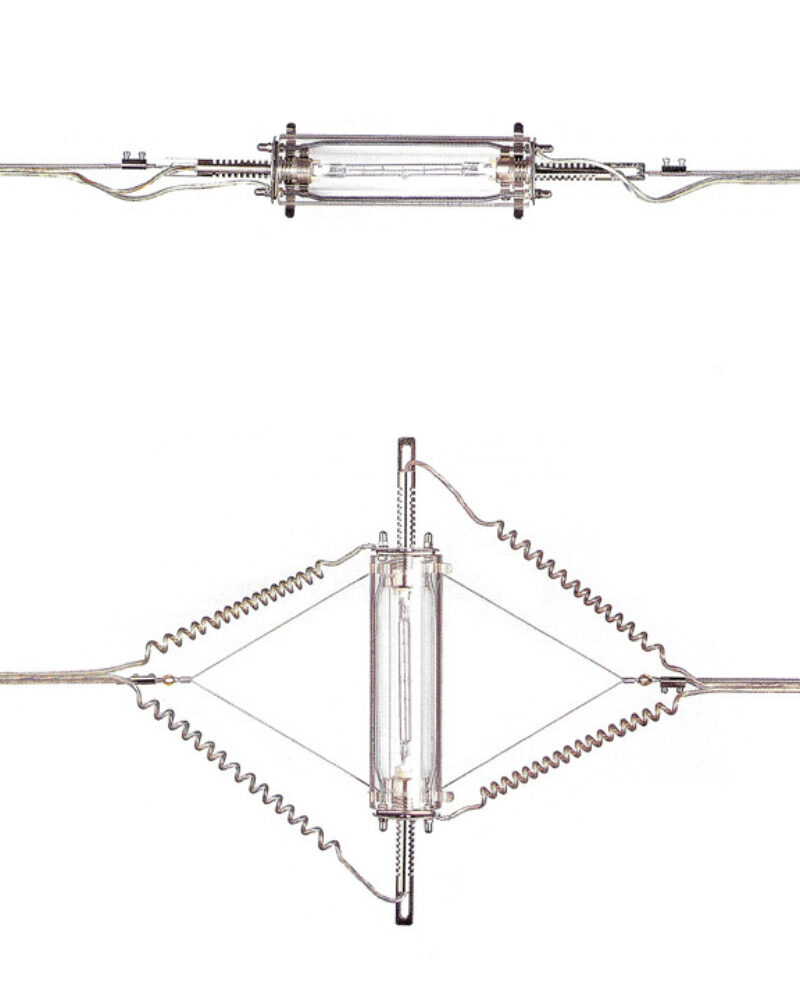
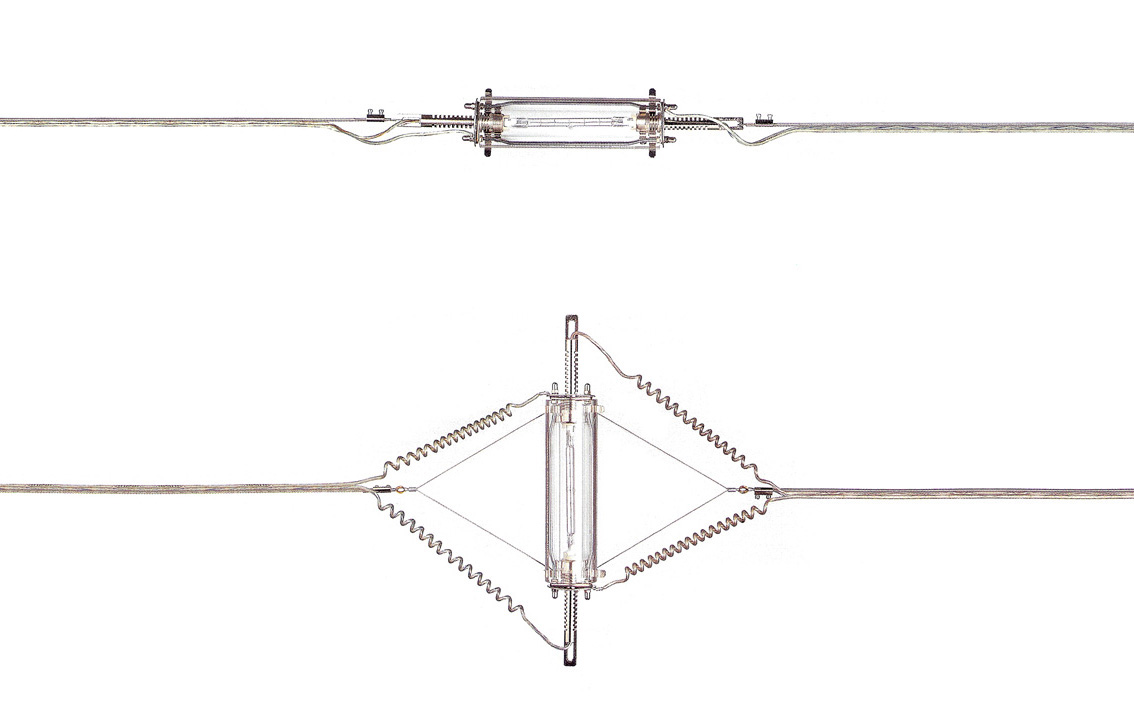
The Scintilla system, conceived, tested, and created by Livio and Piero Castiglioni in their laboratory on Via Presolana, was later industrialized by Piero, thanks to a production agreement with Fontana Arte, which recognized its innovative value and launched its large-scale distribution. The Scintilla was born from a radical concept: to produce a repeated and controlled glare, capable of generating a sparkling light, defined by Castiglioni himself as "sparkling light." The halogen lamps, intentionally left bare, follow one another in a rhythmic sequence, offering the eye not simple illumination, but a pulsating, dynamic optical material capable of shaping space through visual vibration.
This concept overturns the lighting orthodoxy of the time, which aimed for uniformity and invisibility. Instead, the sparkling light affirms light as an active, physical presence, almost acoustic in its rhythm, and gives the project an atmospheric power that fuses architecture, perception, and technique into a single, coherent gesture. It is a design breakthrough: the fixture is no longer an object, but a device for constructing perception.
Throughout the 1970s, this new grammar of light found application in shops, showrooms, and hotels, settings where Castiglioni, often in tandem with his father, experimented with a language capable of integrating space into lighting. From the Scintilla experience onward, Castiglioni developed targeted lighting strategies, always calibrated to the perceptual, functional, and material characteristics of each context. For him, light is a cultural act, a critical gesture, a form of interpretation of reality. Electric light is a material to be shaped: it is directed toward surfaces, it shapes the space, it guides its interpretation, it reinforces its meaning.
The figure of the architect of light, which Castiglioni embodies with coherence and rigor, is that of a designer capable of integrating the scientific measurement of light with the quality of perceived space, bringing together science and sensibility, technique and interpretation. Light, in his thinking, is not an addition to architecture: it is an integral part of its design, an integral component of its grammar.
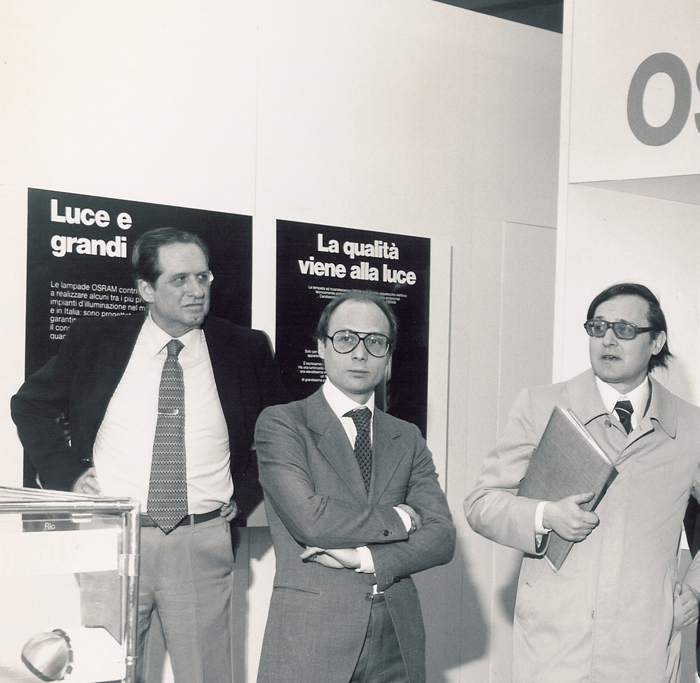
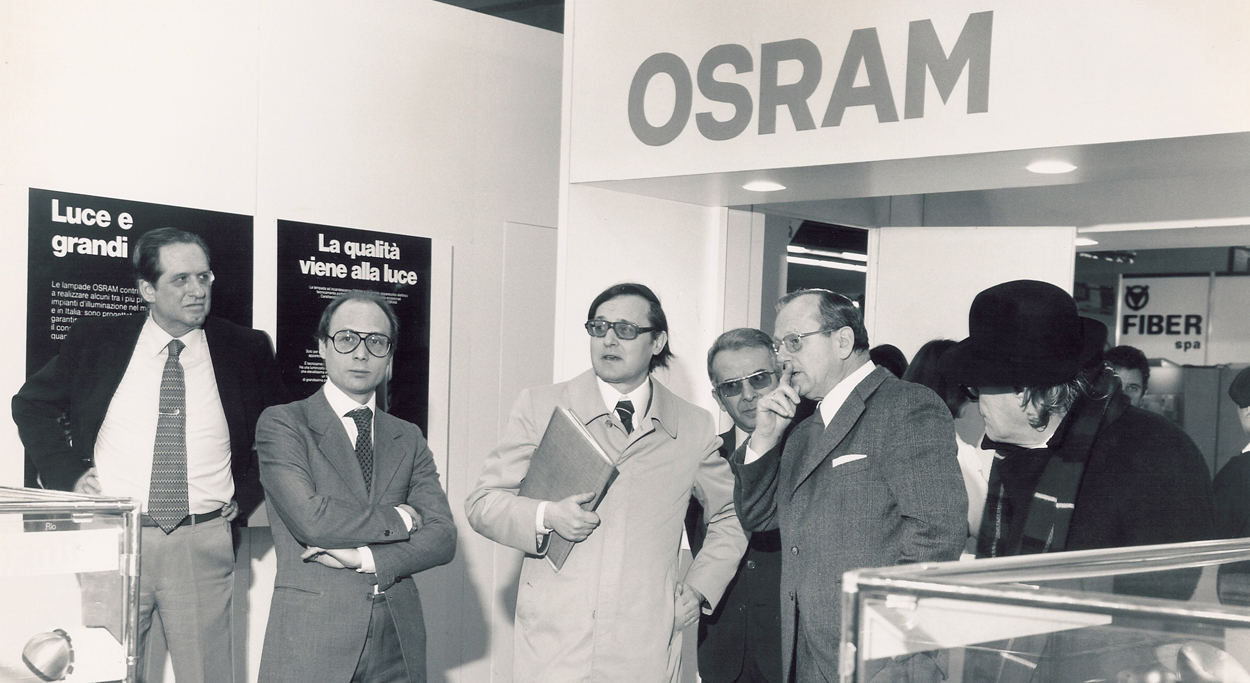
A fundamental contribution to Piero Castiglioni's technical training came from his consultancy with Osram, active since the 1970s. It was in this context that he deepened his study of light sources, exploring in detail the "technical alphabet of electric light" and the innovations of the time: from low-voltage halogen lamps with built-in reflectors to gas- and powder-discharge lamps with high color rendering. The evolution of these sources suggested to Piero Castiglioni the possibility of breaking free from the design of the fixture's casing, focusing instead on the design of systems with interchangeable optics. This further insight would find significant application, years later, in the project for Palazzo Grassi, where small light sources became a key element in the lighting design of the so-called "Cestelli."
An ethical and design approach that challenges established practices, always seeking ways of thinking and tools consistent with the complexity of our time. For Piero Castiglioni, reading volumes, historical knowledge of the context, and analysis of visual functions are the necessary prerequisites for every project. Lighting is first and foremost an operational tool, but it must develop in tandem with the overall architectural project, often influencing and, in some cases, redefining it. His approach is distinguished by uncompromising discretion: in the most delicate situations—historic buildings, restorations, complex spaces—he avoids any redundant elements, preferring solutions that integrate with the existing context and are minimally invasive.
One of the cornerstones of his design vision is the overcoming of hierarchies of scale, following a logic of continuity between object and architecture. This idea stems from the teachings of Ernesto Nathan Rogers, who argued that every element, from the lamp to the building, contributes to the definition of space. From this perspective, lighting is not an afterthought, but an integrated device, capable of shaping space with the same dignity and compositional responsibility as architecture.
In some cases, such as at Palazzo Grassi, the staircase becomes a true conceptual tool, adapting solutions designed for sports venues to the museum dimension, through "portioned" lighting systems that interact with walls and display surfaces. It is precisely this ability to treat architecture as a reflective optic that also constitutes the guiding principle in his work as a designer. Controlling electric light, for Piero Castiglioni, means conceiving it as a living material, arising from various sources, passing through optics, refracting on surfaces and materials, and only then manifesting itself. Light exists only if and when it materializes on volumes.
This principle was also applied in the project for the Musée d'Orsay in Paris, with Gae Aulenti, where the study of the relationship between light source, reflective surfaces, and colors led to a redefinition of the very section of the exhibition spaces. Unlike daylight, which distributes itself spontaneously throughout space, electric light requires a conscious and structured design capable of precisely defining the nature of the light source, its typology, the orientation of the light beam, and its placement within the architectural space. Only through this active design is it possible to manage the perceptual, functional, and aesthetic effects of electric light.
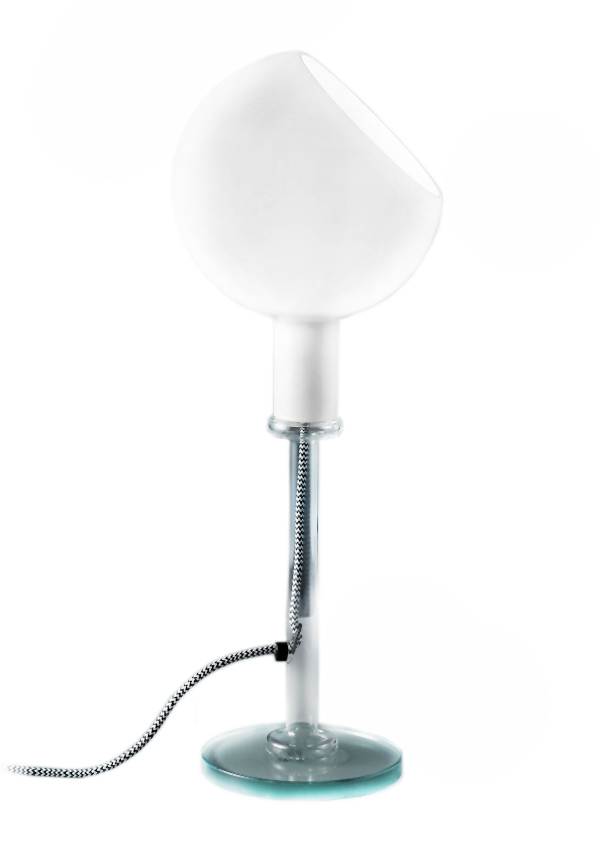
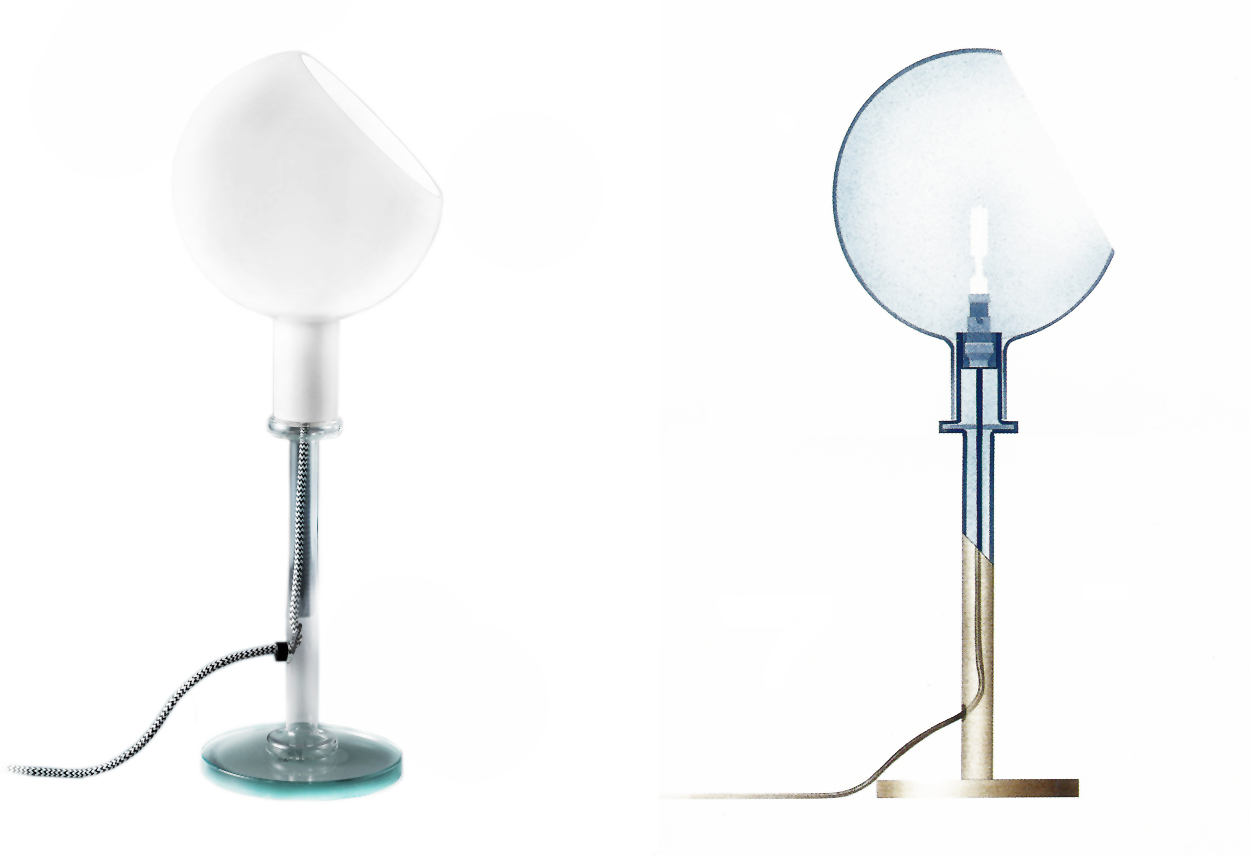
Parola Lamp, designed by Gae Aulenti and Piero Castiglioni for FontanaArte. The object represents an exemplary synthesis of the concepts of diffusion, reflection, and transparency, expressed through a simple formal language and the balanced use of glass in various processes.
The designer, Piero Castiglioni argues, must thoroughly understand the potential of the light source—light spectrum, flux, power, etc.—and the characteristics of the fixture—efficiency, photometric distribution, sizing, etc.—but above all, he or she should pay attention to the interpretation of space, its morphology and function, and then turn their attention to the observer: to their needs and their perception. It is this design dimension—at once technical, perceptive, and profoundly human—that guides every choice and remains the exclusive purview of the lighting designer. From this perspective, their role is similar to that of the director of photography, a key figure in the tradition of Italian cinema, capable of constructing visual narratives in which light is story, atmosphere, and intention.
In the 1980s, lighting design emerged as one of the key tools in the redefinition of exhibition and museum spaces, becoming a privileged area of research and experimentation. Light was no longer considered a simple technical or functional element, but assumed an active design role, capable of interpreting space, guiding its use, and enhancing the contents on display. This new focus on the dimension of light reflected and accompanied a broader transformation of the very idea of the museum, which evolved from the traditional conservative function—focused on the protection and archiving of heritage—toward a more dynamic and participatory vision. The museum thus became a multifunctional cultural space, open to the valorization and active enjoyment of artistic and historical heritage, integrating educational, performative, social, and recreational activities. In this context, light contributes not only to making the artwork visible, but also to building new ways of relating between the visitor, the space, and the content.
Light also began to assume a central role in strategies for enhancing cultural heritage. Superintendents, museum directors, curators, conservators, technicians, and architects expressed their opinions on the relationship between light and artworks—often with divergent opinions. In these years, Piero Castiglioni emerged as an interpreter capable of working with light, bridging the gap between architecture and exhibition design, mastering regulatory and technical-functional aspects and finding meaningful solutions to the problem of the relationship between daylight, artificial light, and the interpretation of the exhibited works.
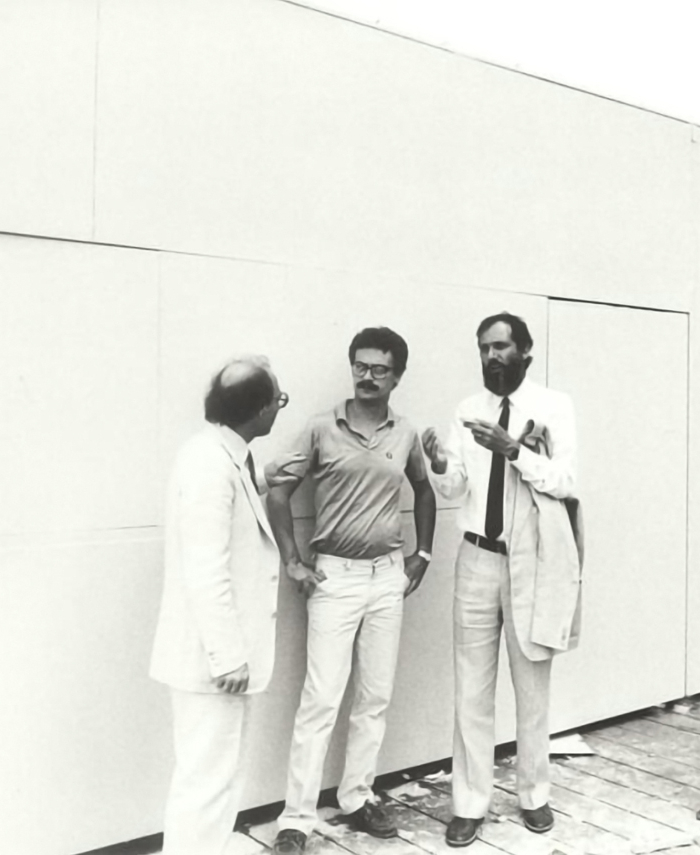
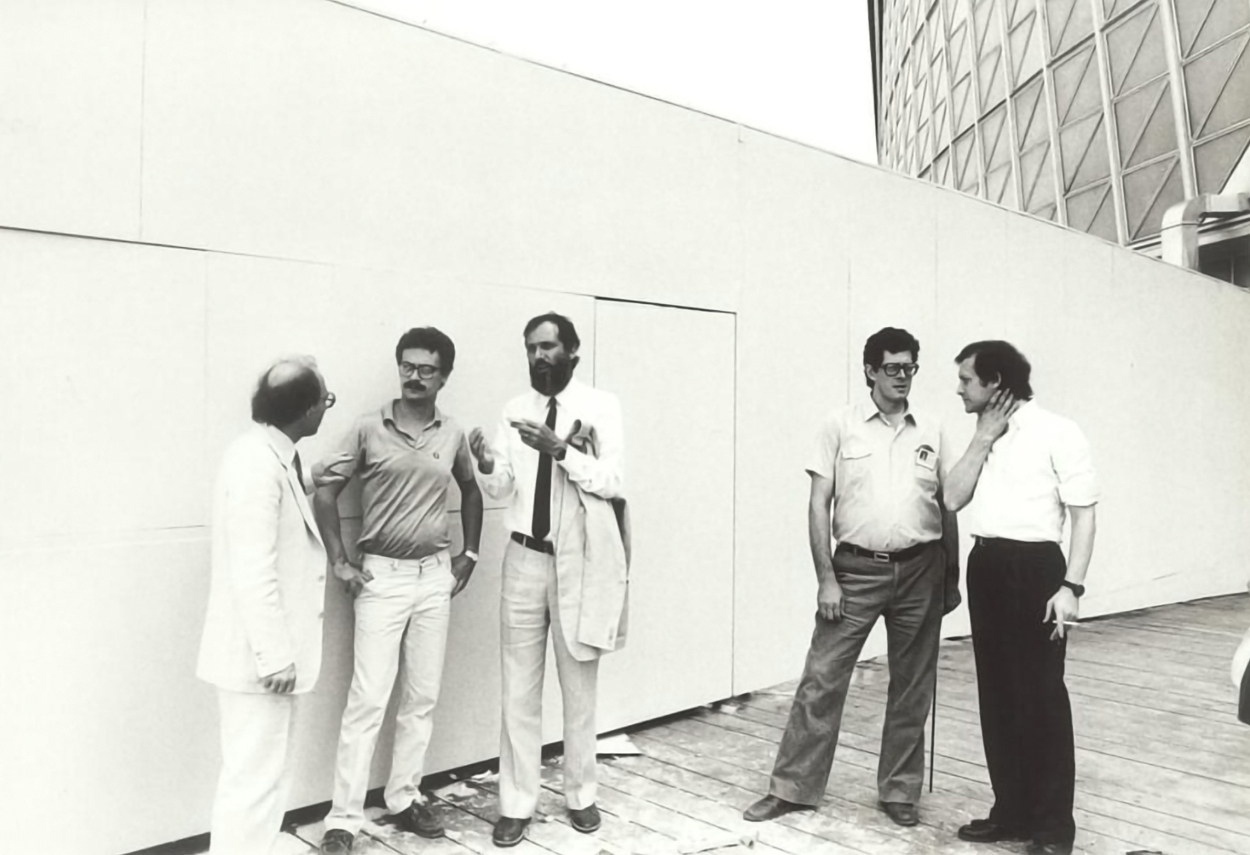
Turin, 1983 – A moment of confrontation between architecture and light. Architect Renzo Piano converses with lighting designer Piero Castiglioni.
Compared to temporary exhibitions, where interpretative freedom and experimentation with different languages are often fostered by the absence of daylight, permanent museum exhibitions require a much more rigorous approach. The stability of the space and the fixity of the artworks require consistent and long-lasting performance from the lighting design, both in terms of conservation and perception. In this context, the lighting system must meet stringent technical criteria, such as color temperature control, differentiation of illumination based on the type of artwork, uniformity of light across the exhibition floors, and glare management. Added to this is attention to the thermal components of light, which can influence the system design, and the need to formally integrate the fixtures with the architectural language of the exhibition. All these aspects make lighting design a complex design tool, in which form, function, and conservation converge in a coherent and controlled lighting language capable of defining the identity of the museum space.
Gae Aulenti states: "I don't think we can speak of a 'museum typology' in an abstract sense; what really matters is the museum's concrete architecture." In her view, the interior space of the museum is not a replicable formula, but rather a coherent system, with a stable structure and a well-defined spatial configuration, born from a specific project and responding precisely to the needs of the context and the exhibition content.
Gae Aulenti's reflections on museum space and her belief that light is a fundamental compositional element—as when she states that "the study of lighting and the control of daylight define the architecture of a museum"—find significant parallels with the ideas of Piero Castiglioni, for whom architecture itself can be conceived as a lighting fixture.
As Anty Pansera observes, "while international constraints and regulations have long governed the lighting of public spaces, particularly museums, daylight—which changes throughout the day and the seasons—requires new relationships and design solutions." In this context, Castiglioni has always responded by designing fixtures integrated into the architecture, capable of interacting with daylight and electric light. These elements, while maintaining their own expressive identity, are not hidden, but rather actively participate in the definition of space.
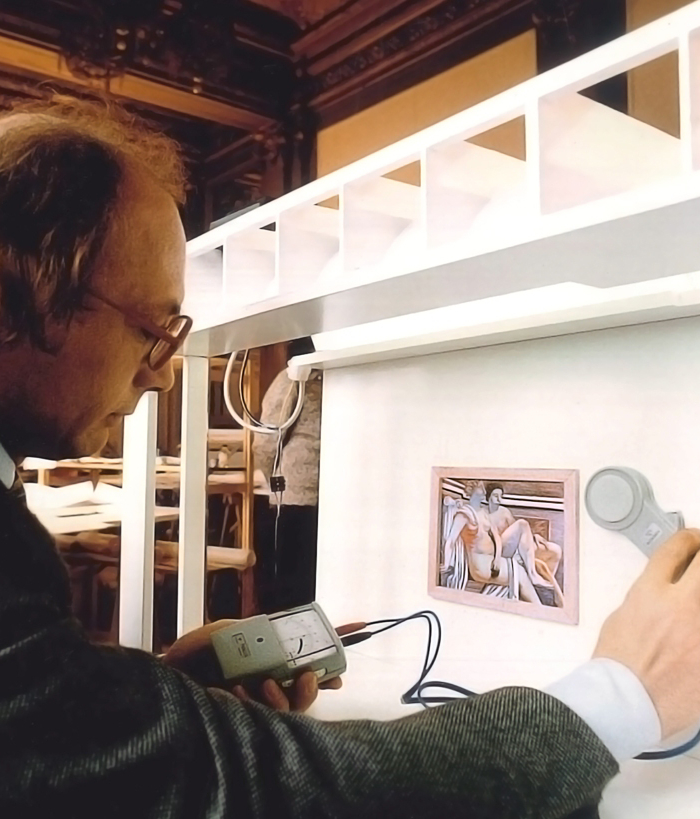
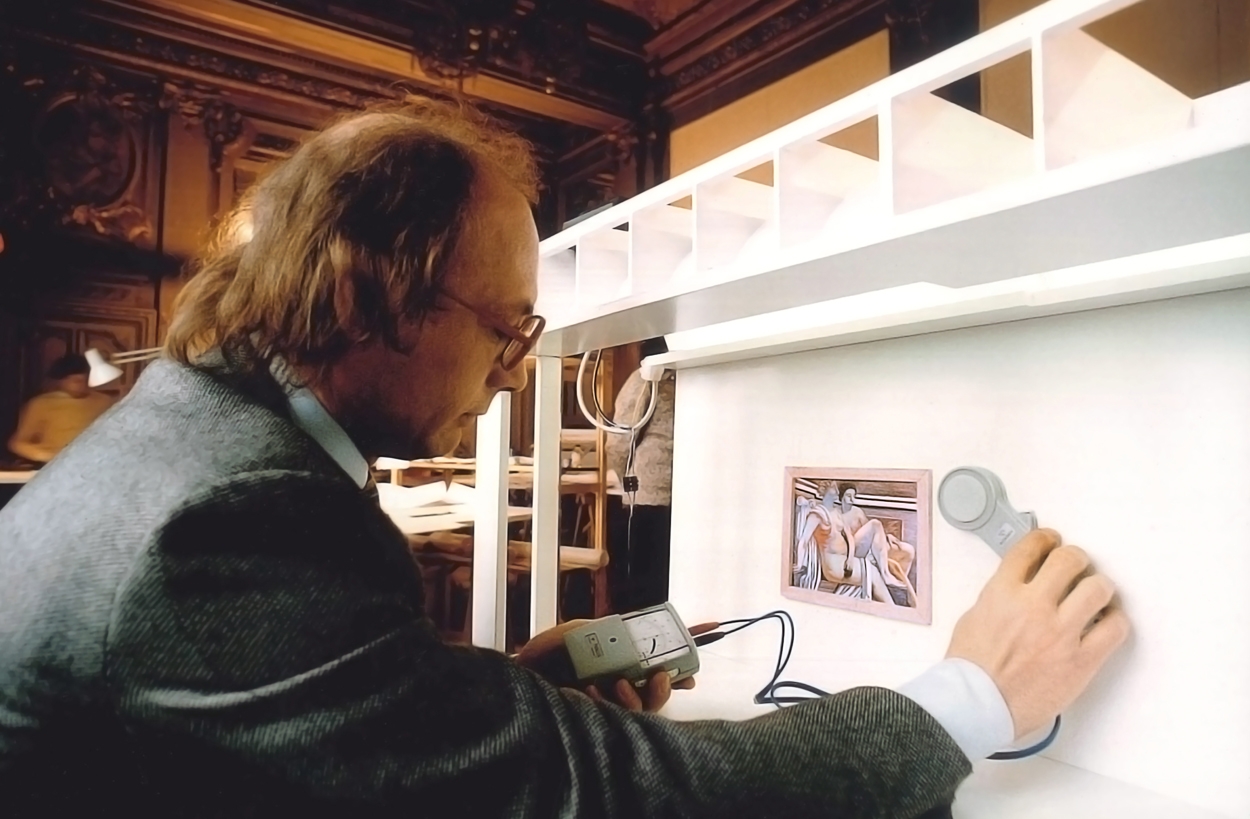
Piero Castiglioni checks the illuminance values for the exhibition walls in the test model for the Musée d’Orsay, in the early 1980s.
In May 1980, Gae Aulenti was invited to participate in the international competition for the redevelopment of the Gare d'Orsay, the former Parisian railway station destined to become one of Europe's most important museums. The key concept, guiding the architectural proposal from the outset, was the essential convergence between the museum space and the lighting design: an insight that prompted the designer to involve Piero Castiglioni from the very beginning of the project's conceptualization phase, entrusting him with the design of electrical lighting solutions.
Castiglioni's work at the Gare d'Orsay spanned six years, from 1980 to 1986, and represented a turning point in the history of museum lighting. It was not simply a matter of designing technical systems, but of developing a lighting strategy that respected the building's historical stratification, enhanced the exhibits, and created a new perception of space. In this context, light was not an accessory element, but a critical material, a means of interpretation, and a narrative device. The project at the Gare d'Orsay also stands out for the complexity and variety of the themes it addressed: large industrial volumes, glass and iron surfaces, temporary and permanent exhibitions, and a dialogue between daylight and electric light. It was a project that anticipated many contemporary reflections on museum lighting, integrating aesthetic, perceptive, and conservation values.
In parallel, Piero Castiglioni and Gae Aulenti collaborated on two other major projects, confirming the centrality of light as an integral component of architectural design. The first is the National Museum of Modern Art, inside the Centre Georges Pompidou in Paris, built between 1982 and 1985, where the challenge was to mediate between the hyper-rational technological system of Renzo Piano and Richard Rogers and the exhibition requirements of an ever-evolving art form. The second is the renovation of Palazzo Grassi in Venice, for exhibition purposes, completed in 1986, where light was called upon to dialogue with the historical memory of the site, with the noble surfaces of the materials, and with the flexible requirements of contemporary exhibition design.
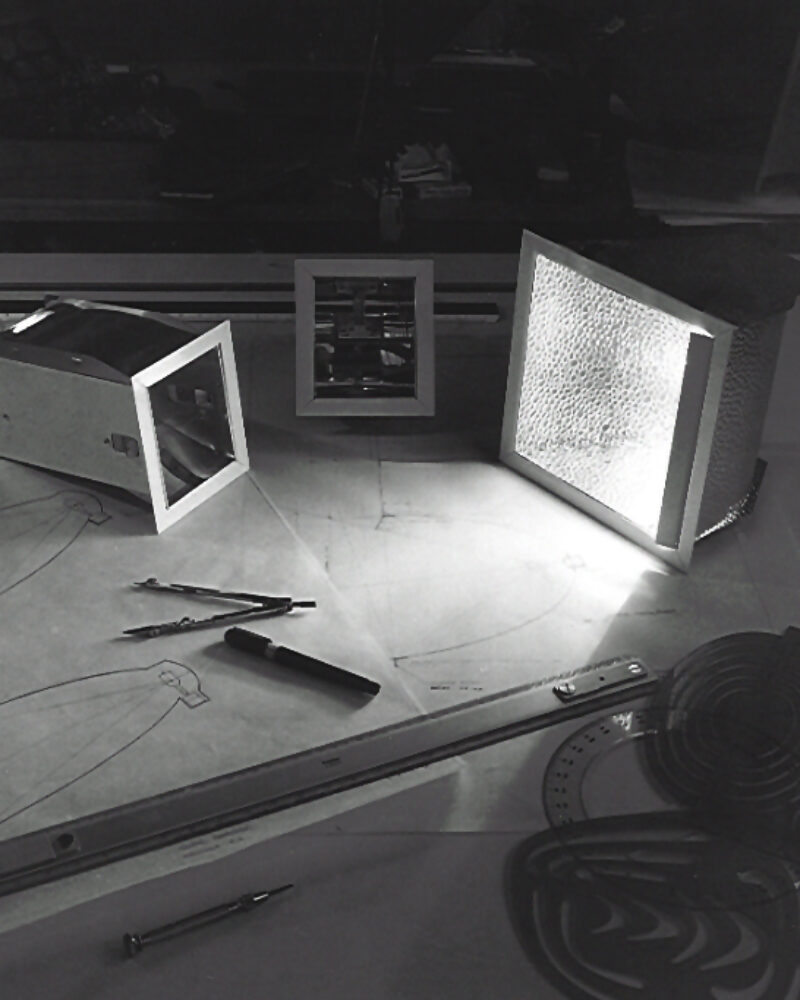
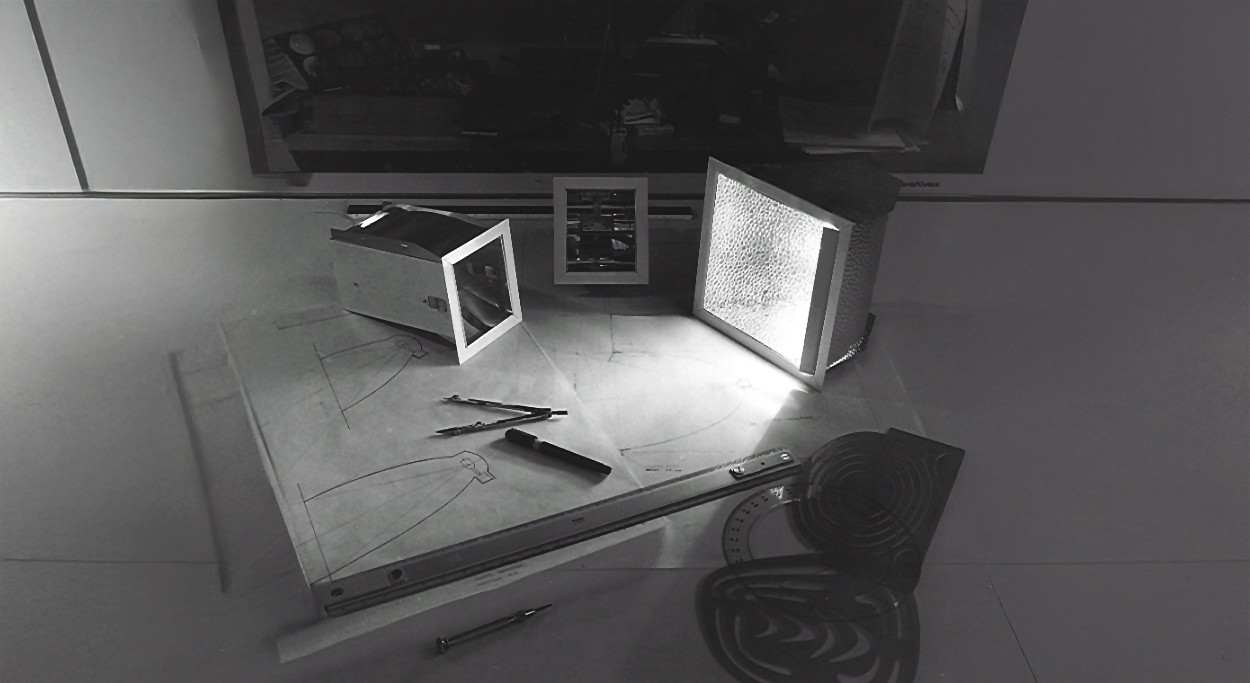
Study and prototype of a lighting fixture made specifically for the Musée National d’Art Moderne, Centre Georges Pompidou in Paris (1982–1985). On the workbench, technical drawings, tracing tools, and optical components highlight the integrated process between architectural design and lighting research conducted by Piero Castiglioni.
Piero Castiglioni states, "My experience at the Centre Georges Pompidou confirmed to me that there is no universal model for a museum, because every museum is the product of a specific context: what makes it unique is its location and, above all, the artworks it houses, which determine its form, function, and exhibition language."
These three experiences—Gare d'Orsay, Centre Pompidou, Palazzo Grassi—define a foundational moment in the history of lighting design applied to museums and indelibly mark Piero Castiglioni's professional career. They demonstrate how light can be a fully-fledged architectural design tool, capable of articulating space, layering time, and sparking new relationships between observer and artwork. During the 1980s, the projects for the Scuola Grande di San Rocco in Venice (1987) and the Groningen Museum in the Netherlands (1990–1991) were added, outlining a coherent research path aimed at redefining the role of light within contemporary exhibition design. At the heart of this approach are some constant principles, which constitute its methodological foundation.
Light plays a silent interpreter role for the exhibited artwork, maintaining an expressive neutrality similar to that of the architectural language, which in turn presents itself as a service structure and not as an overlay to the museum space. In this context, the artificial lighting project is not seen as an additional or decorative intervention, but as an integral part of the architectural project, with which it shares language, objectives, and functional logic.
The lighting device is not conceived as a stand-alone element, nor is it conventionally chosen from a catalog: on the contrary, it is conceived as a custom-made tool, a project within a project, functional to the overall logic of the exhibition.
From this perspective, the raw material of the project is light itself: lighting choices are based on the careful selection of the light source, based on its physical and perceptual characteristics, rather than the design of the fixture. This reversal of perspective highlights a clear priority: it is the distribution of light that determines the shape of the device, and not vice versa.
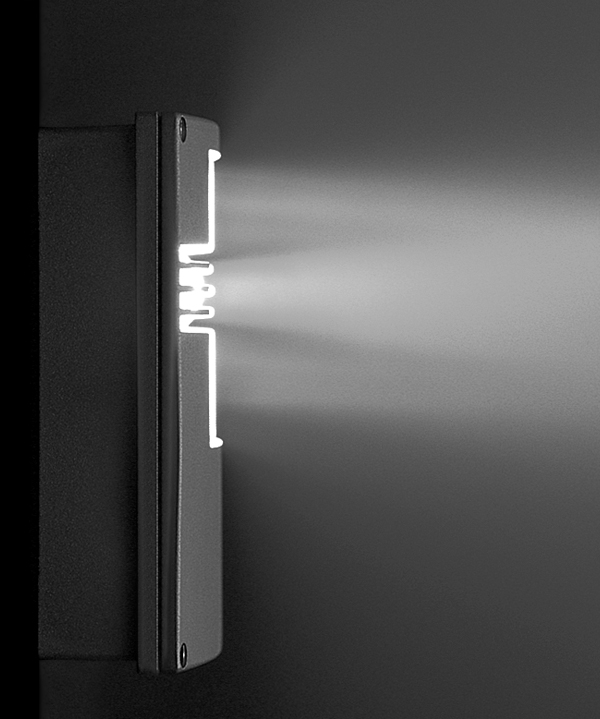
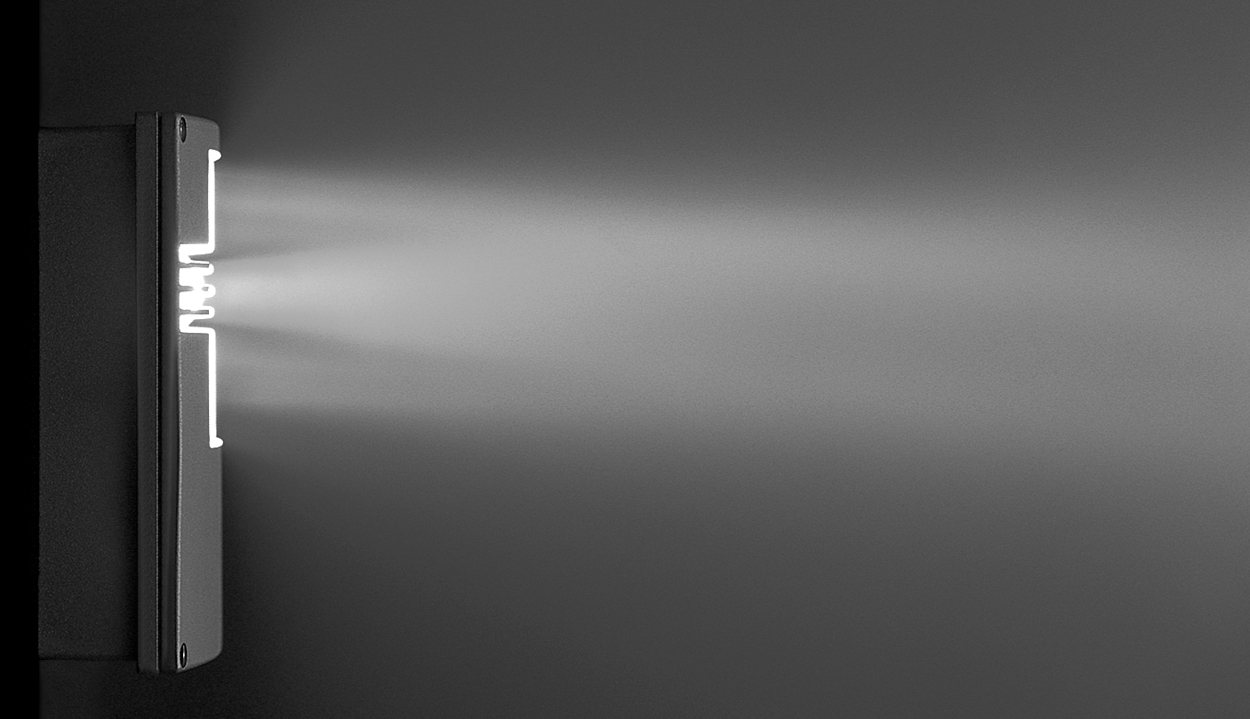
Radius, designed by Piero Castiglioni in 1997 for iGuzzini, is a spotlight that uses a light blade optic: a tempered glass lens at the top directs the beam, while an aluminum reflector positioned below modulates the light distribution. The result is a precise and controlled emission that sculpts space with elegance and rigor.
In his work on exhibition spaces, Piero Castiglioni clearly distinguishes the theme of the museum from that of the temporary exhibition. He wrote in this regard in a 1991 document: "Permanent creations, such as museums, art galleries, and art galleries, require precise and balanced planning in terms of spatial distribution, the choice of durable materials, and lighting that allows for an objective view of the exhibited works and pieces. This ensures a cultural service with strong educational overtones and can be used by a diverse and diverse audience of people of all ages, social backgrounds, and interests."
A widespread awareness of the importance of preserving historical and cultural heritage has led, in recent years, to the concept of the "microclimate museum" and the "museum machine," with studies focusing on materials, colors, era, and the perishability of objects, as well as their placement and organization in space. Lighting design, like architectural design in general, follows its own process, articulated through analysis of the space, the routes to be followed, and the materials to be displayed: from the story we intend to convey to the visitor/spectator using disparate elements that must blend into a harmonious and continuous spatial unity.
According to Castiglioni, museums must be as objective as possible; it is a service element: it must allow the artwork and individual pieces to be seen in the best possible light in relation to the other exhibits. "Lighting that guarantees the same color temperature across all vertical display surfaces, with constant and uniform illuminance levels, allows for the paintings to be presented and their chromatic interpretation to be objective and impartial, and for the internal and specific light of each painting to be revealed. This is particularly important for museums displaying representative works from different eras with different approaches to light."
Subjectivity, freedom of interpretation, and an interdisciplinary use of languages are the attitudes that guide the lighting design of temporary exhibitions. The defined temporal dimension offers the opportunity to employ specific fixtures (for theatrical, cinematic, and industrial applications), the possibility of employing unconventional lighting levels, altering colors through the use of light sources with unique chromatic emissions, and strongly contrasting the relationships between subject and background, accentuating a sense of experimentation.
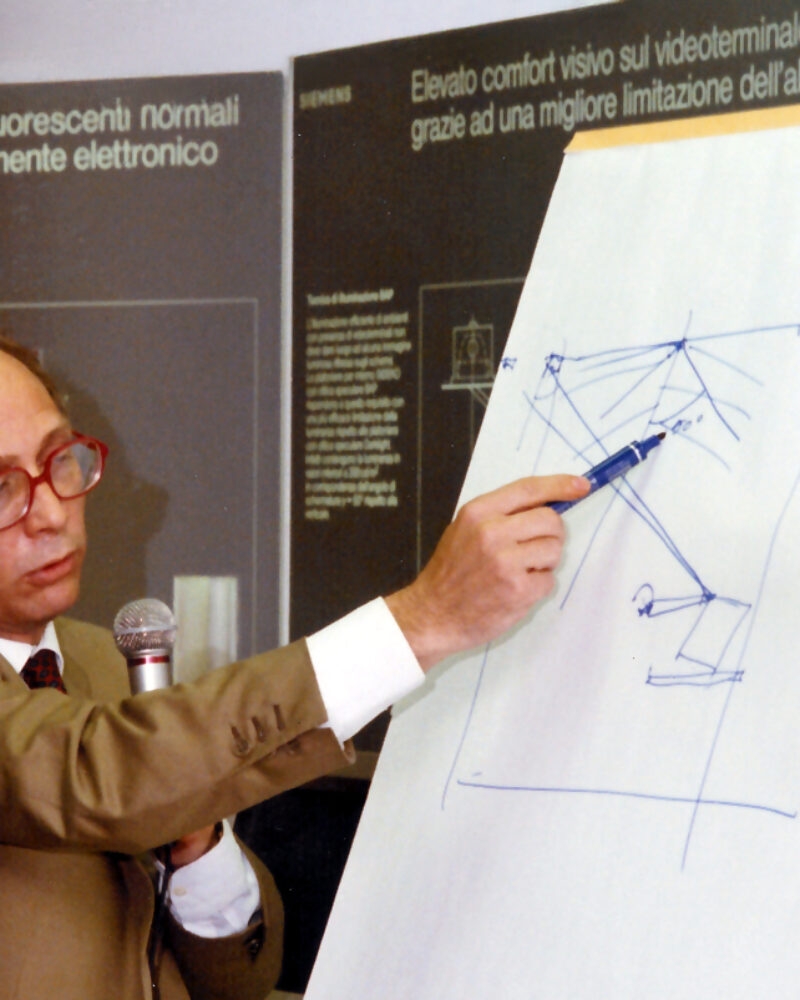
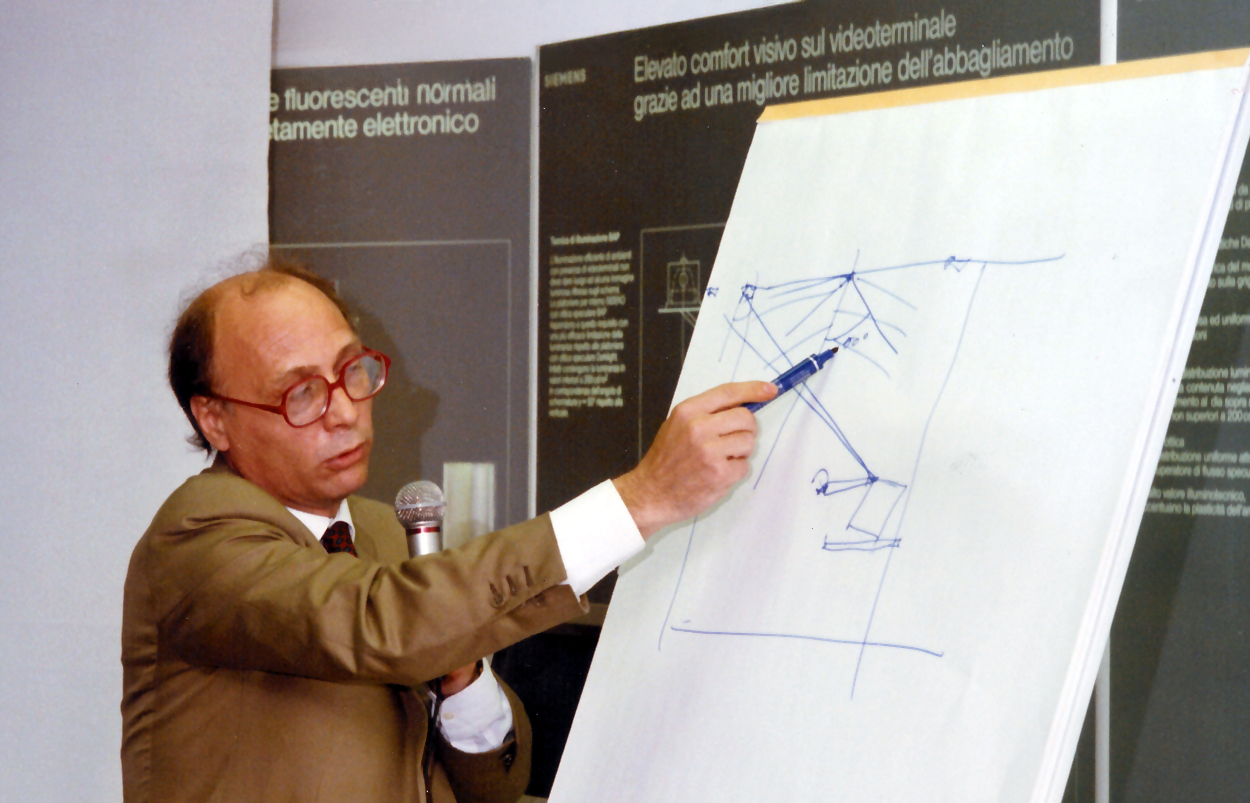
Piero Castiglioni al convegno Siemens del 1985. Durante l’intervento, illustra concetti legati al progetto della luce, sottolineando l’importanza dell’integrazione tra aspetti tecnici e spaziali nell’illuminazione architettonica.
Throughout this long journey, Piero Castiglioni's work demonstrates how lighting design can be much more than a technical discipline: it emerges as a form of design thinking, capable of interrogating space, its functions, and its symbolic and perceptual relationships. His approach integrates lighting engineering skills, architectural sensibility, and cultural vision, creating a new and pioneering professional figure: the Architect of Light. His work spans historical, artistic, urban, and museum contexts, restoring light to its foundational role in the construction of spatial experience. In an age of fragmented specialization, Castiglioni reaffirms the unity of design, making light a tool for critical interpretation, context engagement, and poetic expression.
His contribution is not limited to technical excellence or the formal quality of individual projects, but is rooted in a broader vision: that of a thoughtful, measured, and calibrated light, capable of engaging with architecture and time, with matter and with the gaze. A light that interprets rather than decorates. That transforms rather than adds. That discreetly and rigorously integrates into the life of spaces rather than imposes itself. With over fifty years of experience, more than a thousand completed projects, and a constant pursuit of research, Piero Castiglioni has made a decisive contribution to defining a culture of light in contemporary design. He represents an essential reference for anyone today who intends to work in the field of architectural lighting with awareness, responsibility, and critical intelligence.
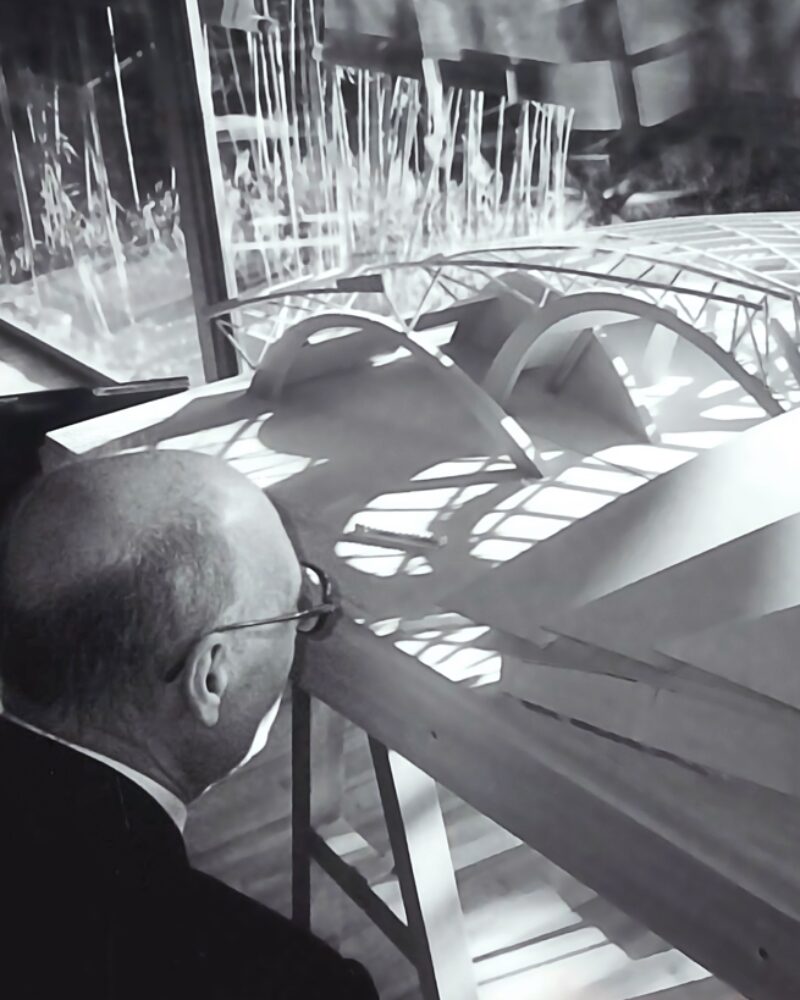
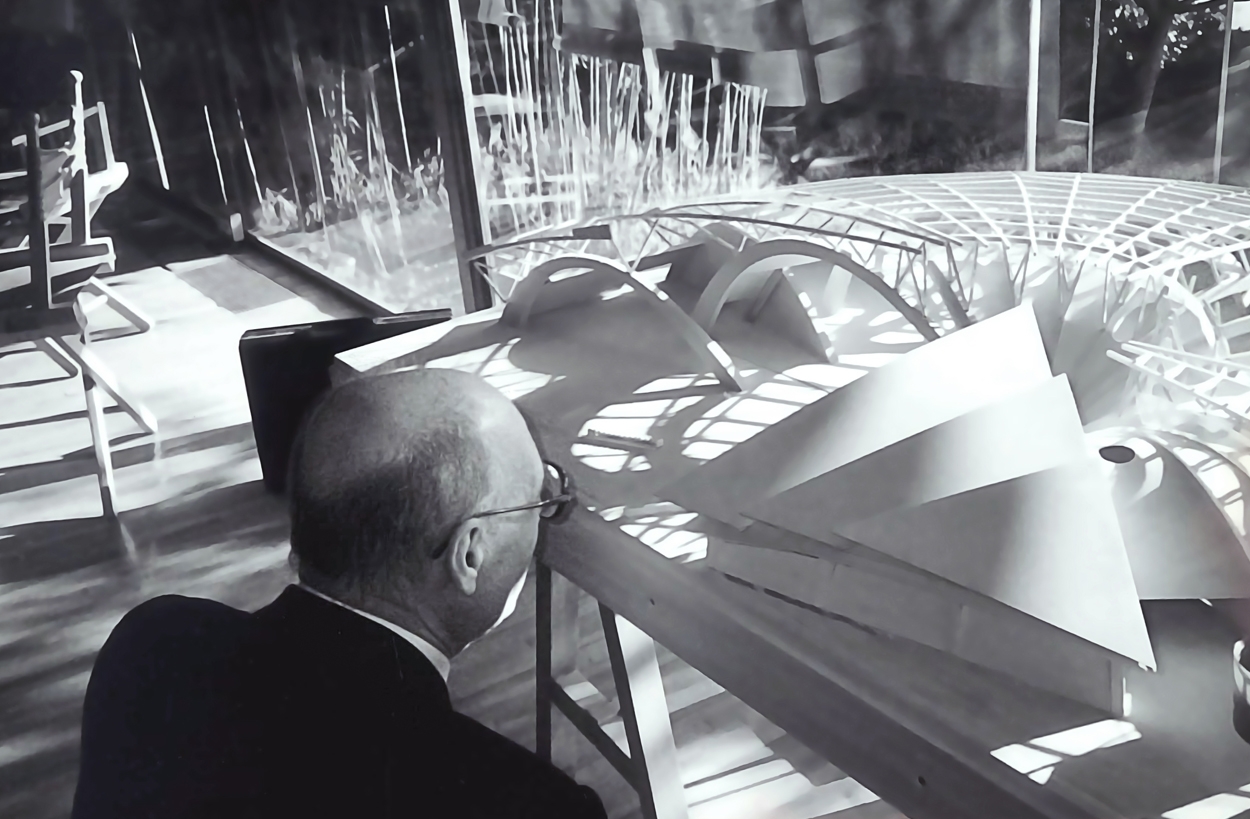
Italy, San Giovanni Rotondo, 2004 – Piero Castiglioni observes the model of the Sanctuary of Saint Pio of Pietrelcina, designed by architect Renzo Piano. A complex and symbolic work, in which architecture, light, and spirituality merge into a single vision.
Other Master pages
This section brings together a series of historical, critical, and cultural insights into the figures and contexts that contributed to the birth and establishment of lighting design as an autonomous discipline. The content explores Piero Castiglioni's role in defining a design approach in which light becomes a structural part of architecture, and the experimental origins of Italian lighting design through the research of Livio Castiglioni, in which light and sound are configured as immaterial languages of the project.
The section also explores the contribution of the Castiglioni brothers, tracing their cultural journey from 1930s Milan to the development of Italian industrial design, and analyzes the central role of the Studio on Via Presolana as a laboratory for experimentation and training for generations of lighting designers.
The overview is rounded out with a reflection on the great masters of design, from rationalism to postmodernism, highlighting the cultural and methodological legacy that has redefined the relationship between light, space, and living in contemporary design.