
Livio Castiglioni. Experimental Origins of Italian Lighting Design
Between waves and flashes: light and sound as invisible languages in Livio Castiglioni's design vision
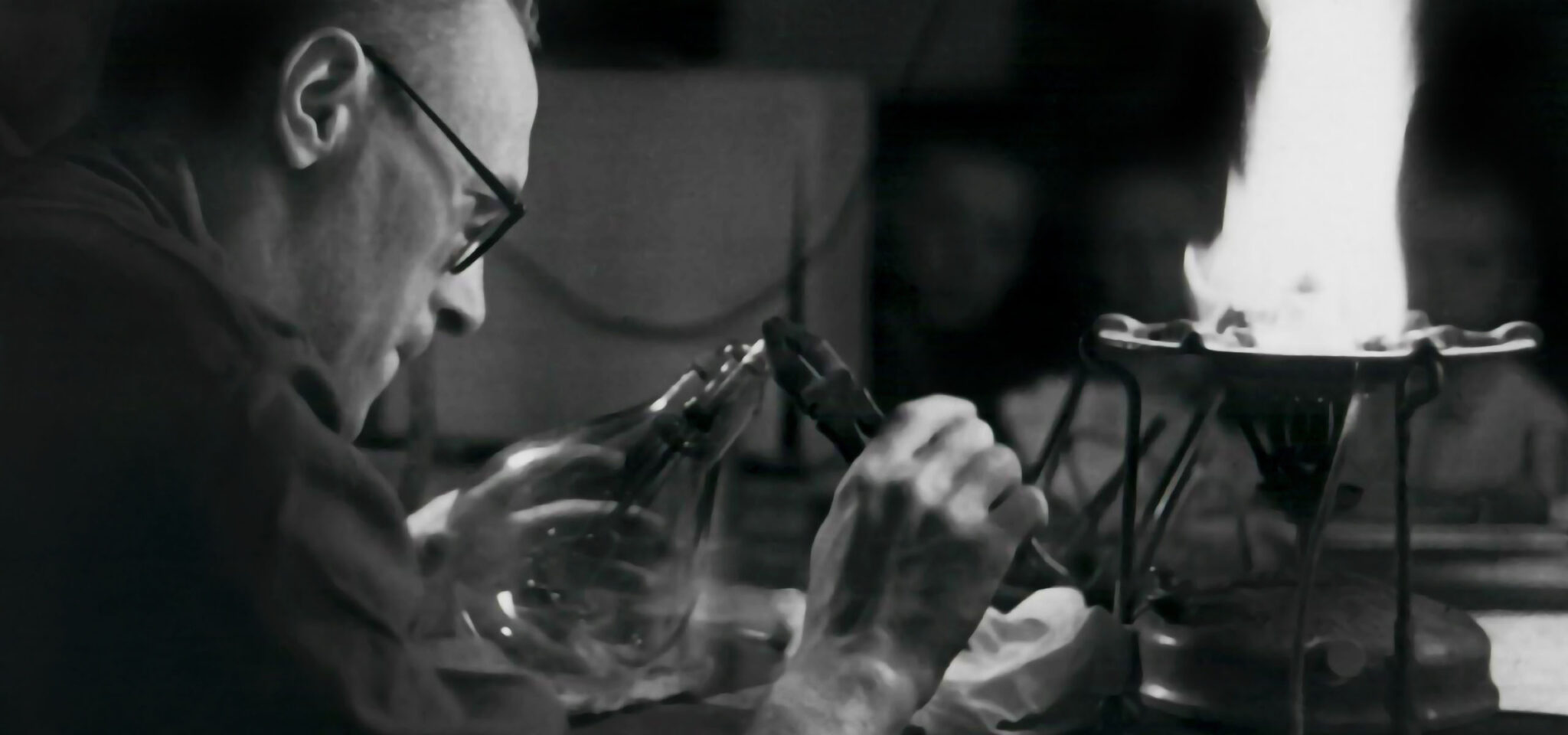
Livio Castiglioni (1911–1979) is a central figure in the genealogy of twentieth-century Italian design. He is the father of Piero Castiglioni, one of the most important figures in the birth of lighting design in Italy, and he passed on to him a design legacy founded on an experimental, technical, and sensorial vision of light, but above all a conception of light as a phenomenon to be investigated, as a constantly transforming material. The studio-laboratory that father and son shared on Via Presolana in Milan in the 1970s became the place where a new way of understanding light took shape: no longer a simple technical function, but an architectural, perceptual, and cultural experience.
But even before that, Livio was the son of the Italian sculptor, painter, and architect Giannino Castiglioni (Milan, May 4, 1884 – Lierna, August 27, 1971), known for his solid and monumental figurative language, tied to the academic tradition but capable of dialoguing with the demands of modernity. Born in Milan and trained at the Brera Academy, he created important public works, celebratory monuments, and sculptural complexes, distinguishing himself for his attention to spatial composition and the plastic rendering of volumes. Among his best-known works are the War Memorial in Erba (1922), the Victory Monument in Bolzano (1928, designed with Marcello Piacentini), and the Crypt of the Ossuary in Redipuglia (1938). His poetics move between the representation of sacrifice, collective memory, and heroism, with a style that often fuses sculpture and architecture in a single scenographic vision.
He was also the older brother of Pier Giacomo (Milan, April 22, 1913 – Milan, November 27, 1968) and Achille Castiglioni (Milan, February 16, 1918 – Milan, December 2, 2002), with whom he shared a transdisciplinary approach since the 1930s, a vision that anticipated the emergence of design as an autonomous discipline in the postwar period. Livio Castiglioni is among the most eccentric and radical figures in twentieth-century Italian design. He forged a design path that escapes the established categories of object design and functionalist aesthetics. His work develops at the edges of the object, in that border zone where light, sound, energy, and perception become the living material of design.
Bruno Munari captured it perfectly when describing the essence of his work: "Livio Castiglioni achieves, with essential electrical means, a deliberate optical, thermal, dynamic, acoustic effect, without computers, without programming, without transistors, without micrological complexes, without electronic amplifiers." A statement that celebrates his poetics of the essential: a technological art made of sensorial transformations, achieved not through sophisticated devices, but with a manual, almost artisanal skill, capable of reinventing the ordinary.
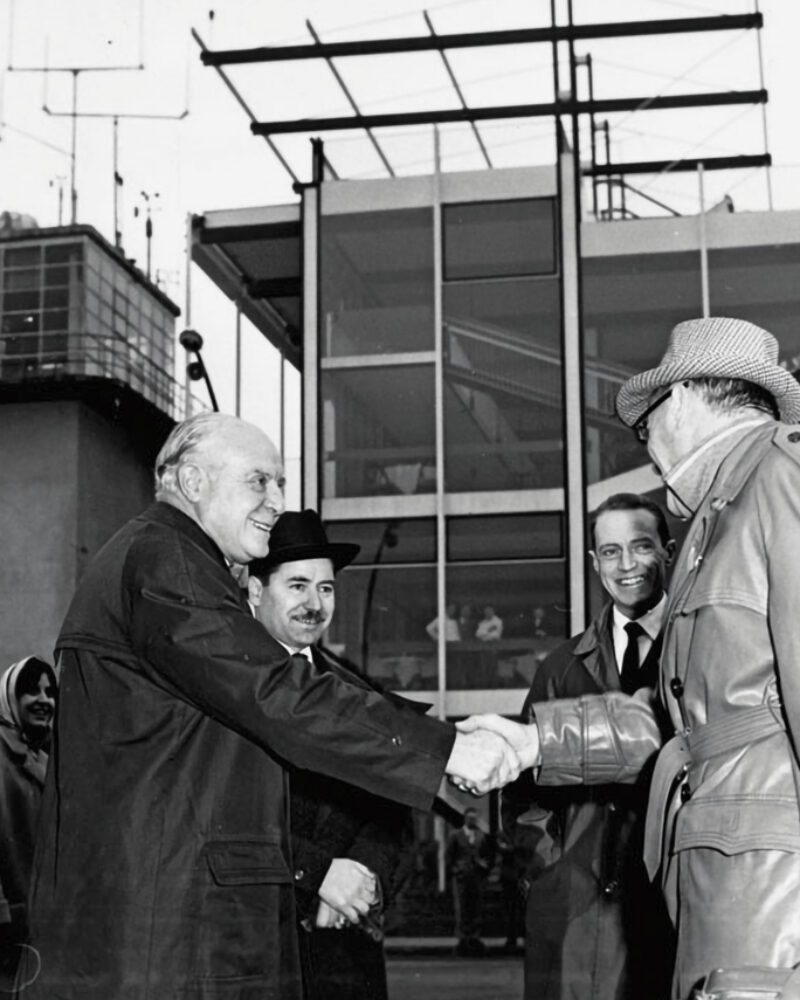
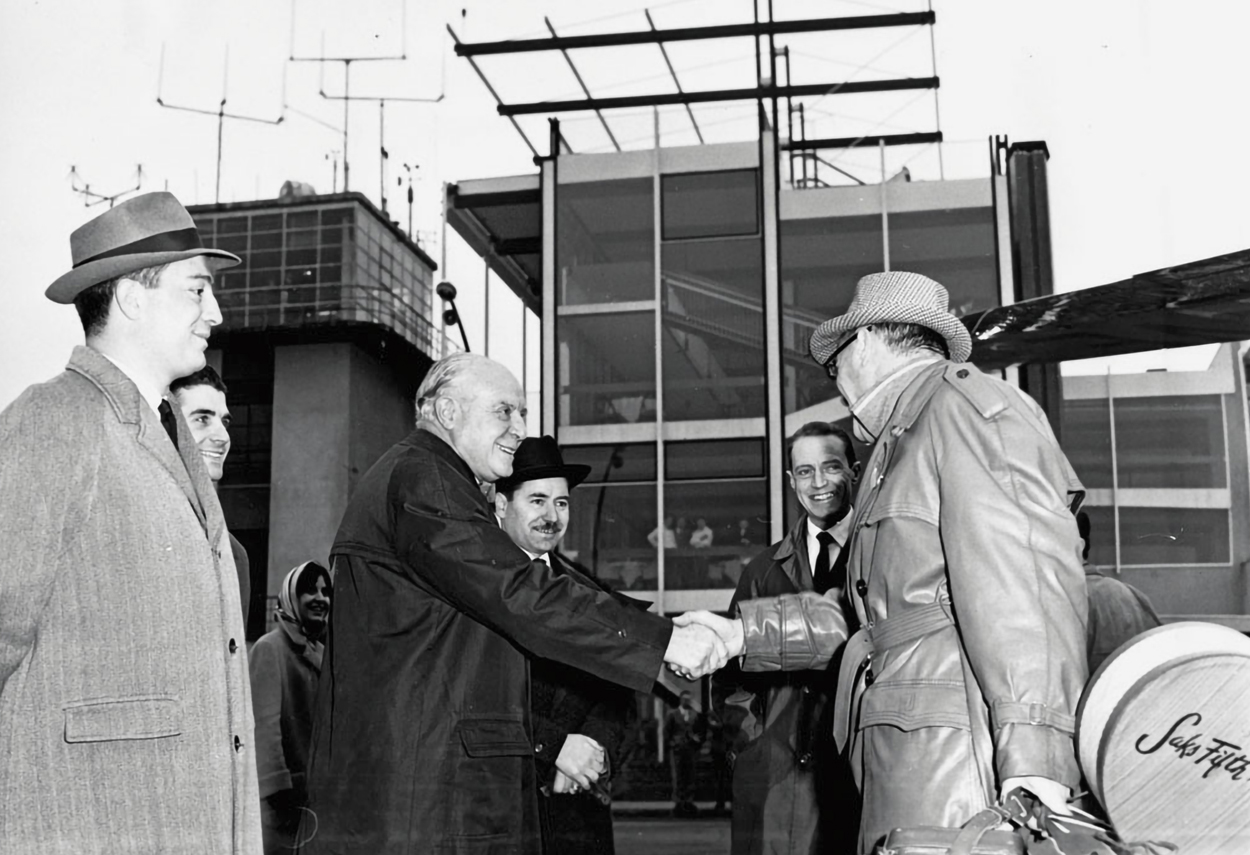
Livio Castiglioni meets Giò Ponti upon arrival at the airport, in a moment of exchange between two protagonists of twentieth-century Italian design culture. In the background, the rationalist architecture of the terminal reinforces the scene as a document of an era of dialogue between design, industry, and vision.
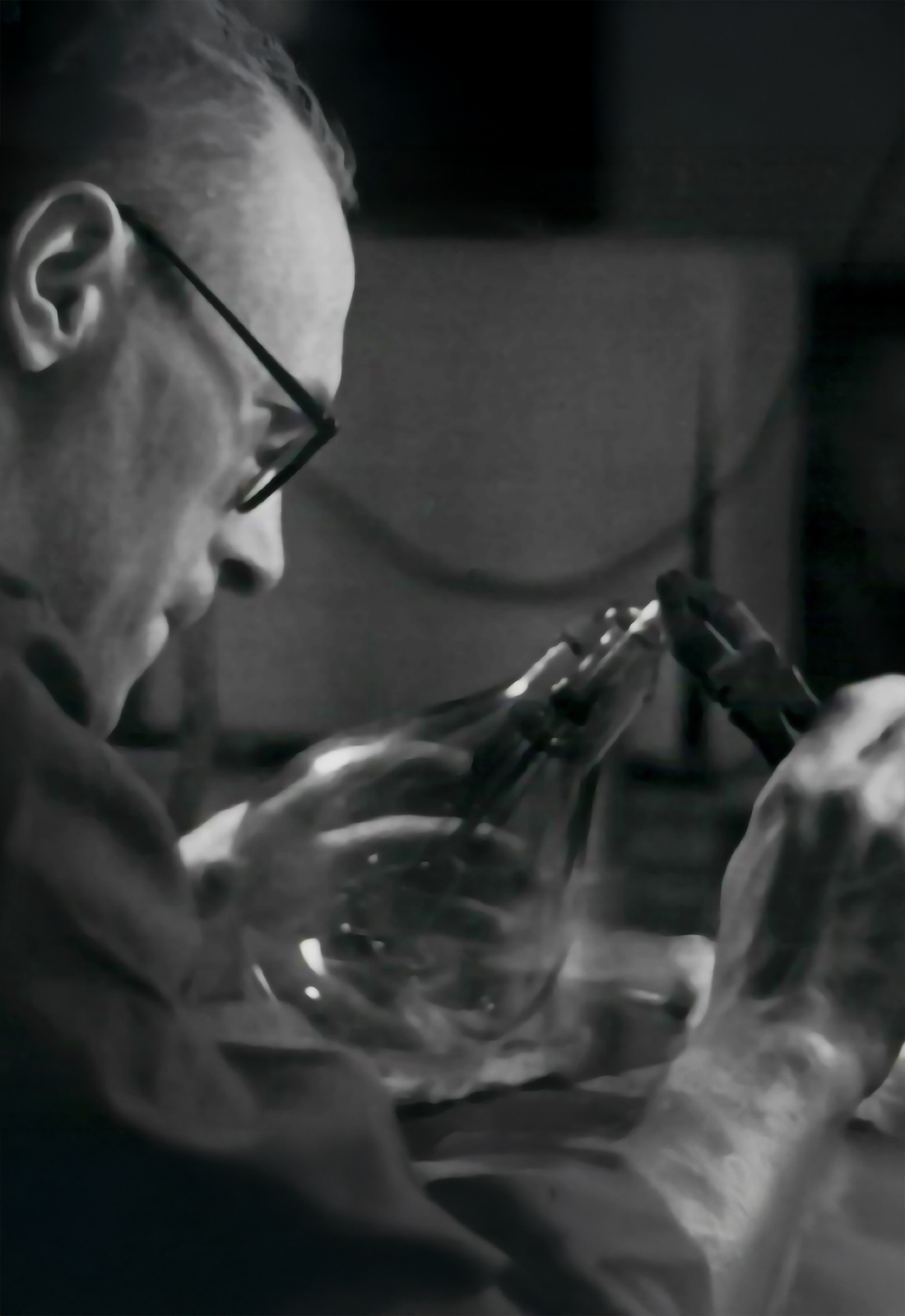
From a very young age, Livio was drawn to early communication technologies: he built crystal radio receivers, installed a transceiver antenna on his house in Lierna as early as 1946, and in 1934 won a national award for a 16 mm short film. His passion for the invisible wave—sound and image—immediately directed his projects toward the immaterial dimension of perception. His interest stems from a profound fascination with light as a visible manifestation of energy, to be explored rather than resolved. In this sense, Livio presents himself as a contemporary heir to the tradition of folk illuminations and fireworks, of which he was an avid collector and connoisseur. In his projects, light is never simply illumination: it is wonder, engagement, and visual pleasure. This aptitude was strengthened by his studies in engineering and architecture at the Milan Polytechnic, where he graduated in 1936. His penchant for electrical technologies translated, already in the 1930s, into a profound reflection on the form of the instrument: abandoning the decorative cabinet, Livio Castiglioni focused on the radio, reworking the relationship between form, function, and interface. The clarity of the dial, the position of the speaker, and the ergonomics of the controls became central elements of a new functional aesthetic, in which form served primarily to communicate.
But it is with light that Livio Castiglioni carries out his most personal exploration. In his projects from the 1940s and 1950s, and especially in his installations for the Milan Triennale, light manifests itself not as an object, but as an architectural phenomenon, removed from decorative emphasis. Castiglioni works by subtraction, reducing means and enhancing the phenomenon. In the famous "Hall of Italian Priorities in Art," overhead light falls from invisible openings in the ceiling, refracts on the walls, and reflects in the floor. Light shapes the space through veils, blades, and directional radiation.
With the "Lighting Exhibition" at the IX Triennale in 1951, in collaboration with Achille and Pier Giacomo, artificial light became a perceptual experience, somewhere between science and suggestion. This vision stood in stark contrast to the dominant practice of lighting design, where the lamp became an aesthetic fetish. For Livio (and later for Piero), the object was a tool, not an end: it was created to produce a specific type of light, responding to a precise visual need, and only then did it take shape.
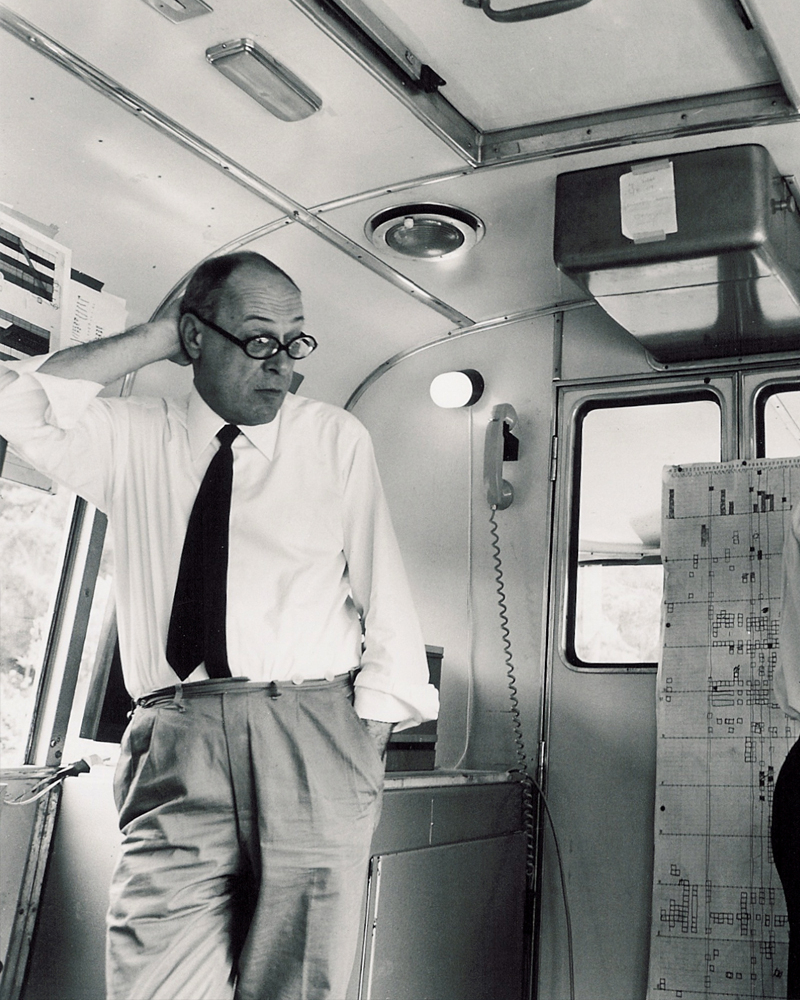
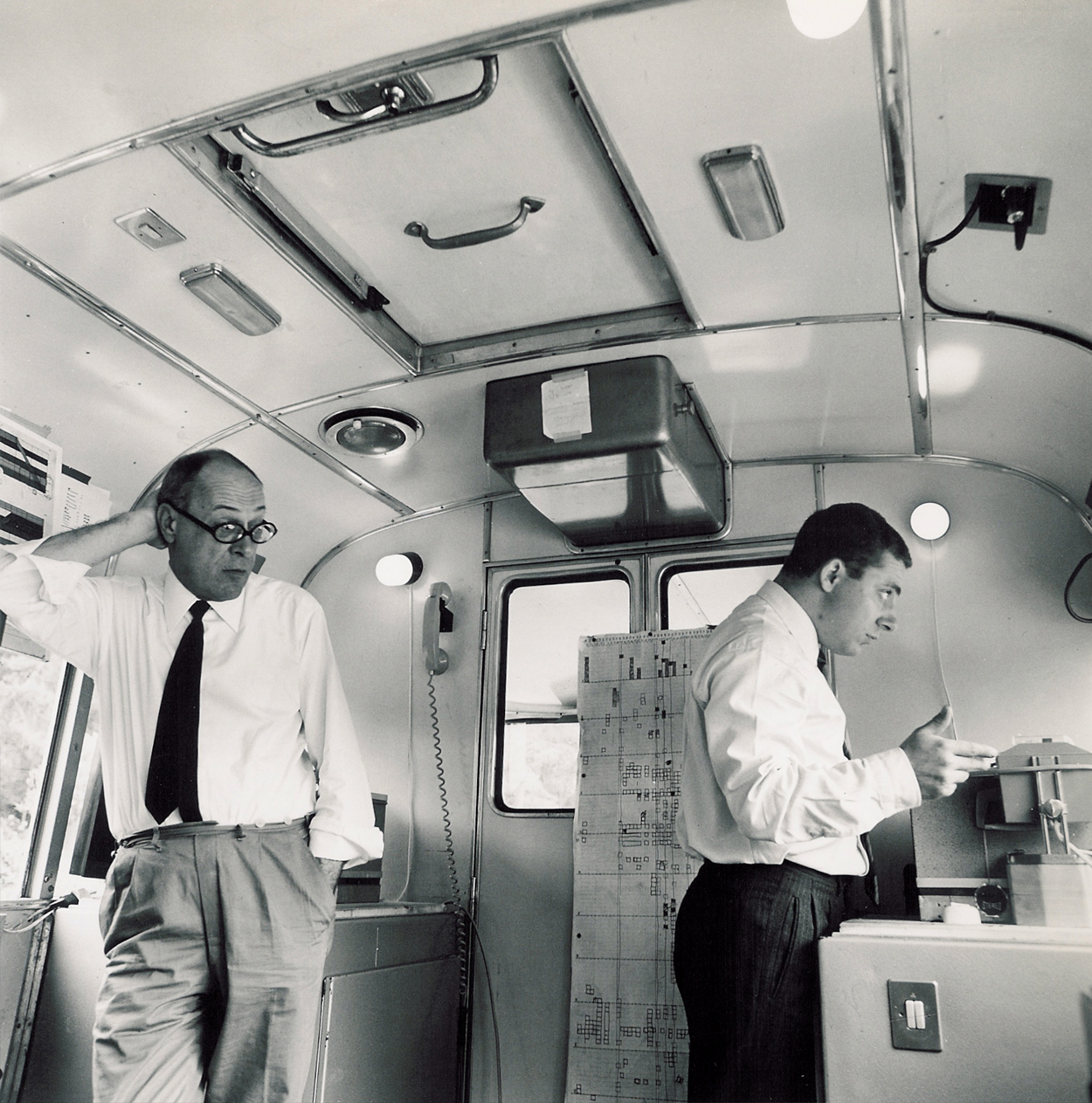
In the 1967 RAI traveling pavilion, created with his brothers and Davide Boriani, Livio designed an analog light and sound control system: a carillon control unit controlled hundreds of visual and acoustic events. It was an immersive performance ahead of its time, entirely mechanical, where light and sound become perceptual choreography. In other projects, such as Trepiù or the Collector's House with Gae Aulenti, light and sound intertwine: incandescent wires that "play," luminous ampoules that "crackle," synesthetic environments in which visual and aural perceptions mutually amplify each other.
In the 1970s, as electronics invaded design with spectacular effects, Livio responded with everyday technology grounded in design pragmatism and concrete function: mercury switches, electrical wires, and ordinary light bulbs were transformed with manual ingenuity into complex sensory experiences. All his work appears as a critique of the shortcuts of spectacular electronics.
It is to this logic that one of Livio's most emblematic inventions, the Boalum, designed with Richard Sapper for Artemide in 1969, belongs. Not a lamp, but a flexible luminous body, devoid of a definitive form, intended to change with the user's intervention. It is the object that more than any other expresses the situationist vocation of his design: the light is not imposed, but constructed in relation to space, the body, and gesture. Boalum is action light, participatory light. In promotional texts of the time, Boalum is described with irony and freedom: "Uses of the Boalum: light with many lights. Take the luminous cord and choose the right place for its placement: on the floor, hanging on the wall, or hanging from above with knots and sinuous returns. Suitable for the entrance or living room, it can be worn, in exceptional cases, by a young woman, preferably blonde and a little sexy." Behind this lightness lies a profound reflection on domestic space: no longer a static and regulated place, but a flexible, relational environment, where light becomes a companion to behaviors and transformations.
Achille Castiglioni remembers him like this: "Livio was always the most inventive and followed his own path [...] he was a bit of an inventor and liked to tinker, put together devices." Before the war, Livio had even built a device capable of picking up the first experimental television broadcasts from England: "they looked like ghosts, like magic."
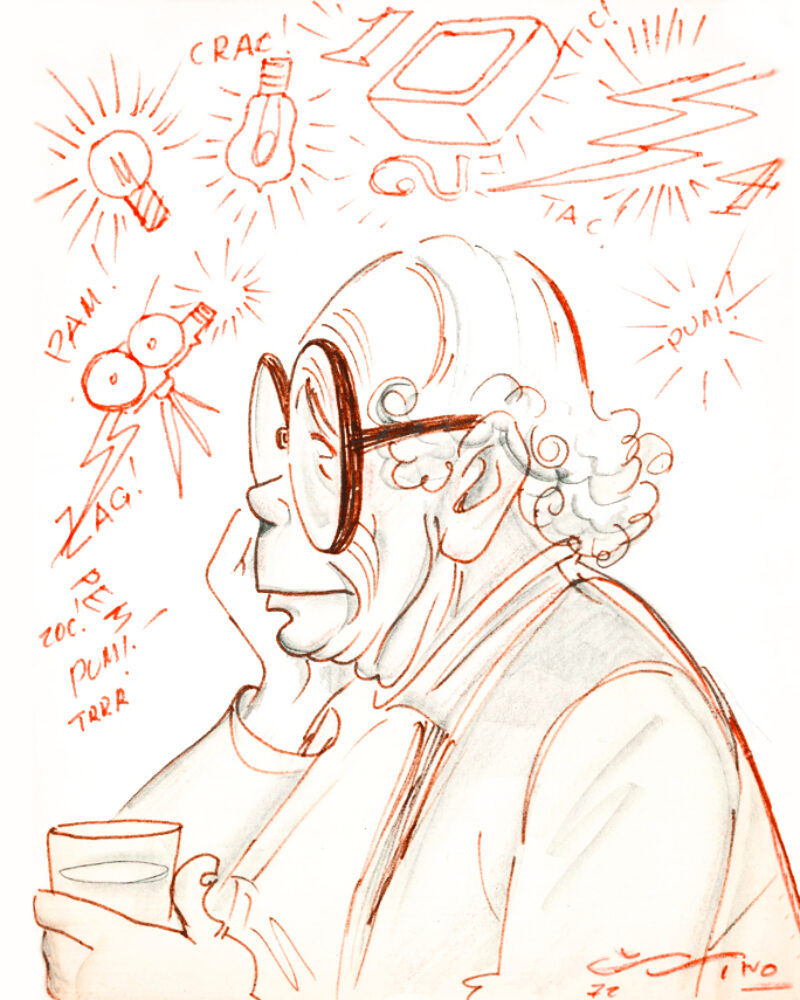
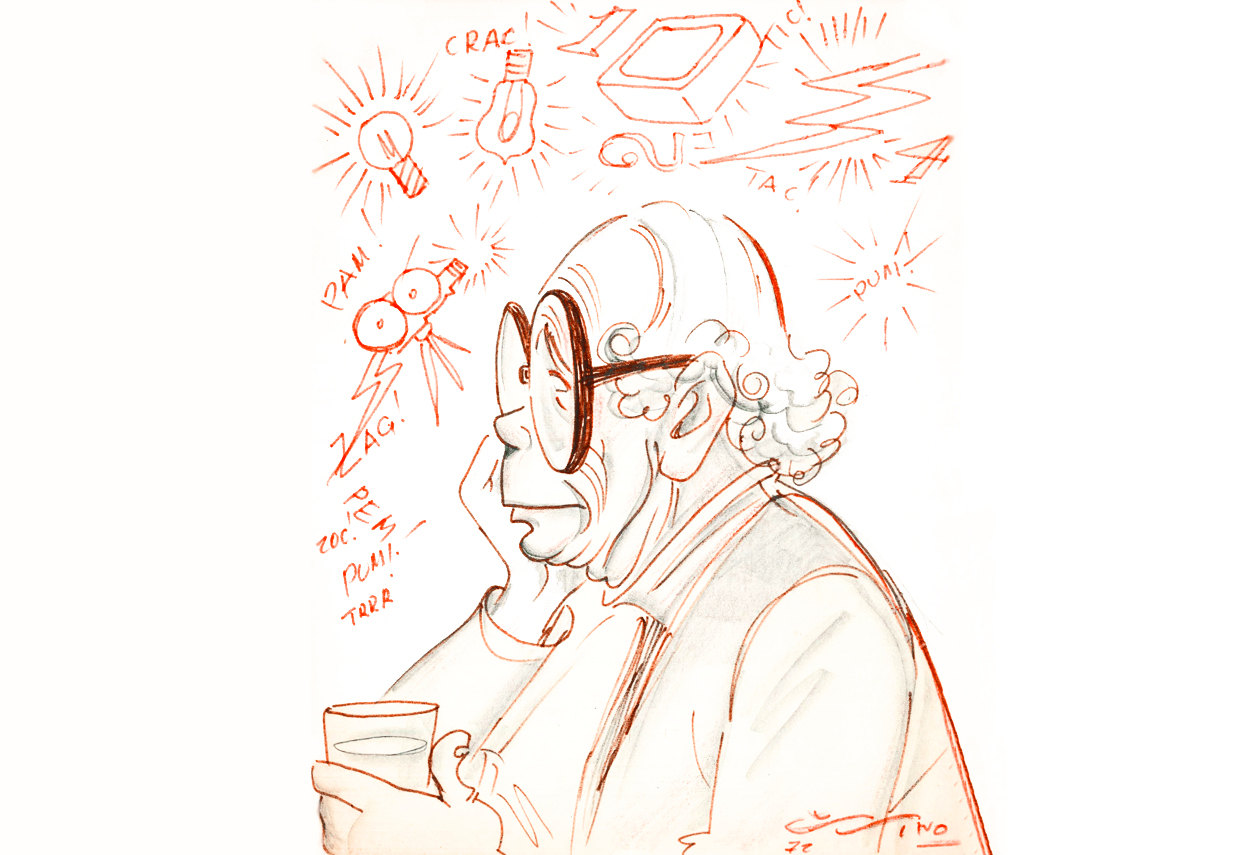
Cussino, caricature by Livio Castiglioni, 1972.
In his studio-workshop on Via Presolana, Livio works with amateur radio and filmmaking tools: reel-to-reel tape recorders, transformers, cables, amplifiers, loudspeakers. He is a modern alchemist who seeks form not as an icon, but as an experience. All his work is a critique of the shortcuts of technological spectacle. Faced with the effects achieved with sophisticated electronics, Livio responds with poetic everyday technology: mercury switches, stove wires, common sources, bent to generate effects of intense perceptual intensity. His research finds fulfillment precisely in this attitude: immaterial yet concrete, sensorial yet scientific, artisanal yet anticipatory. It is no coincidence that in 1979, on the eve of his sudden passing, he was working with Giovanni Klaus Koenig on an exhibition on the forms and designs of radio and television: the two media that, from a young age, had fascinated him and drawn him toward a design based on invisible communication.
Today, Livio Castiglioni's work still seems extraordinarily relevant. His oeuvre demonstrates that design can be thought, research, and a poetic act. That light, when liberated from the object, can become language, narration, and an emotional landscape. At a time when we are once again talking about sensitive environments, immersive spaces, and multisensory relationships, Livio Castiglioni's legacy is more alive than ever: he reminds us that designing means listening to the invisible substance of things, and shaping—with intelligence and freedom—our experience of the world.
Rethinking Livio Castiglioni today means recognizing the value of a project that eluded formalization, yet shaped a vision. He paved the way for a new generation, and in particular for Piero, who would transform that intuition about light into a true discipline: lighting design.
Other Master pages
This section brings together a series of historical, critical, and cultural insights into the figures and contexts that contributed to the birth and establishment of lighting design as an autonomous discipline. The content explores Piero Castiglioni's role in defining a design approach in which light becomes a structural part of architecture, and the experimental origins of Italian lighting design through the research of Livio Castiglioni, in which light and sound are configured as immaterial languages of the project.
The section also explores the contribution of the Castiglioni brothers, tracing their cultural journey from 1930s Milan to the development of Italian industrial design, and analyzes the central role of the Studio on Via Presolana as a laboratory for experimentation and training for generations of lighting designers.
The overview is rounded out with a reflection on the great masters of design, from rationalism to postmodernism, highlighting the cultural and methodological legacy that has redefined the relationship between light, space, and living in contemporary design.