
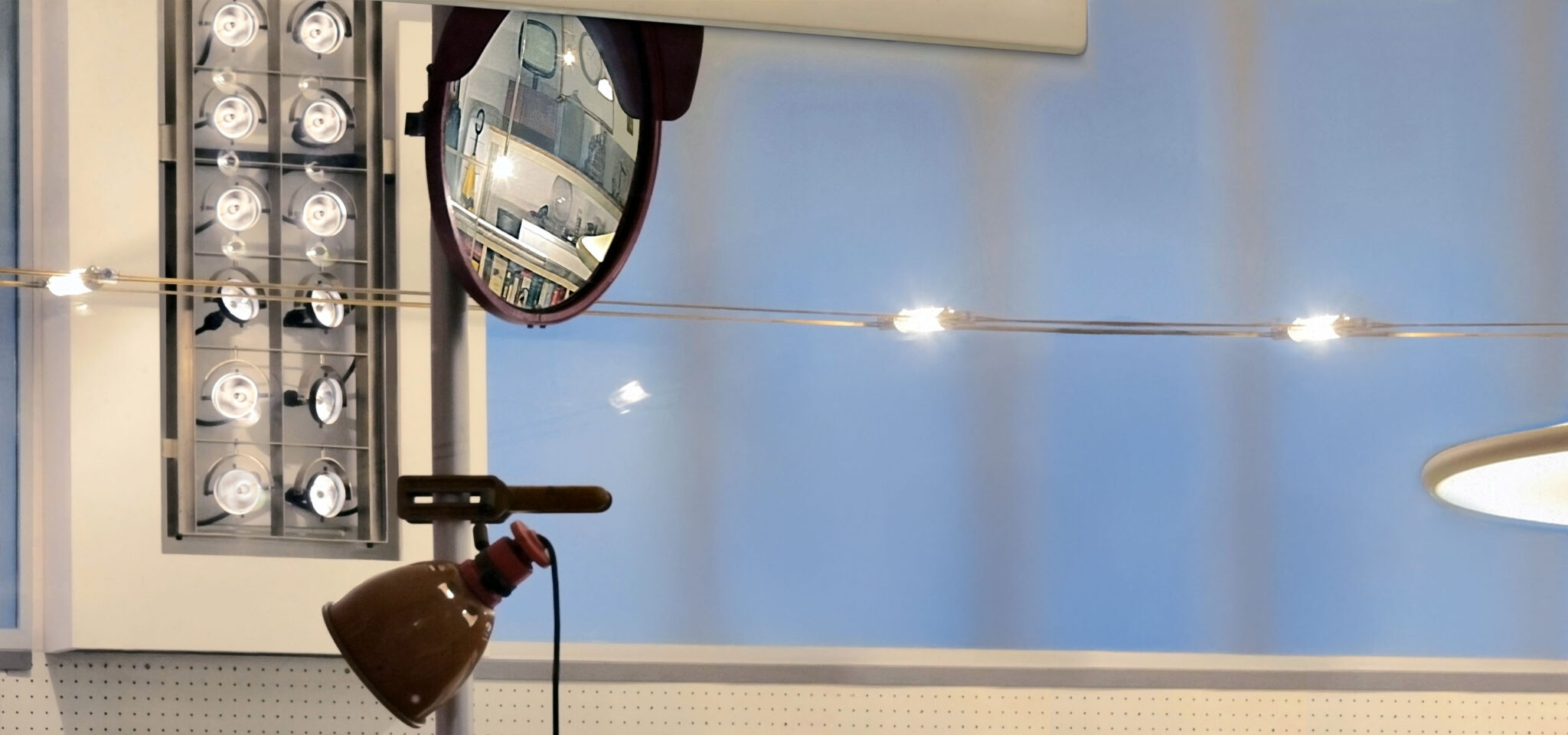
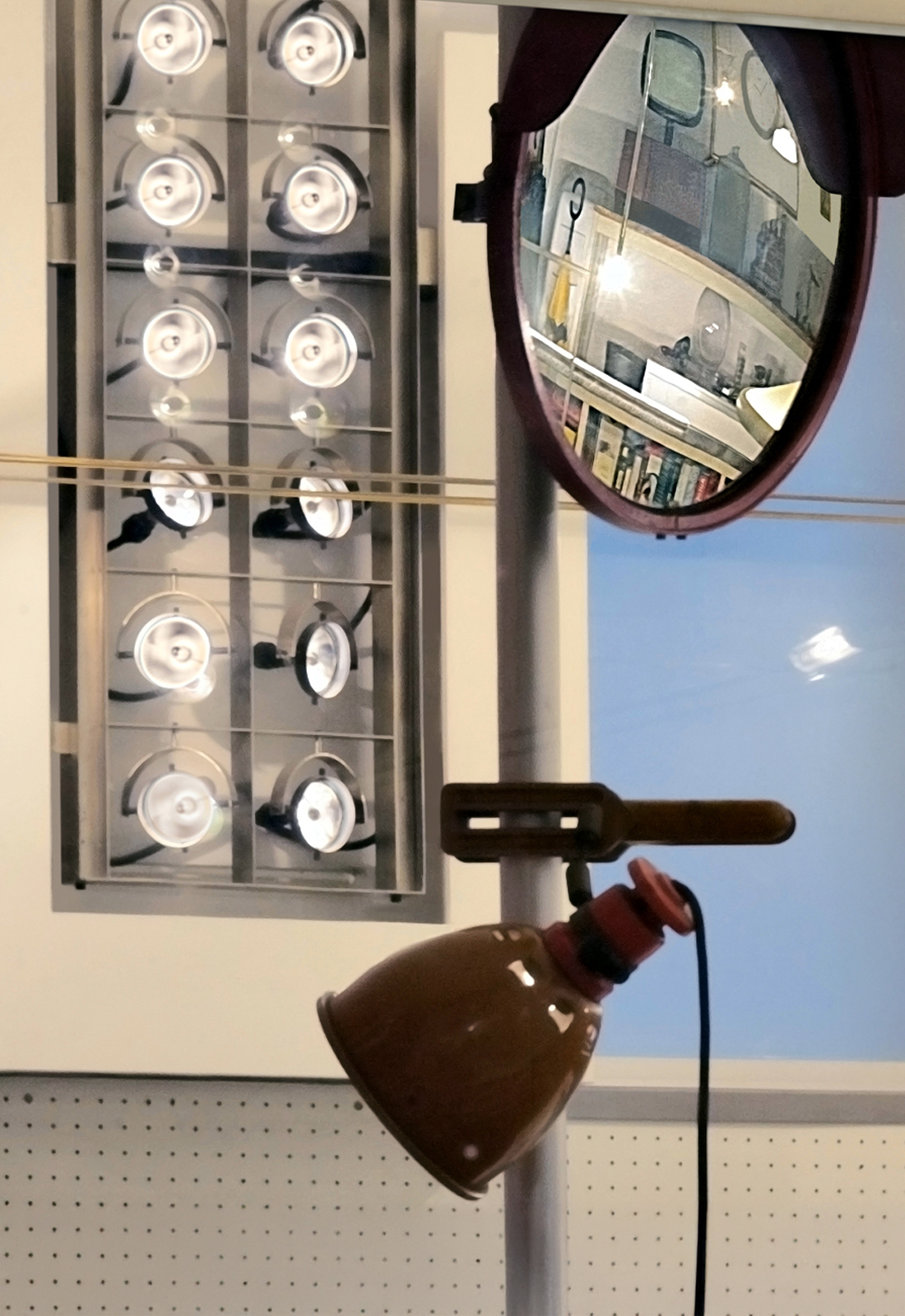
Milan Lighting Studio on Via Presolana
Since 1957, the studio-laboratory on Via Presolana has trained a generation of lighting designers, combining experimentation, design culture, and architectural vision.
The history of the lighting studio on Via Presolana in Milan unfolds around a fruitful and unique relationship between father and son: Livio and Piero Castiglioni. It is through this relationship—based on transmission, exchange, and design continuity—that one of the most significant experiences in Italian lighting culture has emerged. The origins and influences that shaped Livio Castiglioni form the foundation for a shared yet evolving vision, where the father's experimentation intertwines with the son's architectural vision, giving rise to a studio that is not just a workplace, but an intergenerational laboratory of lighting design thinking.
A Milanese architect born in 1911, Livio trained at the Milan Polytechnic and quickly emerged in the vibrant postwar Italian design scene. But his curiosity extended beyond this: he was fascinated by the sensorial dimension of design, exploring the boundaries between technology and perception, taking an interest in the phenomena of sound and light and new audiovisual tools. This eclecticism led him to collaborate with the electronics industry: in the 1940s and 1950s, he was a consultant for Phonola (for which he designed innovative radios with unique shapes) and in the early 1960s for Brionvega, contributing to the aesthetic evolution of radios and hi-fi equipment.
After collaborating with brothers Achille and Pier Giacomo in their studio on Via Porta Nuova—a polyphonic space where architecture, urban planning, and industrial design intertwined—Livio chose, in the mid-1950s, to pursue an independent career. A desire to experiment with new forms of expression led him to open his own atelier-workshop on Via Presolana, Milan, in 1957. Initially dedicated to research on sound, light, and electronic devices, this space gradually transformed, thanks in part to the active involvement of his son Piero, into a hub for integrated lighting design. It was a small artisanal workshop, destined to become a hotbed of ideas that anticipated the modern concept of light in architecture.
From the very beginning of his new studio, Livio Castiglioni adopted a pioneering approach that we might call The Castiglioni Method. In his laboratory, lighting design was conceived as a continuous experimentation, in which the technical component merged with the aesthetic and sensorial. In the 1960s, Livio created his first sound and light environments, anticipating the era of multimedia installations: his participation in the Milan Triennials, where he combined lighting and sound to create immersive experiences, is famous. For the 14th Milan Triennial (1968), for example, he and his son Piero designed integrated lighting systems and audio-video devices, putting his synaesthetic vision of space into practice.
Light thus becomes a design material like any other: something to be shaped to define the atmosphere of a space. This method, founded on inventive play and rigorous analysis, leads Livio to conceive "tailor-made" lighting solutions—handcrafted devices adapted to the specific needs of each project, rather than standard catalogue products. A shining example of this approach is the experimental Boalum lamp (1970), a flexible luminous tube designed with Gianfranco Frattini and produced by Artemide: an object combining technology and poetry, still considered an icon of Italian design. In the laboratory on Via Presolana, in short, technological research and creativity go hand in hand, outlining the key principles of the Castiglioni method: continuous innovation, artisanal attention to detail, and the integration of light into architectural space.
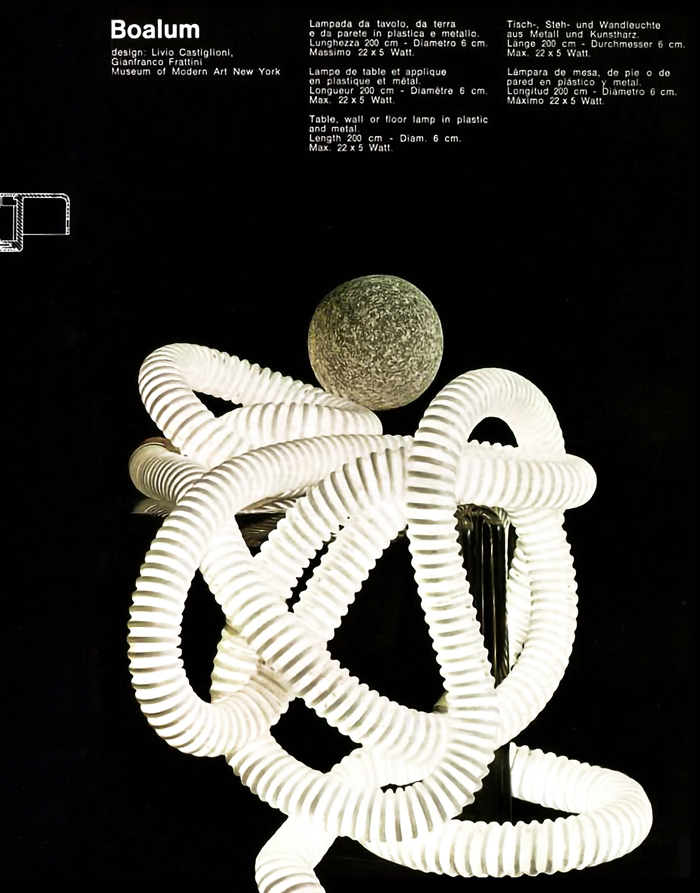
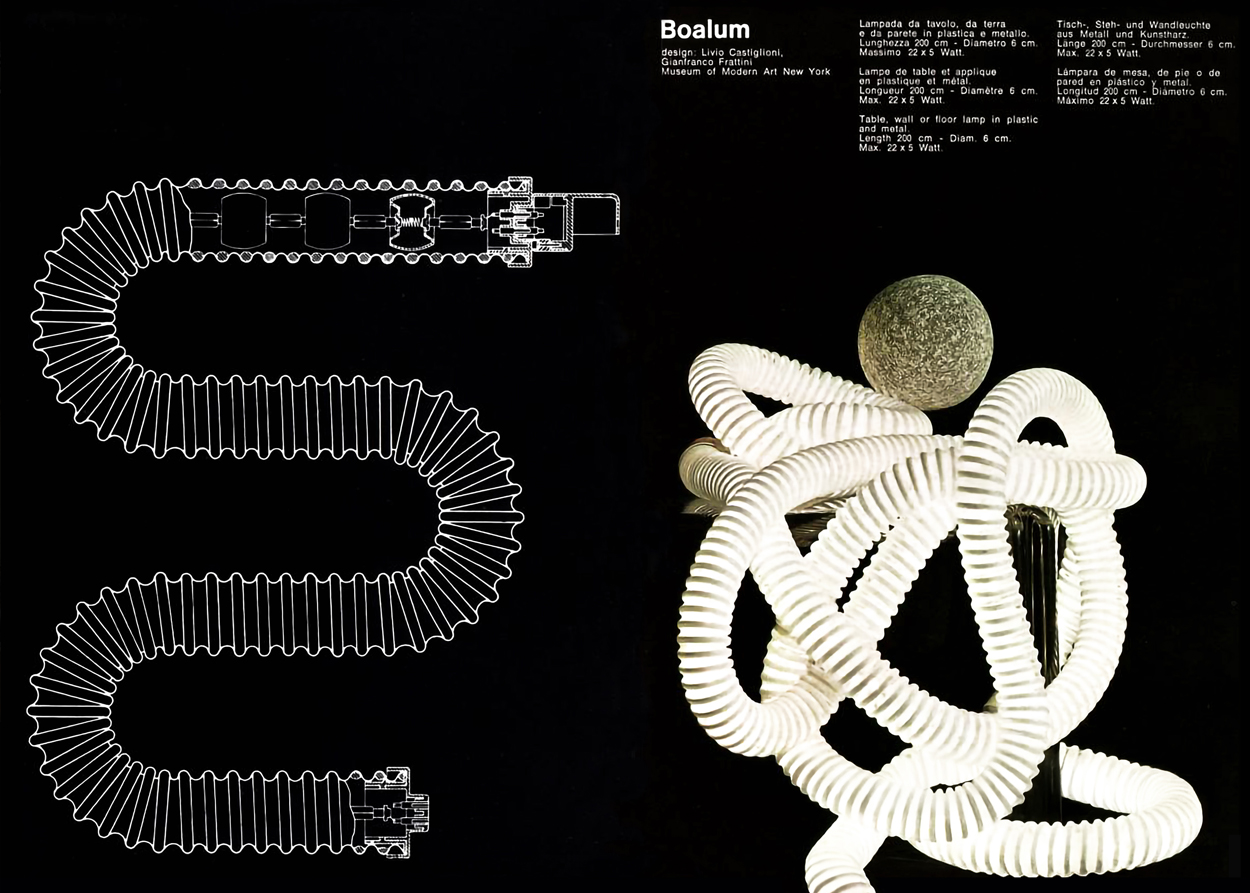
Boalum, a lamp designed by Livio Castiglioni and Gianfranco Frattini in 1970 for Artemide, presented here in the 1973 catalog, is an emblematic example of formal and technological experimentation. Composed of a flexible translucent plastic body containing a series of modular light sources, it can be freely shaped, becoming a table, floor, or wall lamp. Light and matter merge into a seamless device, playful and innovative in spirit, which pioneered the logic of relational design. Included in the collections of the Museum of Modern Art in New York, it represents one of the most radical objects of Italian design of the 1970s.
With the arrival of Piero Castiglioni, Livio's son, the Via Presolana studio embraces generational continuity and a new phase of growth. Piero was born in 1944 and, following in his father's footsteps, graduated in Architecture from the Milan Polytechnic in 1970. As a student, he attended the studio of his uncles Achille and Pier Giacomo in Piazza Castello, absorbing the playful wit and pragmatic approach typical of the family. After graduating, he officially joined the Via Presolana studio alongside his father, bringing fresh ideas and a new architectural perspective on light. Father and son worked side by side for nearly a decade, from 1972 to 1979, sharing projects and insights.
These were years of intense activity, during which the studio created custom lighting for art galleries, showrooms, hotels, offices, and homes, both in Italy and abroad. During this period, special fixtures designed specifically for each setting were produced in small series, cementing the "made-to-measure" philosophy that distinguishes the Castiglioni school. It was in the heart of the laboratory that inventions destined to leave their mark were born: here, the Scintilla system was conceived and physically assembled, an innovative modular cable-and-track structure for halogen lamps, with its extremely clean lines. Scintilla embodies the Castiglioni vision: it combines the essential versatility of a decorative element with the lighting power of a professional technical system.
Initially handcrafted on request, the Scintilla system was so successful that in 1983 it was sold to Fontana Arte for large-scale production. At the same time, Livio and Piero's collaboration with other designers led to new lighting projects: in the 1970s, they participated in the creation of lighting and audiovisual displays for exhibitions such as Eurodomus and other events, cementing the studio's reputation as a benchmark in spatial lighting design.
After Livio's passing in 1979, Piero Castiglioni continued his work with determination, dedicating himself exclusively to lighting and leading the studio into a new era. The 1980s saw a marked evolution: from the design of individual lighting objects to the conception of complete lighting systems integrated into architecture. The workshop on Via Presolana became a meeting place for an ever-expanding network of prestigious collaborations. Piero, building on his father's legacy but with an eye to the future, established professional relationships and friendships with leading figures in Italian and international design.
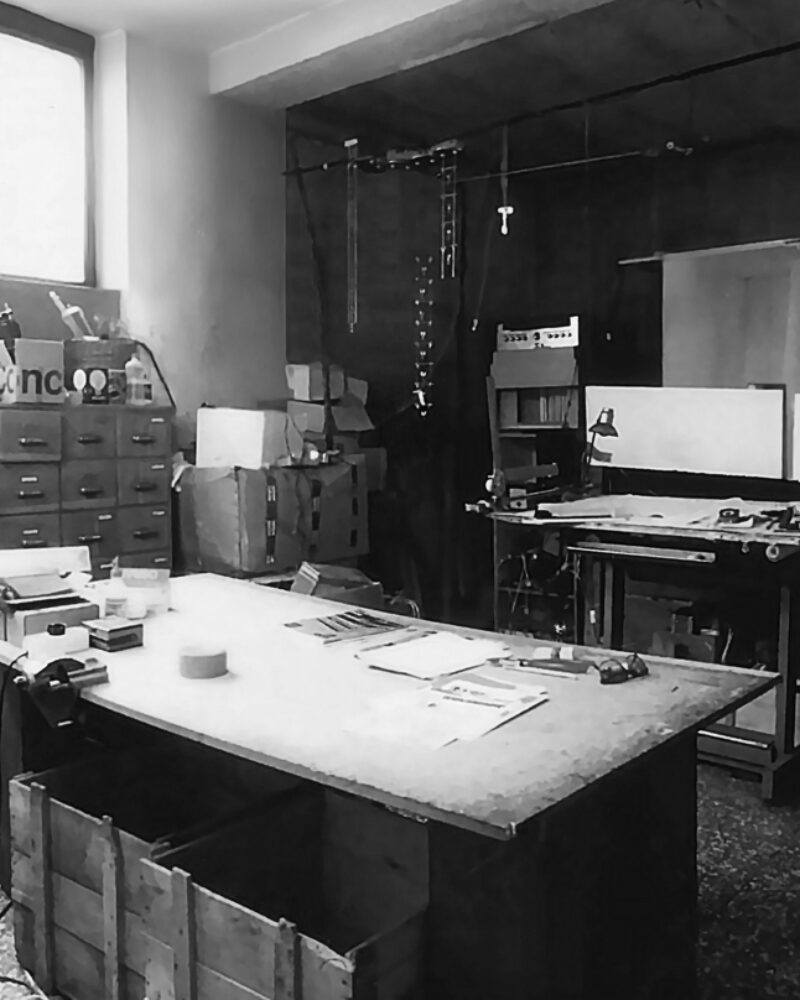
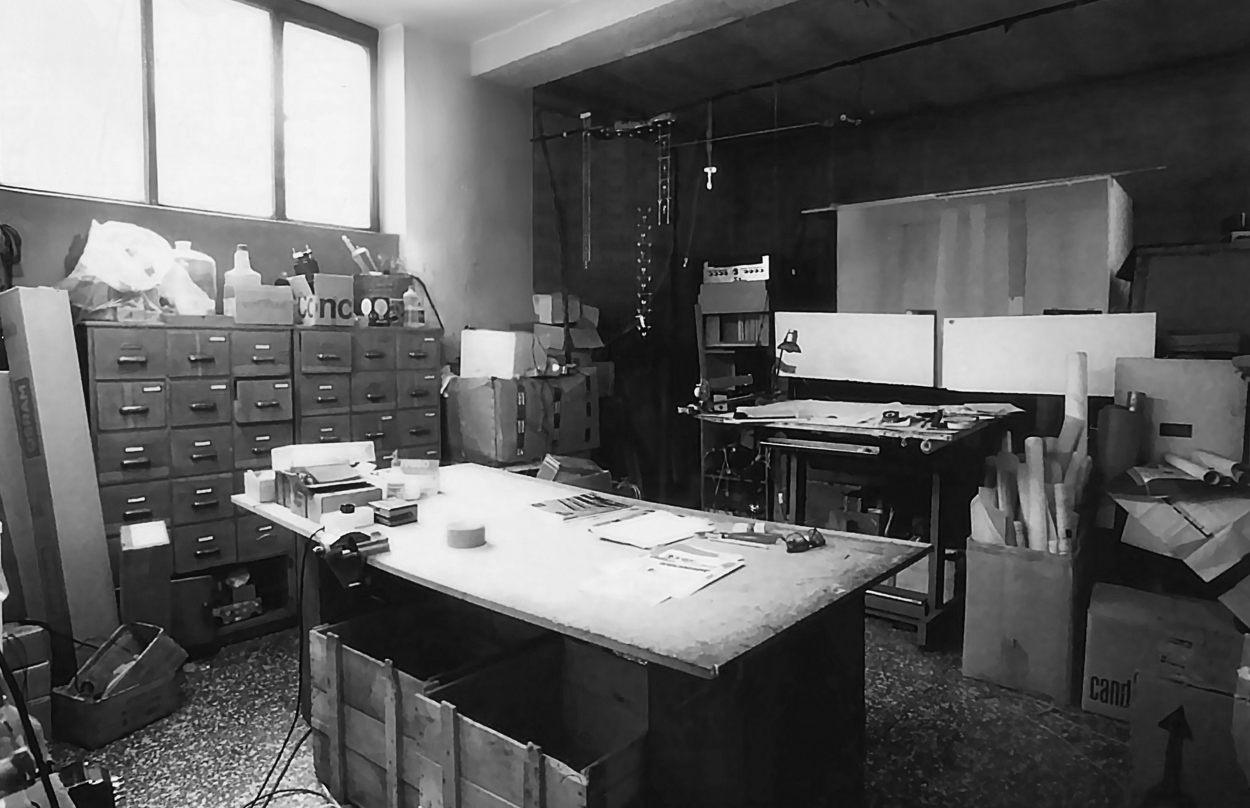
The workshop on Via Presolana in 1979, the operational and creative heart of the Castiglioni studio: an artisanal environment where materials, prototypes, technical drawings, measuring instruments, and electrical components coexist.
In the intimate spaces of that Milanese laboratory, architects and designers such as Gae Aulenti, Bruno Munari, Gianfranco Frattini, Vittorio Gregotti, Cini Boeri, Cesare Casati, Vico Magistretti, Nanda Vigo, Marco Zanuso, and many others met to converse and work together. Each brought their own unique contribution: some, like Aulenti, shared a focus on history and setting (this encounter would lead to a long collaboration on museum projects), others, like Munari, fostered a playful and experimental dimension, and others, like Frattini, brought their experience in product design. This interdisciplinary ferment further enriched the Castiglioni method, which assimilated new stimuli while remaining faithful to its cornerstones: technical rigor, functional simplicity, and formal elegance at the service of the space to be illuminated.
During these same years, Piero Castiglioni designed several emblematic projects that propelled Milanese lighting onto the international stage. In 1986, in collaboration with architect Aulenti, he created the new lighting project for the Musée d'Orsay in Paris, converting the monumental former train station into a temple of masterfully calibrated natural and artificial light. Also in Paris, he contributed to the lighting of the Centre Georges Pompidou, a futuristic space where light was used to emphasize the building's high-tech structure while simultaneously showcasing the works on display. In Venice, Piero was commissioned to design the lighting for the renovated Palazzo Grassi (mid-1980s), where he experimented with innovative solutions to combine respect for the historical context with modern exhibition requirements.
It was precisely within Palazzo Grassi that another creation destined to become a classic was born: the Cestello system, designed by Piero together with Gae Aulenti to flexibly illuminate exhibition spaces. Cestello introduced the concept—revolutionary at the time—of a fixture with multiple, individually adjustable light sources, capable of combining diffused and accent lighting in a single, versatile solution. Presented in 1985 during the inauguration of Palazzo Grassi and subsequently developed industrially by iGuzzini (1988), Cestello became an archetype in the sector: a system that combined typological innovation, technological quality, and aesthetic purity, fully reflecting Castiglioni's approach to light as a modular tool.
Meanwhile, Piero continued to leave his mark on his homeland: among his numerous commissions, the new lighting for the Sala dei Corazzieri at the Quirinale Palace, the most solemn state room of the Presidency of the Republic in Rome, stands out. In that project (completed in the 1990s), Piero worked with architects Mario Bellini, Cini Boeri, and others, expertly combining direct and indirect lighting to enhance the decorative richness without glare, transforming the perception of a historic space through discreet yet highly dramatic solutions. The lighting of the Quirinale Palace in Rome, as well as that of the Galleria Vittorio Emanuele II in Milan a few years later, confirmed Castiglioni's role as a point of reference for high-profile institutional lighting projects.
The story of the Via Presolana workshop, however, isn't limited to its extraordinary projects: its true legacy lies in being a place where one learns the craft, where knowledge of light comes through direct experience, working side by side, in a slow and rigorous process of trial, error, and continuous refinement. Via Presolana represents a true school of design, where theory and practice merge in a unified process, both artisanal and intellectual. An environment where light is approached not only as a technical tool, but as a living material of design culture, in a continuous dialogue between invention, function, and construction. An educational model that has successfully combined rigor and freedom, discipline and vision, leaving a profound mark on the teaching of lighting design and on the generations that have emerged from it.
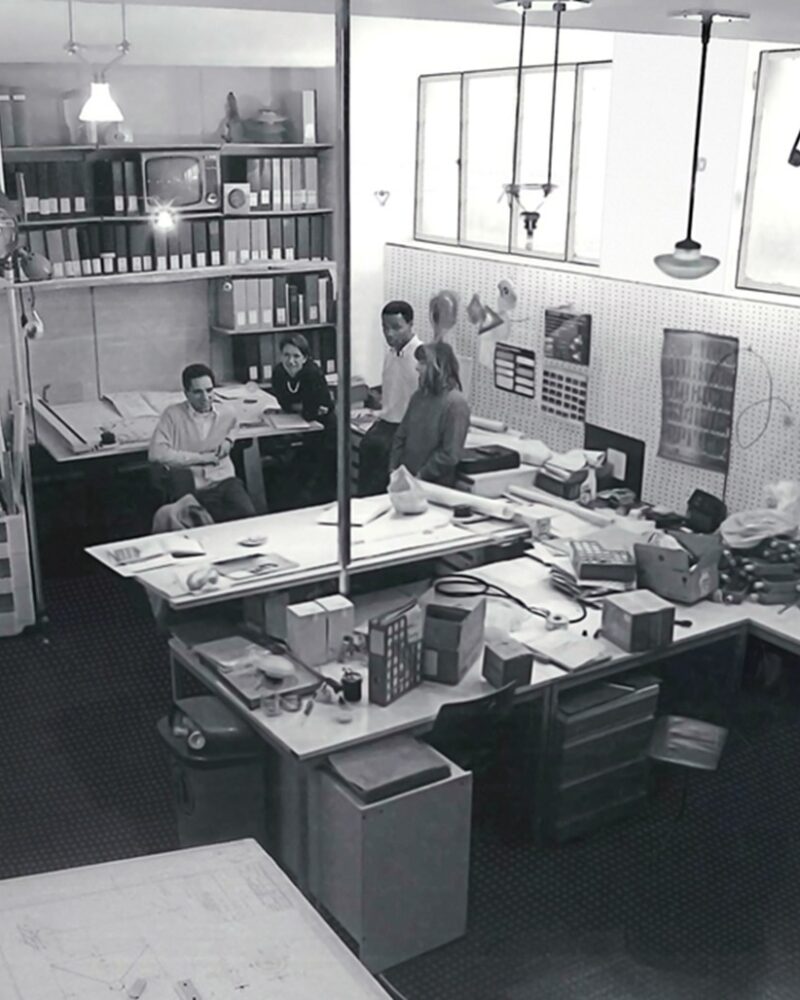
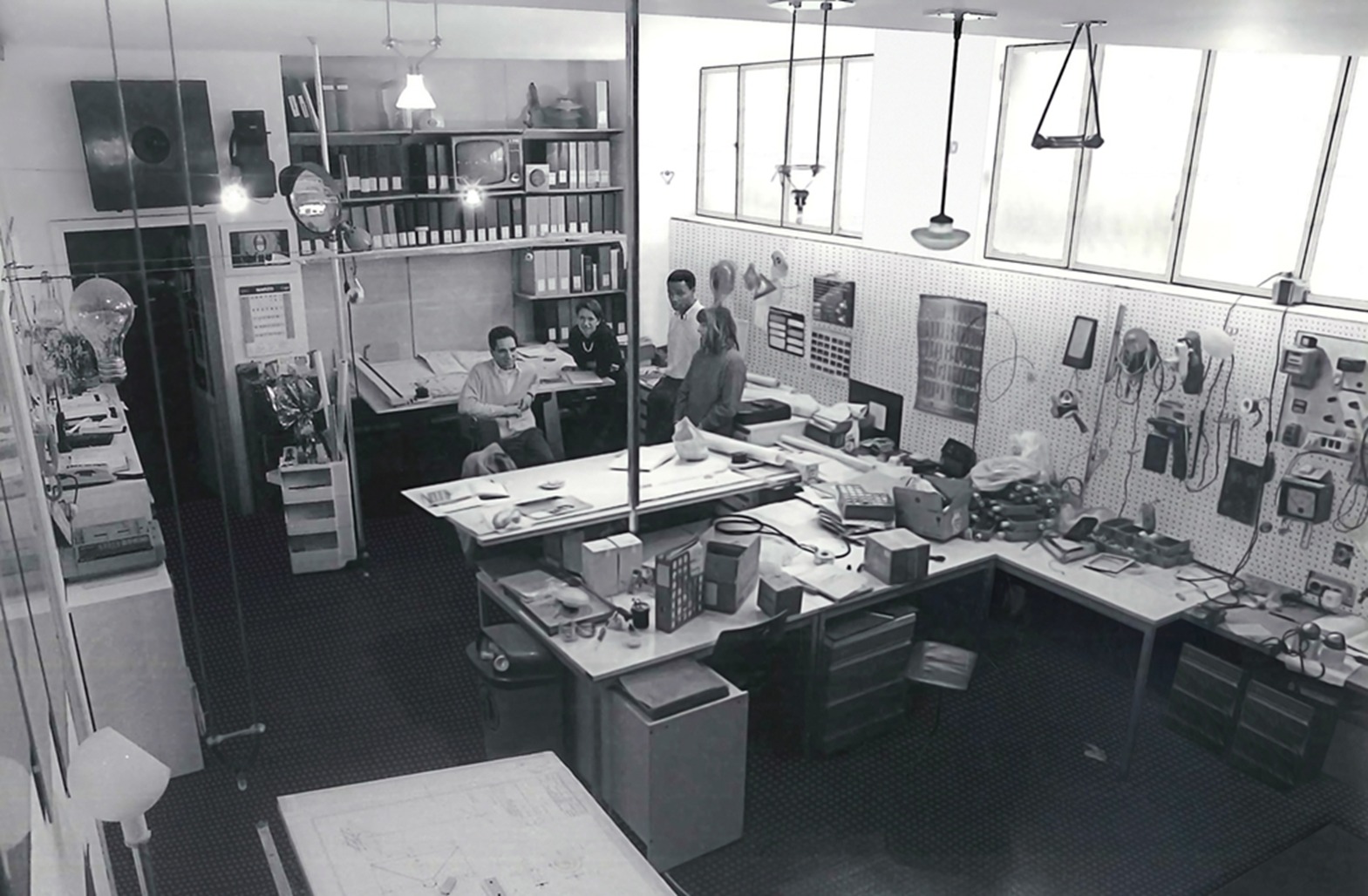
Milan, 1988 – Interior of Piero Castiglioni's studio on Via Presolana. A place of technical and design experimentation, where lighting intertwines with research into materials, light sources, and optical solutions. Among drawing boards, prototypes, and measuring instruments, a rigorous and interdisciplinary working method takes shape, destined to profoundly impact the evolution of Italian lighting design.
From the mid-1980s onward, Studio Castiglioni increasingly became an educational as well as design workshop. Piero, aware of the formative value of hands-on work, opened the doors of the laboratory to young architects eager to specialize in lighting, transforming the studio into a truly contemporary workshop. Here, collaborators learned not from books but by working alongside the master on construction sites, in darkened museums before installation, and during evening lighting tests; they experimented, made mistakes, and improved, breathing in an atmosphere of continuous research.
Among the key collaborators who trained at the studio are names now well-established in the independent lighting design scene. For example, Marinella Patetta and Claudio Valent: both architects with master's degrees in lighting, they joined the Castiglioni studio at a young age and worked there for several years, mastering the "custom lighting" method. Building on this shared experience, in 1989 the couple decided to branch out on their own, founding the Metis Lighting studio in Milan, dedicated exclusively to lighting design and destined to achieve international success.
Likewise, in the 1990s, the Castiglioni studio continued to attract and develop talent: architect Nicoletta Rossi began collaborating with Piero in 1989, followed a few years later by Florentine architect Guido Bianchi (from 2001). For over fifteen years, Rossi and Bianchi contributed to projects in Italy and abroad within the studio, until 2006, when they too embarked on the path to independence, founding Rossi Bianchi Lighting Design in Milan. In their new direction, they continued to develop criteria for innovation and lighting research, capitalizing on the experience gained "in the workshop" on Via Presolana.
Architect Jacopo Acciaro followed a similar path. After working side by side with Piero Castiglioni between 1998 and 2001, he founded his own firm, Voltaire Lighting Design, with which he explored lighting design in international contexts. During his years of collaboration with Piero Castiglioni, Jacopo Acciaro developed a way of understanding light based on the balance between function, technique, and space, gradually developing his own design vision, which he would continue in his subsequent works.
Giovanna Olgiati, who also trained at Studio Castiglioni, continues her career today as an independent lighting designer, helping to spread the approach she learned during her years in the studio. Alongside her professional work, she continues to teach at the Polytechnic University of Milan, where she teaches in the Master's program in Lighting Design and Technologies, passing on to new generations of designers the principles she learned in the field, between the studio and the construction site.
Each of these figures testifies to how the Via Presolana studio functioned as a true Castiglioni school: a place where knowledge was passed on daily, through example and hands-on experience, creating a sort of extended professional family. From Livio's original workshop in 1957 to the current activities of Piero and his professional heirs, the Castiglioni family's history is more than a family story: it is the story of a method and a vision that revolutionized the world of lighting.
Today, Piero Castiglioni is recognized as one of the masters of lighting design, awarded numerous honors (Grand Officer of Merit of the Italian Republic in 2020) and lifetime achievement awards, while his studio continues to develop projects with a systemic and tailor-made approach. But perhaps the greatest tribute to the Castiglioni method lies in the community of lighting designers trained on Via Presolana and the ideas they champion. The legacy of this Milanese atelier, built on passion, experimentation, and sharing, continues to illuminate the contemporary design landscape, confirming that light, as Piero loved to say, "is another material of architecture," to be shaped with technical expertise and artistic sensitivity to transform space and the lives of those who inhabit it.
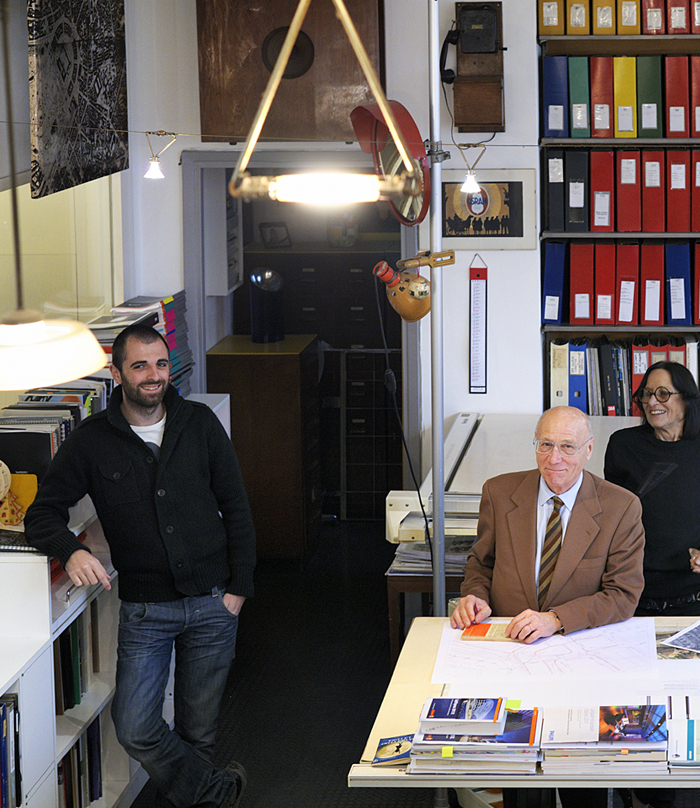
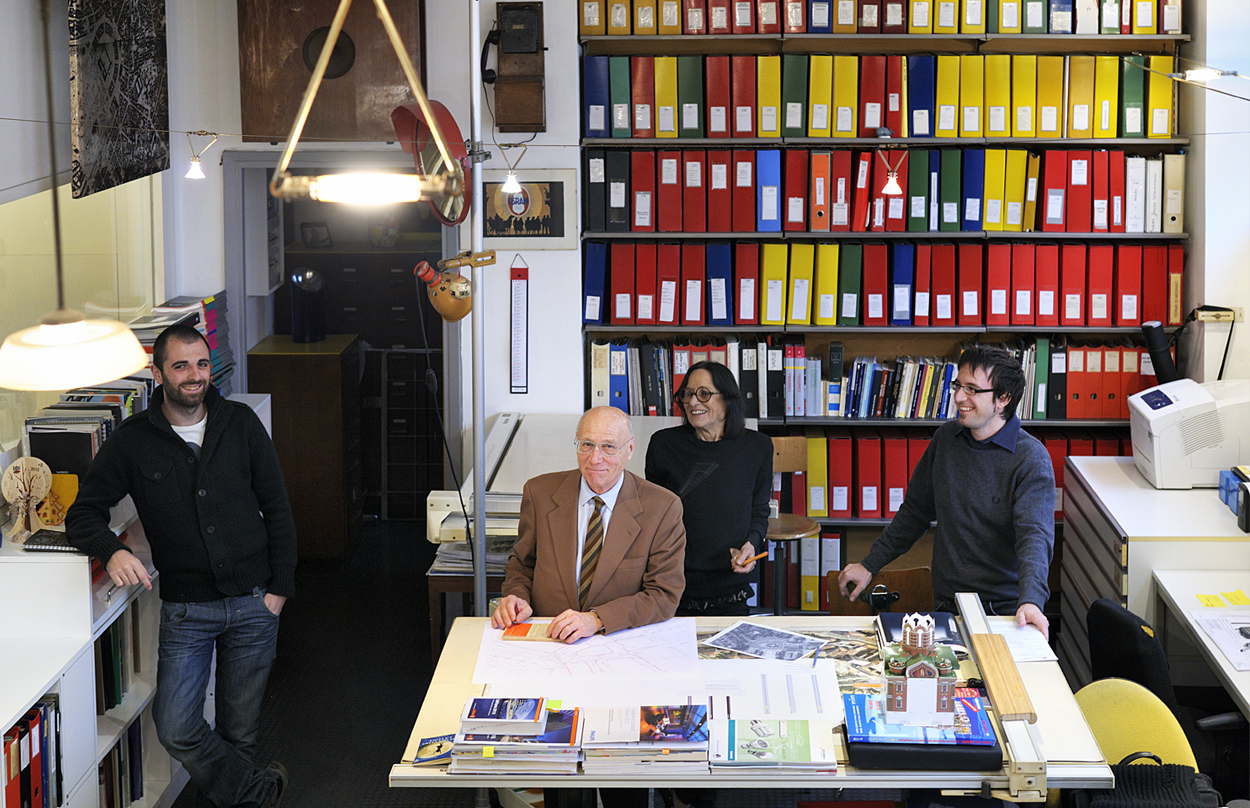
The laboratory on Via Presolana in 2014, fifty years after its founding: around the work table, architect Piero Castiglioni, with his collaborators Chiara Baldacci, Marco Petrucci, and Mauro Zani, testifies to the continuity of a studio that is both a design workshop and a place for the transmission of knowledge.
Other Master pages
This section brings together a series of historical, critical, and cultural insights into the figures and contexts that contributed to the birth and establishment of lighting design as an autonomous discipline. The content explores Piero Castiglioni's role in defining a design approach in which light becomes a structural part of architecture, and the experimental origins of Italian lighting design through the research of Livio Castiglioni, in which light and sound are configured as immaterial languages of the project.
The section also explores the contribution of the Castiglioni brothers, tracing their cultural journey from 1930s Milan to the development of Italian industrial design, and analyzes the central role of the Studio on Via Presolana as a laboratory for experimentation and training for generations of lighting designers.
The overview is rounded out with a reflection on the great masters of design, from rationalism to postmodernism, highlighting the cultural and methodological legacy that has redefined the relationship between light, space, and living in contemporary design.