
Integrated Lighting Design Service
Scope of intervention, content, and methods of performing professional services
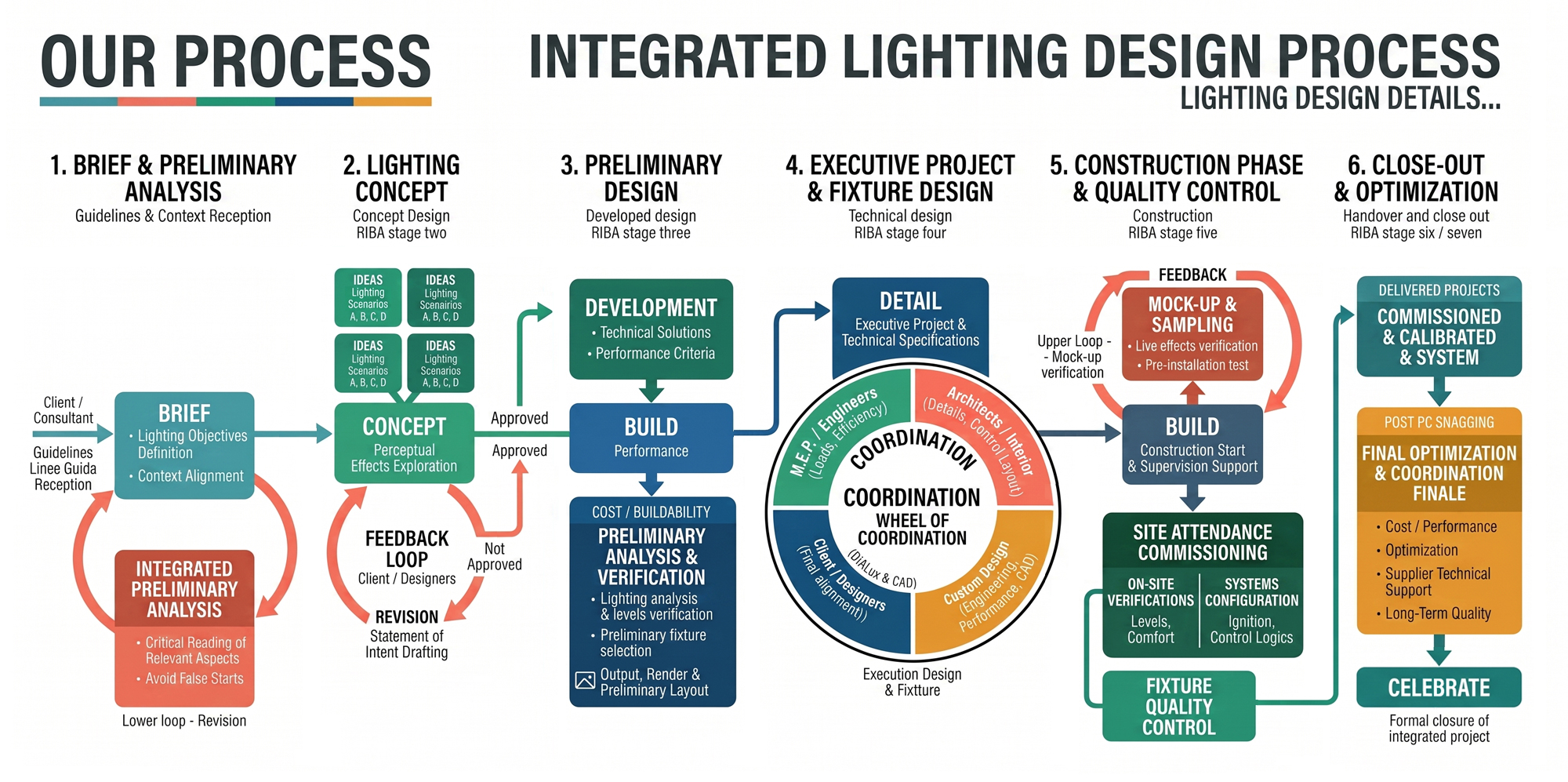
The lighting design service is aimed at ensuring structured, coherent and continuous management of the conceptual, perceptive, performance and technical aspects of lighting throughout the entire design process, through constant interaction with the Client and the multidisciplinary design team. This interaction is oriented towards sharing the lighting objectives and aligning the qualitative, functional and economic expectations of the intervention, in line with the architectural, urban and environmental context, with the methods of use of the spaces and with the regulatory framework of reference.
The contribution of the lighting designer is configured as a specialist and consultative contribution, aimed at defining the lighting design criteria, the expected performance levels, the lighting hierarchies and the architectural integration strategies, as well as their progressive translation into verifiable and measurable lighting solutions. The activity develops from the lighting concept phase, through the analysis of the context and the development of design guidelines, up to the preliminary and executive design phases of lighting expertise, ensuring methodological continuity and consistency between concepts, technical solutions and expected results.
The objectives of the service include the definition of the performance of lighting fixtures and control systems, the performance of lighting analyses and numerical simulations, the drafting of technical lighting documentation and the contribution to the preparation of tender and authorization documents, limited to aspects of lighting expertise. Where required, the service also includes design activities for custom lighting fixtures, developed in response to specific architectural, perceptual and performance needs of the project, without assuming production, certification or commercial responsibilities.
During the construction phase, the lighting designer supports the construction process through specialized technical consultancy activities, support for sampling, adjustment and calibration of fixtures and control systems, as well as verification of on-site lighting performance, carried out without taking on construction management tasks, continuous operational control of the construction site or executive responsibilities, in order to verify consistency between what was designed and what was built.
The lighting designer works in coordination with the designer of the electrical system, with the installation company and with the other figures involved, contributing to the correct integration of the lighting solutions into the overall project. The activities of electrical design, operational management of the construction site, procurement of lighting fixtures and conduct of authorization and administrative procedures are carried out by the competent figures according to their respective attributions. The contribution of the lighting designer remains limited to the lighting, perceptual and performance aspects, in order to ensure technical feasibility, cost control, design consistency and quality of the final result.
Lighting Concept
Definition of lighting objectives in relation to the architectural and urban context of the intervention and the methods of use of the spaces, considering the different conditions of use, perceptual sequences and significant visual relationships. The objectives are formulated in line with the general approach of the project, with the compositional intentions and with the identity values of the place, identifying the roles attributed to light in terms of orientation, recognizability, spatial hierarchy and perceptive quality, without anticipating detailed technical solutions.
Development of an integrated preliminary analysis, intended as a critical and selective reading of the historical, architectural, urban, environmental and functional aspects relevant to lighting design. The analysis is aimed at identifying emerging elements, physical and regulatory constraints, significant materials and surfaces, relationships between solids and voids, as well as existing lighting conditions, constituting the knowledge base for the concept setting. This phase makes it possible to define a coherent interpretative framework, useful for guiding subsequent design choices in a conscious and motivated way.
Elaboration of the lighting concept using representation and pre-verification tools, such as concept sketches, principle diagrams, functional diagrams, study visualizations and images of lighting tests, where available. These tools are used to explore and evaluate perceptual effects, volumetric relationships, light hierarchies and the behavior of light on architectural and spatial elements, allowing a first qualitative feedback of design intentions. The concept retains a strategic and non-prescriptive character, defining a coherent and recognizable lighting language.
Drafting of the report of intent, as a document of direction of the lighting project, in which the design criteria, lighting priorities and development lines of the subsequent phases are formalized in a clear and structured way . The report explains the role of light within the overall project, clarifies the conceptual choices adopted and constitutes a shared reference for the continuation of the design activity, ensuring methodological continuity and consistency between concept and subsequent technical translations.
Preliminary Design
Transposition of the lighting concept into coherent, verifiable and measurable technical solutions, through the definition of the reference performance criteria and their application to the different spatial areas of the intervention. In this phase, the concept is translated into preliminary operational choices, maintaining consistency with the perceptive, compositional and functional intentions expressed in the initial phases, and ensuring compatibility with architectural, regulatory and economic constraints.
Production of photographic renderings to support the spatial understanding of the project, aimed at the qualitative evaluation of lighting effects, visual hierarchies, light-matter relationships and overall perceptual conditions. The representations have an analytical and communicative function, with no executive value, and are used as a tool for verifying design hypotheses and comparing them with the client and the project team.
Carrying out preliminary lighting technical analyses, through numerical simulations aimed at verifying illuminance levels, contrast ratios, uniformity and the first conditions of visual comfort, in relation to the intended use and the applicable regulatory references. The analyses make it possible to validate the initial conceptual choices and to identify any critical issues already in the preliminary phase, directing subsequent design optimizations.
Definition of the first distribution hypotheses of the luminaires, divided into lighting functions (general, accent, functional or scenographic lighting), with attention to spatial legibility, the hierarchy of architectural elements and consistency with the overall design language. At this stage, no definitive solutions are set, but coherent and comparable technical scenarios.
Preliminary selection of luminaires, based on the analysis of photometric performance, optical and chromatic characteristics, installation methods and architectural integration, as well as compatibility with the estimated budget and known maintenance constraints. The selection is indicative and constitutes a reference for subsequent checks, without committing supply choices.
Drafting of the preliminary lighting layout using simulation software and technical drawing (DIALux and CAD), including the arrangement of the luminaires, the main functional dimensions and the indications necessary for reading the project. The layout represents the technical basis of interdisciplinary coordination with the other projects involved (architectural, plant engineering, structural), ensuring spatial coherence and feasibility of the solutions proposed in the subsequent phases.
Executive Project
Complete, coordinated and definitive development of the lighting project, aimed at translating conceptual and preliminary choices into punctually defined and workable technical solutions. In this phase, the project is consolidated in terms of performance, regulations and economics, ensuring consistency between lighting objectives, design constraints and construction conditions, in coordination with the other disciplines involved.
Processing of ordinary and emergency lighting calculations, through certified simulations, with timely verification of performance requirements, illuminance levels, uniformities, contrast ratios and visual safety conditions, in accordance with applicable regulatory references. The checks include the expected operating conditions and emergency configurations, ensuring that the project complies with the standards required for the different intended uses.
Drafting of the technical data sheets of the lighting fixtures, including the main photometric, electrical and installation characteristics, as well as installation details and installation indications, useful for the correct interpretation of the project during the construction phase. These documents unequivocally define the methods of integration of the luminaires with the architecture and with the other plant systems, reducing executive ambiguities.
Definition of the electrical loads of lighting expertise and contribution to the quantification of the energy needs of the lighting system, to support the estimated metric calculation and the verification of consistency with the project budget. In this phase, energy efficiency strategies are also developed, through the optimization of sources, optics, regulation levels and usage logics, including possible integration with environmental sustainability protocols (e.g. LEED), limited to the lighting aspects.
Functional and performance definition of lighting fixtures and light control systems, with specification of the lighting logics, adjustments and lighting scenarios envisaged, in line with the methods of use of the spaces and with the lighting objectives of the project.
The lighting scenarios are described in a clear and structured way, providing all the information necessary for their correct implementation and operational management, to support the development of electrical layouts and plant diagrams, which remain the responsibility of electrical engineering.
Preparation of tender documentation, limited to lighting drawings, including technical descriptions, performance specifications and useful indications for the correct evaluation of bids, without binding references to brands or suppliers, except as permitted by current legislation.
Drafting of the technical-regulatory report and the executive lighting layout using simulation software and technical drawing (DIALux and CAD), as an essential support for the correct implementation of the intervention. The executive documentation is a unique reference for the construction phase, ensuring design clarity, verifiability of performance and continuity between the project and the work carried out.
Luminaire design
Design and prototyping of custom lighting fixtures, developed in response to specific architectural, performance and perceptual needs of the project, if the solutions on the market are not adequate. The activity focuses on the definition of the lighting principle of the luminaire, the lighting behaviour and its formal and functional integration into the reference context, in compliance with the applicable dimensional, installation and regulatory constraints.
Photometric development of the luminaire, including the definition of the light distribution curves, the chromatic characteristics and the relevant performance parameters, aimed at verifying the expected performance and subsequent integration into the lighting simulation models. Production of photographic renderings and studio visualizations, used for the evaluation of the lighting effects, the visual impact and the formal coherence of the luminaire with respect to the architectural language and the project concept.
Product engineering activities, conducted in collaboration with the technical figures involved, aimed at transforming the concept into a technically feasible and reproducible object. This phase includes the definition of construction solutions, dimensional tolerances and assembly methods, while maintaining control over the lighting and perceptual aspects that qualify the project.
Definition of electrical and electronic components of lighting expertise, with particular attention to the choice of light sources, optics, power supply and light management systems, in line with performance and energy requirements. Development of CAD layouts of the device and of the main technical details, to support the verification, prototyping and production phases.
Support for the industrialization phases, limited to lighting design aspects, through technical comparison with production partners and validation of the solutions adopted in terms of light quality, reliability and repeatability of the product. Carrying out research and experimentation activities on emerging materials and technologies, with attention to the quality of light, energy efficiency and integration with architecture, as qualifying elements of the luminaire design.
Construction Phase
Specialist technical consultancy activities to support the supervision of works, aimed at verifying the correct application of the lighting project in its qualitative and performance components. The lighting designer supports the construction process by checking the consistency between the executive drawings and the works in progress, pointing out any deviations or critical issues relevant to the maintenance of the design objectives, without assuming management or coordination functions of the works.
Control of the lighting values on site, through punctual checks of the installation conditions and expected performance, with particular attention to the correspondence of lighting levels, light distributions and visual comfort conditions with respect to what has been designed.
Support in the verification of the sampling of lighting fixtures, with reference to the optical, chromatic and construction characteristics, as well as the consistency with the design intentions and the defined architectural integration criteria .
This activity is aimed at the qualitative validation of the project solutions and the provision of the elements necessary for the subsequent procurement and installation phases, which remain the responsibility of the figures in charge.
Support for setting switch-ons, regulation logics and light control systems, in line with the lighting scenarios defined in the project and with the ways in which the spaces are used. This activity includes assistance in the initial test and calibration phases, aimed at ensuring the correct perceptual and functional performance of the lighting system, in compliance with the expected performance.
Carrying out value engineering activities, limited to lighting aspects, through the analysis of any technical alternatives proposed during the construction phase, with an assessment of their performance, economic and regulatory compatibility with the approved project. The goal is to preserve the overall quality of the intervention, maintaining the balance between costs, performance and design consistency.
Support for the creation of mock-ups and on-site samples, as tools for preventive verification of lighting effects, light-material relationships and integration with the architectural context. Technical assistance in relations with suppliers, plant engineers and local authorities, for aspects of lighting expertise, in order to guarantee executive quality, design consistency and compliance with technical and regulatory constraints throughout the entire construction process.
Electrical System Designer and Qualified Installation Company
In the context of lighting design, the involvement of the designer of the electrical system is an essential technical prerequisite for the safety, reliability of the system, compliance with current regulations and the correct management of the electrical infrastructure serving the lighting. This figure, identifiable as an engineer or industrial expert qualified according to current legislation, can operate as a professional appointed by the Customer or be part of the organization of the installation company. If the company does not have this competence internally, the appointment of an external electrical system designer, formally appointed, is necessary before the start of executive activities.
The electrical system designer is responsible for the design and sizing of the power supply network serving the lighting system, including the definition of the general and secondary electrical panels, the correct sizing of the lines, the selection of protective devices and the design of the wiring routes. In historical or architecturally sensitive contexts, particular attention is paid to reducing the impact of plant works, ensuring respect for protected surfaces, materials and pre-existing buildings.
The figure of the electrical designer also takes care of the design of the power supply, command and control systems of the lighting fixtures, defining the plant architectures necessary for the implementation of the lighting logics, regulation and management. These systems, based on control protocols such as DALI, DMX, KNX or equivalent, are functional to the implementation of the lighting scenarios envisaged by the lighting project, to the containment of energy consumption and to an efficient management of maintenance over time. The electrical design is developed in close coordination with the lighting designer, respecting the performance and perceptive choices defined by the lighting project.
It is also the responsibility of the electrical system designer to verify the compliance of the project with the applicable technical and safety regulations, with particular reference to the CEI standards and the legislation in force on electrical systems. This activity includes the preparation of the technical documentation necessary for authorization purposes and the definition of the documents useful for the issuance of the mandatory certifications for the commissioning of the plant. The Declaration of Conformity pursuant to Ministerial Decree 37/08, although drawn up by the installation company, is based on consistency between design and execution and represents an essential element for final testing.
The correct implementation of the lighting project requires the involvement of a qualified installation company, with proven experience in the sector and technical skills appropriate to the complexity of the intervention. The company is responsible for the execution of the works in accordance with the approved project and the regulations in force, working in coordination with the lighting designer, the designer of the electrical system and the other professionals involved.
The installation company provides for the drafting of the construction and detailed drawings necessary for the executive phase, illustrating in a timely manner the methods of installation of the lighting fixtures, the plant arrangements, the wiring routes, the fixing systems and the technical solutions adopted. These documents must be consistent with the design specifications provided and constitute an operational reference for the correct execution of the works.
The operational management of the installation includes the execution of the installation and fixing of the lighting fixtures, the implementation of any complementary civil works, the laying of ducts and power lines, as well as the installation of electrical panels, technical cabinets and control devices. The company guarantees that all work is carried out in a workmanlike manner and in compliance with design and regulatory requirements.
At the end of the works, the installation company is required to issue the Declaration of Conformity of the electrical system, certifying that the execution of the works has taken place in accordance with the project, the applicable technical standards and the provisions of the law. This requirement is a necessary condition for the commissioning of the plant.
If the installation company is also in charge of the purchase of lighting fixtures, it assumes full responsibility for managing relations with the supplier or manufacturer, including the management of any malfunctions, manufacturing defects, returns or replacements, in compliance with the contractual and warranty conditions. This responsibility remains distinct from the role of the lighting designer, who maintains exclusive technical control over the compliance of the luminaires with the project specifications.
The continuous presence of specialized technical staff of the installation company on site allows us to ensure constant assistance in the installation, adjustment and testing phases of the lighting fixtures. In collaboration with the lighting designer, who intervenes according to the procedures provided for by the professional assignment, with the designer of the electrical system and with the other figures involved, the installation company contributes to the verification of the full final functionality of the system, ensuring consistency between the project and the work carried out and the correct management of any technical criticalities, until the completion of the intervention.
Lighting Fixtures Procurement and Responsibility
In relation to the methods of procurement of lighting fixtures, purchasing responsibilities may be assumed directly by the Client or attributed to the installation company in charge, depending on the agreements defined in the initial stages of the design process and the procedures adopted by the contracting authority. The choice of the method of purchase affects the operational organization of the construction site and the management of relationships with suppliers, without changing the technical and performance requirements established by the lighting project.
In the case of direct purchase by the Customer, this method allows direct control of costs and a punctual verification of the correspondence of the lighting fixtures to the technical, performance and aesthetic requirements defined in the lighting project. The Client retains responsibility for the contractual relationship with the supplier and the related administrative procedures, ensuring that the equipment supplied complies with the project specifications and the approved technical documentation.
If the purchase is entrusted to the installation company, the management of the supply falls within the scope of the operational activities of the construction site, with the advantage of greater integration between supply and installation and a simplification of overall logistics. In this configuration, the company assumes responsibility for the purchase and supply of the equipment, in compliance with the design indications and the defined technical specifications , ensuring the correct execution of the works in accordance with the approved project.
Regardless of the method of purchase adopted, relations with the manufacturer or supplier of the lighting fixtures are the exclusive responsibility of the person in charge of procurement. Any malfunctions, manufacturing defects, non-conformities or the need to return and replace the luminaires are handled directly by the buyer, according to the contractual terms and warranty conditions established by the supplier, without direct involvement of the lighting designer in commercial, contractual or administrative procedures.
In both cases, the lighting designer provides for the delivery of a detailed list of materials, including precise technical indications, official technical data sheets of the selected products, expected quantities and identification codes. This documentation constitutes a unique technical reference for the procurement phase and makes it possible to verify the full compliance of the lighting fixtures supplied with the performance, aesthetic and functional characteristics defined by the lighting project, ensuring the consistency of the final result with the design objectives and applicable regulatory requirements.
The procurement of lighting fixtures must take place through companies operating in the lighting sector that are able to guarantee adequate quality standards, technical reliability and compliance with current regulations. The selection of qualified manufacturers, or companies of the same technical level, is particularly suitable for public lighting interventions and in projects for the enhancement of listed cultural heritage, as it allows the use of fixtures characterized by suitable photometric and chromatic quality, adequate energy efficiency, durability over time, construction robustness and availability of the required documentation and certifications by the technical regulations and the prescriptions of the bodies responsible for protection.
Authorizations Required for Public Lighting Interventions
The lighting design of interventions in the public sector, and in particular on urban spaces, historic buildings or contexts subject to protection, requires a prior and timely verification of the applicable authorization and regulatory framework. The correct identification of the necessary authorizations is an integral part of the design process and an essential condition for the technical, administrative and temporal feasibility of the intervention. The lighting designer contributes to this process through the preparation of documentation of lighting expertise, coordination with other design disciplines and technical support to the relevant bodies, without assuming any investigative, decision-making or authorisation roles.
Authorization of the Superintendence pursuant to Legislative Decree 42/2004 In the case of interventions on protected cultural heritage or on buildings declared of historical-artistic interest, the execution of the works is subject to obtaining the authorization of the competent Superintendence, pursuant to art. 21 and 22 of Legislative Decree 42/2004 – Code of Cultural Heritage and Landscape. The authorisation application must be accompanied by an adequately detailed lighting project, including a technical-descriptive report of the lighting objectives and the design criteria adopted, a description of the methods of installation of the luminaires and any interference with the architectural surfaces, as well as graphic drawings and functional schemes suitable for representing the impact of the intervention. Any supplementary documentation may be requested by the body in charge depending on the specificity of the protected asset. The authorisation may contain binding requirements relating to the methods of execution, the materials, the technologies used or the perceptual characteristics of light. If the works are not started within the period of validity of the authorization, the intervention is subject to a new assessment, also in relation to the evolution of protection criteria and conservation practices.
Landscape Authorization pursuant to Article 146 of Legislative Decree 42/2004 For public lighting interventions falling within areas subject to landscape constraints, the landscape authorization is mandatory, issued pursuant to Article 146 of Legislative Decree 42/2004. This authorization is required for all interventions that may affect the perceptive, aesthetic or visual structure of the protected context, including the installation of new lighting fixtures, the modification of existing lighting conditions and the introduction of architectural or scenographic lighting systems. The assessment is aimed at verifying the landscape compatibility of the intervention, with particular attention to the visual insertion of the lighting elements, chromatic coherence, glare control and limitation of light pollution. The contribution of the lighting designer consists in the definition of design solutions consistent with the principles of protection, supported by adequate technical and representative documentation.
In addition to the cultural and landscape authorizations, the intervention is subject to obtaining the municipal building titles provided for by current legislation, depending on the type and extent of the works. According to Presidential Decree 380/2001 – Consolidated Building Act, the intervention may require the Building Permit in the case of works involving significant urban-building transformations, or the Certified Notification of Commencement of Activity (SCIA) for interventions attributable to the cases provided for by the legislation, as well as any simplified procedures where applicable. It should be noted that, even in cases attributable to free construction, if the intervention involves buildings or areas subject to constraints, the acquisition of the protection authorizations provided for by Legislative Decree 42/2004 remains mandatory. The lighting designer provides technical support to the definition of the lighting content of the necessary documents, in coordination with the architectural designer and the person in charge of the procedure.
Involvement of the Electricity Grid Operator In cases where the public lighting intervention involves new connections to the electricity grid, upgrades of the existing supply or infrastructural adjustments to the distribution network, the involvement of the local Electricity Grid Operator is required , in accordance with the procedures provided for by the technical and contractual regulations in force. The role of the operator assumes technical and operational importance in relation to the availability and configuration of the distribution network, as well as the conditions of connection and supply. The lighting designer contributes to the correct definition of lighting and energy needs, providing the data necessary for the sizing of the supply and ensuring consistency between design solutions, expected performance and available infrastructures.
Other About pages
This section contains the index of in-depth biographical and professional pages dedicated to Marco Petrucci, a Lighting Designer specializing in Lighting Design and Technologies. The contents trace his academic training at La Sapienza University of Rome and the Polytechnic University of Milan, the role of light as the foundation of architectural design, with particular reference to the path he developed alongside Piero Castiglioni, and the cultural and methodological legacy of the Castiglioni school.
The index continues with collaborations with international architects and studios, analyzed as forums for design dialogue and disciplinary integration, and with an in-depth look at the interpretation of space, understood as enhancing architectural identity and improving enjoyment through the perceptual control of light. The section concludes with a focus on regulatory rigor, technology, and sustainability, highlighting the application of international standards, lighting control systems, and light quality criteria as structural elements of the design process.