
Regulatory Rigour, Technology and Sustainability
International Standards, Lighting Control and Quality of Light
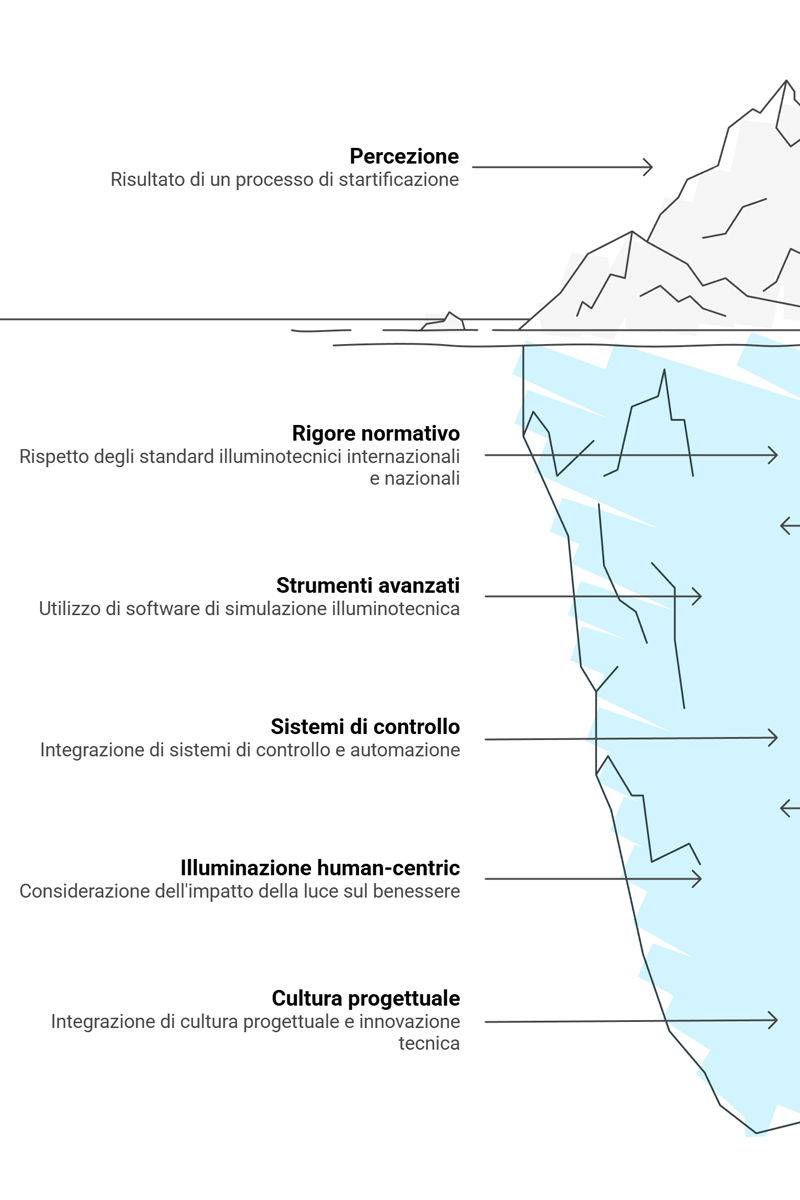
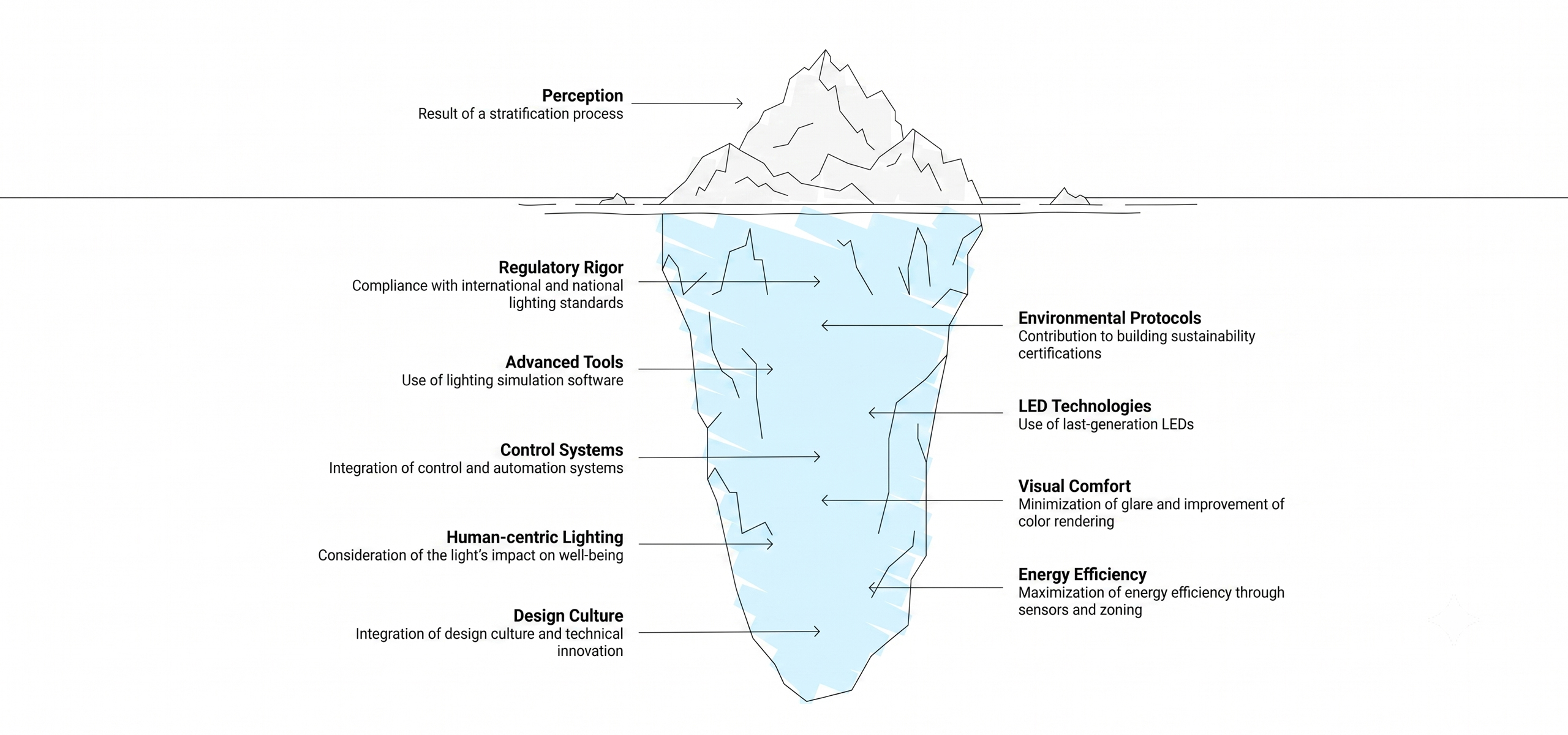
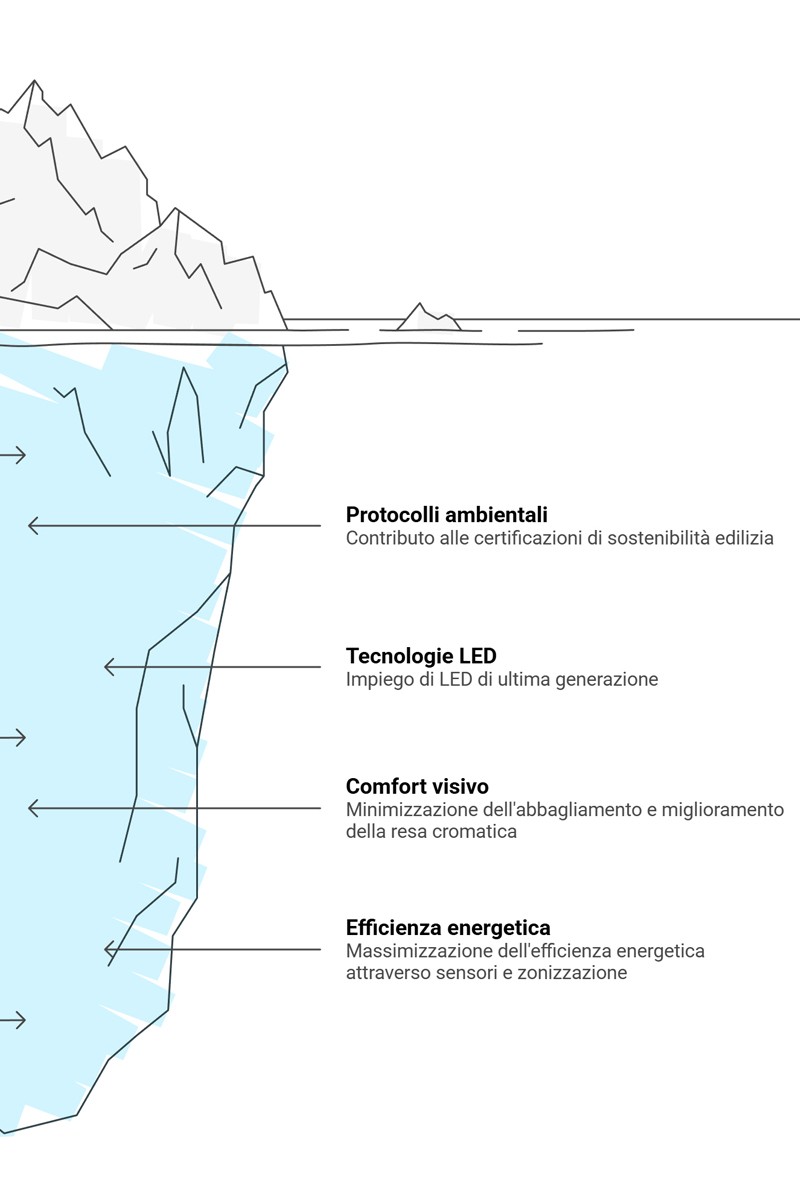
At the basis of Marco Petrucci's design activity there is a structured methodological approach, based on compliance with technical regulations and the use of the most modern lighting technologies. Each intervention is developed in accordance with international and national lighting standards: Petrucci follows the recommendations of the CIE (Commission Internationale de l'Éclairage) and adopts the UNI, EN, CEI, ISO and IES standards as an obligatory reference to guarantee the quality and safety of the systems. Whether it is the lighting of offices, museums or public spaces, each parameter (illuminance levels, uniformity, UGR glare, color rendering, etc.) is calibrated to meet or exceed the regulatory requirements in force, ensuring optimal visual comfort for users. At the same time, the projects take into account the main environmental protocols in the building sector, so that light contributes to the achievement of sustainability certifications such as LEED, BREEAM or WELL. For example, in the projects developed with Renzo Piano and Mario Cucinella, lighting played a key role in the LEED score, thanks to high-efficiency solutions and control strategies that minimise consumption and dispersed light emissions. This attention to the environment is an integral part of the methodology that sees sustainable lighting not only as a technical requirement, but as an ethical duty towards the community and the planet.
Advanced tools and constant technological updating are other pillars of the working method. In the executive design phase, he uses professional lighting simulation software such as DIALux, Relux and Litestar 4D, which allow him to virtually model spaces and make accurate lighting calculations (distribution of luminous candles, analysis of photometric curves, photorealistic renderings). Through these tools, each choice is verified and optimized in advance: different configurations of luminaires, optics and color temperatures are tested, evaluating their visual and energy impact, so as to select the best solution before actual installation. The use of the latest generation LED technologies is a distinctive feature of the projects: LED sources with high luminous efficiency and excellent colour rendering are favoured, which guarantee energy savings and long service life on the one hand, and quality light on the other, capable of enhancing materials and colours in a natural way. LEDs, combined with advanced optical systems (lenses, reflectors, diffusers), also make it possible to obtain lighting effects that were previously unthinkable with the old sources, expanding the expressive language available to the lighting designer.
Another central aspect is the integration of state-of-the-art control and automation systems, which make lighting systems flexible, intelligent and user-centered. Depending on the needs of the project, he implements standard digital protocols such as DALI-2 (Digital Addressable Lighting Interface) for the precise management of groups of lamps and programmable lighting scenarios, KNX and BACnet for interfacing with home automation systems and BMS (Building Management System) of the building, or DMX (often used to control dynamic and chromatic effects in facades or scenographic installations). In historical or retrofit contexts, advanced wireless solutions such as Casambi are also adopted, which allow networks of lighting fixtures to be controlled via Bluetooth without the need for invasive wiring, preserving listed buildings. For high-end retail or residential environments, proprietary systems such as Lutron are integrated, guaranteeing reliability and fine tuning of the lighting. Thanks to these control tools, the designed light becomes dynamic and adaptive: light levels, shades of white (with tunable white LED systems) and even colors can vary throughout the day or according to usage scenarios, optimizing visual comfort and efficiency. For example, in offices it is possible to automatically adjust artificial light according to the supply of natural light (Daylight Harvesting), improving well-being and saving energy; in museums, different scenarios can be set up for daily visits, evening events or maintenance, always ensuring the correct conservation of the works; In urban squares, the brightness can be dimmed at night to reduce light pollution and then increased in case of need or public events.
Attention to visual comfort and sustainability remains the common thread of every technical choice made by Marco Petrucci. He conducts in-depth analyses to minimize direct and reflected glare phenomena, controlling the intensity and distribution of the luminances emitted by the lighting fixtures. It prefers luminaires with shielded optics and anti-glare accessories (dark-light dishes, anti-glare lights, lens visors) especially in environments where people stay for a long time, such as open-plan offices or museum halls, in order to prevent visual fatigue. At the same time, the lighting is designed in a human-centric key, also considering aspects such as high colour rendering (CRI/Ra >90) for a natural perception of colours and, where relevant, the impact of blue light and respect for the circadian rhythm in the evening hours (e.g. in wellness or hospital projects, where it applies the principles of the WELL Building Standard to ensure the well-being of the occupants). On the sustainability front, each project is designed to maximize energy efficiency: this is done through the selection of high-performance lm/W luminaires, the use of presence and brightness sensors to avoid waste, and the division of the systems into zones and scenarios to illuminate only where and when needed. The results are lighting systems that, with the same comfort, consume significantly less energy than traditional solutions, contributing to the reduction of CO₂ emissions and management costs for customers.
Ultimately, Marco Petrucci's methodology combines design culture and technical innovation into a coherent whole. As evidenced by his career, he constantly integrates cutting-edge technologies and international standards with a sensitivity to the historical-artistic context and the human needs of illuminated space. Its professional mission is to offer each project a "tailor-made" light, which is both highly performing and poetically immersed in the environment. Thanks to this philosophy, the goal is to create excellent lighting experiences, in which the end user perceives not only adequate lighting, but a real perceptive added value: light becomes comfort, atmosphere, orientation and beauty. Projects such as cathedrals, monumental complexes, museums, public and private spaces are recognizable for the balance between functionality and aesthetic enhancement. In conclusion, the profile of Marco Petrucci – Lighting Designer – is characterized by consolidated experience, authority in the field of light and a technical-cultural coherence that is reflected in every detail of his works: a professional capable of lighting up the architectural space with innovative, sustainable lighting solutions that are deeply respectful of the genius loci.
Other About pages
This section contains the index of in-depth biographical and professional pages dedicated to Marco Petrucci, a Lighting Designer specializing in Lighting Design and Technologies. The contents trace his academic training at La Sapienza University of Rome and the Polytechnic University of Milan, the role of light as the foundation of architectural design, with particular reference to the path he developed alongside Piero Castiglioni, and the cultural and methodological legacy of the Castiglioni school.
The index continues with collaborations with international architects and studios, analyzed as forums for design dialogue and disciplinary integration, and with an in-depth look at the interpretation of space, understood as enhancing architectural identity and improving enjoyment through the perceptual control of light. The section concludes with a focus on regulatory rigor, technology, and sustainability, highlighting the application of international standards, lighting control systems, and light quality criteria as structural elements of the design process.