Differences Between Traditional LEDs and μPLS by Nichia: From the Car to the City, the Path of the Digital Light Engine

From road safety to smart city: μPLS and high-resolution microLEDs

In recent decades, lighting technology has progressed very rapidly, moving from incandescent and halogen lamps to the more efficient and long-lived LED (Light Emitting Diodes) lights. Traditional LEDs, based on semiconductor diodes, have revolutionized lighting thanks to their high luminous efficiency and reliability, gradually supplanting conventional sources in many fields. For example, a common incandescent bulb has a luminous efficacy of only ~10 lm/W, while the latest generation LEDs can exceed 150-200 lm/W. In addition to consuming less energy, LEDs last thousands of hours longer: a halogen lamp lasts about 1,500 hours, compared to the 25,000-50,000 hours of life typical of an LED source. These advantages have made LEDs the preferred choice for modern lighting in the domestic, public and automotive sectors. However, the transition to LEDs has not only been about improving efficiency and durability, but has paved the way for new digital lighting functions. Today, we are witnessing the emergence of advanced light sources that integrate light and information, allowing finely pixelated control of the light beam. A cutting-edge example is the μPLS (Micro Pixelated Light Source) technology developed by Nichia in collaboration with Infineon. This solution combines an array of ultra-high-resolution micro-LEDs with integrated control circuitry, creating the first high-definition digital light engine for applications such as adaptive automotive headlights. We will also see the operation of traditional LEDs and that of μPLS, deepening the technological differences, the areas of application, the economic implications and the future prospects of diffusion. Finally, we will discuss the concept of "light that informs", i.e. how new light sources can not only illuminate but also communicate information, transforming lighting into a means of visual communication.

Traditional LEDs: operation and characteristics A traditional LED is essentially a p-n junction diode  that emits photons when current passes through it (electroluminescence phenomenon). The color of the light depends on the semiconductor material and the bandgap: for example, Nichia was the first to develop a  high-brightness blue LED in 1993, paving the way for the white LED  (generally obtained by coating a blue LED with yellow phosphors). Compared to incandescent lamps (which generate light by heating a filament) or fluorescent lamps, LEDs convert a much larger portion of electrical energy into visible light instead of heat, hence their superior energy efficiency. For example, commercial white LEDs can reach or exceed 100 lm/W, while a halogen lamp rarely exceeds ~30 lm/W. In addition, the absence of fragile parts (such as filaments) gives the LEDs excellent mechanical robustness and shock resistance, as well as immediate ignition even at low temperatures.

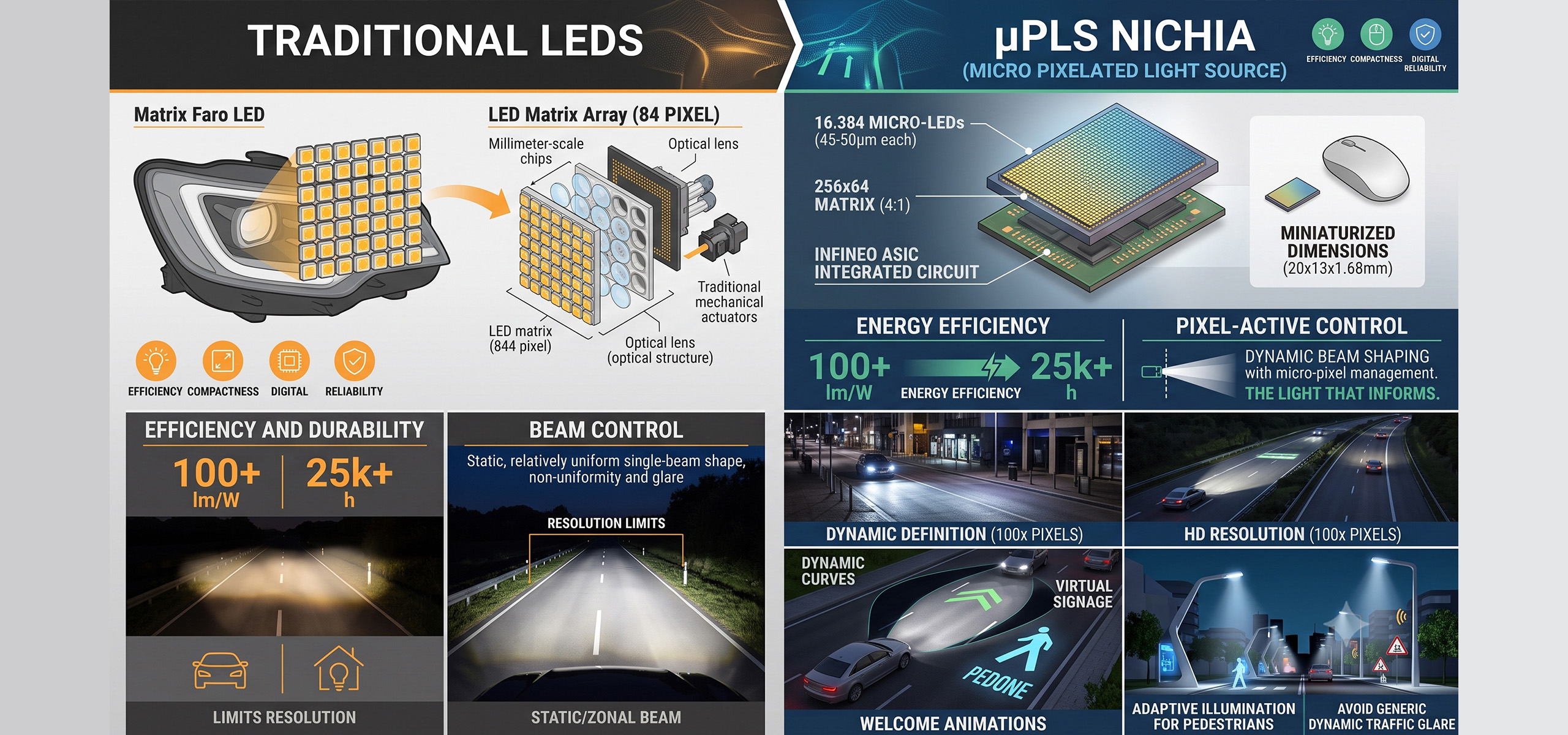
In  the automotive context, LEDs have brought significant benefits in terms of visibility and safety. As early as the 2000s, LEDs for taillights and brake lights (thanks to the instantaneous switch-on, faster than bulbs) and later for front headlights became widespread.  Modern LED headlights offer a whiter and brighter light than halogens, illuminating the road better and less strain on the driver's eyes. The longer service life also reduces the need for lamp replacement. A wider and more defined beam has already been achieved with simple LED light clusters, improving visibility on the sides of the road and the legibility of the signs. A limitation of traditional LEDs, however, lies in the fact that each LED (or LED module) emits light in a fixed manner over a relatively large area, and beam control requires additional optical (lenses, reflectors) or mechanical (shutters) elements. For example, in the first generation LED headlights, the transition from low beam to high beam was achieved by obscuring part of the beam with mechanical masks. In more advanced systems, matrix LEDs have appeared, i.e. arrays of discrete LEDs that can be individually controlled to shape the beam: typically dozens of LEDs arranged in matrices of 8, 16 up to 84 elements in recent high-end car models. By selectively turning off some LEDs, the matrix headlight can create shadow areas in the beam (e.g. so as not to dazzle vehicles in front) and at the same time fully illuminate the rest of the road. While 84 pixels are already enough to dramatically improve selective light distribution, the automotive lighting industry was aiming for higher resolution and flexibility. This is where new high-definition digital light sources such as Nichia's μPLS come into play: they push miniaturization to the point of integrating thousands of micro-LEDs into a few square millimeters, achieving an increase in resolution of more than two orders of magnitude compared to traditional LED matrixes.

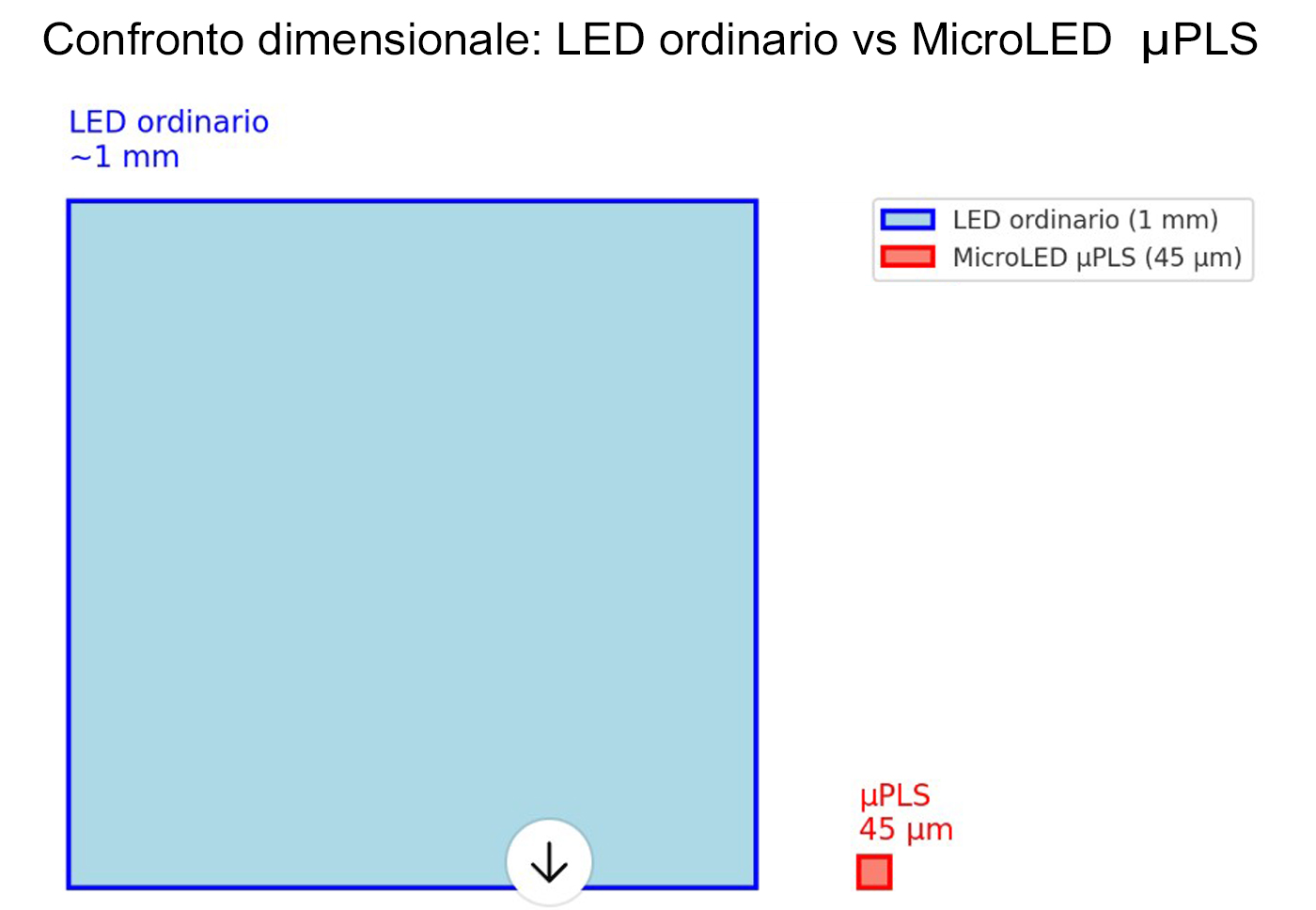
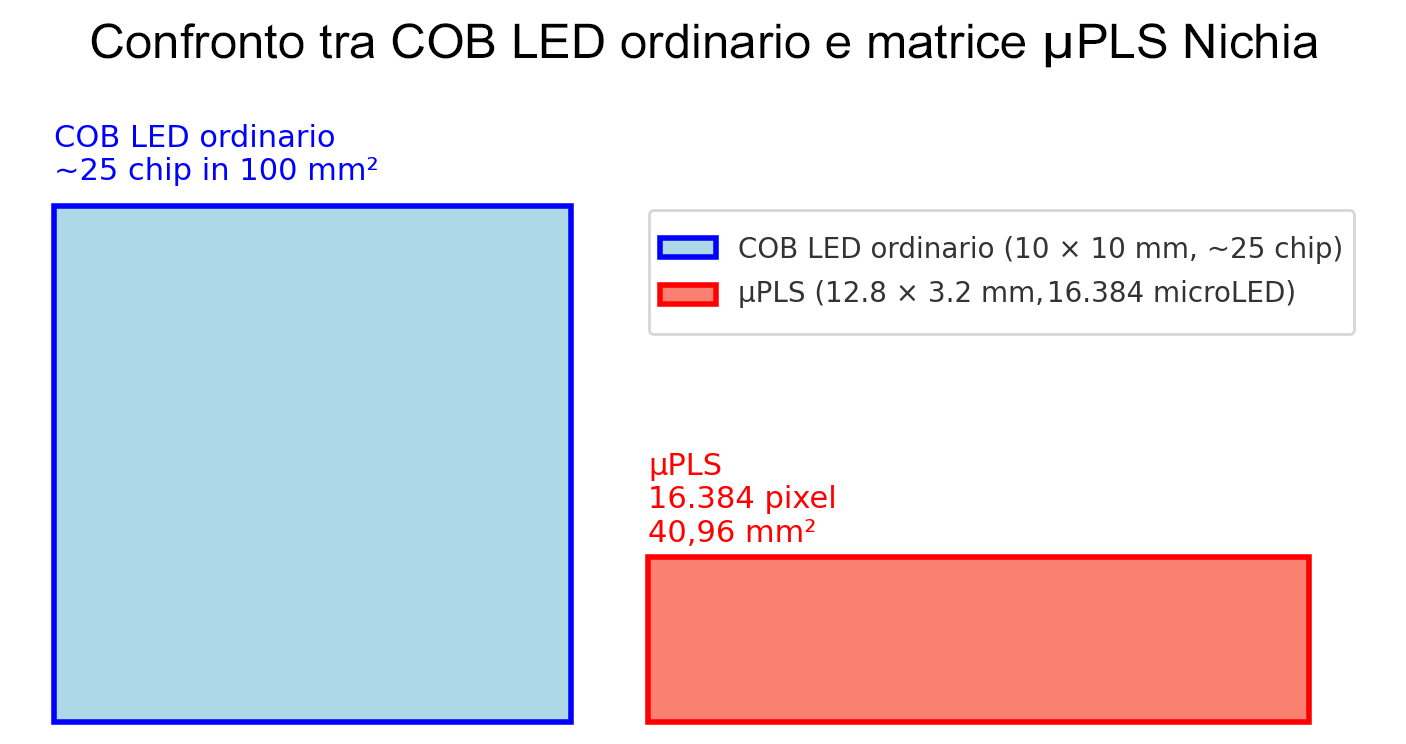
μPLS: Nichia's micro-pixel source that integrates light and digital The acronym μPLS (or Micro PLS, where PLS stands for Pixelated Light Source) identifies Nichia's innovative solution for creating high-resolution light sources by tightly integrating micro-LEDs and control electronics. First introduced in 2023, μPLS is in fact a light engine that combines 16,384 micro-LEDs in a single package, each individually controllable. This makes it possible to generate a "pixelated" light beam with very high definition, opening up previously unimaginable possibilities for adaptive light distribution. To give an idea of the dimensions involved, the micro-LEDs used have a chip of about 45-50 μm on each side (just half of a tenth of a millimeter), therefore smaller than a human hair. In the μPLS, these micro-LEDs are arranged in a matrix of 256 × 64 pixels (4:1 aspect ratio), occupying an emissive area of only 12.8 × 3.2 mm. In this tiny area, the density is about 400 microLEDs per mm², which allows for a very high projection resolution compared to conventional headlights. On the electronic side, μPLS integrates an ASIC (Application-Specific Integrated Circuit) developed with Infineon directly under the LED matrix, capable of driving and monitoring each micro-LED independently. This ASIC performs multiple functions: it supplies current to each micro-LED by modulating it in PWM (Pulse Width Modulation) to adjust its brightness, reads the state of each pixel (e.g. to detect faulty LEDs or variations) and includes on-chip temperature sensors to thermally manage the system. In addition, the ASIC acts as a "digital" interface by receiving video signals or patterns as input to be projected, via high-speed communication lines compatible with automotive protocols (e.g. CAN-FD, SPI). In practice, the μPLS headlight is designed as a programmable light display: inside it, a digital video signal instantly activates the LEDs necessary to draw the desired beam on the road.
It should be emphasized that a key feature of μPLS is the ability to turn on only the pixels needed at all times. This distinguishes it from previous HD solutions  based on micro-mirrors (such as DLP systems): in digital mirror projectors, a powerful light source is constantly on and the micro-mirrors deflect the light to form the image, resulting in energy still being consumed for the entire beam even where it is obscured. In the case of μPLS, on the other hand, LEDs are active emitters similar to the pixels of an OLED display: they remain off when there is no need to illuminate a certain area, with a huge gain in energy efficiency. An Infineon executive compared this difference to that between an LCD TV  (which requires a backlight that is always on over the entire screen area) and an OLED (where each pixel emits its own light only when needed). The practical effect is that μPLS can achieve significant energy savings and reduce the heat generated, despite the high pixel count, compared to previous high-definition matrix headlights with microrotors or mirrors.

Another consequence of the μPLS's highly integrated design is compactness. By eliminating bulky optical modules (such as mirror arrays or large lenses), the entire system is reduced to "one small chip." Nichia reports that the μPLS package measures just 20 × 13 × 1.68 mm, allowing for much thinner and lighter front headlamps. We are talking about projectors about the size of "two computer mice" in volume, against units as large as a brick of the old microreflector systems. This miniaturization gives automotive designers more freedom in designing slim-profile headlights – for example, they can be integrated into the bumper or body – and reduces the weight on the vehicle to the benefit of electric and autonomous cars as well. Despite its small size, the μPLS offers impressive brightness: thanks to the high efficiency of the Nichia micro-LEDs and the ability to drive them at relatively high currents, a luminance of about 83 cd/mm² (at 3.5 mA and 120°C) is achieved, which is sufficient for bright projections at long distances. In driving tests, the μPLS headlights demonstrated a very intense and well-defined projection, attributed precisely to the high density and efficiency of the micro-LEDs under strong piloting.

Technically, to obtain  high-intensity white light,  Nichia uses its experience in luminescent materials: a phosphor converter layer is applied above the micro-LED matrix (which presumably emit blue/violet)  which transforms part of the radiation into a yellow component, producing combined white light. In addition, a very thin layer of  micro-optical layers can be integrated to optimize the beam direction and uniformity of each pixel. The innovative 3D assembly technique developed by Nichia allows  the ASIC and micro-LEDs to be layered in a single, robust package, making reliable connections between the two (not a trivial challenge given the thousands of contacts). The μPLS is the result of approximately three years of co-development between Nichia and Infineon, with rigorous testing according to automotive standards (AEC-Q) and the involvement of a leading European Tier1 supplier for integration into the headlight. Nichia owns the final product and started mass production in early 2023.

In summary, the μPLS represents a very high resolution digital light source, in which "the technology that makes light" (micro-LED) and "the technology that controls it" (driving ASIC) are merged into a single device. This is a paradigm shift: the spotlight is no longer a set of lamps and lenses, but an integrated programmable optoelectronic system, similar to a very high brightness and robust projector for outdoor use.

μPLS applications and use scenarios The immediate and most natural use of μPLS technology is in the latest generation of automotive headlights, in particular to implement  high-definition Adaptive Driving Beam (ADB). An ADB LED headlight  dynamically adapts its beam: it maximizes the illumination of the road for the driver, but automatically dims portions to avoid glare from other users (oncoming vehicles, pedestrians). With the μPLS, this function achieves an unprecedented level of accuracy. Its 16,384 pixels allow you to "crop" the exact silhouettes of vehicles or objects on the light beam, creating sharp contours around them. For example, when driving at night on a busy road, the system can keep the high beams on and, thanks to the controlled pixels, create shadow areas around the silhouettes of oncoming vehicles without bothering them, while the rest of the road remains illuminated as daylight. This improves both safety (the driver always sees well) and everyone's comfort (no one is blinded).
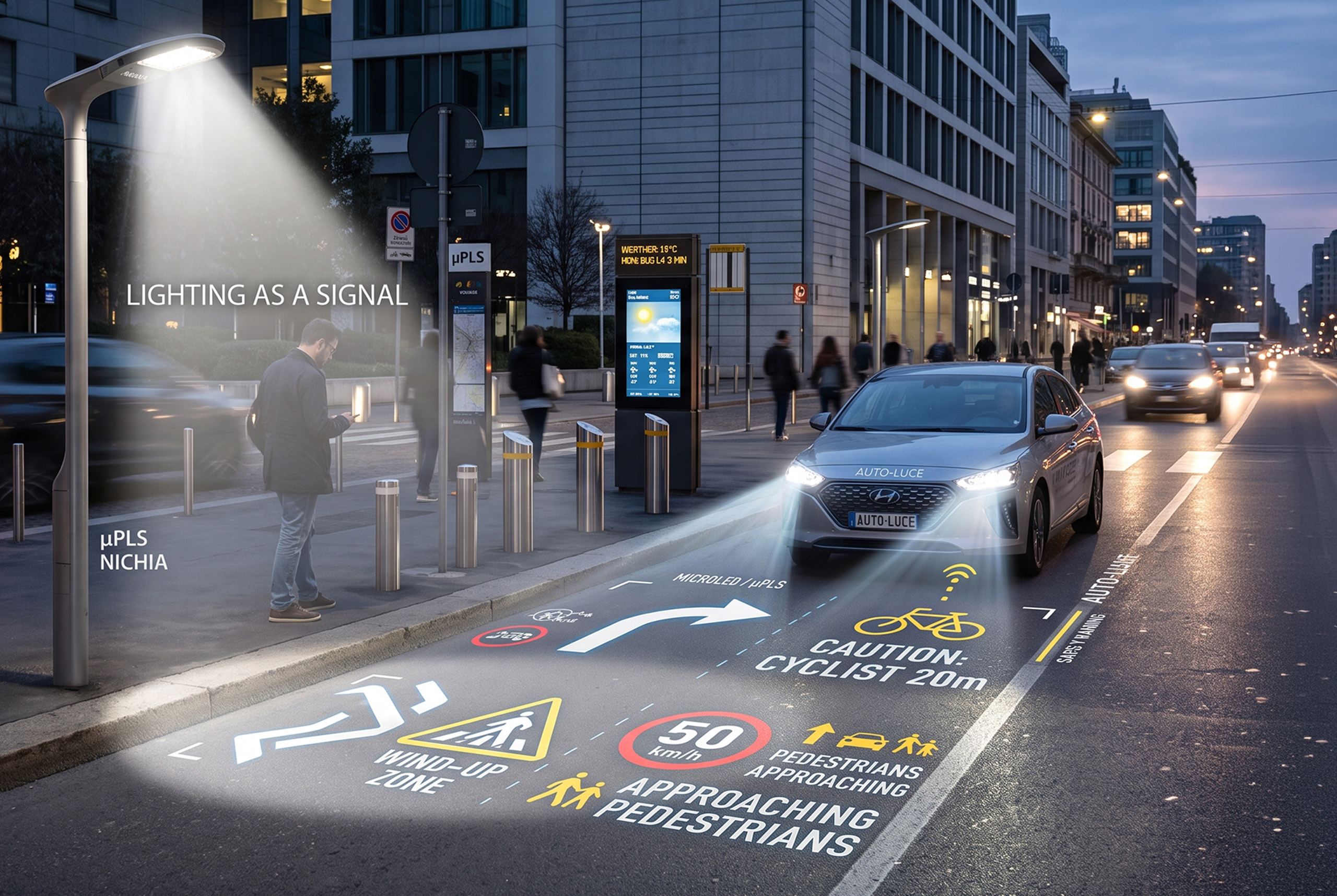
Not only that, but the ultra-high resolution offers new projection capabilities. The headlight can serve as a symbol and signal projector directly on the road. In dangerous or special conditions, light pictograms can be displayed: for example, virtual arrows or lanes to assist in keeping the lane, virtual pedestrian crossings to signal pedestrians to cross, or warning signs near obstacles/limits on the roadway. One car manufacturer has shown that headlights can even project a glowing zebra onto the asphalt in the vicinity of a pedestrian, to signal to other vehicles that they intend to cross. Similarly, in the presence of construction sites, HD headlights could highlight the boundaries of the narrow lane in which to channel themselves with a dedicated light. This is all part of the concept of communication through light: the vehicle no longer just passively illuminates the road, but interacts with the environment by providing useful information to both the driver and other road users.

The μPLS also enables very interesting "outline" scenarios: we are talking about welcome scenarios projected when the car is opened or parked, for example by showing the brand logo or a personalized message to the owner on the ground. Off-road or off-road, high-definition headlights could highlight obstacles in the path or lightly mark the safe trajectory. In the context of autonomous driving, the headlamps could communicate to others (pedestrians, cyclists) the intentions of the vehicle, for example by projecting a stop sign or a path to indicate "please cross" at the pedestrian crossing.

Outside the automotive sector, the availability of such compact and bright micro-LED matrices could also find applications in architectural lighting and displays. Think of active road signs: signs that appear normal during the day, but at night thanks to integrated micro-LEDs they can change symbols and writings in real time (e.g. for work in progress, variable limits, etc.). Or high-brightness portable projectors: a module like μPLS is essentially a miniature solid-state projector, so it could be used to project images or information into advanced head-up display (HUD) systems, or light-based augmented reality devices.

The versatility of the μPLS also extends to software flexibility: as a software-defined system, it allows for OTA (over-the-air) updates to add new lighting features over time. A car manufacturer could introduce, via firmware update, new lighting schemes or symbols after the sale of the car, adhering to the trend of software-defined cars. Looking ahead, this means that the car's lighting becomes part of the vehicle's digital ecosystem, which can be customised and improved with updates just like infotainment. In addition to the automotive sector, other markets could adopt high-density micro-LEDs: aviation (for intelligent landing lights on runways, or adaptive headlights for airplanes), public lighting (street lights that direct the beam avoiding dispersion and light pollution, adapting to the presence of pedestrians/vehicles), and outdoor projection (e.g. architectural mapping with compact LED projectors). Certainly, the industry will have to face production challenges (increasing volumes while maintaining automotive reliability) and standardization. But the direction is mapped out: lighting is becoming digital and intelligent, ready to integrate into connected ecosystems and smart cities.

Another trend to consider is sustainability: high-resolution headlights can also contribute to the overall energy efficiency of electric vehicles, consuming only the energy strictly necessary to illuminate (thanks to pixel-active control). They also make it possible to reduce the front surface of the headlights (thanks to the low thickness), improving aerodynamics and leaving more space for sensors (Lidar, radar) important for autonomous driving. All of these factors make it likely that it will spread rapidly globally as costs fall.

Differences Between Traditional LEDs and μPLS by Nichia: From the Car to the City, the Path of the Digital Light Engine

From road safety to smart city: μPLS and high-resolution microLEDs

In recent decades, lighting technology has progressed very rapidly, moving from incandescent and halogen lamps to the more efficient and long-lived LED (Light Emitting Diodes) lights. Traditional LEDs, based on semiconductor diodes, have revolutionized lighting thanks to their high luminous efficiency and reliability, gradually supplanting conventional sources in many fields. For example, a common incandescent bulb has a luminous efficacy of only ~10 lm/W, while the latest generation LEDs can exceed 150-200 lm/W. In addition to consuming less energy, LEDs last thousands of hours longer: a halogen lamp lasts about 1,500 hours, compared to the 25,000-50,000 hours of life typical of an LED source. These advantages have made LEDs the preferred choice for modern lighting in the domestic, public and automotive sectors. However, the transition to LEDs has not only been about improving efficiency and durability, but has paved the way for new digital lighting functions. Today, we are witnessing the emergence of advanced light sources that integrate light and information, allowing finely pixelated control of the light beam. A cutting-edge example is the μPLS (Micro Pixelated Light Source) technology developed by Nichia in collaboration with Infineon. This solution combines an array of ultra-high-resolution micro-LEDs with integrated control circuitry, creating the first high-definition digital light engine for applications such as adaptive automotive headlights. We will also see the operation of traditional LEDs and that of μPLS, deepening the technological differences, the areas of application, the economic implications and the future prospects of diffusion. Finally, we will discuss the concept of "light that informs", i.e. how new light sources can not only illuminate but also communicate information, transforming lighting into a means of visual communication.

Traditional LEDs: operation and characteristics A traditional LED is essentially a p-n junction diode  that emits photons when current passes through it (electroluminescence phenomenon). The color of the light depends on the semiconductor material and the bandgap: for example, Nichia was the first to develop a  high-brightness blue LED in 1993, paving the way for the white LED  (generally obtained by coating a blue LED with yellow phosphors). Compared to incandescent lamps (which generate light by heating a filament) or fluorescent lamps, LEDs convert a much larger portion of electrical energy into visible light instead of heat, hence their superior energy efficiency. For example, commercial white LEDs can reach or exceed 100 lm/W, while a halogen lamp rarely exceeds ~30 lm/W. In addition, the absence of fragile parts (such as filaments) gives the LEDs excellent mechanical robustness and shock resistance, as well as immediate ignition even at low temperatures.

In  the automotive context, LEDs have brought significant benefits in terms of visibility and safety. As early as the 2000s, LEDs for taillights and brake lights (thanks to the instantaneous switch-on, faster than bulbs) and later for front headlights became widespread.  Modern LED headlights offer a whiter and brighter light than halogens, illuminating the road better and less strain on the driver's eyes. The longer service life also reduces the need for lamp replacement. A wider and more defined beam has already been achieved with simple LED light clusters, improving visibility on the sides of the road and the legibility of the signs. A limitation of traditional LEDs, however, lies in the fact that each LED (or LED module) emits light in a fixed manner over a relatively large area, and beam control requires additional optical (lenses, reflectors) or mechanical (shutters) elements. For example, in the first generation LED headlights, the transition from low beam to high beam was achieved by obscuring part of the beam with mechanical masks. In more advanced systems, matrix LEDs have appeared, i.e. arrays of discrete LEDs that can be individually controlled to shape the beam: typically dozens of LEDs arranged in matrices of 8, 16 up to 84 elements in recent high-end car models. By selectively turning off some LEDs, the matrix headlight can create shadow areas in the beam (e.g. so as not to dazzle vehicles in front) and at the same time fully illuminate the rest of the road. While 84 pixels are already enough to dramatically improve selective light distribution, the automotive lighting industry was aiming for higher resolution and flexibility. This is where new high-definition digital light sources such as Nichia's μPLS come into play: they push miniaturization to the point of integrating thousands of micro-LEDs into a few square millimeters, achieving an increase in resolution of more than two orders of magnitude compared to traditional LED matrixes.

μPLS: Nichia's micro-pixel source that integrates light and digital The acronym μPLS (or Micro PLS, where PLS stands for Pixelated Light Source) identifies Nichia's innovative solution for creating high-resolution light sources by tightly integrating micro-LEDs and control electronics. First introduced in 2023, μPLS is in fact a light engine that combines 16,384 micro-LEDs in a single package, each individually controllable. This makes it possible to generate a "pixelated" light beam with very high definition, opening up previously unimaginable possibilities for adaptive light distribution. To give an idea of the dimensions involved, the micro-LEDs used have a chip of about 45-50 μm on each side (just half of a tenth of a millimeter), therefore smaller than a human hair. In the μPLS, these micro-LEDs are arranged in a matrix of 256 × 64 pixels (4:1 aspect ratio), occupying an emissive area of only 12.8 × 3.2 mm. In this tiny area, the density is about 400 microLEDs per mm², which allows for a very high projection resolution compared to conventional headlights. On the electronic side, μPLS integrates an ASIC (Application-Specific Integrated Circuit) developed with Infineon directly under the LED matrix, capable of driving and monitoring each micro-LED independently. This ASIC performs multiple functions: it supplies current to each micro-LED by modulating it in PWM (Pulse Width Modulation) to adjust its brightness, reads the state of each pixel (e.g. to detect faulty LEDs or variations) and includes on-chip temperature sensors to thermally manage the system. In addition, the ASIC acts as a "digital" interface by receiving video signals or patterns as input to be projected, via high-speed communication lines compatible with automotive protocols (e.g. CAN-FD, SPI). In practice, the μPLS headlight is designed as a programmable light display: inside it, a digital video signal instantly activates the LEDs necessary to draw the desired beam on the road.

It should be emphasized that a key feature of μPLS is the ability to turn on only the pixels needed at all times. This distinguishes it from previous HD solutions  based on micro-mirrors (such as DLP systems): in digital mirror projectors, a powerful light source is constantly on and the micro-mirrors deflect the light to form the image, resulting in energy still being consumed for the entire beam even where it is obscured. In the case of μPLS, on the other hand, LEDs are active emitters similar to the pixels of an OLED display: they remain off when there is no need to illuminate a certain area, with a huge gain in energy efficiency. An Infineon executive compared this difference to that between an LCD TV  (which requires a backlight that is always on over the entire screen area) and an OLED (where each pixel emits its own light only when needed). The practical effect is that μPLS can achieve significant energy savings and reduce the heat generated, despite the high pixel count, compared to previous high-definition matrix headlights with microrotors or mirrors.

Another consequence of the μPLS's highly integrated design is compactness. By eliminating bulky optical modules (such as mirror arrays or large lenses), the entire system is reduced to "one small chip." Nichia reports that the μPLS package measures just 20 × 13 × 1.68 mm, allowing for much thinner and lighter front headlamps. We are talking about projectors about the size of "two computer mice" in volume, against units as large as a brick of the old microreflector systems. This miniaturization gives automotive designers more freedom in designing slim-profile headlights – for example, they can be integrated into the bumper or body – and reduces the weight on the vehicle to the benefit of electric and autonomous cars as well. Despite its small size, the μPLS offers impressive brightness: thanks to the high efficiency of the Nichia micro-LEDs and the ability to drive them at relatively high currents, a luminance of about 83 cd/mm² (at 3.5 mA and 120°C) is achieved, which is sufficient for bright projections at long distances. In driving tests, the μPLS headlights demonstrated a very intense and well-defined projection, attributed precisely to the high density and efficiency of the micro-LEDs under strong piloting.

Technically, to obtain  high-intensity white light,  Nichia uses its experience in luminescent materials: a phosphor converter layer is applied above the micro-LED matrix (which presumably emit blue/violet)  which transforms part of the radiation into a yellow component, producing combined white light. In addition, a very thin layer of  micro-optical layers can be integrated to optimize the beam direction and uniformity of each pixel. The innovative 3D assembly technique developed by Nichia allows  the ASIC and micro-LEDs to be layered in a single, robust package, making reliable connections between the two (not a trivial challenge given the thousands of contacts). The μPLS is the result of approximately three years of co-development between Nichia and Infineon, with rigorous testing according to automotive standards (AEC-Q) and the involvement of a leading European Tier1 supplier for integration into the headlight. Nichia owns the final product and started mass production in early 2023.

In summary, the μPLS represents a very high resolution digital light source, in which "the technology that makes light" (micro-LED) and "the technology that controls it" (driving ASIC) are merged into a single device. This is a paradigm shift: the spotlight is no longer a set of lamps and lenses, but an integrated programmable optoelectronic system, similar to a very high brightness and robust projector for outdoor use.

μPLS applications and use scenarios The immediate and most natural use of μPLS technology is in the latest generation of automotive headlights, in particular to implement  high-definition Adaptive Driving Beam (ADB). An ADB LED headlight  dynamically adapts its beam: it maximizes the illumination of the road for the driver, but automatically dims portions to avoid glare from other users (oncoming vehicles, pedestrians). With the μPLS, this function achieves an unprecedented level of accuracy. Its 16,384 pixels allow you to "crop" the exact silhouettes of vehicles or objects on the light beam, creating sharp contours around them. For example, when driving at night on a busy road, the system can keep the high beams on and, thanks to the controlled pixels, create shadow areas around the silhouettes of oncoming vehicles without bothering them, while the rest of the road remains illuminated as daylight. This improves both safety (the driver always sees well) and everyone's comfort (no one is blinded).

Not only that, but the ultra-high resolution offers new projection capabilities. The headlight can serve as a symbol and signal projector directly on the road. In dangerous or special conditions, light pictograms can be displayed: for example, virtual arrows or lanes to assist in keeping the lane, virtual pedestrian crossings to signal pedestrians to cross, or warning signs near obstacles/limits on the roadway. One car manufacturer has shown that headlights can even project a glowing zebra onto the asphalt in the vicinity of a pedestrian, to signal to other vehicles that they intend to cross. Similarly, in the presence of construction sites, HD headlights could highlight the boundaries of the narrow lane in which to channel themselves with a dedicated light. This is all part of the concept of communication through light: the vehicle no longer just passively illuminates the road, but interacts with the environment by providing useful information to both the driver and other road users.

The μPLS also enables very interesting "outline" scenarios: we are talking about welcome scenarios projected when the car is opened or parked, for example by showing the brand logo or a personalized message to the owner on the ground. Off-road or off-road, high-definition headlights could highlight obstacles in the path or lightly mark the safe trajectory. In the context of autonomous driving, the headlamps could communicate to others (pedestrians, cyclists) the intentions of the vehicle, for example by projecting a stop sign or a path to indicate "please cross" at the pedestrian crossing.

Outside the automotive sector, the availability of such compact and bright micro-LED matrices could also find applications in architectural lighting and displays. Think of active road signs: signs that appear normal during the day, but at night thanks to integrated micro-LEDs they can change symbols and writings in real time (e.g. for work in progress, variable limits, etc.). Or high-brightness portable projectors: a module like μPLS is essentially a miniature solid-state projector, so it could be used to project images or information into advanced head-up display (HUD) systems, or light-based augmented reality devices.

The versatility of the μPLS also extends to software flexibility: as a software-defined system, it allows for OTA (over-the-air) updates to add new lighting features over time. A car manufacturer could introduce, via firmware update, new lighting schemes or symbols after the sale of the car, adhering to the trend of software-defined cars. Looking ahead, this means that the car's lighting becomes part of the vehicle's digital ecosystem, which can be customised and improved with updates just like infotainment. In addition to the automotive sector, other markets could adopt high-density micro-LEDs: aviation (for intelligent landing lights on runways, or adaptive headlights for airplanes), public lighting (street lights that direct the beam avoiding dispersion and light pollution, adapting to the presence of pedestrians/vehicles), and outdoor projection (e.g. architectural mapping with compact LED projectors). Certainly, the industry will have to face production challenges (increasing volumes while maintaining automotive reliability) and standardization. But the direction is mapped out: lighting is becoming digital and intelligent, ready to integrate into connected ecosystems and smart cities.

Another trend to consider is sustainability: high-resolution headlights can also contribute to the overall energy efficiency of electric vehicles, consuming only the energy strictly necessary to illuminate (thanks to pixel-active control). They also make it possible to reduce the front surface of the headlights (thanks to the low thickness), improving aerodynamics and leaving more space for sensors (Lidar, radar) important for autonomous driving. All of these factors make it likely that it will spread rapidly globally as costs fall.
Other Lighting Post

Other Lighting Post

This section brings together a comprehensive body of theoretical, scientific, and design insights into the theory of light applied to lighting design, systematically addressing the complex relationship between light, visual perception, and spatial design. The content develops the physical foundations of light, an understanding of the mechanisms of human vision, the differences between photopic and melanopic illuminance, and the biological impact of artificial light, integrating advanced metrics and contemporary interpretation criteria.

The page also explores the functioning of LED sources, the spectral and perceptual implications of solid-state light, the evolution of color rendering criteria, and the growing role of light as an informational and perceptual system, capable of influencing behavior, comfort, and the quality of spatial experience.

Ample space is dedicated to the relevant regulatory and technical framework, international standards, sustainability protocols, and control systems, understood as essential tools for rigorous, measurable, and consistent design.

Overall, the section provides a vision of the theory of light as the cultural and operational basis of lighting design, in which scientific knowledge, perceptual awareness, and design method converge to guide the lighting designer in the construction of balanced, legible, and qualitatively significant spaces.

This section brings together a comprehensive body of theoretical, scientific, and design insights into the theory of light applied to lighting design, systematically addressing the complex relationship between light, visual perception, and spatial design. The content develops the physical foundations of light, an understanding of the mechanisms of human vision, the differences between photopic and melanopic illuminance, and the biological impact of artificial light, integrating advanced metrics and contemporary interpretation criteria.

The page also explores the functioning of LED sources, the spectral and perceptual implications of solid-state light, the evolution of color rendering criteria, and the growing role of light as an informational and perceptual system, capable of influencing behavior, comfort, and the quality of spatial experience.

Ample space is dedicated to the relevant regulatory and technical framework, international standards, sustainability protocols, and control systems, understood as essential tools for rigorous, measurable, and consistent design.

Overall, the section provides a vision of the theory of light as the cultural and operational basis of lighting design, in which scientific knowledge, perceptual awareness, and design method converge to guide the lighting designer in the construction of balanced, legible, and qualitatively significant spaces.

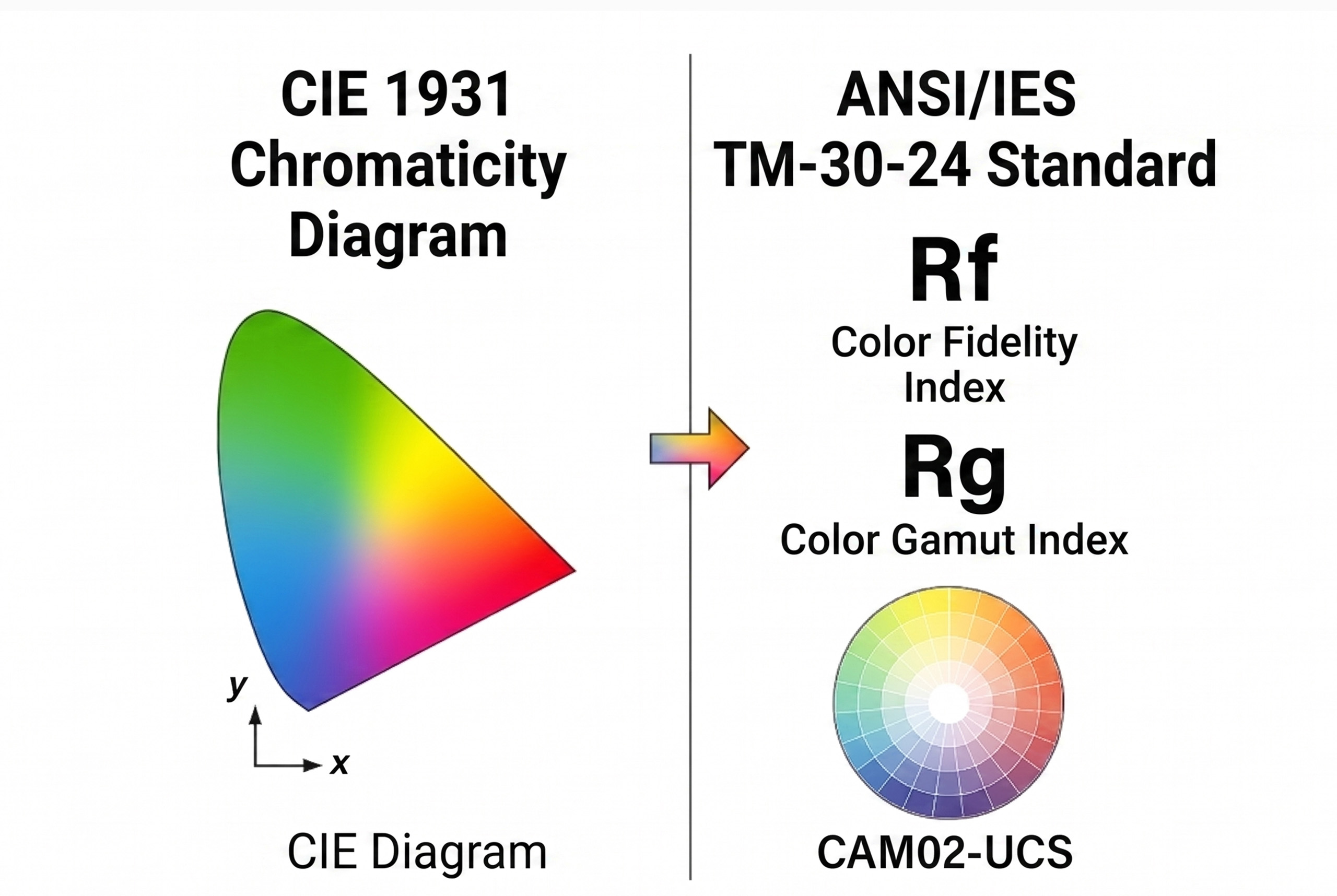
Beyond the CRI: The New Era of Colour Rendering in Architectural Light How Rf and Rg redefine color rendering for a light designed on the visual experience Continuing the analysis…
Dalla-Percezione-alla-Funzione-L’Influenza-della-Temperatura-di-Colore-sullo-Spazio-Illuminato-copertina
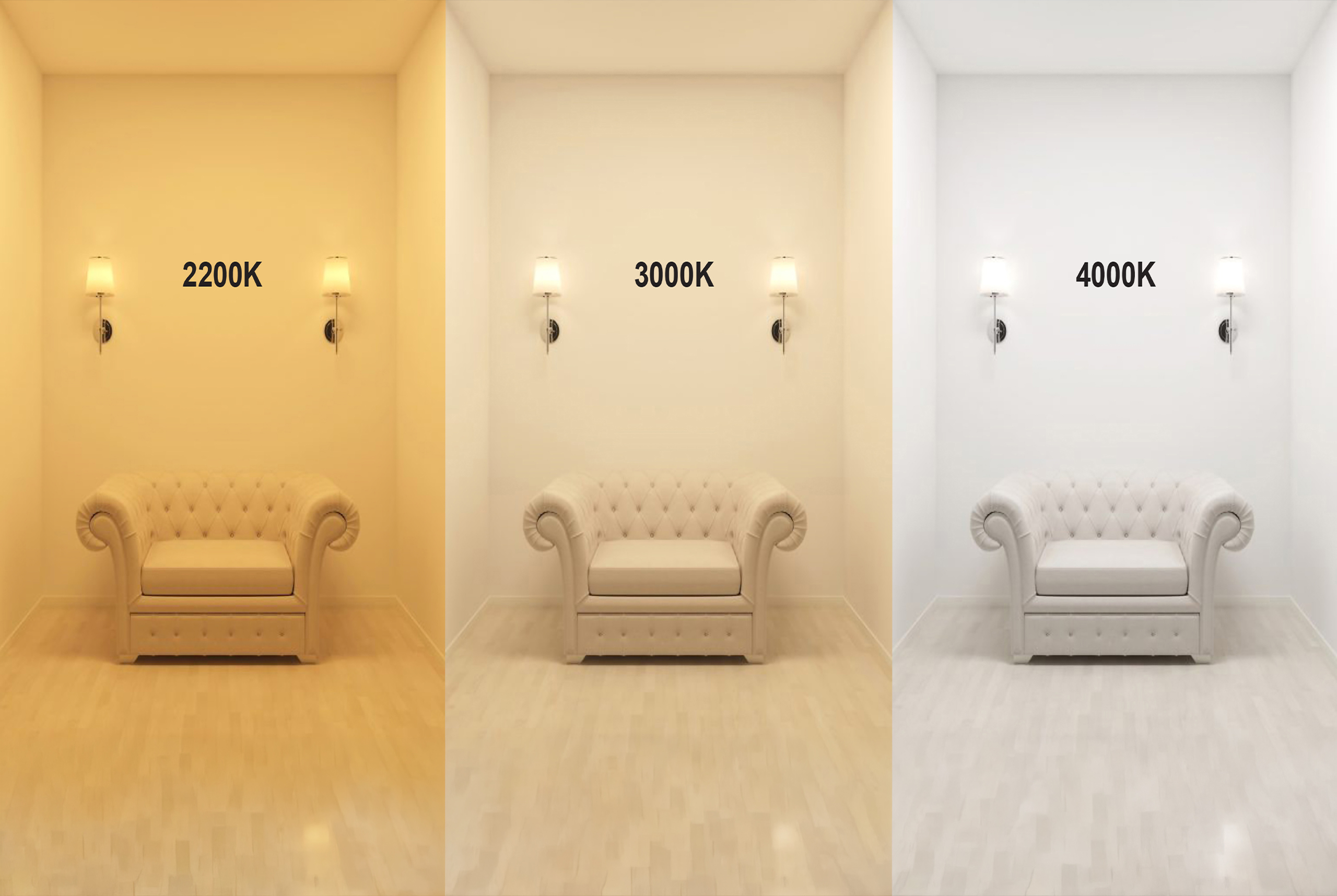
From Perception to Function: The Influence of Color Temperature on Illuminated Space Color temperature as a perceptual language: designing atmospheres, guiding vision and shaping space After exploring the scientific bases,…
La-luce-che-informa-rivoluzione-o-rischio-per-il-futuro-dell’illuminazione-copertina-eng
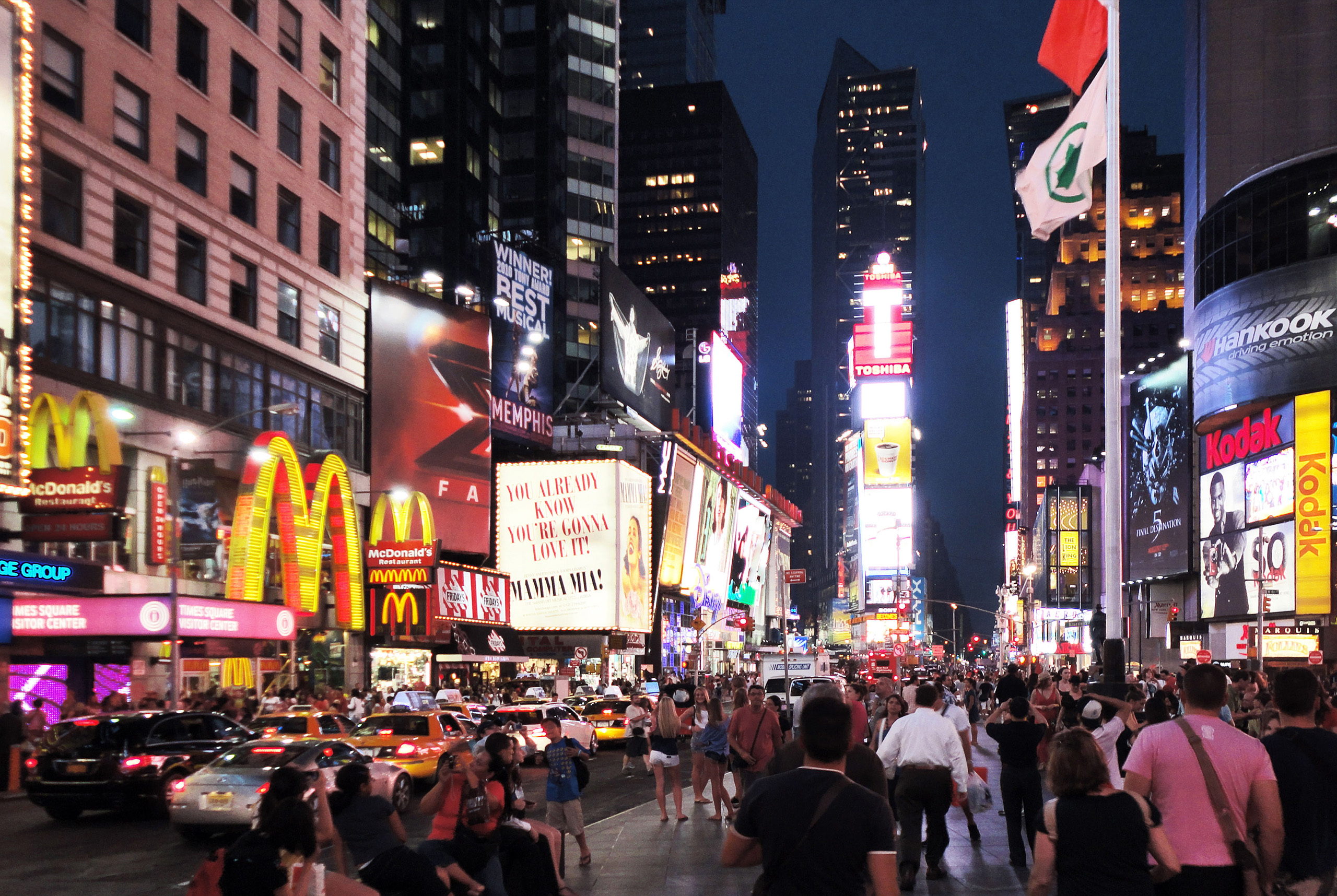
The Light That Informs: Revolution or Risk for the Future of Lighting? μPLS and microLED between innovation and danger of visual excess Historically, we are used to thinking of artificial…
The Silent Revolution of LEDs: The Crisis of Seeing in the Age of Solid-State Lighting From Daylight to Electrical Simulation, Digital Lighting Redefines Perception, Dissolving the Link Between Visual Experience…
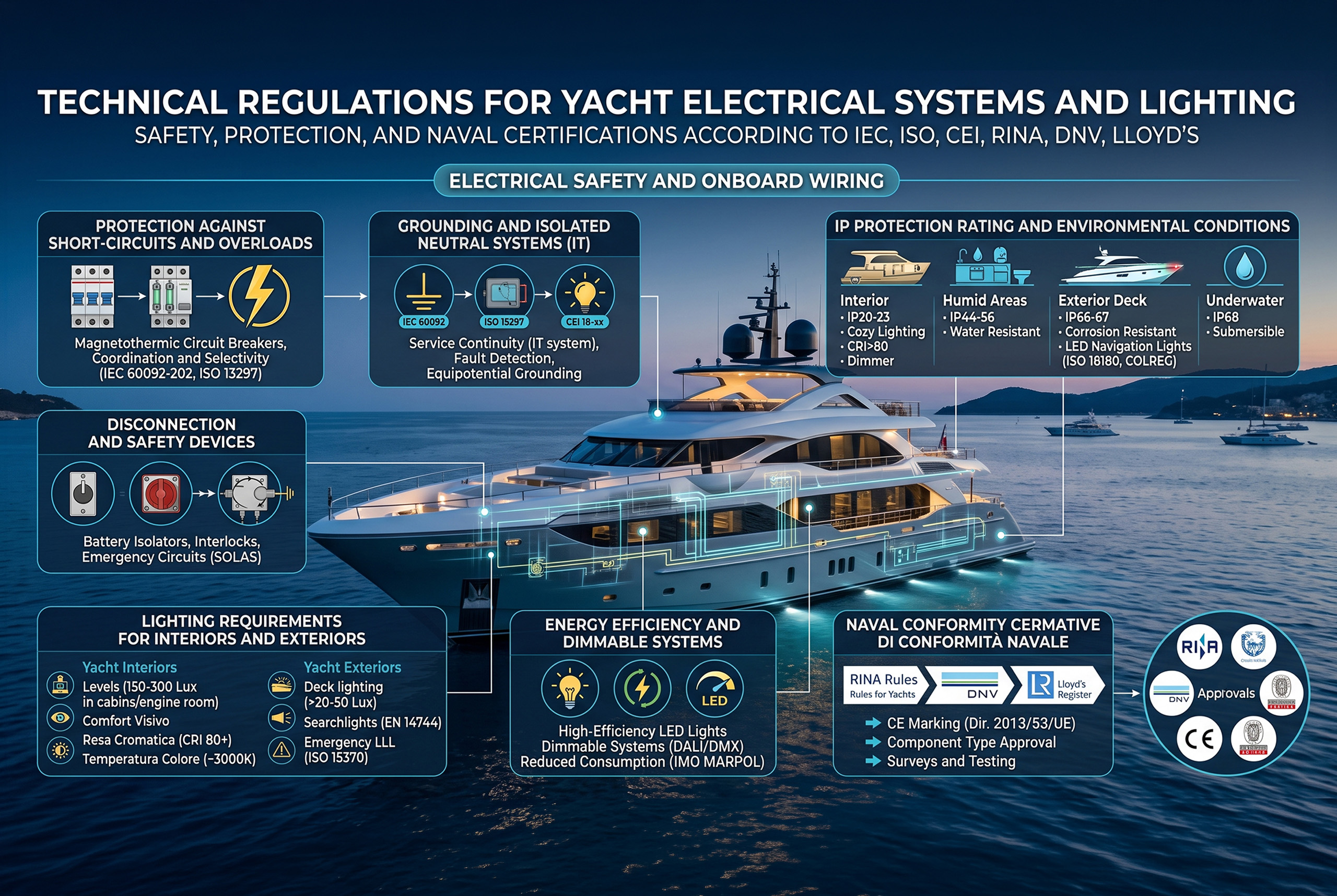
Technical Regulations for Electrical Systems and Lighting in Yachts Electrical safety, visual comfort and ship compliance according to IEC, ISO, CEI, RINA and DNV standards. Electrical Safety and Wiring in…
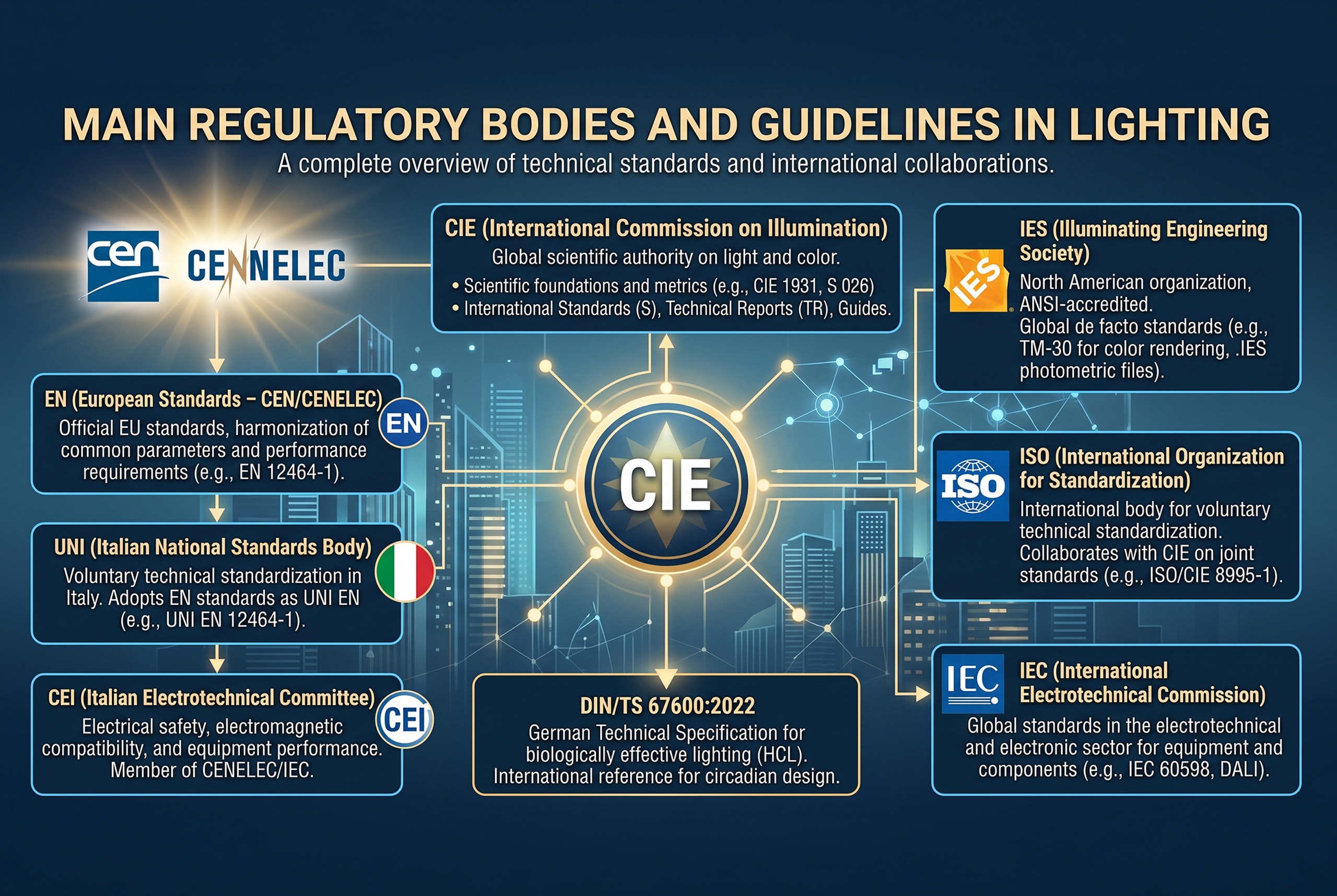
Main Regulatory Bodies and Guidelines in Lighting Technology A comprehensive framework on technical standards, international collaborations and key documents for designing light according to scientific and performance criteria. CIE (International…
Standard-Lighting-Measurements-(LM)-dell’IES-Codici,-Struttura-e-Implicazioni-Progettuali_Copertina-eng
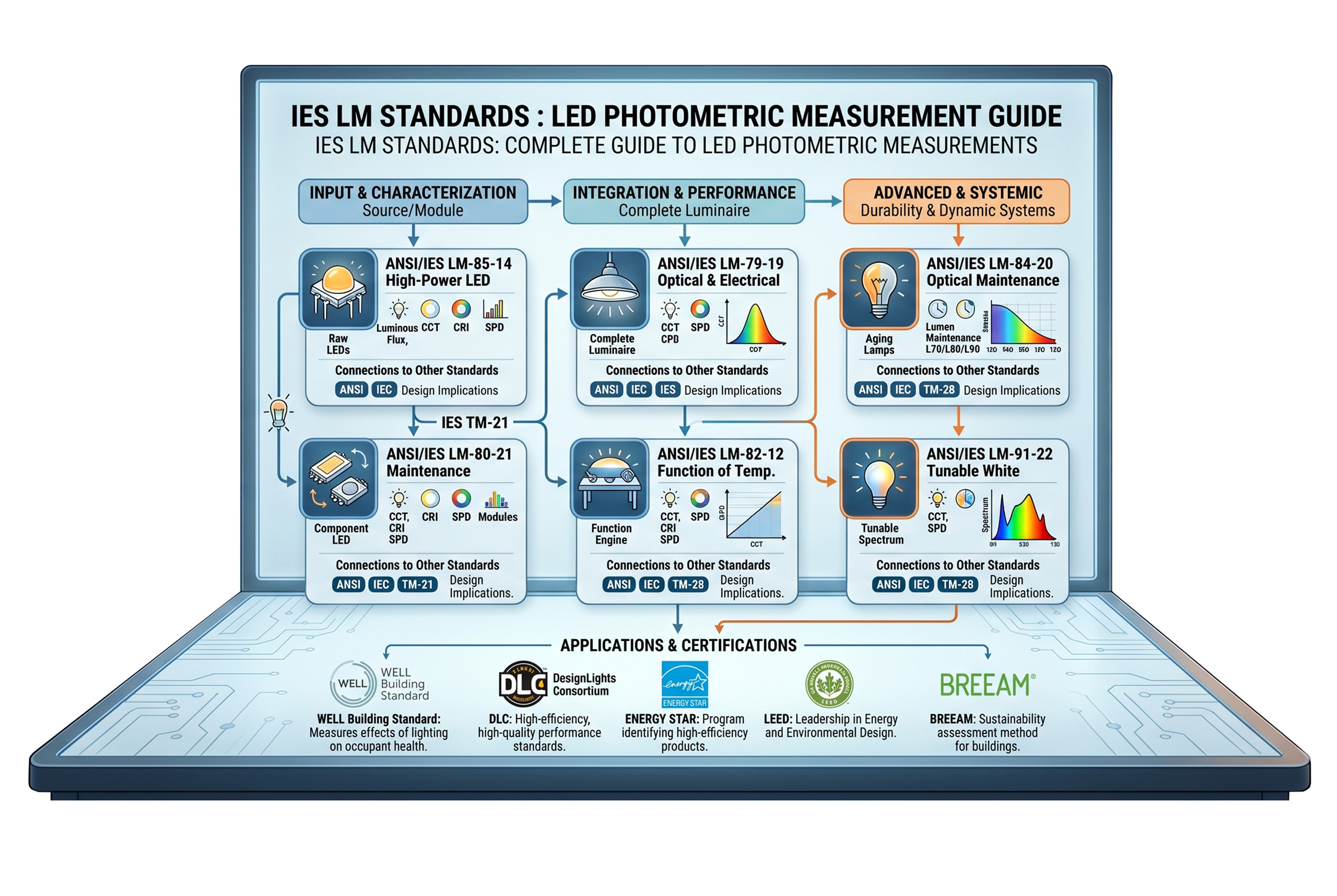
IES Standard Lighting Measurements (LM): Codes, Structure, and Design Implications Technical guide to LM standards for measuring the photometric, chromatic, and electrical performance of LEDs, modules, and luminaires. After having…
Standard-Technical-Memoranda-(TM)-dell’IES-Codici,-Struttura-e-Implicazioni-Progettuali_Copertina-eng
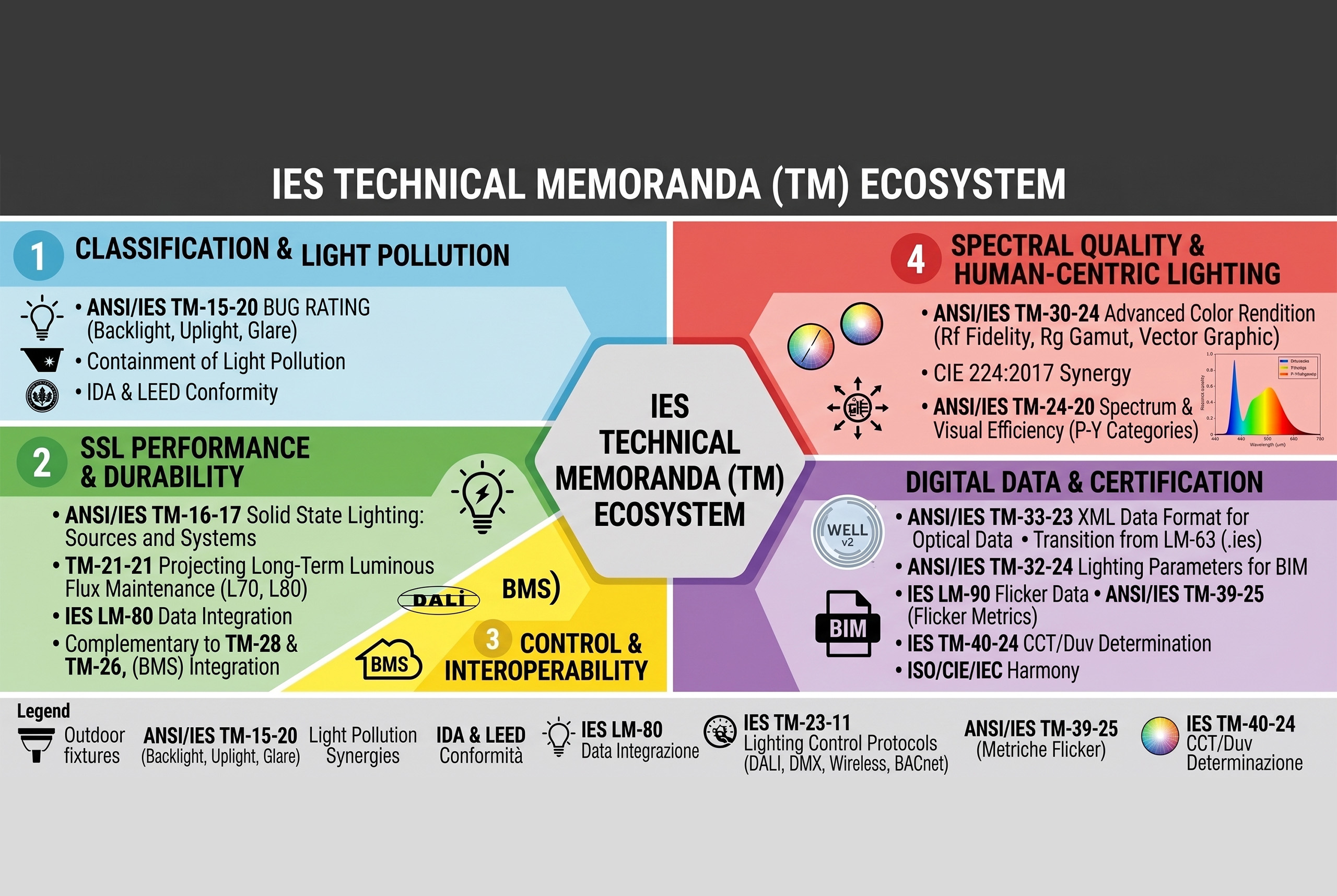
IES Standard Technical Memoranda (TM): Codes, Structure, and Design Implications A technical guide to the use and interpretation of TM documents in lighting design The following insight is dedicated to…
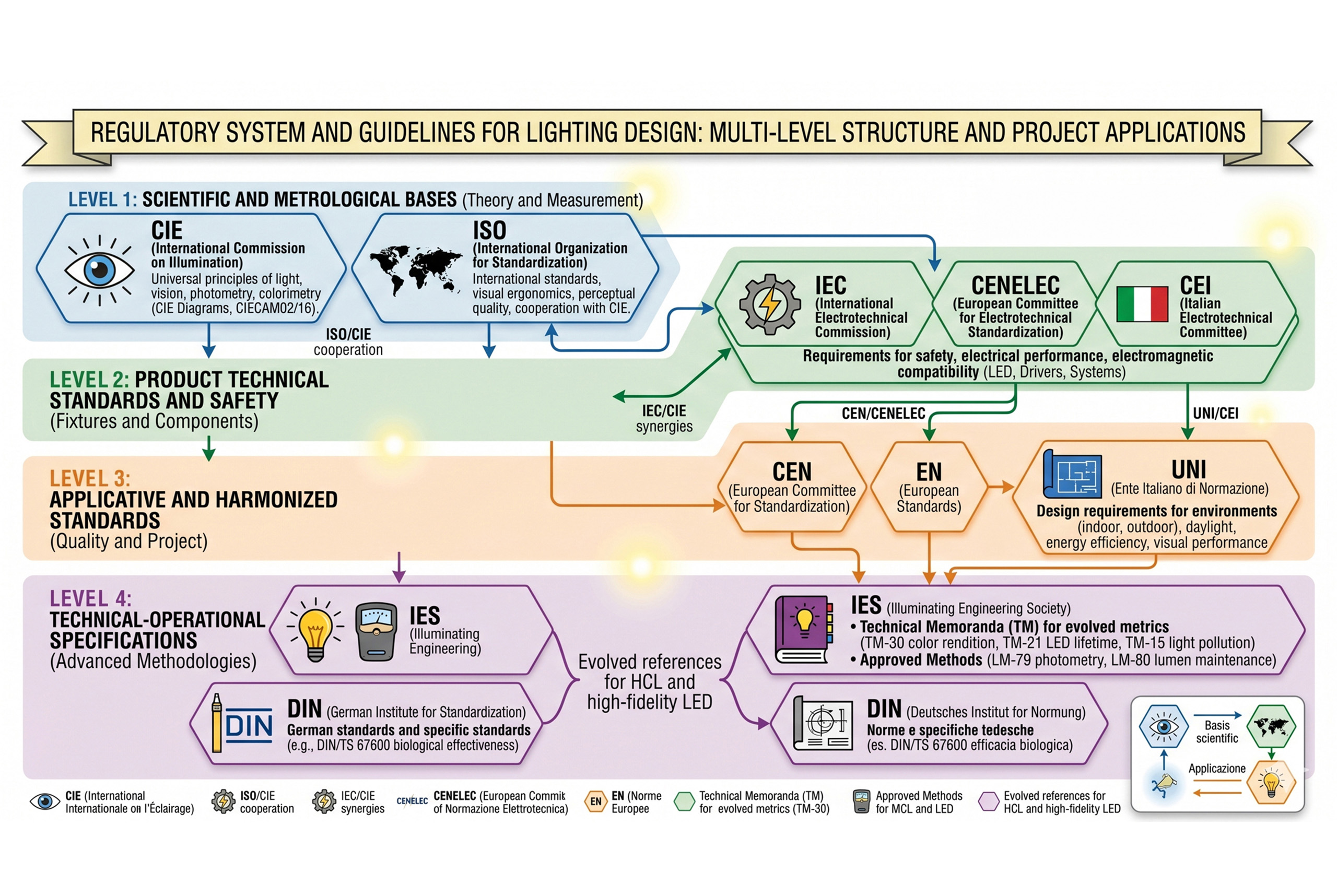
Authoritative Standards and Guidelines in Lighting Technology: Multilevel Structure and Design Applications A complex regulatory system for designing light with technical rigor and application coherence The evolution of light sources…
With the advent of LED sources, can we define the 1931 CIE diagram as obsolete? Formally no, but practically yes, in many application contexts. Now that we have understood how…
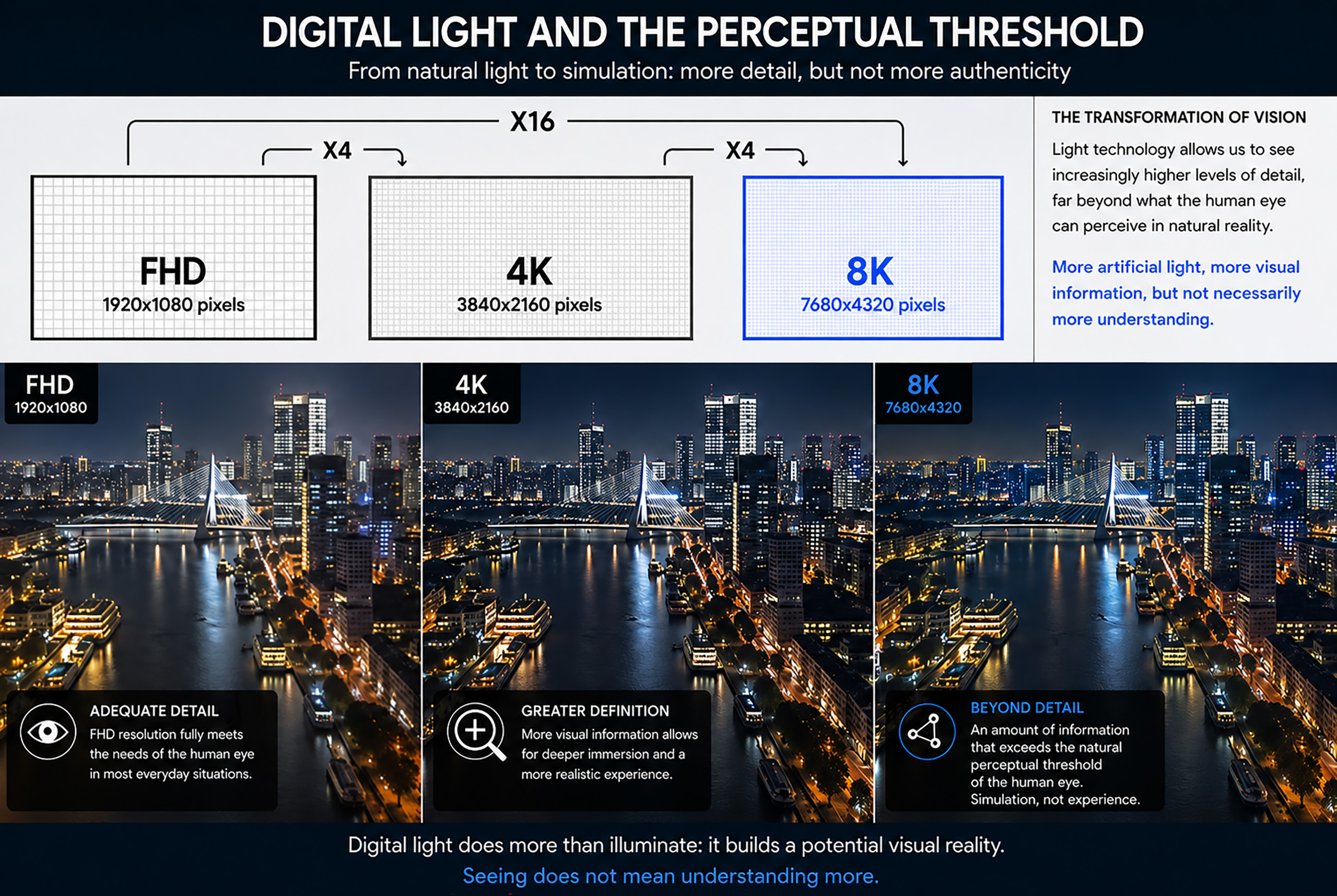
digital light and perceived thresholds - cover
Digital Lighting and Visual Perception: the Dissolution of the See/Understand Relationship How electric light is changing the relationship between seeing, experiencing, and understanding the world In today's era of digital…
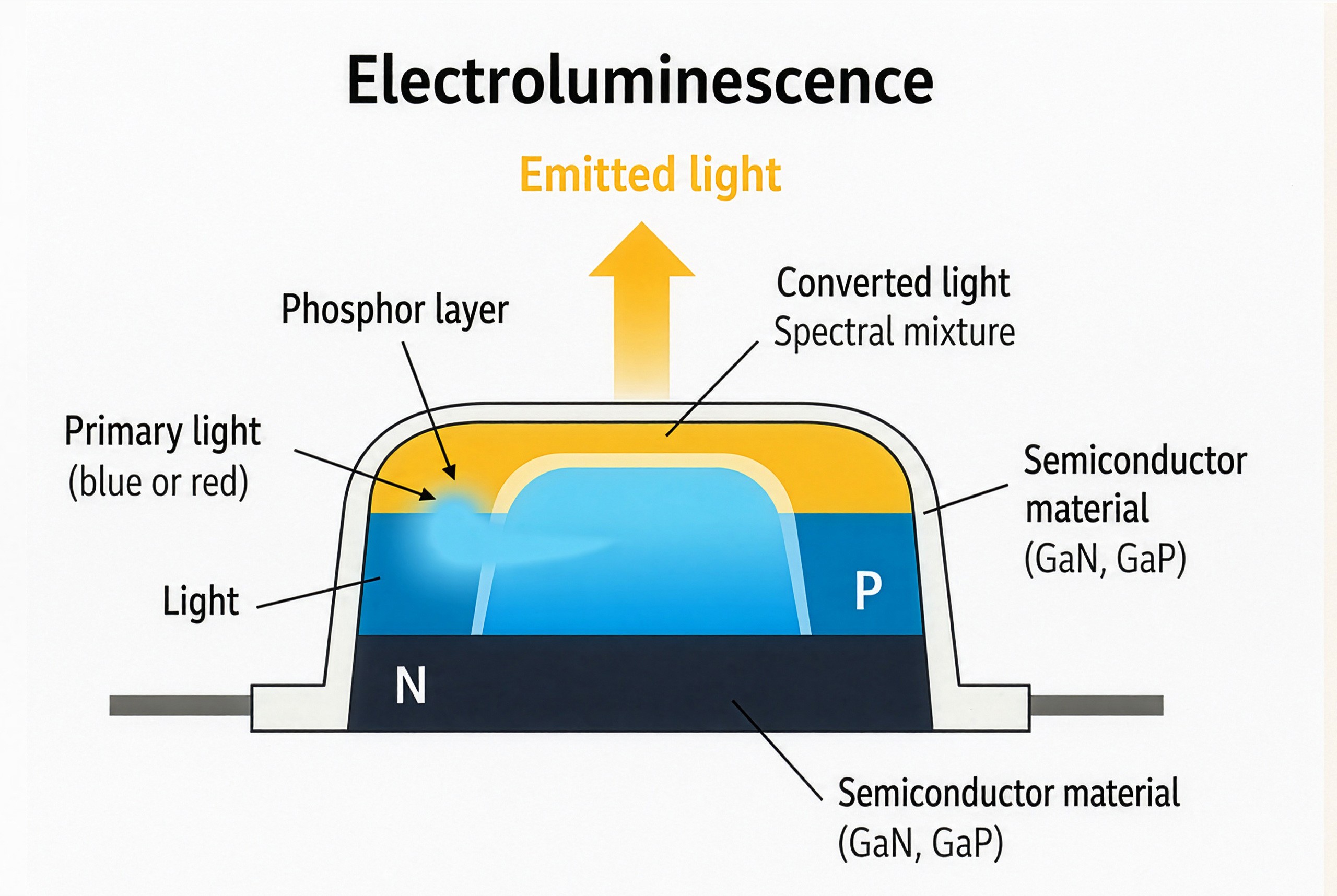
Electroluminescence Process in LED Semiconductor Devices
How LEDs Work: Electroluminescence, Materials, and the Light Spectrum From semiconductor structure to color rendering: how LED light takes shape Visible light, although perceived as a continuous and unified phenomenon,…
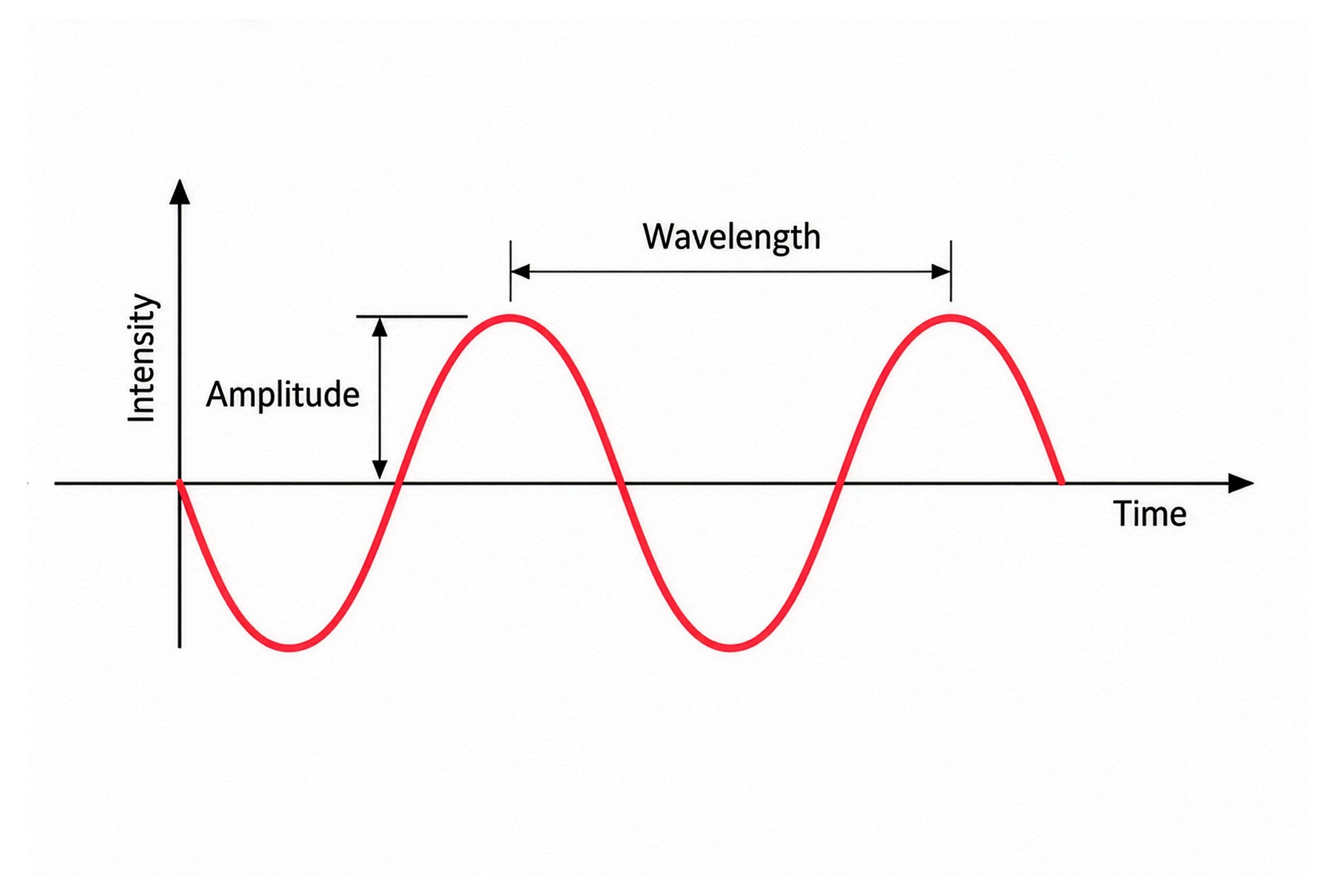
Fundamental Properties of Electromagnetic-Waves Amplitude and Wavelength
Visible Light and the Electromagnetic Spectrum: Physical Principles for Lighting Design How wavelengths influence perception, color, and light design After examining how the human eye adapts to different illumination levels…
Visual Signal Transmission Pathway in the Human Retina
Photopic vs Melanopic Illuminance: Definition and Spectral Sensitivity MEDI, EML, and CS. Three essential indicators for measuring the circadian impact of artificial light The perception of light varies according to…
Light Perception Human Eye Capabilities and Limitations
Light Perception: Capabilities and Limits of the Human Eye Understanding how the human eye works is the first step toward designing light with awareness  The human eye is a highly…
Lighting-Design-e-Teoria-della-Luce
Lighting Design and Light Theory Complexity in the relationship between light, perception, and design   How does a lighting designer develop a lighting project? Which disciplines should a rigorous lighting…
MENU