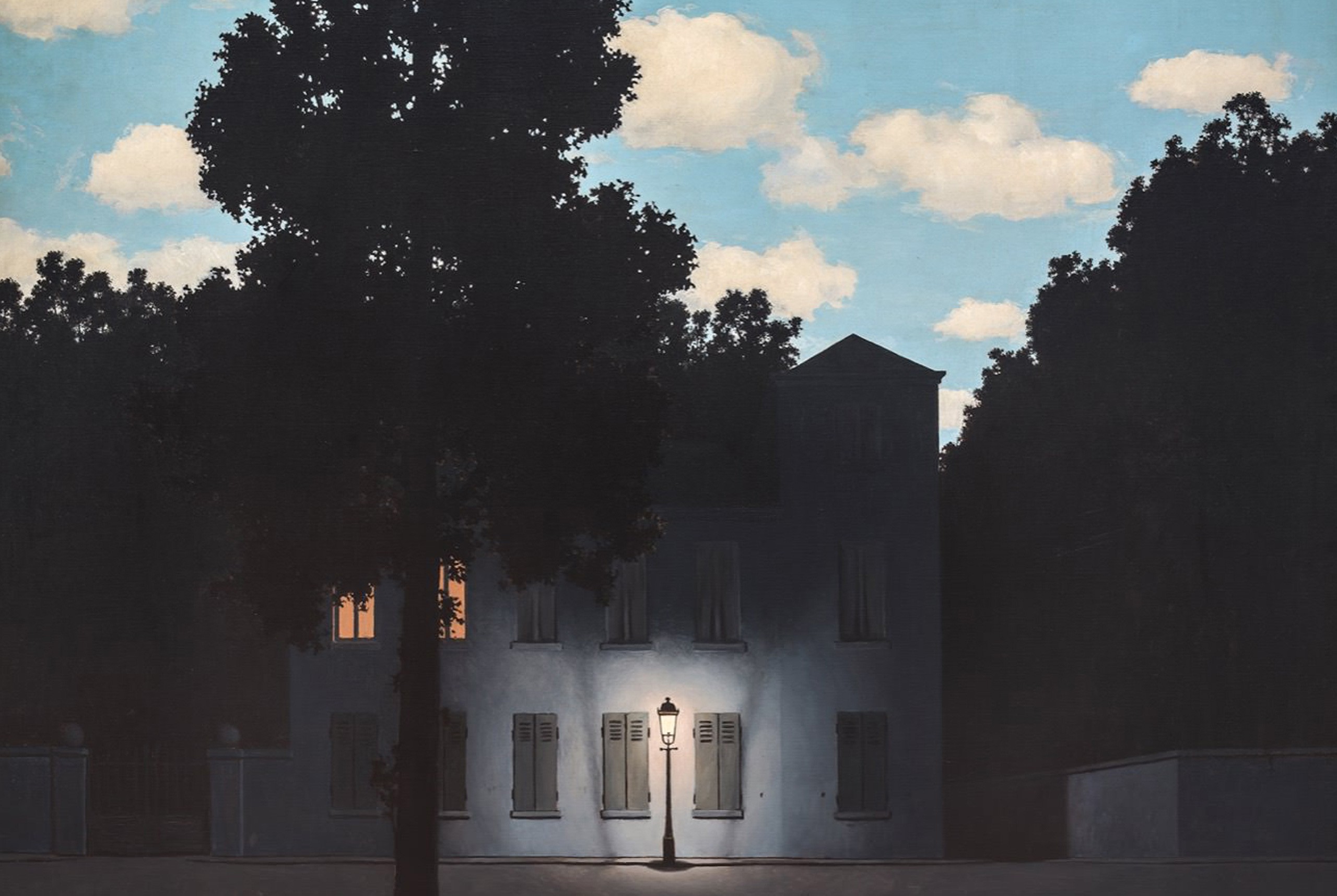
In today's era of digital enlightenment, characterized by bright screens, sensors and omnipresent LED sources, a crisis is emerging in the traditional paradigm according to which seeing is equivalent to understanding. For centuries, the light It has been a privileged metaphor for truth and knowledge (the "lights" of reason, spiritual enlightenment): "light presents itself as a metaphor for truth" noted Hans Blumenberg, reflecting on the historical role of this cultural image. Today, however, light no longer functions simply as a neutral means of revelation, but rather operates as cultural and symbolic filter, mediating and shaping our relationship with space, time, and reality. In this text, we will analyze this transformation from a theoretical-scientific perspective, drawing on philosophical and interdisciplinary contributions: from phenomenology of perception in Merleau-Ponty all’ aesthetics of vision by Paul Virilio, from the semiotics of light of Vilém Flusser to the theories of simulation (Baudrillard and others).
We will explore how sophisticated artificial light sources and contemporary visual technologies are altering the human perceptual threshold and blurring the boundary between direct experience and simulation, questioning the immediate equivalence between “seeing” and “understanding”. Finally, we will highlight the implications of these reflections for the contemporary lighting design, where lighting design must deal with new perceptual and cultural responsibilities.
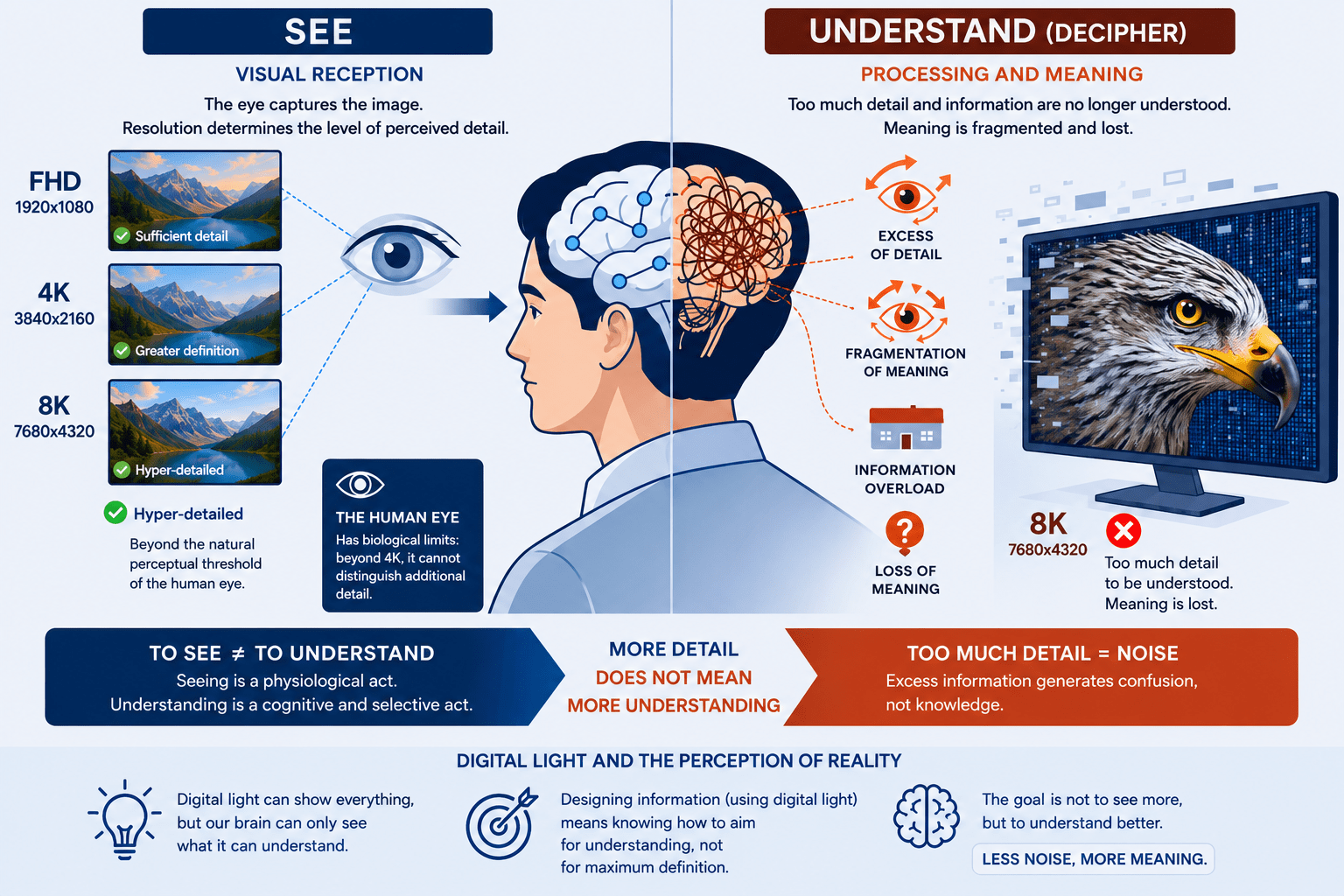
In classical Western thought, light was synonymous with revelation—illuminating something meant making it manifest and intelligible. Plato, in his famous metaphor of the cave, posits sunlight as an emblem of true Being; the eighteenth-century Enlightenment elevated "lights" to a symbol of reason and progress. This conception rests on the idea that view (at least with sufficient light) means accessing an objective truth. However, the twentieth century began to question this immediacy. Light, from a metaphor for truth, has gone refracting in multiple cultural codes: for example in the society of show described by Guy Debord, the abundance of bright advertising and media images ends up mediating and often distorting the direct relationship with reality.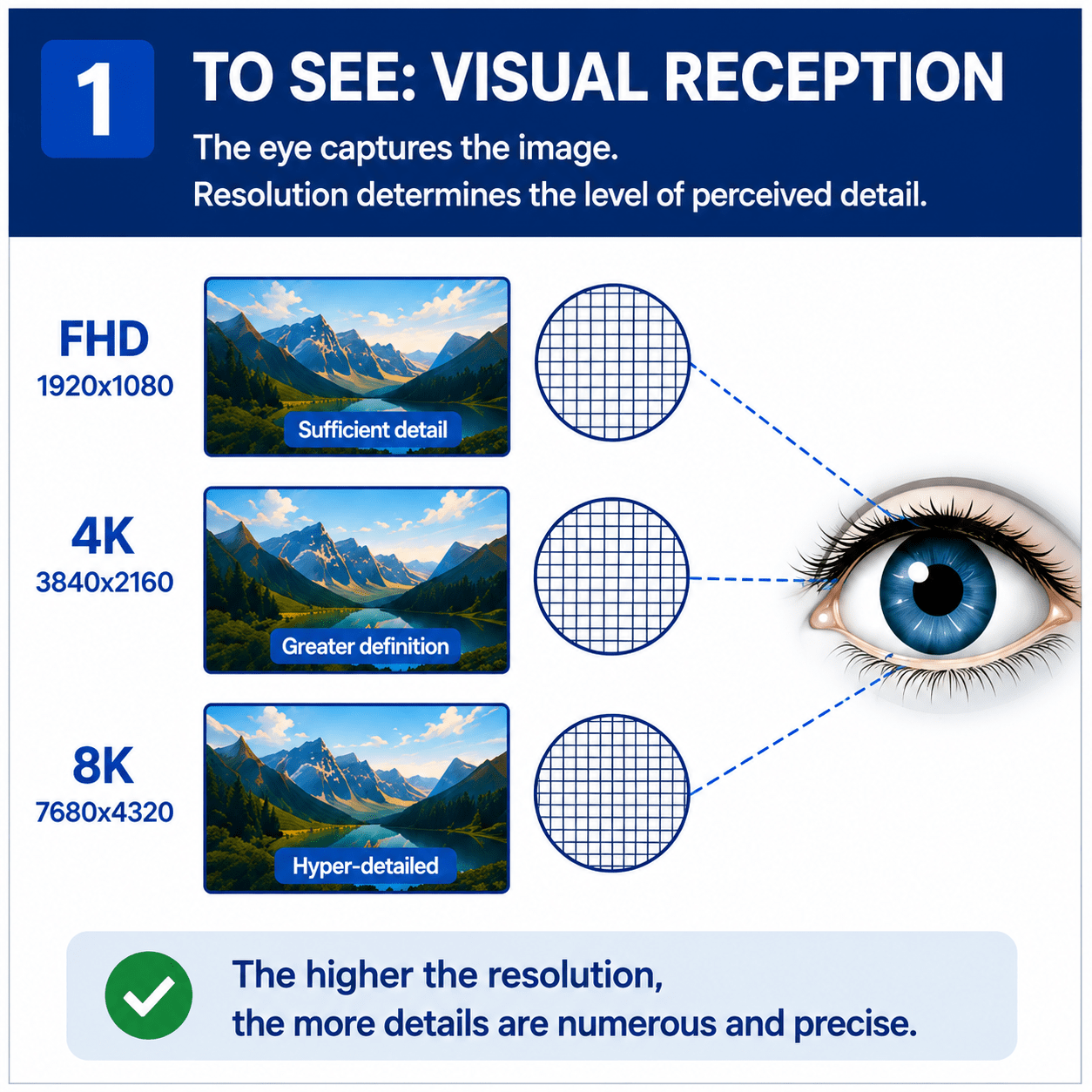
With the advent of digital technologies, the artificial light– from backlit photographs to screen pixels – has transformed into a autonomous language, a filter through which we interpret the world. William Flusser, in his semiotics of technique, observes that technical images (such as photography, literally “writing of light”) are not transparent reproductions of reality but “symbolic abstractions" that obscure their origin: they are often mistaken for direct representations of reality while in reality "encode layers of meaning programmed by the apparatus”. Digital light therefore does not passively reveal the world, but rather actively recreates according to codes just think of photographic filters and post-production processes that alter the light and color of an image to evoke certain emotions, or urban lighting that uses symbolic colors (the red of red-light districts, the Italian flag on a national monument, etc.) to convey cultural messages. Light thus becomes a expressive and selective medium: it highlights certain aspects of reality while obscuring others, it directs the gaze rather than simply enhancing it. This evolution has profound consequences on our relationship with space, time and reality. Space can be shaped by light: internal and external environments take on changing identities with different lighting scenarios (think of immersive installations that use projections to change the volumetric perception of a room). Time itself has been redefined: electric and then digital lighting have progressively abolished the darkness of night, artificially extending the day and enabling continuous 24/7 productivity. As critic Jonathan Crary notes, the erosion of the night for productive purposes accompanies the advance of modern capitalism, breaking down once-insurmountable temporal barriers and completely assimilating natural rhythms with artificial ones. Finally, reality is increasingly mixed with light simulations: we live surrounded by screens and visual interfaces that present a mediated (sometimes manipulated) version of the world, to the point that – as anticipated by Jean Baudrillard – simulacra risk replacing reality, generating a “hyperreality” where the boundaries between true and false, original and copy, become evanescent. In short, in the age of digital illumination, light no longer automatically guarantees cognitive clarity. This shift also implies a transformation in the role of the observer. Perception is no longer a passive reception of visual stimuli but an active process of decoding, shaped by technological systems, cultural conventions, and individual experience. To see, therefore, increasingly means to interpret rather than simply to observe. On the contrary, it creates an overloaded and complex visual environment, within which seeing requires an active effort of interpretation In the following paragraphs, we will explore this concept from various theoretical perspectives, to understand why seeing no longer immediately coincides with understanding, and what challenges this entails.
A first fundamental contribution to question the equation seeing=understanding comes from phenomenology of perception by Maurice Merleau-Ponty. Already in the mid-twentieth century, Merleau-Ponty emphasized that visual perception does not provide “truths like geometry, but rather presences”. In other words, what we see is not a series of objective and univocal data, but a lived, situated and embodied experience: “things present themselves to me and I am present to things, in a mutual implication, through the juncture with the being that is my body”. Perception is therefore a primary act in which subject and object co-belong, and seeing always involves a certain corporeal and existential participation. Merleau-Ponty also highlights the necessarily partial and prospective nature of every vision.
We never see an object in its absolute totality: for example, when I observe a table lamp, I directly perceive only the side facing me, and yet I implicitly perceive the hidden side too, relying on a “wedding ring” in the fact that that side exists. Every visual act therefore implies a beyond unseen – a context, a back, a surrounding world that exceeds what appears frontally. "Perception is my opening, through my limited point of view, to everything that surrounds me", says Merleau-Ponty. This means that seeing is never equivalent to intellectually possessing the object in an exhaustive way, but rather to establishing an evolving, always perfectible relationship with it. Consequently, understanding what one sees is not an automatic given, but rather the fruit of a continuous dialectic between the visible and the invisible, between what appears and what remains implicit.
“My perception of the world is one among many perceptions… it is never a privileged position… There in lies the ambivalence and the enigmatic character of perception" Merleau-Ponty invites us to recognize that every gaze is situated "here and now" (in a body, in a story, in an environment) and that seeing also means interpreting, imagining what is missing, coordinating one's own point of view with that of others. This phenomenological perspective is more relevant today than ever. If already in everyday perception "natural" Seeing was intrinsically ambiguous and required an act of embodied understanding. In the contemporary context of digitally mediated realities, this ambiguity is amplified. Images on screens do not fully engage our bodies as direct experience would; therefore, we risk losing the sensorial and situational anchoring that Merleau-Ponty considered essential to understanding the world. The phenomenological lesson therefore reminds us that to understand what we see—whether digital or real—always requires an effort at perceptual integration: placing the image in context, reconstructing its hidden aspects, comparing it with other possible perspectives.View it is never a purely optical act, but is imbued with intentionality (direction of sense) and pre-reflective interpretation in the digital age, recognizing this complexity becomes crucial to avoid mistaking luminous appearances for immediate understanding.
 If Merleau-Ponty has shown the original ambiguity of the vision, the philosopher and urban planner Paul Virilio analyzed how the vision technologies modern ones have taken this ambiguity to the point of paradox. Virilio introduces concepts such as dromology (logic of speed) and speaks of an aesthetics of disappearance: in the age of electronic media, what is hyper-visible ends up disappearing from critical consciousness. His emblematic warning is that "First of all, you shouldn't believe your eyes.” – a provocative statement that turns the popular saying on its head “seeing is believing”. By this, Virilio means that the supposed neutrality and objectivity of the technologically enhanced gaze is fallacious: the images produced by devices (cameras, satellites, screens) carry with them the shadows of the ideologies and programs that generate them. It is therefore necessary to develop an active suspicion of the immediately visible, because it often hides more than it reveals.
One of Virilio's key ideas is that the overabundance of images and visual information in the contemporary world leads to a form of light blindness. In The Negative Horizon he states:"Today we are no longer truly seers but already re-seeers; the tautological repetition of the same object, at work in our mode of production (industry), is also at work in our mode of perception. We spend our time and our lives contemplating what we have already contemplated: ... our habitat is built on redundancy."
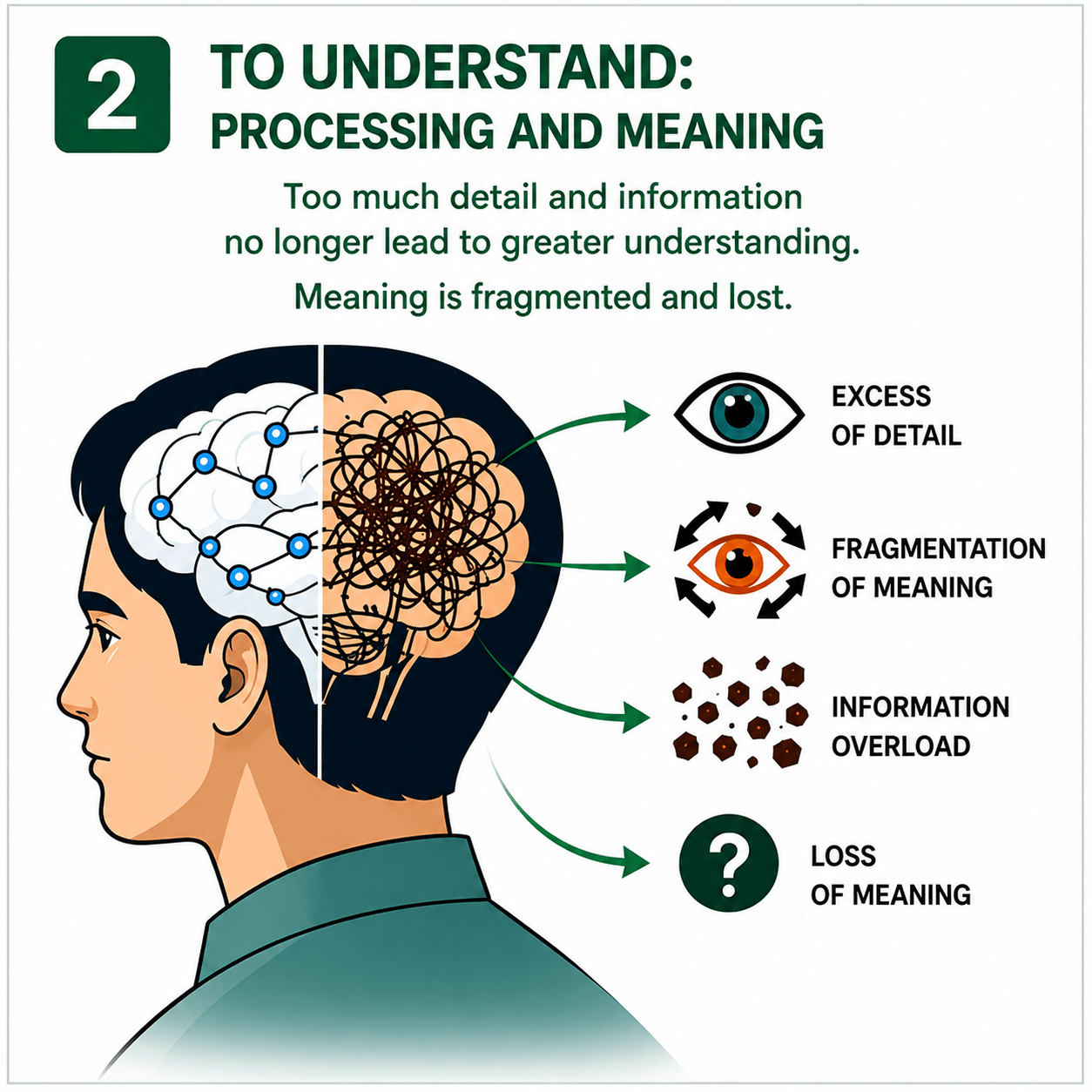
This incisive passage describes a state of recursive vision, in which the media incessantly present us with variations of the same thing (the same visual stereotypes, the same formats, the same rehashed news), generating habituation. The result is an audience of "reviewers," who believe they're always seeing new things but in reality re-see what's already known and packaged, losing the capacity for a fresh and truly perceptive gaze. Knowledge risks stagnating in a self-referential bubble of redundant images: we see more, but we understand less because visual stimulation no longer activates surprise or critical thinking. Virilio closely links this visual saturation to the instantaneous speed of digital communications.
In the era of “real time” and the ubiquity of light flows, our perceptions are “transfigured by media and digital technologies, with the aim of instantly presenting everything that is worth observing”. He speaks in this regard of a “telecommunication enlightenment,” ironically mocking the new dogma that having everything immediately visible (thanks to computer networks operating at the speed of light) is automatically a good thing. In reality, this dromological compression of space and time entails serious side effects: “to see better we risk handing this task over to technological vehicles”, delegating human perceptive faculties to vision machines (from surveillance systems to augmented reality viewers). The paradox is that, in the attempt to see everywhere and always, we end up seeing less: by relying on devices, the human eye becomes unaccustomed, lazy, and the excess of visual stimuli leads to a form of cognitive blindness. Virilio in fact underlines how the opposite extreme of total transparency is disappearance: when everything is illuminated without intervals, nothing actually stands out anymore and our attention is zeroed.
This "aesthetic of disappearance" also manifests itself at the social and political level: events that once would have provoked shock or reflection (disasters, wars) today, hyper-visualized by the media, scroll across screens like fast-paced spectacles, leaving no deep understanding. It is no coincidence that Virilio has studied the "logistics of perception" in modern conflicts, showing how mediatized war becomes a video game in which horror is aestheticized and distanced from the spectator. This de-responsibilization through fast-paced images is linked to the dissolution of seeing = understanding: you can witness even terrible scenes on live TV or streaming, without really understanding its meaning or moral implications, because the way it is enjoyed (fast, repetitive, spectacular) anesthetizes judgment.
In short, the aesthetics of vision according to Virilio warns agains illusion of omnivision provided by digital technology. He suggests that, contrary to what was once thought, more light and more images do not automatically lead to greater knowledge—indeed, they can erode the ability to discern. Virilio's reflection forces us to ask: What does it really mean to “see” in the age of digital media? It is still an authentic encounter with reality, or more and more a mediated act in which we risk being passive and manipulated? To recover the dimension of understanding, perhaps we need to "slow down" our gaze, reintroducing shadows and silences into the visual experience, as an antidote to the excessive light that blinds.
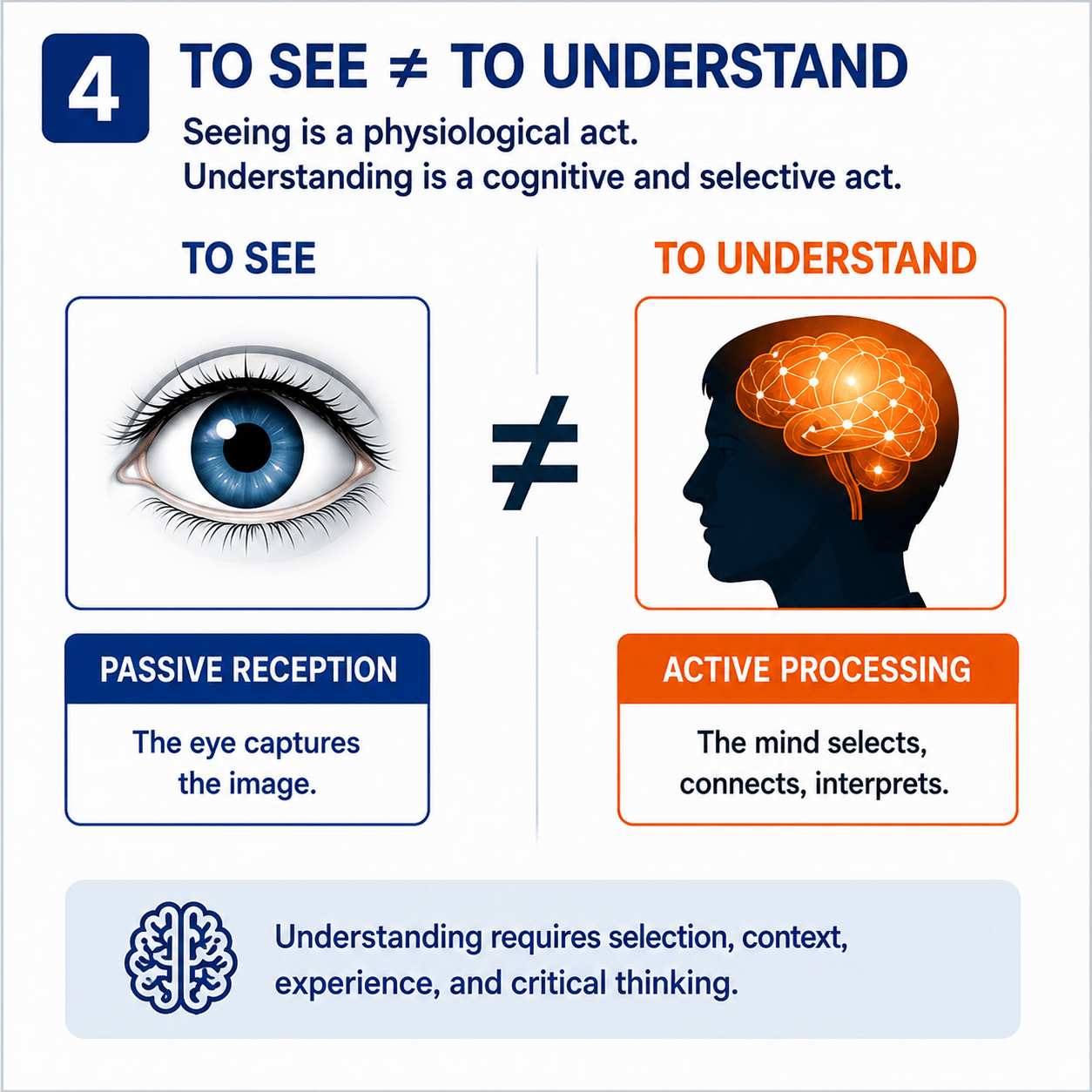
A further theoretical piece to understand the separation between seeing and understanding in the digital context is offered to us by William Flusser, thinker who has thoroughly investigated photography and technical-media images. Flusser starts from the observation that, with the invention of photography first and then of electronic media, humanity has delegated the production of images to automatic devices (cameras, video cameras, computers) equipped with programs. This has radical consequences on the status of images and therefore on our way of seeing the world. In his Philosophy of Photography, Flusser states that photographs (the prototype of technical images) are coded two-dimensional surfaces: they appear as luminous traces of reality, but in reality they are built according to algorithms and intentions inscribed in the device. The common mistake is to take these images as transparent windows on the world, while instead they should be read as texts, as symbols that require interpretation. Flusser notes that "few know how to decode them critically" and this generates a sort of "photographic illiteracy”: everyone takes and looks at photos, believing they understand reality thanks to them, but in reality they are subjected to their hidden program.
This analysis is directly linked to the theme “seeing vs. understanding according to Flusser, in the era of technical images, a false sense of security has crept in that seeing an image is equivalent to knowing what it represents, while in reality images can lie or, more precisely, they can simulate a non-existent reality. Here the echo with the theories of Baudrillard it's strong: Baudrillard coined the term simulacrum to indicate a copy without an original, a sign that no longer refers to an underlying reality but only to other signs.
In the condition of hyperreality, “images no longer reflect reality but instead generate their own self-referential world”. A clear example today are the images generated by Artificial Intelligence machine learning algorithms can create ultra-realistic photos of people or places that don't actually exist at all. These synthetic images often they appear more real than reality, easily deceiving the human eye. We are thus faced with visual simulationsSo refined that they can provoke real emotional or decision-making reactions, despite lacking a physical reference. This brings the problem to its climax: if we see a face in a photo (perhaps shared by a media outlet), we instinctively tend to believe that face exists, that it corresponds to a real person—after all, "I saw it with my own eyes." But in the age of deepfakes and advanced rendering, this seeing-understanding (as true) nexus is completely unreliable. Understanding now requires a greater critical effort we must ask ourselves who produced that image, with what means and intentions, and what program lies behind it.
Flusser would say that we need to decode images, not just look at them passively. On the level of semiotics of light, we can say that digital light has taken on a more symbolic than indicative if natural light illuminated the world to show it to us as it is, electronic light often reconstructs it symbolically: think of the difference between looking at a landscape in person and looking at that same landscape photographed and filtered on a screen. In the second case, the colors, the contrast, the framing—all elements of controlled light—already convey a narrative, an interpretation. The backlit image on the screen is not a neutral mirror of the world, but a discourse about the world. And like any discourse, it can be true or false, banal or profound, informative or manipulative digital light It is therefore intrinsically hermeneutic: it must be interpreted.
A further contribution also comes from the reflection on society of the spectacle and contemporary visual culture Susan Sontag, in On Photography, already noted how continuous exposure to images (of wars, disasters, etc.) risks desensitizing the spectator, transforming real events into consumable spectacle. Guy Debord, for his part, denounced that in the mediatized society "everything that was directly experienced has moved away into a representation”, implying that immediate experience (which alone generates genuine understanding) is replaced by a flow of prefabricated representations. In this context, seeing is not enough: we need to recover an engagement with reality that the image alone cannot provide.
In summary, Flusser's semiotics of light and Baudrillard's theory of simulacra show us a world in which bright appearances can be deceiving, in which sight must be trained as reading is trained, and in which the presence of light does not automatically imply the presence of truth. This does not mean adopting a paranoid attitude or denying the value of images, but recognizing that understanding requires going beyond the first glance: we need to contextualize images, verify them, and interpret their symbols and cultural codes. Only in this way can seeing regain cognitive depth, rather than remaining a superficial act. In the next section, we will see how this dynamic manifests itself concretely with modern light and visual technologies.
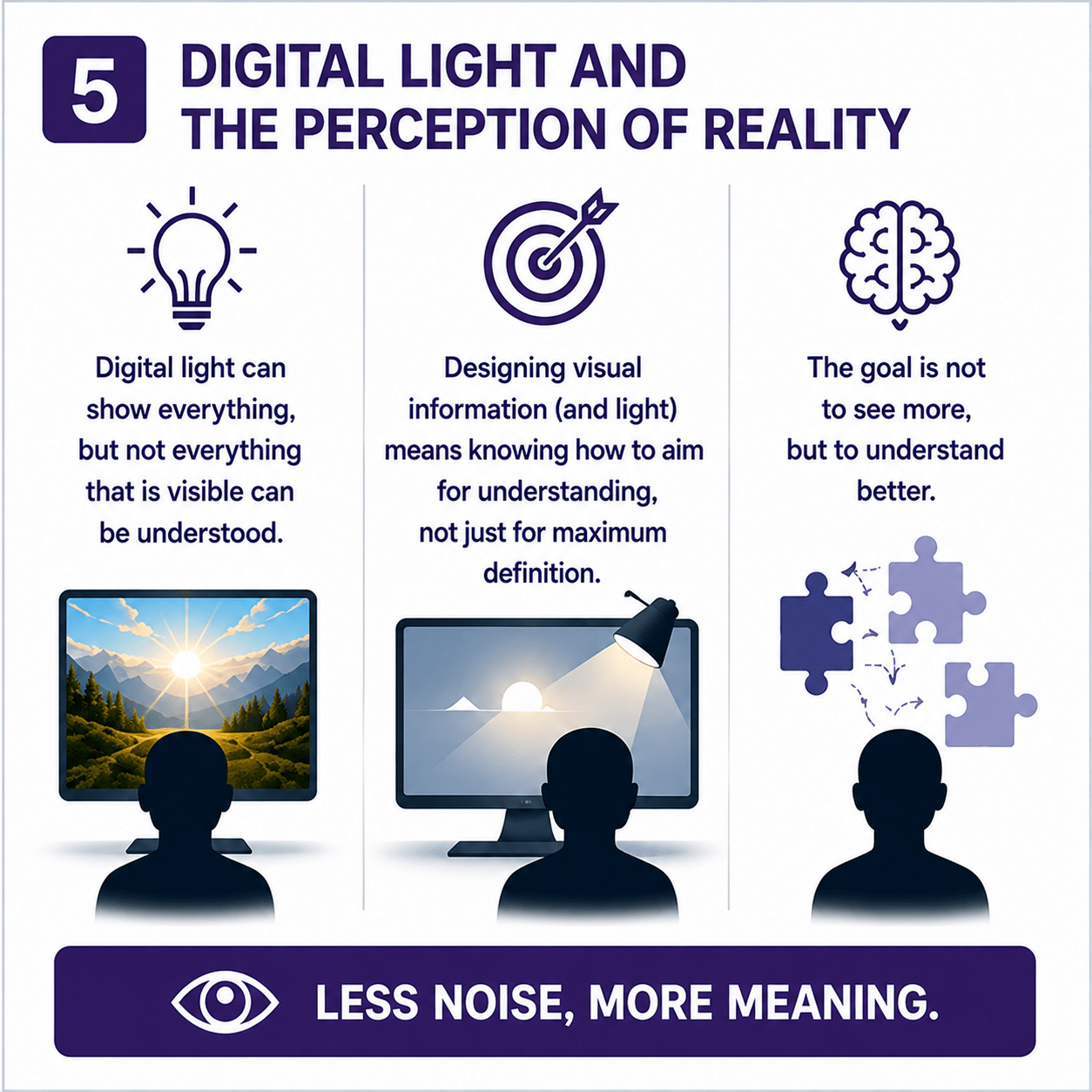
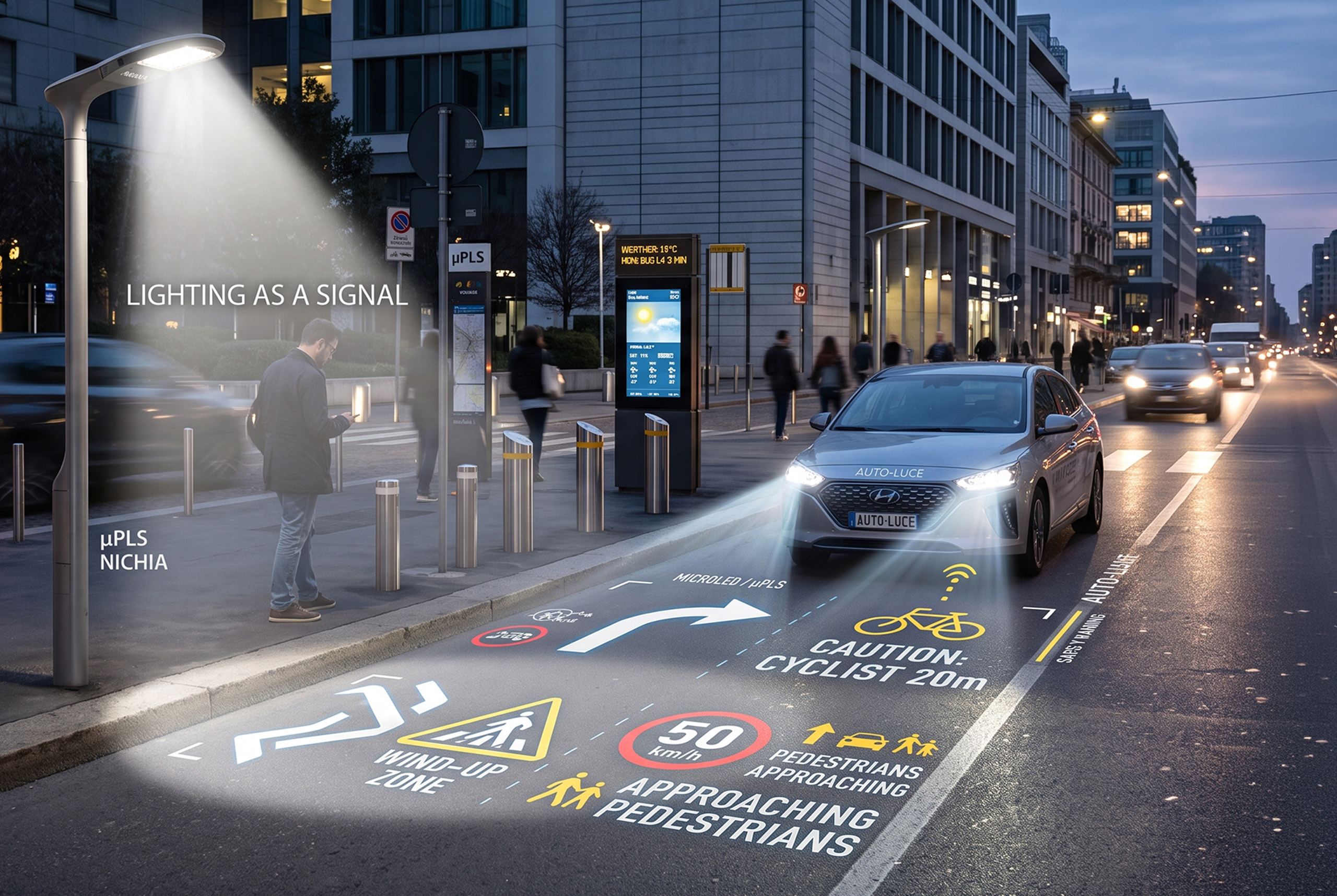
Technological evolution in the field of lighting and display has led to devices and light sources of unprecedented sophistication: ultra-high definition screens, virtual and augmented reality, holographic projectors, dynamic LEDs capable of modulating color and intensity instantly, lasers and optical fibers in architecture, etc. These advances have greatly extended the boundaries of what can be shown through light, raising questions about the relationship between sensitive perception ed experience of reality in particular, we often talk about the perceptual threshold: the limit within which a light stimulus appears plausible or acceptable to the human senses. New technologies tend to push this threshold higher, creating sensory simulations so vivid that they compete with (or sometimes exceed) natural experience.
An emblematic example is the Virtual Reality (VR) Immersive. Wearing a VR headset, the user is surrounded by bright stereoscopic images that respond to their movements: the illusion of being in an alternate space can become extremely strong. If the simulation is accurate enough in terms of visual quality (resolution, frame rate, field of view) and consistent with other sensory cues, the brain can be tricked into reacting as it would in a real situation. For example, looking in VR from the top of a virtual skyscraper, many people experience real dizziness and sweating, even though they rationally know they are in the living room: the perceptual threshold of their visual-equilibrium system has been stimulated beyond its limit, providing an experience of fear identical to the “real” one.
This illustrates how to see something convincingly (thanks to the sophistication of digital light) can evoke authentic reactions and emotions, challenging the distinction between direct experience and artificial simulation. We are forced to ask ourselves: if a light simulation is indistinguishable from reality to our senses, how does the resulting experience differ? And above all, how can we correctly understand this experience? A meta-perceptive level, an awareness of the context (for example: "I know it's a virtual environment, so there's no real danger") is needed to integrate the sensorial aspect with actual reality. Again, seeing alone is not enough; an additional act of reflection is needed to avoid mistaking illusion for reality.
Even outside of VR, the artificial light sources are altering our daily perception. Think of the urban night lighting modern cities, with brightly lit city centers and giant advertising screens, create a simulated nightscape where it's always "like daytime." The human eye, adapted for millennia to the natural alternation of light and dark, finds itself in an environment of perpetual artificial dimness that confuses circadian rhythms and the very perception of time (the hours of night lose their visual identity). Light pollution it eliminates natural darkness and even the view of the stars, altering not only the ecosystem but also our existential experience of the night. In other words, the powerful technical light doesn't just extend vision – reconstructs the context in which the vision occurs, creating a new perceptual "normality". Another case is that of the high dynamic range (HDR) displays and advanced imaging technologies in cinema and television. Thanks to LEDs and lasers, these systems can reproduce light intensities and contrasts far superior to those of old screens, approaching the range of luminances found in nature (for example, the sun's glare on water, or deep shadows in bright light).
The effect for the viewer is a sensation of augmented reality, of a "transparent window" onto the film world. But some scholars note that HDR also produces a hyperrealism sometimes strange: we see more detail and brightness than we would perceive with the naked eye in reality (since the human eye has adaptation mechanisms that the film can bypass by showing everything sharp at the same time). This hyper-visibility can paradoxically recall Baudrillard's simulacra: a "truer than true" which, however, is not reality, but rather a technical construction. Once again, we are faced with light as a symbolic filter: the director or designer decides which details to illuminate perfectly and which not, guiding our understanding of the scene. It is up to us spectators to recover a critical attitude so as not to passively absorb the shimmering image.
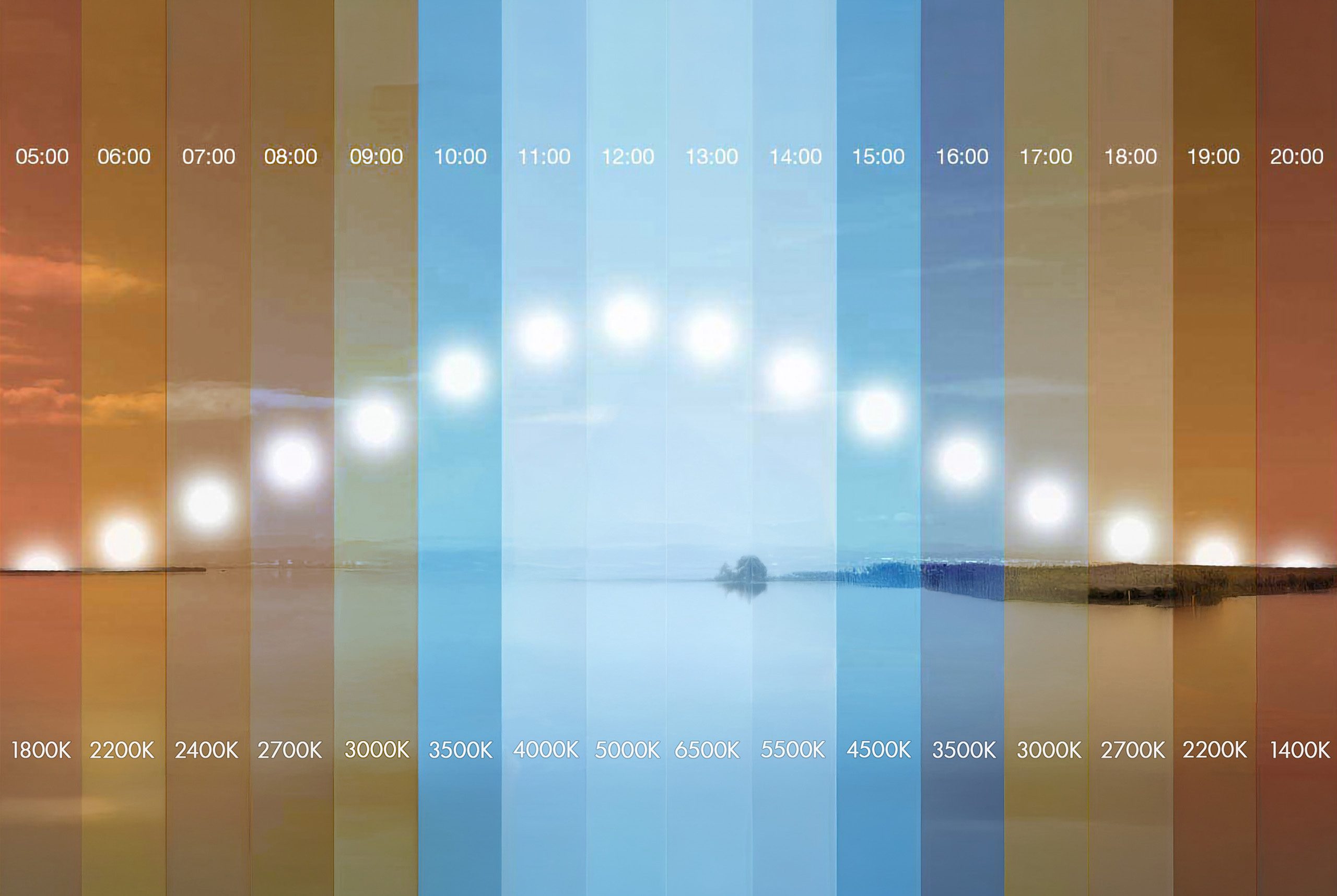
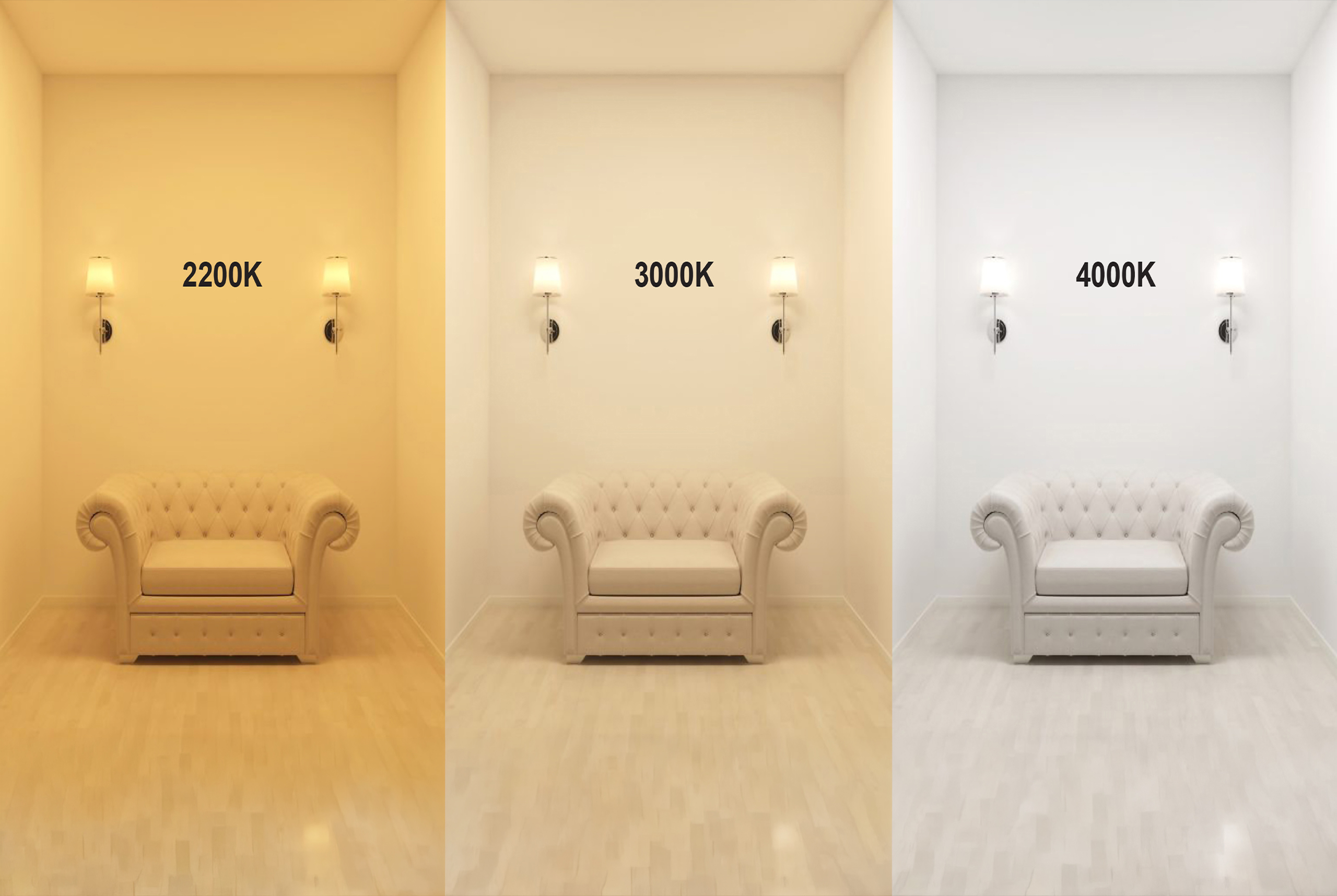
Finally, let's consider the impact of dynamic and intelligent lights in architecture and lighting design today, it's possible to program lighting systems that change color, intensity, and configuration in real time, perhaps reacting to the presence of people or the time of day. This allows you to transform the atmosphere of a space with the push of a button: a room can switch from cool, bright tones (stimulating, energizing) to warm, soft lights (relaxing) depending on your needs, almost simulating different environments in the same physical space. This has enormous design potential, but it also requires awareness. Human perception it can, in fact, be guided or manipulated by lighting design: for example, colored lights in a shopping mall can make items appear more appealing, or dramatic lighting in a tourist city can simulate a historical atmosphere that obscures the ordinary reality of those places. The most attentive lighting designers also integrate reflections on the meaning conveyed by light into their projects.
Lighting designer Susanna Antico, for example, observes that the use of dynamic white light (i.e. lighting capable of varying shades of white) in a project for a cathedral would have allowed change the perception of the building depending on the moments and functions: a colder and more severe light to convey solemnity on certain occasions, or a warmer and more welcoming light on others, "conveying a message on a sensorial level" and giving added value to the visual experience of the monument. This testimony highlights how in contemporary lighting design light is designed not only to show but to communicate and bring to life certain qualities of space the designer must therefore understand how people interpret that light: once again, the dimension of understanding becomes central, as opposed to mere physical sight. Well-designed lighting aims to ensure that the user perceives a space in a manner consistent with its function and identity (e.g., a museum with neutral, diffused light to encourage concentration on the works, vs. a restaurant with warm accent lighting to create intimacy). This involves studying the psychology of perception, visual culture, color semiotics, etc. Modern lighting design is therefore a field where art, science, and philosophy meet: it is necessary to exploit technology (LEDs, digital controls) while maintaining theoretical and ethical coherence in the use of light, so that the end user is not disoriented or deceived, but can enjoy an enriching and authentic experience.
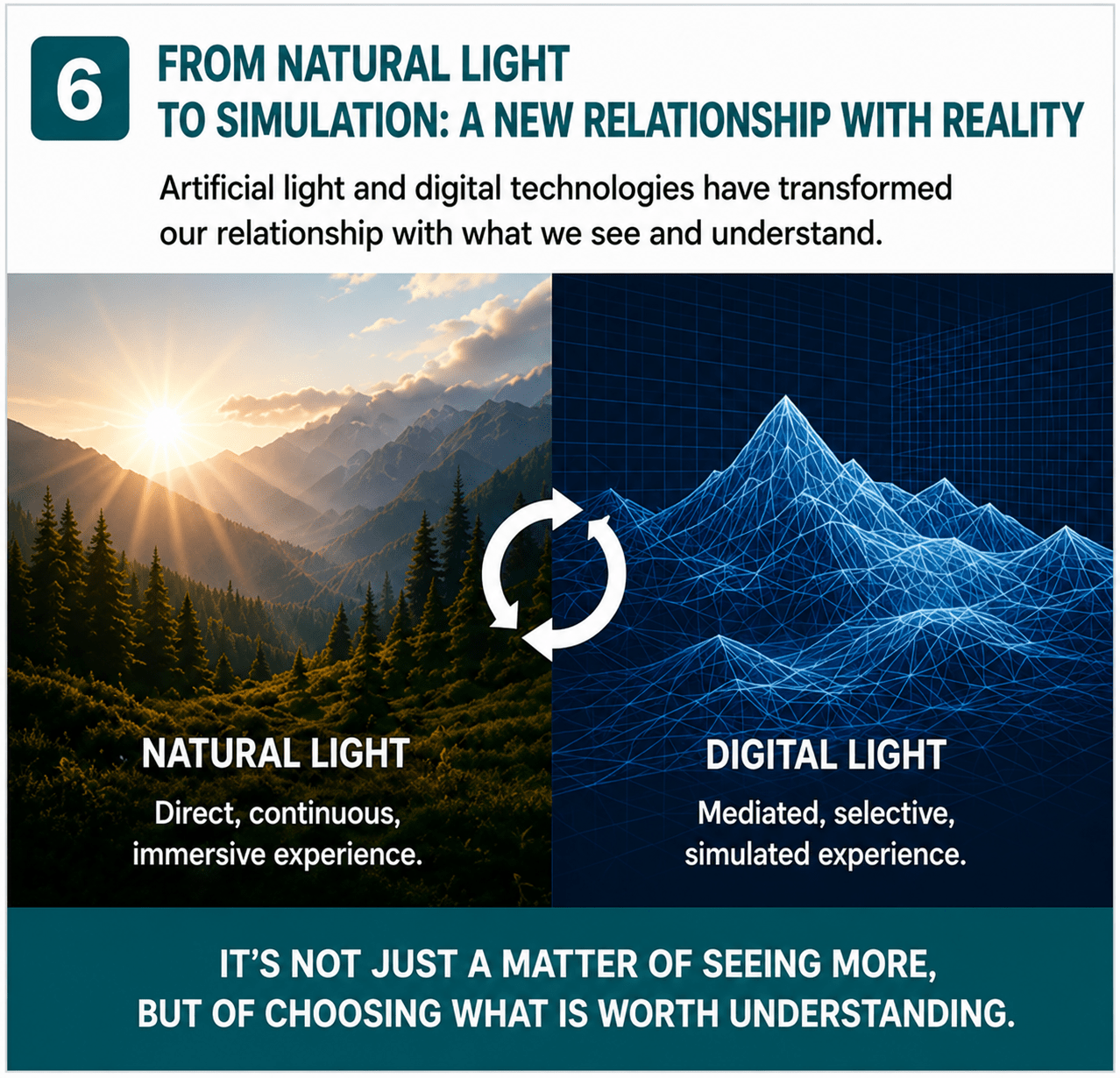
In light of this analysis, we can affirm that in the age of digital enlightenment, the historical coincidence between seeing and understanding has effectively dissolved, or at least been problematized. We have seen, through Merleau-Ponty, that even in natural perception, seeing is a complex act, never reducible to the mere passive reception of data. With Virilio, Flusser, Baudrillard, and others, we have understood how technological mediations of vision have exacerbated this complexity: the abundance of light and images does not automatically make us more aware, rather it can generate the illusion of knowledge (when in reality we are passive spectators) or an overload that annihilates understanding.The light, from a source of clarity, has become in part a language with which you can tell truths but also lies.
However, acknowledging this dissolution doesn't mean falling into pessimism or denying the value of sight. On the contrary, it means demanding a more robust and active way of connecting seeing and understanding. We need to develop what we might call "visual literacy" for the 21st century: knowing how to critically read the light, images, and luminous settings we encounter, a bit like reading a text. This requires education (from knowing how to distinguish an authentic photo from a deepfake, to understanding the psychological effect of a certain colored light in an environment) and perhaps a new relationship with technology. Instead of passively submitting to digital hyper-illumination, we can use it creatively and consciously.
Lighting designers, visual artists and engineers are responsible for building lighting devices and scenarios that amplify understanding rather than reducing it – for example, data visualizations that clarify complex phenomena through light, immersive environments that foster empathy and awareness, and not just sensationalism. Ultimately, the combination experience vs. simulation remains open: light simulations will increasingly become a part of our experiences (just think of telepresence, the metaverse, smart cities), but we will have to continually trace the boundaries of meaning. Understanding will mean, as always in philosophy, going straight to the core: sometimes turning off the screens and observing with the naked eye; sometimes, on the contrary, using advanced visual tools but with a critical eye. The challenge posed by the "digital lighting" is therefore a call for a new form of inner enlightenment: knowing how to see through light, not just what light shows us. Only in this way can we inhabit a world flooded with artificial lights without losing the ability to truly illuminate our minds. In an age where cities shine all night and images accompany us at every moment, rediscovering the distinction between physical seeing and profound understanding is an act of freedom and conscious planning. Light, a powerful and ambivalent medium, can still be an instrument of revelation—but a revelation that is not given once and for all from the outside, but rather actively built from the encounter between our eyes, our culture, and the world. This complex yet fascinating encounter defines the new horizon of lighting design and, more generally, of our existence in the world as visual beings and interpreters at the same time.
In today's era of digital enlightenment, characterized by bright screens, sensors and omnipresent LED sources, a crisis is emerging in the traditional paradigm according to which seeing is equivalent to understanding. For centuries, the light It has been a privileged metaphor for truth and knowledge (the "lights" of reason, spiritual enlightenment): "light presents itself as a metaphor for truth" noted Hans Blumenberg, reflecting on the historical role of this cultural image. Today, however, light no longer functions simply as a neutral means of revelation, but rather operates as cultural and symbolic filter, mediating and shaping our relationship with space, time, and reality. In this text, we will analyze this transformation from a theoretical-scientific perspective, drawing on philosophical and interdisciplinary contributions: from phenomenology of perception in Merleau-Ponty all’ aesthetics of vision by Paul Virilio, from the semiotics of light of Vilém Flusser to the theories of simulation (Baudrillard and others).
We will explore how sophisticated artificial light sources and contemporary visual technologies are altering the human perceptual threshold and blurring the boundary between direct experience and simulation, questioning the immediate equivalence between “seeing” and “understanding”. Finally, we will highlight the implications of these reflections for the contemporary lighting design, where lighting design must deal with new perceptual and cultural responsibilities.
In classical Western thought, light was synonymous with revelation—illuminating something meant making it manifest and intelligible. Plato, in his famous metaphor of the cave, posits sunlight as an emblem of true Being; the eighteenth-century Enlightenment elevated "lights" to a symbol of reason and progress. This conception rests on the idea that view (at least with sufficient light) means accessing an objective truth. However, the twentieth century began to question this immediacy. Light, from a metaphor for truth, has gone refracting in multiple cultural codes: for example in the society of show described by Guy Debord, the abundance of bright advertising and media images ends up mediating and often distorting the direct relationship with reality.
With the advent of digital technologies, the artificial light– from backlit photographs to screen pixels – has transformed into a autonomous language, a filter through which we interpret the world. William Flusser, in his semiotics of technique, observes that technical images (such as photography, literally “writing of light”) are not transparent reproductions of reality but “symbolic abstractions" that obscure their origin: they are often mistaken for direct representations of reality while in reality "encode layers of meaning programmed by the apparatus”. Digital light therefore does not passively reveal the world, but rather actively recreates according to codes just think of photographic filters and post-production processes that alter the light and color of an image to evoke certain emotions, or urban lighting that uses symbolic colors (the red of red-light districts, the Italian flag on a national monument, etc.) to convey cultural messages. Light thus becomes a expressive and selective medium: it highlights certain aspects of reality while obscuring others, it directs the gaze rather than simply enhancing it. This evolution has profound consequences on our relationship with space, time and reality. Space can be shaped by light: internal and external environments take on changing identities with different lighting scenarios (think of immersive installations that use projections to change the volumetric perception of a room). Time itself has been redefined: electric and then digital lighting have progressively abolished the darkness of night, artificially extending the day and enabling continuous 24/7 productivity. As critic Jonathan Crary notes, the erosion of the night for productive purposes accompanies the advance of modern capitalism, breaking down once-insurmountable temporal barriers and completely assimilating natural rhythms with artificial ones. Finally, reality is increasingly mixed with light simulations: we live surrounded by screens and visual interfaces that present a mediated (sometimes manipulated) version of the world, to the point that – as anticipated by Jean Baudrillard – simulacra risk replacing reality, generating a “hyperreality” where the boundaries between true and false, original and copy, become evanescent. In short, in the age of digital illumination, light no longer automatically guarantees cognitive clarity. This shift also implies a transformation in the role of the observer. Perception is no longer a passive reception of visual stimuli but an active process of decoding, shaped by technological systems, cultural conventions, and individual experience. To see, therefore, increasingly means to interpret rather than simply to observe. On the contrary, it creates an overloaded and complex visual environment, within which seeing requires an active effort of interpretation In the following paragraphs, we will explore this concept from various theoretical perspectives, to understand why seeing no longer immediately coincides with understanding, and what challenges this entails.
A first fundamental contribution to question the equation seeing=understanding comes from phenomenology of perception by Maurice Merleau-Ponty. Already in the mid-twentieth century, Merleau-Ponty emphasized that visual perception does not provide “truths like geometry, but rather presences”. In other words, what we see is not a series of objective and univocal data, but a lived, situated and embodied experience: “things present themselves to me and I am present to things, in a mutual implication, through the juncture with the being that is my body”. Perception is therefore a primary act in which subject and object co-belong, and seeing always involves a certain corporeal and existential participation. Merleau-Ponty also highlights the necessarily partial and prospective nature of every vision.
We never see an object in its absolute totality: for example, when I observe a table lamp, I directly perceive only the side facing me, and yet I implicitly perceive the hidden side too, relying on a “wedding ring” in the fact that that side exists. Every visual act therefore implies a beyond unseen – a context, a back, a surrounding world that exceeds what appears frontally. "Perception is my opening, through my limited point of view, to everything that surrounds me", says Merleau-Ponty. This means that seeing is never equivalent to intellectually possessing the object in an exhaustive way, but rather to establishing an evolving, always perfectible relationship with it. Consequently, understanding what one sees is not an automatic given, but rather the fruit of a continuous dialectic between the visible and the invisible, between what appears and what remains implicit.
“My perception of the world is one among many perceptions… it is never a privileged position… There in lies the ambivalence and the enigmatic character of perception" Merleau-Ponty invites us to recognize that every gaze is situated "here and now" (in a body, in a story, in an environment) and that seeing also means interpreting, imagining what is missing, coordinating one's own point of view with that of others. This phenomenological perspective is more relevant today than ever. If already in everyday perception "natural" Seeing was intrinsically ambiguous and required an act of embodied understanding. In the contemporary context of digitally mediated realities, this ambiguity is amplified. Images on screens do not fully engage our bodies as direct experience would; therefore, we risk losing the sensorial and situational anchoring that Merleau-Ponty considered essential to understanding the world. The phenomenological lesson therefore reminds us that to understand what we see—whether digital or real—always requires an effort at perceptual integration: placing the image in context, reconstructing its hidden aspects, comparing it with other possible perspectives.View it is never a purely optical act, but is imbued with intentionality (direction of sense) and pre-reflective interpretation in the digital age, recognizing this complexity becomes crucial to avoid mistaking luminous appearances for immediate understanding.
If Merleau-Ponty has shown the original ambiguity of the vision, the philosopher and urban planner Paul Virilio analyzed how the vision technologies modern ones have taken this ambiguity to the point of paradox. Virilio introduces concepts such as dromology (logic of speed) and speaks of an aesthetics of disappearance: in the age of electronic media, what is hyper-visible ends up disappearing from critical consciousness. His emblematic warning is that "First of all, you shouldn't believe your eyes.” – a provocative statement that turns the popular saying on its head “seeing is believing”. By this, Virilio means that the supposed neutrality and objectivity of the technologically enhanced gaze is fallacious: the images produced by devices (cameras, satellites, screens) carry with them the shadows of the ideologies and programs that generate them. It is therefore necessary to develop an active suspicion of the immediately visible, because it often hides more than it reveals.
One of Virilio's key ideas is that the overabundance of images and visual information in the contemporary world leads to a form of light blindness. In The Negative Horizon he states:"Today we are no longer truly seers but already re-seeers; the tautological repetition of the same object, at work in our mode of production (industry), is also at work in our mode of perception. We spend our time and our lives contemplating what we have already contemplated: ... our habitat is built on redundancy."
This incisive passage describes a state of recursive vision, in which the media incessantly present us with variations of the same thing (the same visual stereotypes, the same formats, the same rehashed news), generating habituation. The result is an audience of "reviewers," who believe they're always seeing new things but in reality re-see what's already known and packaged, losing the capacity for a fresh and truly perceptive gaze. Knowledge risks stagnating in a self-referential bubble of redundant images: we see more, but we understand less because visual stimulation no longer activates surprise or critical thinking. Virilio closely links this visual saturation to the instantaneous speed of digital communications.
In the era of “real time” and the ubiquity of light flows, our perceptions are “transfigured by media and digital technologies, with the aim of instantly presenting everything that is worth observing”. He speaks in this regard of a “telecommunication enlightenment,” ironically mocking the new dogma that having everything immediately visible (thanks to computer networks operating at the speed of light) is automatically a good thing. In reality, this dromological compression of space and time entails serious side effects: “to see better we risk handing this task over to technological vehicles”, delegating human perceptive faculties to vision machines (from surveillance systems to augmented reality viewers). The paradox is that, in the attempt to see everywhere and always, we end up seeing less: by relying on devices, the human eye becomes unaccustomed, lazy, and the excess of visual stimuli leads to a form of cognitive blindness. Virilio in fact underlines how the opposite extreme of total transparency is disappearance: when everything is illuminated without intervals, nothing actually stands out anymore and our attention is zeroed.
This "aesthetic of disappearance" also manifests itself at the social and political level: events that once would have provoked shock or reflection (disasters, wars) today, hyper-visualized by the media, scroll across screens like fast-paced spectacles, leaving no deep understanding. It is no coincidence that Virilio has studied the "logistics of perception" in modern conflicts, showing how mediatized war becomes a video game in which horror is aestheticized and distanced from the spectator. This de-responsibilization through fast-paced images is linked to the dissolution of seeing = understanding: you can witness even terrible scenes on live TV or streaming, without really understanding its meaning or moral implications, because the way it is enjoyed (fast, repetitive, spectacular) anesthetizes judgment.
In short, the aesthetics of vision according to Virilio warns agains illusion of omnivision provided by digital technology. He suggests that, contrary to what was once thought, more light and more images do not automatically lead to greater knowledge—indeed, they can erode the ability to discern. Virilio's reflection forces us to ask: What does it really mean to “see” in the age of digital media? It is still an authentic encounter with reality, or more and more a mediated act in which we risk being passive and manipulated? To recover the dimension of understanding, perhaps we need to "slow down" our gaze, reintroducing shadows and silences into the visual experience, as an antidote to the excessive light that blinds.
A further theoretical piece to understand the separation between seeing and understanding in the digital context is offered to us by William Flusser, thinker who has thoroughly investigated photography and technical-media images. Flusser starts from the observation that, with the invention of photography first and then of electronic media, humanity has delegated the production of images to automatic devices (cameras, video cameras, computers) equipped with programs. This has radical consequences on the status of images and therefore on our way of seeing the world. In his Philosophy of Photography, Flusser states that photographs (the prototype of technical images) are coded two-dimensional surfaces: they appear as luminous traces of reality, but in reality they are built according to algorithms and intentions inscribed in the device. The common mistake is to take these images as transparent windows on the world, while instead they should be read as texts, as symbols that require interpretation. Flusser notes that "few know how to decode them critically" and this generates a sort of "photographic illiteracy”: everyone takes and looks at photos, believing they understand reality thanks to them, but in reality they are subjected to their hidden program.
This analysis is directly linked to the theme “seeing vs. understanding according to Flusser, in the era of technical images, a false sense of security has crept in that seeing an image is equivalent to knowing what it represents, while in reality images can lie or, more precisely, they can simulate a non-existent reality. Here the echo with the theories of Baudrillard it's strong: Baudrillard coined the term simulacrum to indicate a copy without an original, a sign that no longer refers to an underlying reality but only to other signs.
In the condition of hyperreality, “images no longer reflect reality but instead generate their own self-referential world”. A clear example today are the images generated by Artificial Intelligence machine learning algorithms can create ultra-realistic photos of people or places that don't actually exist at all. These synthetic images often they appear more real than reality, easily deceiving the human eye. We are thus faced with visual simulationsSo refined that they can provoke real emotional or decision-making reactions, despite lacking a physical reference. This brings the problem to its climax: if we see a face in a photo (perhaps shared by a media outlet), we instinctively tend to believe that face exists, that it corresponds to a real person—after all, "I saw it with my own eyes." But in the age of deepfakes and advanced rendering, this seeing-understanding (as true) nexus is completely unreliable. Understanding now requires a greater critical effort we must ask ourselves who produced that image, with what means and intentions, and what program lies behind it.
Flusser would say that we need to decode images, not just look at them passively. On the level of semiotics of light, we can say that digital light has taken on a more symbolic than indicative if natural light illuminated the world to show it to us as it is, electronic light often reconstructs it symbolically: think of the difference between looking at a landscape in person and looking at that same landscape photographed and filtered on a screen. In the second case, the colors, the contrast, the framing—all elements of controlled light—already convey a narrative, an interpretation. The backlit image on the screen is not a neutral mirror of the world, but a discourse about the world. And like any discourse, it can be true or false, banal or profound, informative or manipulative digital light It is therefore intrinsically hermeneutic: it must be interpreted.
A further contribution also comes from the reflection on society of the spectacle and contemporary visual culture Susan Sontag, in On Photography, already noted how continuous exposure to images (of wars, disasters, etc.) risks desensitizing the spectator, transforming real events into consumable spectacle. Guy Debord, for his part, denounced that in the mediatized society "everything that was directly experienced has moved away into a representation”, implying that immediate experience (which alone generates genuine understanding) is replaced by a flow of prefabricated representations. In this context, seeing is not enough: we need to recover an engagement with reality that the image alone cannot provide.
In summary, Flusser's semiotics of light and Baudrillard's theory of simulacra show us a world in which bright appearances can be deceiving, in which sight must be trained as reading is trained, and in which the presence of light does not automatically imply the presence of truth. This does not mean adopting a paranoid attitude or denying the value of images, but recognizing that understanding requires going beyond the first glance: we need to contextualize images, verify them, and interpret their symbols and cultural codes. Only in this way can seeing regain cognitive depth, rather than remaining a superficial act. In the next section, we will see how this dynamic manifests itself concretely with modern light and visual technologies.
Technological evolution in the field of lighting and display has led to devices and light sources of unprecedented sophistication: ultra-high definition screens, virtual and augmented reality, holographic projectors, dynamic LEDs capable of modulating color and intensity instantly, lasers and optical fibers in architecture, etc. These advances have greatly extended the boundaries of what can be shown through light, raising questions about the relationship between sensitive perception ed experience of reality in particular, we often talk about the perceptual threshold: the limit within which a light stimulus appears plausible or acceptable to the human senses. New technologies tend to push this threshold higher, creating sensory simulations so vivid that they compete with (or sometimes exceed) natural experience.
An emblematic example is the Virtual Reality (VR) Immersive. Wearing a VR headset, the user is surrounded by bright stereoscopic images that respond to their movements: the illusion of being in an alternate space can become extremely strong. If the simulation is accurate enough in terms of visual quality (resolution, frame rate, field of view) and consistent with other sensory cues, the brain can be tricked into reacting as it would in a real situation. For example, looking in VR from the top of a virtual skyscraper, many people experience real dizziness and sweating, even though they rationally know they are in the living room: the perceptual threshold of their visual-equilibrium system has been stimulated beyond its limit, providing an experience of fear identical to the “real” one.
This illustrates how to see something convincingly (thanks to the sophistication of digital light) can evoke authentic reactions and emotions, challenging the distinction between direct experience and artificial simulation. We are forced to ask ourselves: if a light simulation is indistinguishable from reality to our senses, how does the resulting experience differ? And above all, how can we correctly understand this experience? A meta-perceptive level, an awareness of the context (for example: "I know it's a virtual environment, so there's no real danger") is needed to integrate the sensorial aspect with actual reality. Again, seeing alone is not enough; an additional act of reflection is needed to avoid mistaking illusion for reality.
Even outside of VR, the artificial light sources are altering our daily perception. Think of the urban night lighting modern cities, with brightly lit city centers and giant advertising screens, create a simulated nightscape where it's always "like daytime." The human eye, adapted for millennia to the natural alternation of light and dark, finds itself in an environment of perpetual artificial dimness that confuses circadian rhythms and the very perception of time (the hours of night lose their visual identity). Light pollution it eliminates natural darkness and even the view of the stars, altering not only the ecosystem but also our existential experience of the night. In other words, the powerful technical light doesn't just extend vision – reconstructs the context in which the vision occurs, creating a new perceptual "normality". Another case is that of the high dynamic range (HDR) displays and advanced imaging technologies in cinema and television. Thanks to LEDs and lasers, these systems can reproduce light intensities and contrasts far superior to those of old screens, approaching the range of luminances found in nature (for example, the sun's glare on water, or deep shadows in bright light).
The effect for the viewer is a sensation of augmented reality, of a "transparent window" onto the film world. But some scholars note that HDR also produces a hyperrealism sometimes strange: we see more detail and brightness than we would perceive with the naked eye in reality (since the human eye has adaptation mechanisms that the film can bypass by showing everything sharp at the same time). This hyper-visibility can paradoxically recall Baudrillard's simulacra: a "truer than true" which, however, is not reality, but rather a technical construction. Once again, we are faced with light as a symbolic filter: the director or designer decides which details to illuminate perfectly and which not, guiding our understanding of the scene. It is up to us spectators to recover a critical attitude so as not to passively absorb the shimmering image.
Finally, let's consider the impact of dynamic and intelligent lights in architecture and lighting design today, it's possible to program lighting systems that change color, intensity, and configuration in real time, perhaps reacting to the presence of people or the time of day. This allows you to transform the atmosphere of a space with the push of a button: a room can switch from cool, bright tones (stimulating, energizing) to warm, soft lights (relaxing) depending on your needs, almost simulating different environments in the same physical space. This has enormous design potential, but it also requires awareness. Human perception it can, in fact, be guided or manipulated by lighting design: for example, colored lights in a shopping mall can make items appear more appealing, or dramatic lighting in a tourist city can simulate a historical atmosphere that obscures the ordinary reality of those places. The most attentive lighting designers also integrate reflections on the meaning conveyed by light into their projects.
Lighting designer Susanna Antico, for example, observes that the use of dynamic white light (i.e. lighting capable of varying shades of white) in a project for a cathedral would have allowed change the perception of the building depending on the moments and functions: a colder and more severe light to convey solemnity on certain occasions, or a warmer and more welcoming light on others, "conveying a message on a sensorial level" and giving added value to the visual experience of the monument. This testimony highlights how in contemporary lighting design light is designed not only to show but to communicate and bring to life certain qualities of space the designer must therefore understand how people interpret that light: once again, the dimension of understanding becomes central, as opposed to mere physical sight. Well-designed lighting aims to ensure that the user perceives a space in a manner consistent with its function and identity (e.g., a museum with neutral, diffused light to encourage concentration on the works, vs. a restaurant with warm accent lighting to create intimacy). This involves studying the psychology of perception, visual culture, color semiotics, etc. Modern lighting design is therefore a field where art, science, and philosophy meet: it is necessary to exploit technology (LEDs, digital controls) while maintaining theoretical and ethical coherence in the use of light, so that the end user is not disoriented or deceived, but can enjoy an enriching and authentic experience.
In light of this analysis, we can affirm that in the age of digital enlightenment, the historical coincidence between seeing and understanding has effectively dissolved, or at least been problematized. We have seen, through Merleau-Ponty, that even in natural perception, seeing is a complex act, never reducible to the mere passive reception of data. With Virilio, Flusser, Baudrillard, and others, we have understood how technological mediations of vision have exacerbated this complexity: the abundance of light and images does not automatically make us more aware, rather it can generate the illusion of knowledge (when in reality we are passive spectators) or an overload that annihilates understanding.The light, from a source of clarity, has become in part a language with which you can tell truths but also lies.
However, acknowledging this dissolution doesn't mean falling into pessimism or denying the value of sight. On the contrary, it means demanding a more robust and active way of connecting seeing and understanding. We need to develop what we might call "visual literacy" for the 21st century: knowing how to critically read the light, images, and luminous settings we encounter, a bit like reading a text. This requires education (from knowing how to distinguish an authentic photo from a deepfake, to understanding the psychological effect of a certain colored light in an environment) and perhaps a new relationship with technology. Instead of passively submitting to digital hyper-illumination, we can use it creatively and consciously.
Lighting designers, visual artists and engineers are responsible for building lighting devices and scenarios that amplify understanding rather than reducing it – for example, data visualizations that clarify complex phenomena through light, immersive environments that foster empathy and awareness, and not just sensationalism. Ultimately, the combination experience vs. simulation remains open: light simulations will increasingly become a part of our experiences (just think of telepresence, the metaverse, smart cities), but we will have to continually trace the boundaries of meaning. Understanding will mean, as always in philosophy, going straight to the core: sometimes turning off the screens and observing with the naked eye; sometimes, on the contrary, using advanced visual tools but with a critical eye. The challenge posed by the "digital lighting" is therefore a call for a new form of inner enlightenment: knowing how to see through light, not just what light shows us. Only in this way can we inhabit a world flooded with artificial lights without losing the ability to truly illuminate our minds. In an age where cities shine all night and images accompany us at every moment, rediscovering the distinction between physical seeing and profound understanding is an act of freedom and conscious planning. Light, a powerful and ambivalent medium, can still be an instrument of revelation—but a revelation that is not given once and for all from the outside, but rather actively built from the encounter between our eyes, our culture, and the world. This complex yet fascinating encounter defines the new horizon of lighting design and, more generally, of our existence in the world as visual beings and interpreters at the same time.
Other Lighting Post
Other Lighting Post
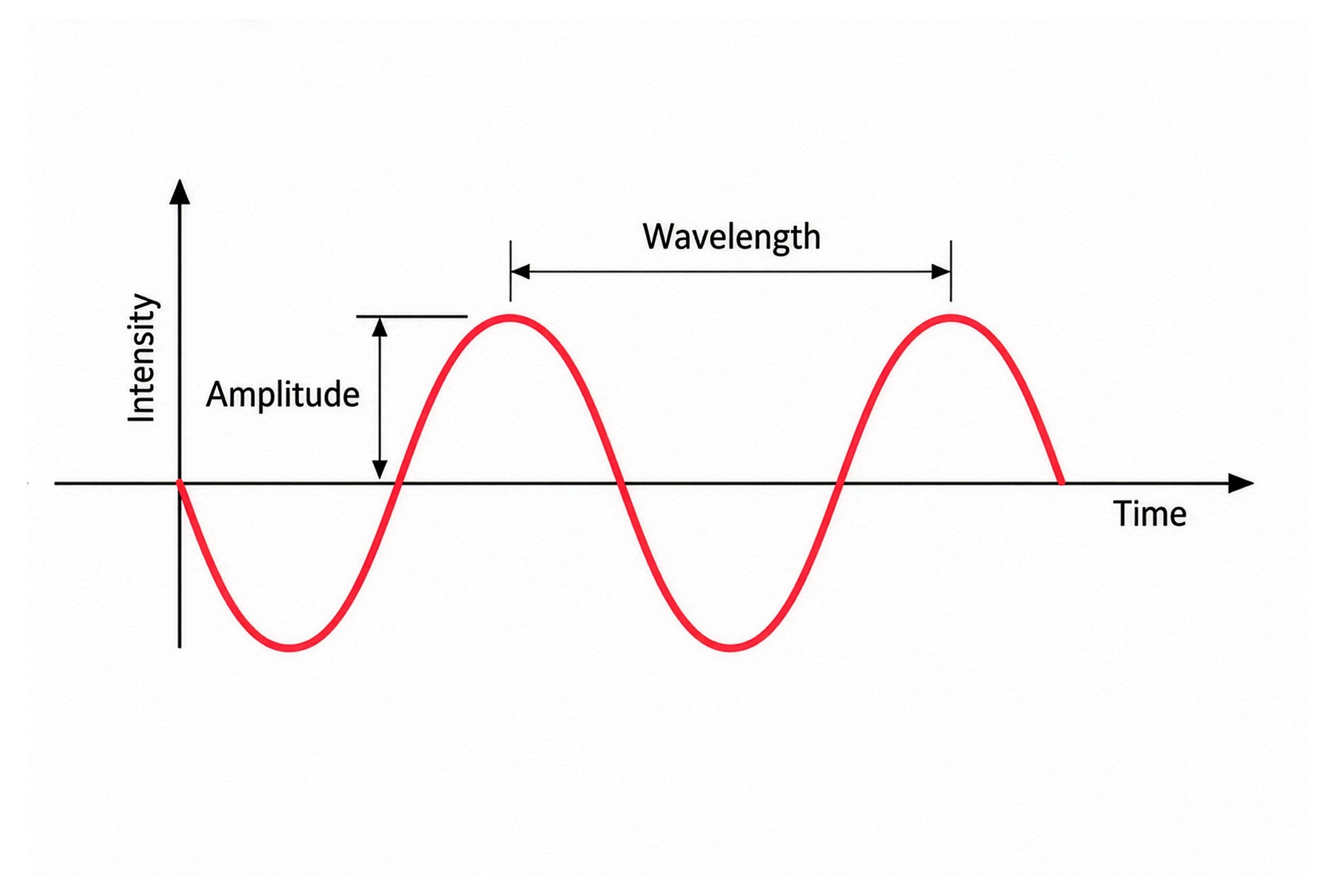
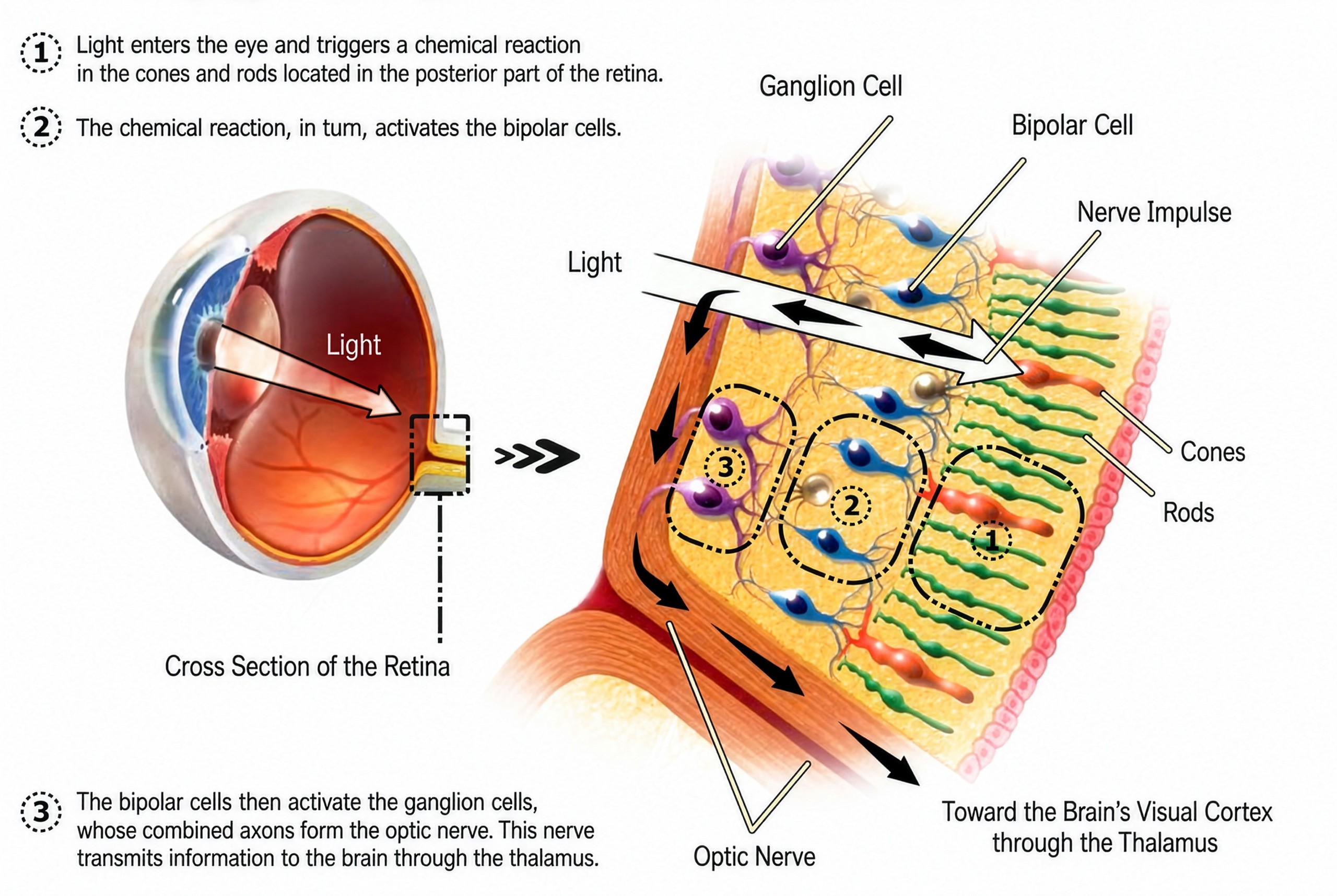
This section brings together a comprehensive body of theoretical, scientific, and design insights into the theory of light applied to lighting design, systematically addressing the complex relationship between light, visual perception, and spatial design. The content develops the physical foundations of light, an understanding of the mechanisms of human vision, the differences between photopic and melanopic illuminance, and the biological impact of artificial light, integrating advanced metrics and contemporary interpretation criteria.
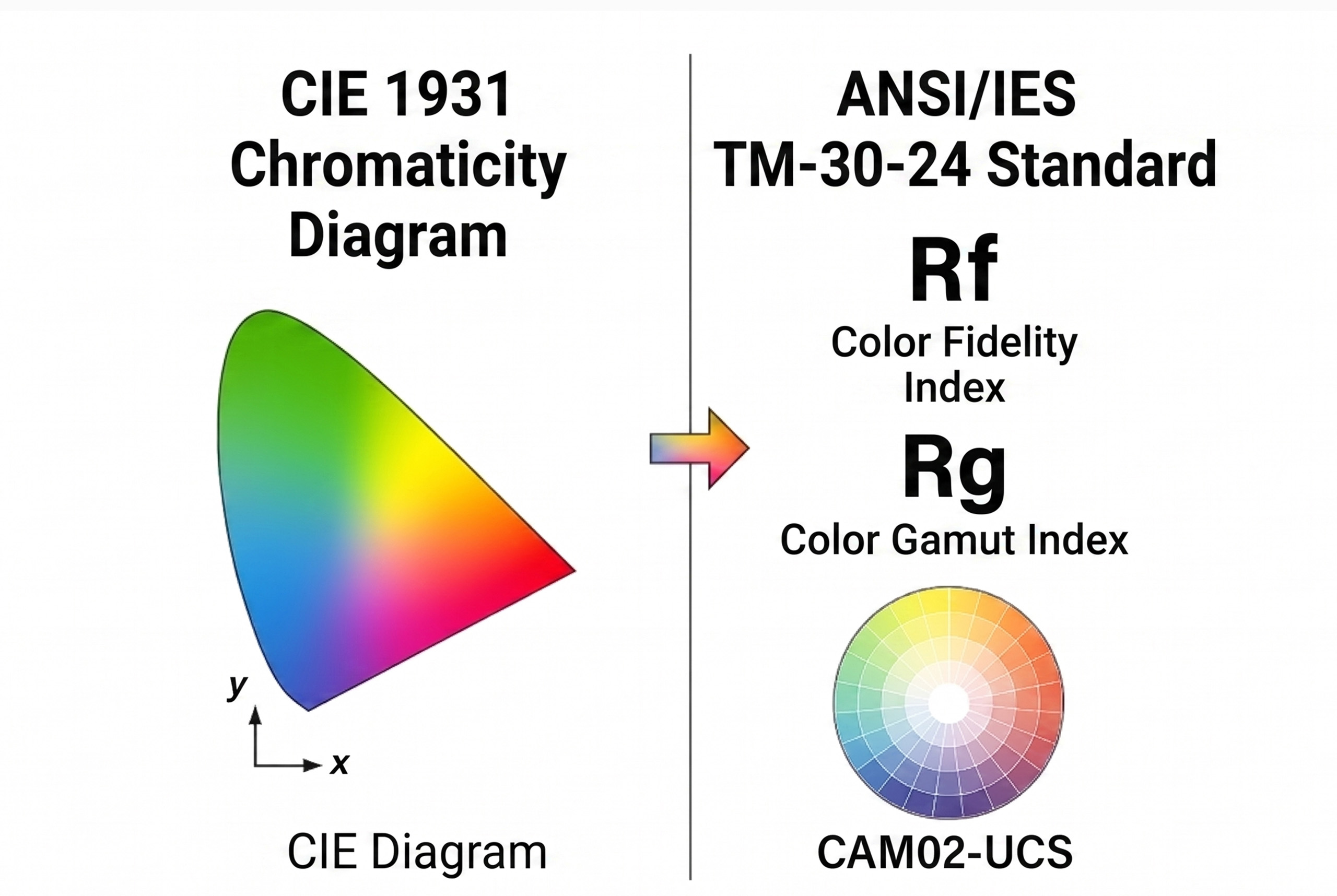
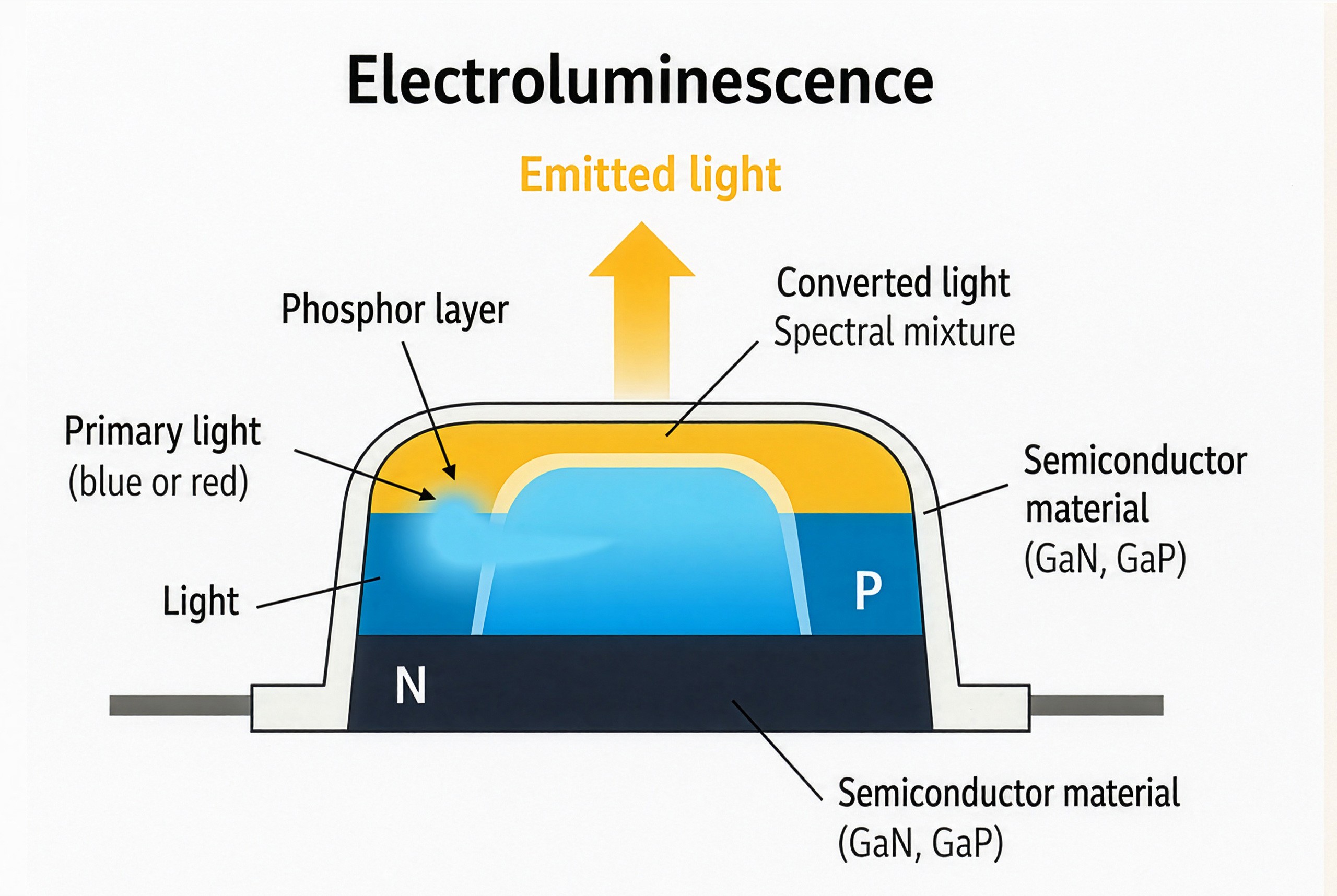
The page also explores the functioning of LED sources, the spectral and perceptual implications of solid-state light, the evolution of color rendering criteria, and the growing role of light as an informational and perceptual system, capable of influencing behavior, comfort, and the quality of spatial experience.
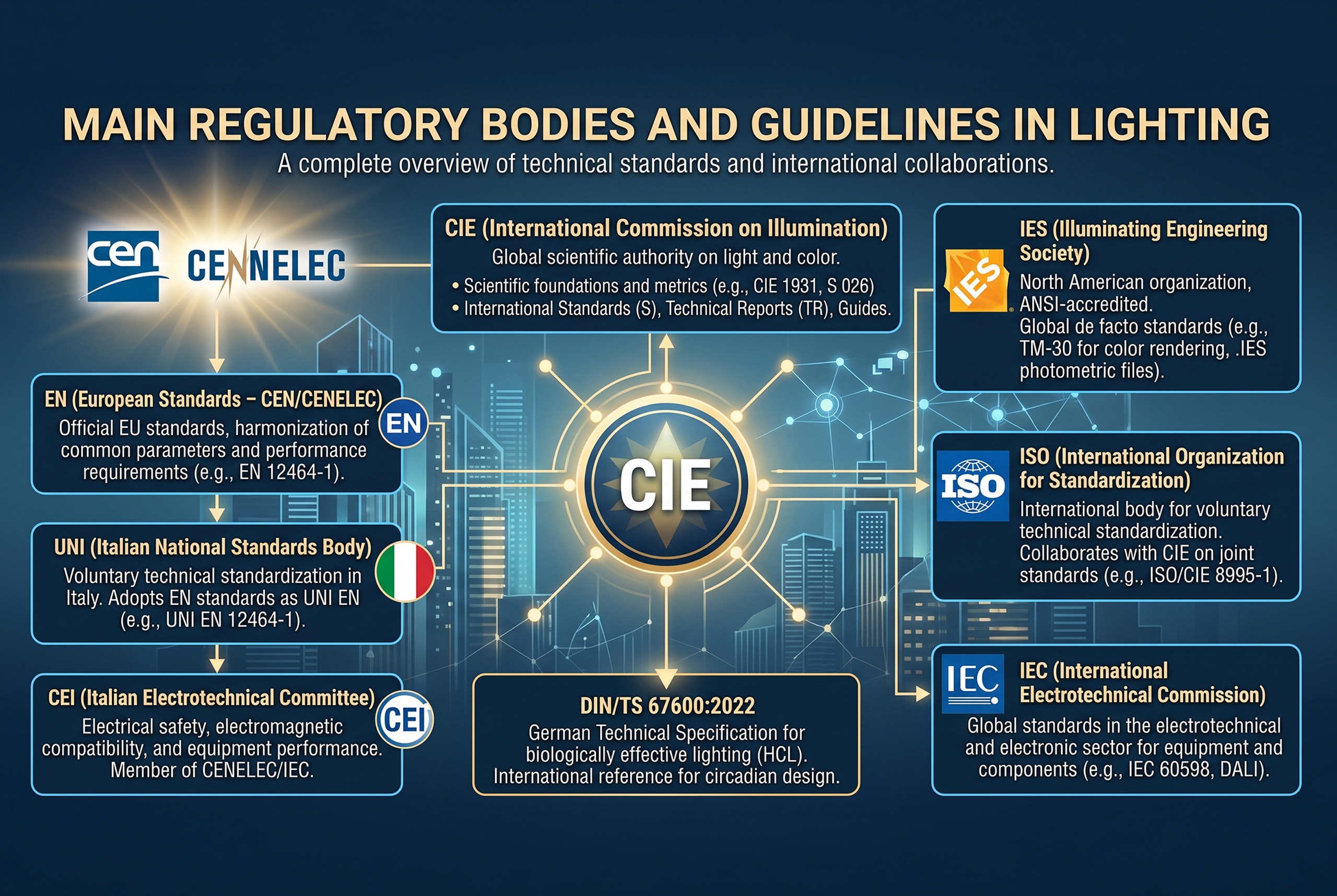
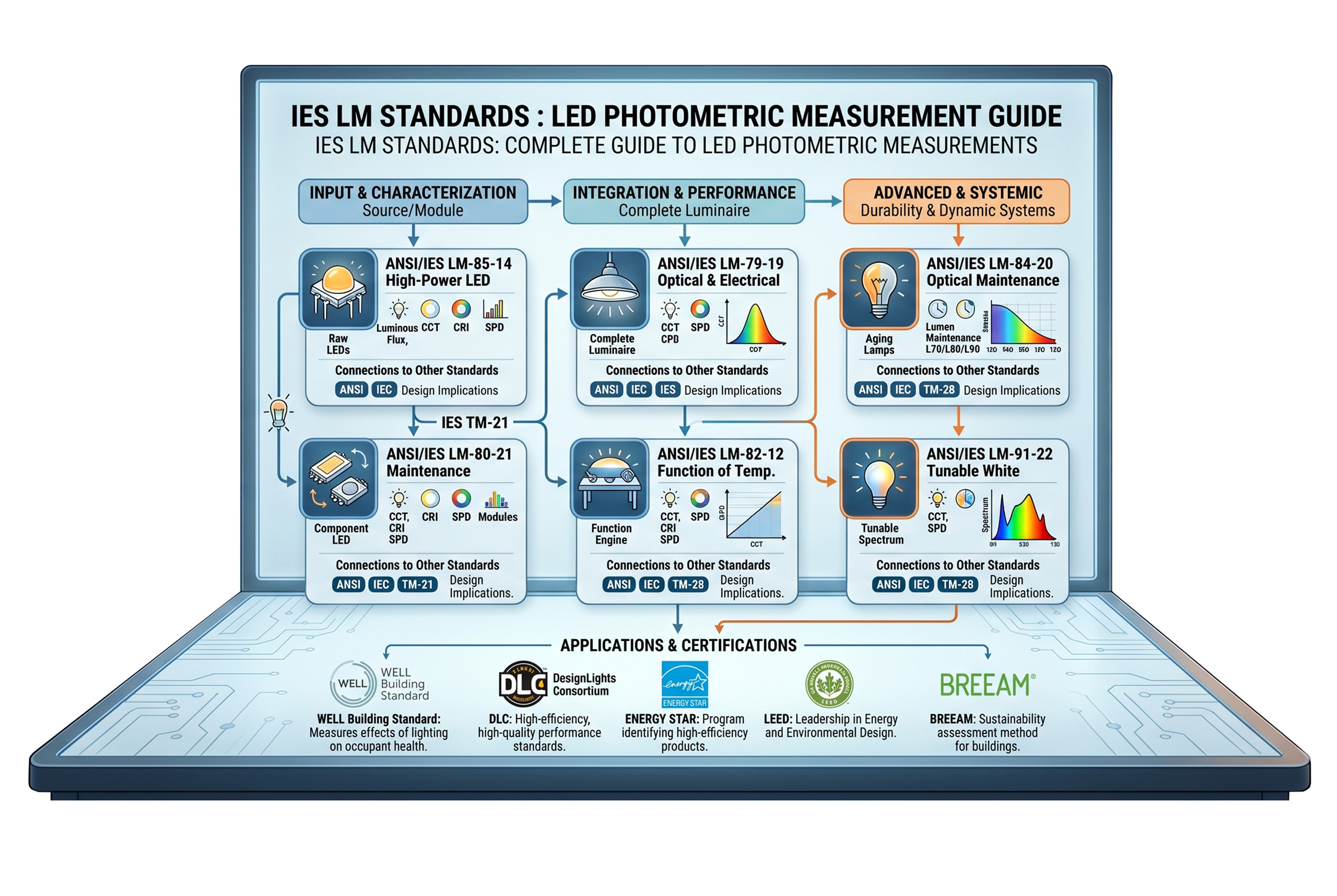
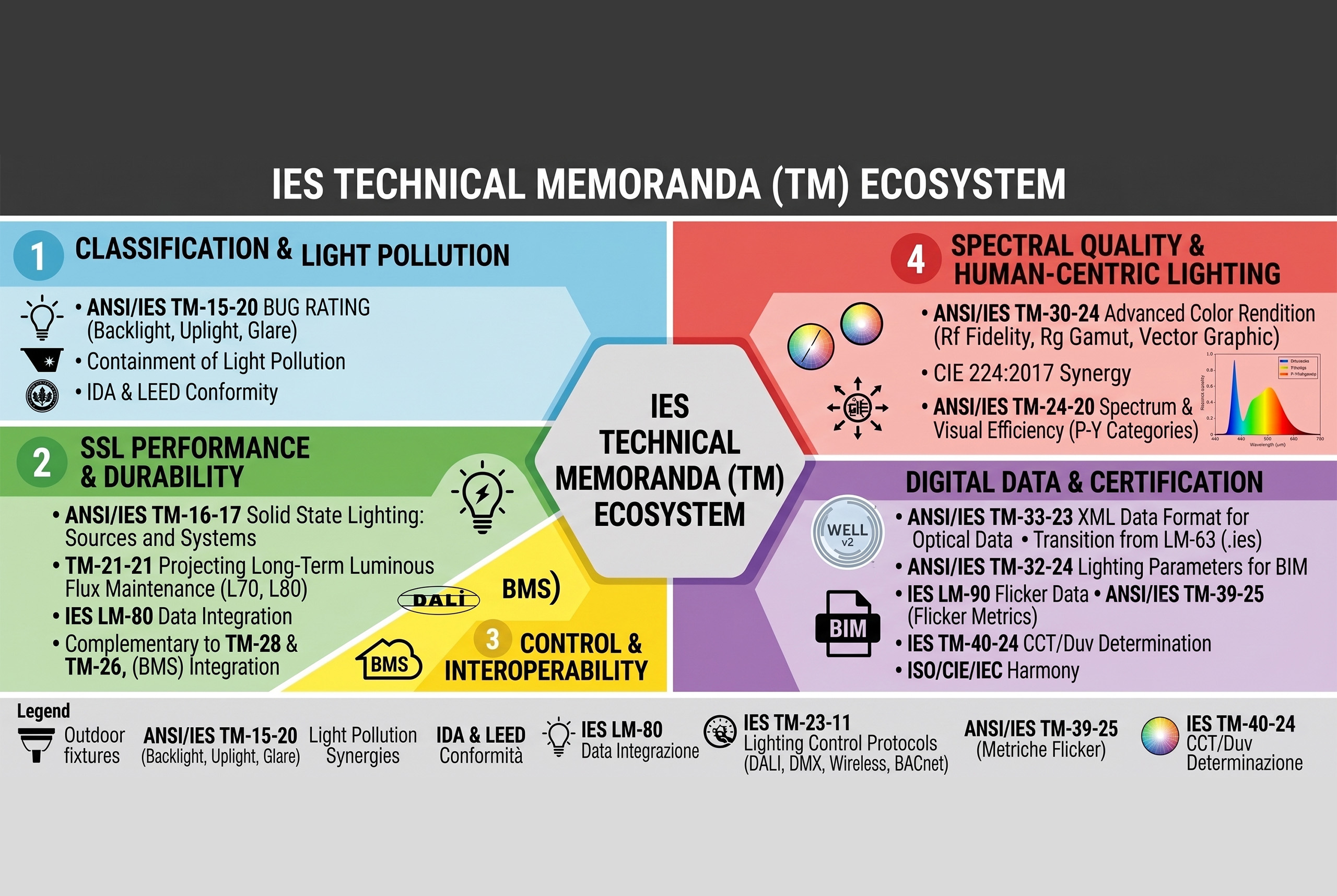
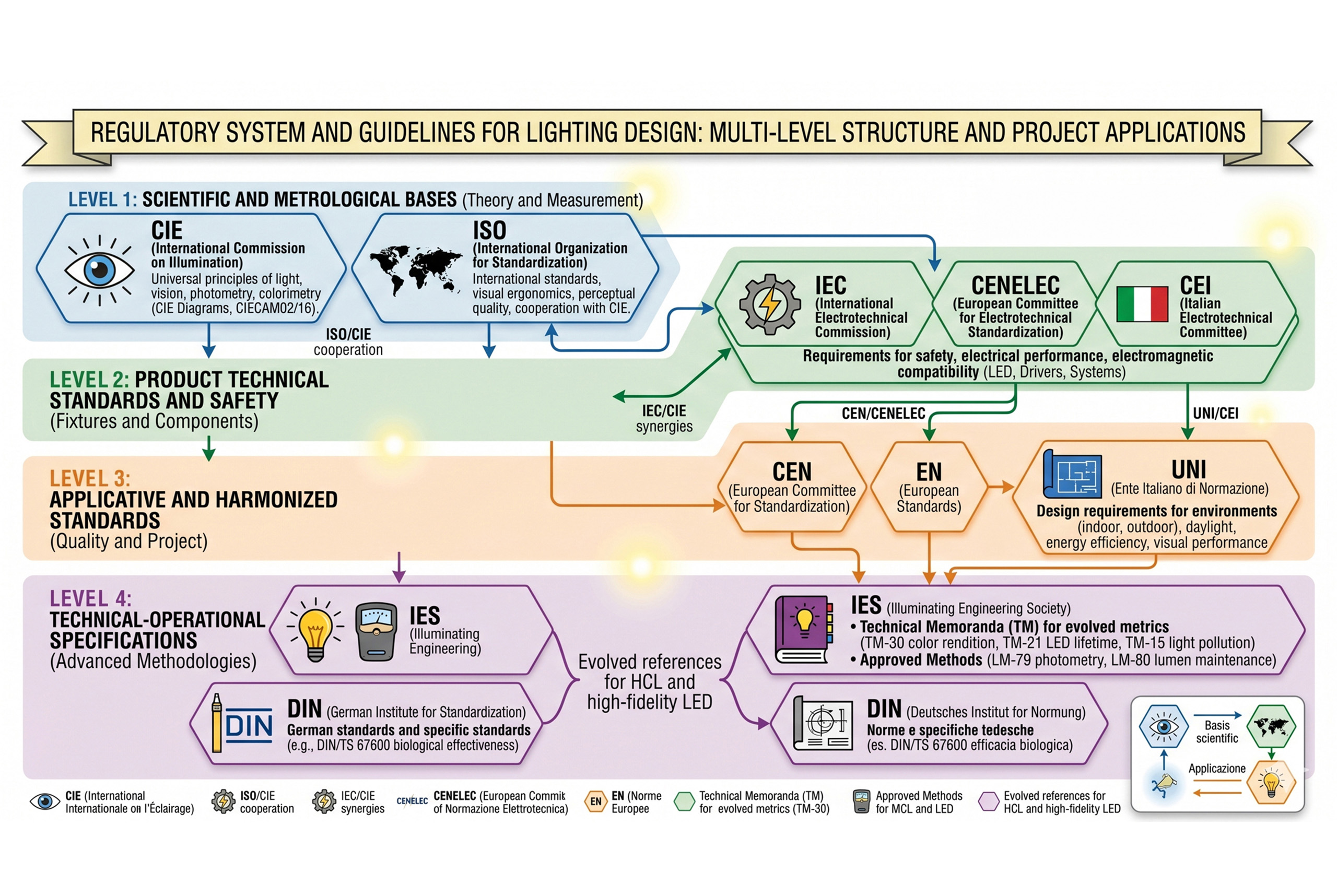
Ample space is dedicated to the relevant regulatory and technical framework, international standards, sustainability protocols, and control systems, understood as essential tools for rigorous, measurable, and consistent design.
Overall, the section provides a vision of the theory of light as the cultural and operational basis of lighting design, in which scientific knowledge, perceptual awareness, and design method converge to guide the lighting designer in the construction of balanced, legible, and qualitatively significant spaces.
This section brings together a comprehensive body of theoretical, scientific, and design insights into the theory of light applied to lighting design, systematically addressing the complex relationship between light, visual perception, and spatial design. The content develops the physical foundations of light, an understanding of the mechanisms of human vision, the differences between photopic and melanopic illuminance, and the biological impact of artificial light, integrating advanced metrics and contemporary interpretation criteria.
The page also explores the functioning of LED sources, the spectral and perceptual implications of solid-state light, the evolution of color rendering criteria, and the growing role of light as an informational and perceptual system, capable of influencing behavior, comfort, and the quality of spatial experience.
Ample space is dedicated to the relevant regulatory and technical framework, international standards, sustainability protocols, and control systems, understood as essential tools for rigorous, measurable, and consistent design.
Overall, the section provides a vision of the theory of light as the cultural and operational basis of lighting design, in which scientific knowledge, perceptual awareness, and design method converge to guide the lighting designer in the construction of balanced, legible, and qualitatively significant spaces.