HOME / News / Light + Building 2018

Light design mitic suspension - led lightsing design

Light + Building 2018

Frankfurt (18 March 2018 - 23 March 2018)

DESIGN SHEET
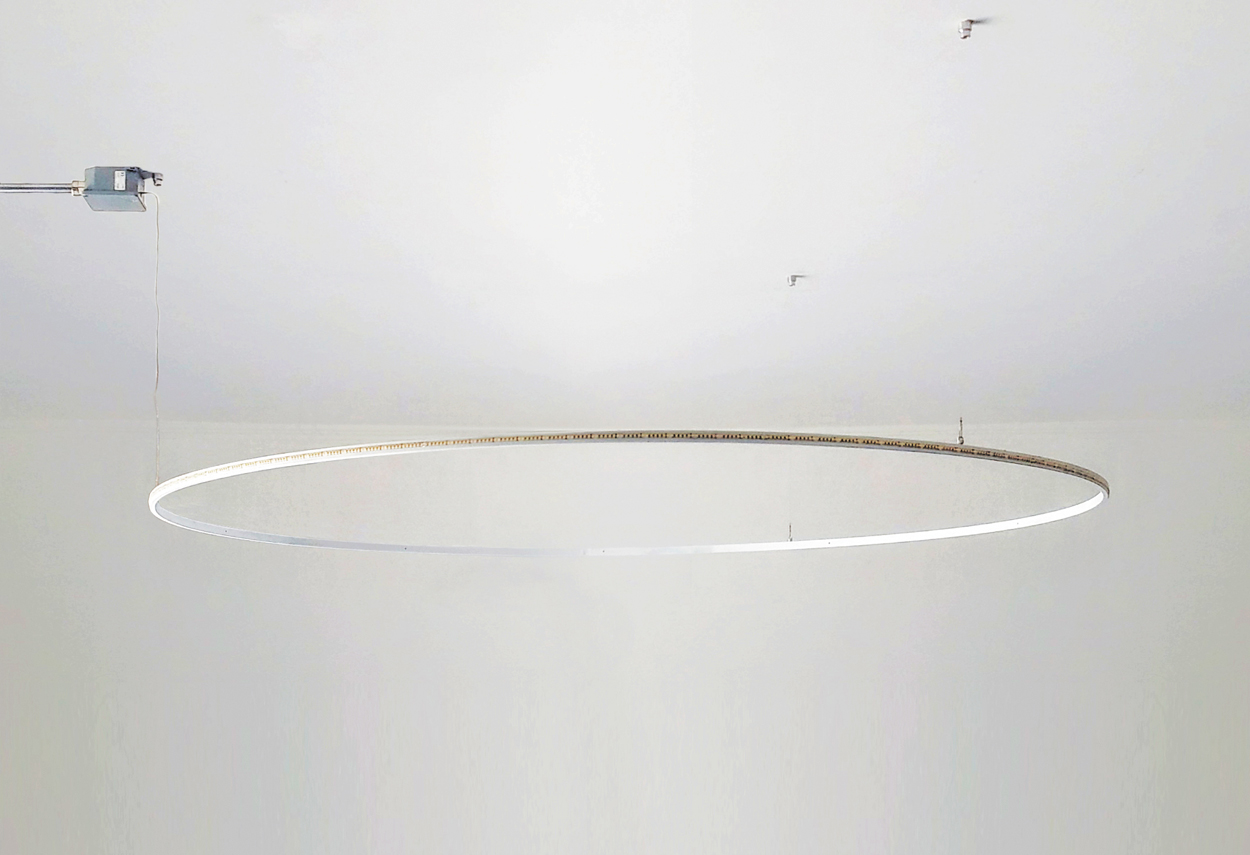
Indirect Lighting devices for wall or suspension applications. Monocromatic LED source, homogeneous and comfy light output.
5,3 meters Glazed-Iron-Bar. Remote control power-supply.
Lighting source: LED 250W
Dims: Ø1700 mm
2017 | Lighting Device | Mitic

RETAIL SHEET
The round shape has a sort of resilient magnetic power catching the viewer's eye. The Disk is a shape that convey dynamism; its topology recalls a perfect and changeless motion, no beginning and no end, an unaltered light similar to one that is created by this lamp.  They all come by the idea of emptiness, evoking the chrome rims of the cars to be sold at the trade show. It is given the space a shape with the use of light, thus becoming a symbol and an icon of Miticauto.
2017 | Italy | Colleferro | Miticauto Showroom

Team members:
Designer: Marco Petrucci
Architect: Riccardo Follaro
Technical Drawing: Francesco Idini
Engineering and production: G.R.A.M. snc of Antonio and Maurizio Rosamilia
Clients: Miticauto of Simone Petrucci


Photo courtesy:
Marco Petrucci

Leave a Comment

Other Masters

This section pays tribute to the great masters of design, protagonists of creative journeys capable of transcending time and engaging with different cultural, social and technological contexts. Their works strike a balance between memory and innovation, between the rigour of architectural history and the drive towards new forms of expression, offering insights that remain relevant on how spaces are conceived, built and experienced.
Through the telling of their personal stories and the analysis of their most representative projects, a wealth of ideas, insights and visions emerges that continues to influence the present. Each master thus becomes a privileged vantage point for understanding how design responds to human needs, interprets societal changes and knows how to transform technical and cultural constraints into creative opportunities.
These paths are not only witnesses of the past but also tools for questioning the future. The topics addressed — from the evolution of formal languages to the relationship with technology, from the quality of spatial experience to environmental responsibility — outline constantly changing scenarios, in which design proves to be a living discipline, capable of renewing itself without losing connection to its roots.

MENU