To fully understand the criteria for assessing the energy performance of lighting systems, as in the case of the LENI indicator defined by the EN 15193-1:2017+A1:2021 standard, it is necessary to dwell on the physical and electrical bases that regulate the production of artificial light. In fact, each lighting system is the result of a transformation of electrical energy into light radiation, and the associated energy consumption depends directly on the way in which this conversion takes place.
Although the most commonly used energy parameter in design is the watt (W) – understood as a measure of the power absorbed by a luminaire – it is important to clarify that there is no direct correspondence between the watts consumed and the amount of light emitted. The relationship between electrical power and light output is mediated by the conversion efficiency of the system, i.e. the number of lumens produced for each watt absorbed (lm/W). This ratio, known as luminous efficiency, is a fundamental indicator for evaluating the performance of a source.
In the context of contemporary lighting design, which aims to reduce specific energy requirements while maintaining adequate levels of visual and biological comfort, it is essential to know not only the amount of light needed, but also how it is generated and how efficiently it is generated. This involves the analysis of the main electrical quantities involved in the operation of the luminaires: current (A), voltage (V), resistance (Ω) and power (W), according to the laws of classical electrical engineering.
To consciously and efficiently approach the design of a lighting system, it is not enough to consider the basic electrical quantities in isolation: it is necessary to understand their functional relationships within the circuit, especially when using solid-state sources such as LEDs, which require a controlled and stable power supply. In this context, the concrete application of the fundamental laws of electrical engineering, such as Ohm's law, makes it possible to accurately predict the behavior of the system, evaluate losses and correctly size each component. These relationships also derive the formulas for calculating electrical power, an essential tool for translating theoretical design into real energy efficiency.
Ohm's law and the derived formulas for calculating electrical power are essential basic tools for understanding the interaction between circuit components and their impact on consumption. In addition, in modern lighting systems, especially those based on LED technology, additional parameters such as the power factor (PF) come into play, which expresses the electrical efficiency of the system in terms of energy actually used compared to circulating energy. A high PF value (ideally close to 1) indicates a well-balanced system, capable of reducing dispersion and reactive load on the grid.
The introduction of concepts such as luminous flux (lumens), luminous efficiency (lm/W) and power factor makes it possible to overcome the traditional approach based solely on watts, promoting a more advanced and integrated vision of lighting design. In this perspective, the energy consumption measured by the LENI should not be understood as a simple sum of watts (Wh), but as the result of a complex system, in which sources, luminaires, controls and conditions of use must operate in synergy to ensure maximum efficiency, visual comfort and sustainability.
Artificial light is the direct result of the transformation of electrical energy into visible radiant energy. This apparently simple process is actually governed by complex physical laws involving both electrical and photometric parameters. To understand how it works, it is essential to start from the definition of electrical power, i.e. the amount of energy consumed by a device to generate a certain effect, in this case light emission.
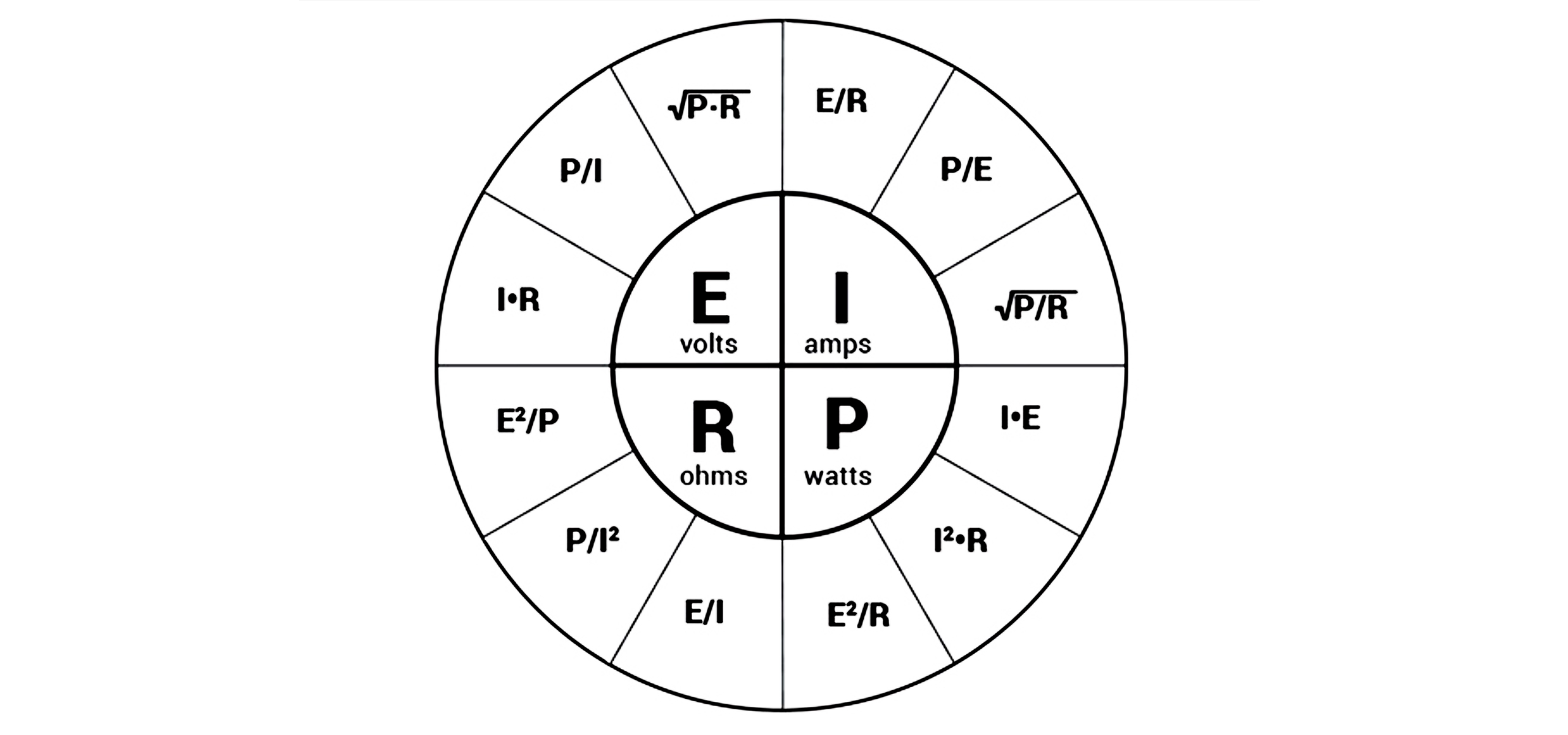
The proposed image, entitled "Ohm's formula and power wheel", represents an effective synthesis tool to understand the fundamental relationships between electrical quantities in direct current circuits. It offers an intuitive, straightforward circular representation that relates the four essential variables of electrical engineering: voltage (E), current (I), resistance (R) and power (P).
In the center of the diagram are the four main symbols: E indicates the voltage or difference in electric potential, expressed in volts (V); I represents the electric current, expressed in amperes (A); R identifies the electrical resistance, measured in ohms (Ω); while P is the electrical power, expressed in watts (W). These four quantities are linked together through a series of derived formulas, which occupy the outer ring of the wheel and allow you to calculate any unknown, knowing at least two of the remaining parameters.
For example, electrical power can be determined in three distinct but equivalent ways:
Similarly, relationships such as E = I × R, E = P/I, or E = √(P × R) can be used to calculate voltage. Similarly, current can be derived from I = E/R, I = P/E, or I = √(P/R). Finally, resistance is obtained from formulas such as R = E / I, R = E² / P, or R = P / I².
This circular representation, often used in schools, universities and professional settings, not only has educational value: it is also extremely useful in application contexts such as electrical systems and lighting design, where it is often necessary to quickly verify the correct sizing of a circuit, the maximum manageable load or the compatibility between power supply and source. In the case of artificial lighting, for example, knowing the value of the absorbed power (W) of a luminaire is not enough: it is also necessary to understand how much current (A) it generates as a function of the mains voltage (V), if the resistance of the circuit (Ω) is compatible with the installed devices, and if the distribution of real and apparent power is consistent with a high power factor (PF). All these considerations are based on the relationships present in the wheel.
From a broader point of view, the Ohm formula and power wheel represents a compact cognitive map, which helps the designer to orient himself between calculations and verifications without losing the big picture. Each formula inserted in the wheel can be used as a basis for an energy assessment, for the verification of regulatory compliance, or to estimate the electrical behavior of a lighting system in real conditions. These formulas make it possible to quantify the electrical energy absorbed by a luminaire and to predict how it is transformed – into heat, light or both – depending on the type of source and its efficiency.
An intuitive way to understand the behavior of an electrical circuit is to compare it to a hydraulic system. In this analogy, electric current is equivalent to the flow of water flowing through a pipe, while voltage is the pressure that pushes the flow. A wider pipe requires less pressure to carry the same volume, just as more current can compensate for a low voltage to produce equivalent power. In the case of electric lighting, however, the watt does not provide an indication of the actual amount of light generated. The perceived brightness of a source depends on another quantity: the lumen (lm), which measures the luminous flux, i.e. the total amount of visible light emitted. The relationship between watts and lumens is governed by the parameter known as luminous efficiency, expressed in lumens per watt (lm/W). For example, a traditional 60-watt incandescent lamp produces about 800 lumens on average, while a modern LED can emit the same amount of light while consuming only 8-10 watts, under the same operating conditions.
This comparison between electrical energy and hydraulic flow, useful for intuitively clarifying the role of fundamental electrical quantities, lays the foundations for a more in-depth approach to the real operating conditions of lighting fixtures. If on the one hand the luminous efficiency expressed in lumens per watt allows us to evaluate how much a system is able to transform electrical energy into visible light, on the other hand it is also necessary to consider the way in which this energy is absorbed and managed by the circuit. In particular, more advanced technical parameters come into play, such as the nominal supply voltage, the absorbed current and above all the power factor (Power Factor, PF), which defines the quality and efficiency of the interaction between the load and the power grid. Only by integrating these considerations is it possible to accurately assess the overall energy behavior of a lighting system, ensuring both its lighting performance and compatibility with power grids and current regulations.
In Europe, the nominal mains voltage is generally set at 230 volts, while in the United States it is around 120 volts. In professional lighting systems, the current absorbed by each device varies according to the power required and the type of power supply used. In this context, the power factor (PF) plays a crucial role, defined as the ratio between the active power (i.e. the power actually transformed into light and heat) and the apparent power, which also includes the reactive components of the system, such as those due to inductances or capacitance. A PF value of 1 indicates a perfectly efficient system from an electrical point of view, in which all the energy taken from the grid is used productively. On the contrary, a low power factor highlights the presence of reactive energy, which does not contribute to light emission, but weighs on the sizing of the systems, causes overheating, voltage drops and dispersions along the network. In high-quality LEDs, the PF is generally above 0.90, while in less performing sources, such as some compact fluorescent lamps, it can fall below 0.70, causing significant inefficiencies and potential compatibility issues with technical regulations.
In summary, although the watt is historically associated with the power of a light source, it is only the electrical parameter relating to consumption. The actual amount of light emitted is measured in lumens, and what matters in terms of design efficiency is the lumen/watt ratio, which describes the system's ability to transform electrical energy into visible light. In contemporary lighting design, oriented towards sustainability and perceptual quality, this parameter is a fundamental metric. It allows you to select technologies with high luminous efficiency, minimizing consumption without compromising visual comfort or required performance.

To fully understand the criteria for assessing the energy performance of lighting systems, as in the case of the LENI indicator defined by the EN 15193-1:2017+A1:2021 standard, it is necessary to dwell on the physical and electrical bases that regulate the production of artificial light. In fact, each lighting system is the result of a transformation of electrical energy into light radiation, and the associated energy consumption depends directly on the way in which this conversion takes place.
Although the most commonly used energy parameter in design is the watt (W) – understood as a measure of the power absorbed by a luminaire – it is important to clarify that there is no direct correspondence between the watts consumed and the amount of light emitted. The relationship between electrical power and light output is mediated by the conversion efficiency of the system, i.e. the number of lumens produced for each watt absorbed (lm/W). This ratio, known as luminous efficiency, is a fundamental indicator for evaluating the performance of a source.
In the context of contemporary lighting design, which aims to reduce specific energy requirements while maintaining adequate levels of visual and biological comfort, it is essential to know not only the amount of light needed, but also how it is generated and how efficiently it is generated. This involves the analysis of the main electrical quantities involved in the operation of the luminaires: current (A), voltage (V), resistance (Ω) and power (W), according to the laws of classical electrical engineering.
To consciously and efficiently approach the design of a lighting system, it is not enough to consider the basic electrical quantities in isolation: it is necessary to understand their functional relationships within the circuit, especially when using solid-state sources such as LEDs, which require a controlled and stable power supply. In this context, the concrete application of the fundamental laws of electrical engineering, such as Ohm's law, makes it possible to accurately predict the behavior of the system, evaluate losses and correctly size each component. These relationships also derive the formulas for calculating electrical power, an essential tool for translating theoretical design into real energy efficiency.
Ohm's law and the derived formulas for calculating electrical power are essential basic tools for understanding the interaction between circuit components and their impact on consumption. In addition, in modern lighting systems, especially those based on LED technology, additional parameters such as the power factor (PF) come into play, which expresses the electrical efficiency of the system in terms of energy actually used compared to circulating energy. A high PF value (ideally close to 1) indicates a well-balanced system, capable of reducing dispersion and reactive load on the grid.
The introduction of concepts such as luminous flux (lumens), luminous efficiency (lm/W) and power factor makes it possible to overcome the traditional approach based solely on watts, promoting a more advanced and integrated vision of lighting design. In this perspective, the energy consumption measured by the LENI should not be understood as a simple sum of watts (Wh), but as the result of a complex system, in which sources, luminaires, controls and conditions of use must operate in synergy to ensure maximum efficiency, visual comfort and sustainability.
Artificial light is the direct result of the transformation of electrical energy into visible radiant energy. This apparently simple process is actually governed by complex physical laws involving both electrical and photometric parameters. To understand how it works, it is essential to start from the definition of electrical power, i.e. the amount of energy consumed by a device to generate a certain effect, in this case light emission.
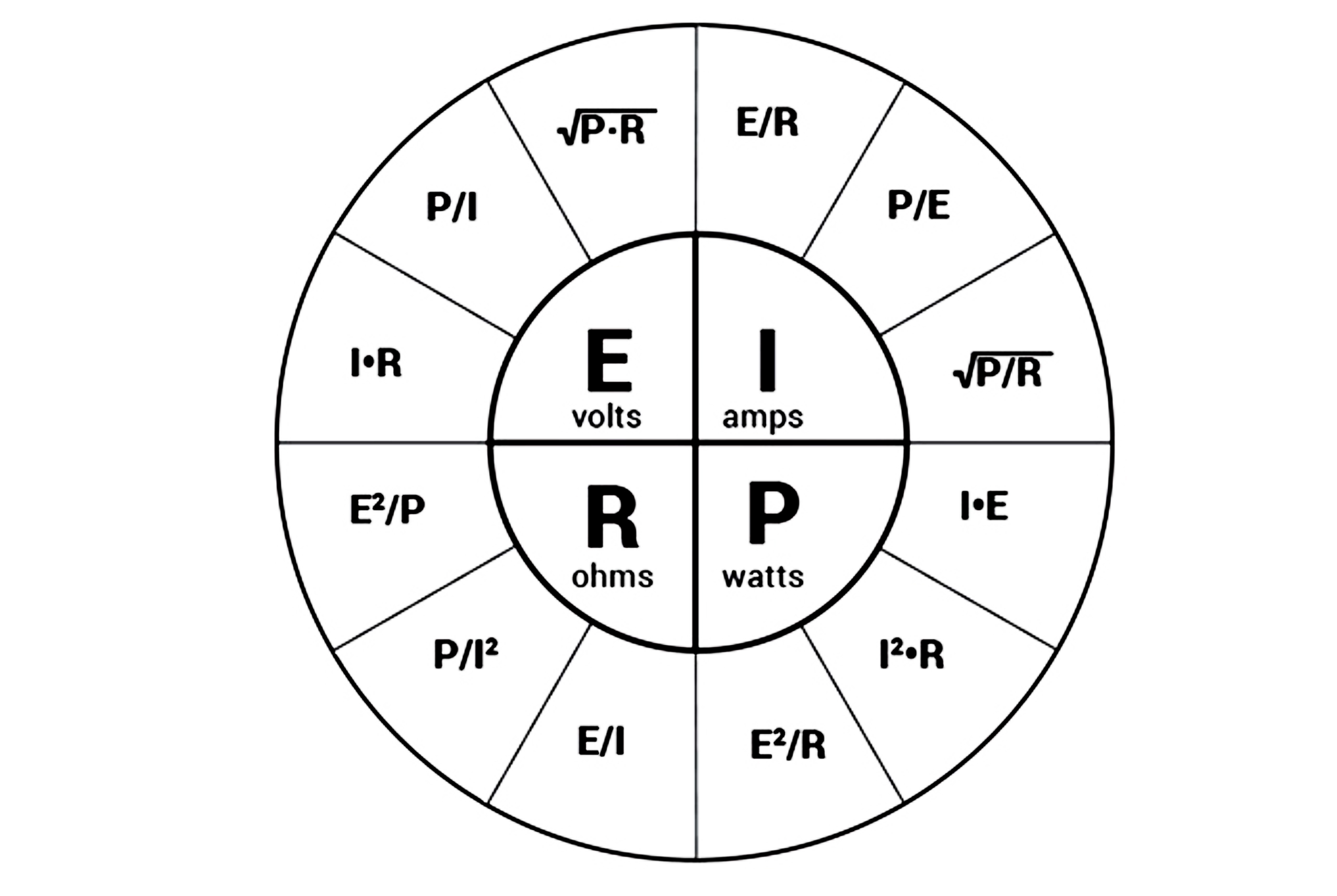
The proposed image, entitled "Ohm's formula and power wheel", represents an effective synthesis tool to understand the fundamental relationships between electrical quantities in direct current circuits. It offers an intuitive, straightforward circular representation that relates the four essential variables of electrical engineering: voltage (E), current (I), resistance (R) and power (P).
In the center of the diagram are the four main symbols: E indicates the voltage or difference in electric potential, expressed in volts (V); I represents the electric current, expressed in amperes (A); R identifies the electrical resistance, measured in ohms (Ω); while P is the electrical power, expressed in watts (W). These four quantities are linked together through a series of derived formulas, which occupy the outer ring of the wheel and allow you to calculate any unknown, knowing at least two of the remaining parameters.
For example, electrical power can be determined in three distinct but equivalent ways:
Similarly, relationships such as E = I × R, E = P/I, or E = √(P × R) can be used to calculate voltage. Similarly, current can be derived from I = E/R, I = P/E, or I = √(P/R). Finally, resistance is obtained from formulas such as R = E / I, R = E² / P, or R = P / I².
This circular representation, often used in schools, universities and professional settings, not only has educational value: it is also extremely useful in application contexts such as electrical systems and lighting design, where it is often necessary to quickly verify the correct sizing of a circuit, the maximum manageable load or the compatibility between power supply and source. In the case of artificial lighting, for example, knowing the value of the absorbed power (W) of a luminaire is not enough: it is also necessary to understand how much current (A) it generates as a function of the mains voltage (V), if the resistance of the circuit (Ω) is compatible with the installed devices, and if the distribution of real and apparent power is consistent with a high power factor (PF). All these considerations are based on the relationships present in the wheel.
From a broader point of view, the Ohm formula and power wheel represents a compact cognitive map, which helps the designer to orient himself between calculations and verifications without losing the big picture. Each formula inserted in the wheel can be used as a basis for an energy assessment, for the verification of regulatory compliance, or to estimate the electrical behavior of a lighting system in real conditions. These formulas make it possible to quantify the electrical energy absorbed by a luminaire and to predict how it is transformed – into heat, light or both – depending on the type of source and its efficiency.
An intuitive way to understand the behavior of an electrical circuit is to compare it to a hydraulic system. In this analogy, electric current is equivalent to the flow of water flowing through a pipe, while voltage is the pressure that pushes the flow. A wider pipe requires less pressure to carry the same volume, just as more current can compensate for a low voltage to produce equivalent power. In the case of electric lighting, however, the watt does not provide an indication of the actual amount of light generated. The perceived brightness of a source depends on another quantity: the lumen (lm), which measures the luminous flux, i.e. the total amount of visible light emitted. The relationship between watts and lumens is governed by the parameter known as luminous efficiency, expressed in lumens per watt (lm/W). For example, a traditional 60-watt incandescent lamp produces about 800 lumens on average, while a modern LED can emit the same amount of light while consuming only 8-10 watts, under the same operating conditions.
This comparison between electrical energy and hydraulic flow, useful for intuitively clarifying the role of fundamental electrical quantities, lays the foundations for a more in-depth approach to the real operating conditions of lighting fixtures. If on the one hand the luminous efficiency expressed in lumens per watt allows us to evaluate how much a system is able to transform electrical energy into visible light, on the other hand it is also necessary to consider the way in which this energy is absorbed and managed by the circuit. In particular, more advanced technical parameters come into play, such as the nominal supply voltage, the absorbed current and above all the power factor (Power Factor, PF), which defines the quality and efficiency of the interaction between the load and the power grid. Only by integrating these considerations is it possible to accurately assess the overall energy behavior of a lighting system, ensuring both its lighting performance and compatibility with power grids and current regulations.
In Europe, the nominal mains voltage is generally set at 230 volts, while in the United States it is around 120 volts. In professional lighting systems, the current absorbed by each device varies according to the power required and the type of power supply used. In this context, the power factor (PF) plays a crucial role, defined as the ratio between the active power (i.e. the power actually transformed into light and heat) and the apparent power, which also includes the reactive components of the system, such as those due to inductances or capacitance. A PF value of 1 indicates a perfectly efficient system from an electrical point of view, in which all the energy taken from the grid is used productively. On the contrary, a low power factor highlights the presence of reactive energy, which does not contribute to light emission, but weighs on the sizing of the systems, causes overheating, voltage drops and dispersions along the network. In high-quality LEDs, the PF is generally above 0.90, while in less performing sources, such as some compact fluorescent lamps, it can fall below 0.70, causing significant inefficiencies and potential compatibility issues with technical regulations.
In summary, although the watt is historically associated with the power of a light source, it is only the electrical parameter relating to consumption. The actual amount of light emitted is measured in lumens, and what matters in terms of design efficiency is the lumen/watt ratio, which describes the system's ability to transform electrical energy into visible light. In contemporary lighting design, oriented towards sustainability and perceptual quality, this parameter is a fundamental metric. It allows you to select technologies with high luminous efficiency, minimizing consumption without compromising visual comfort or required performance.
Other Lighting Post
Other Lighting Post
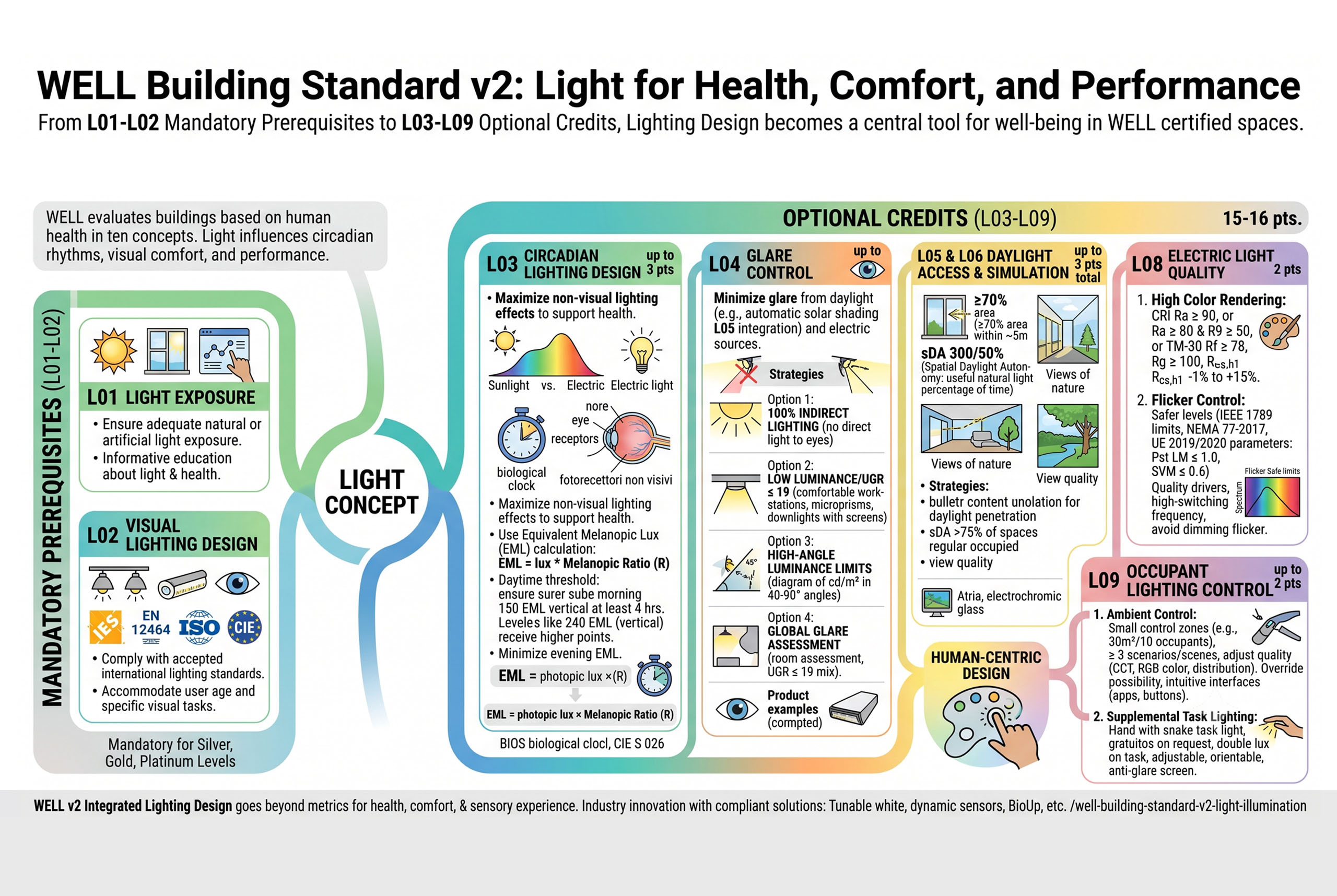
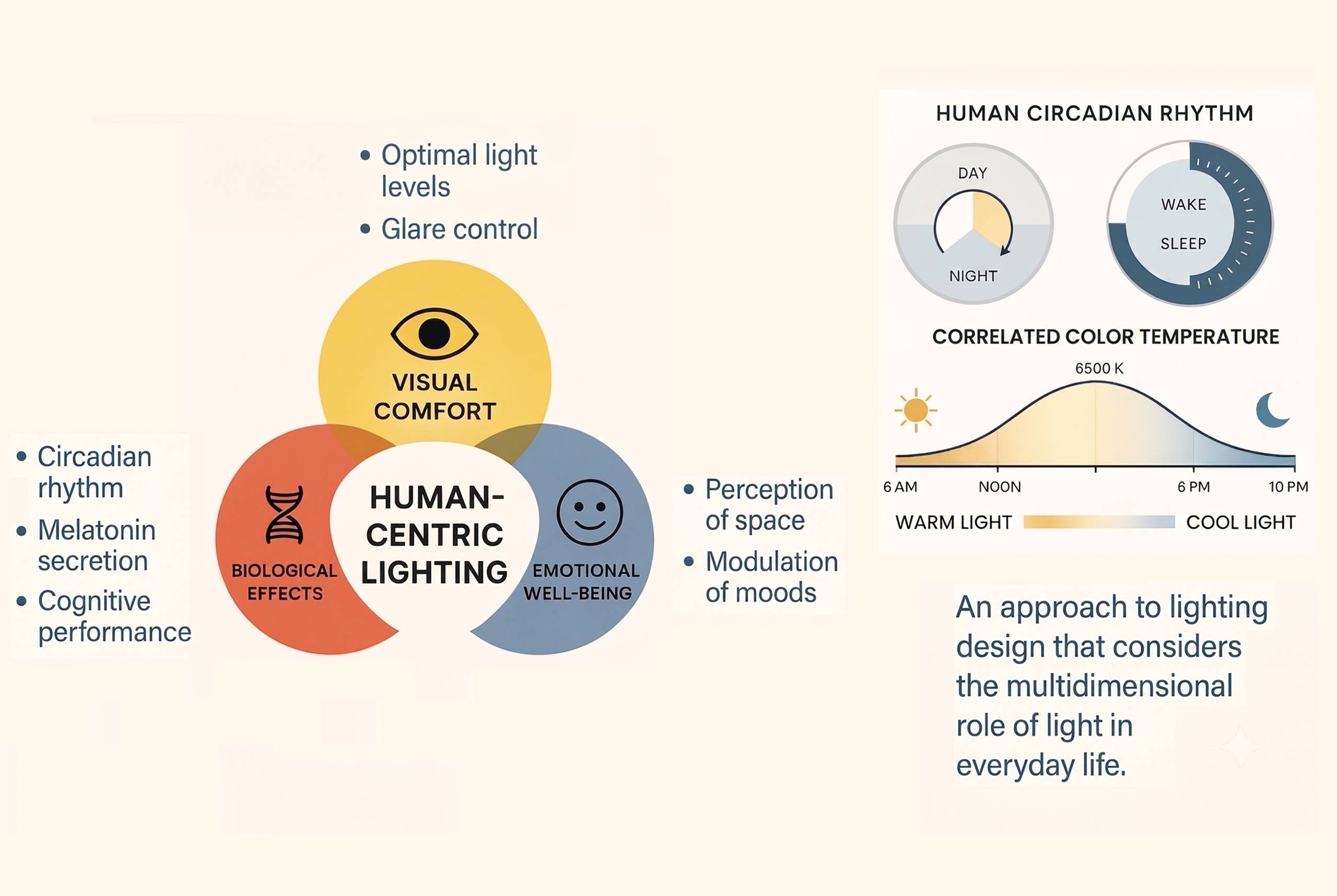
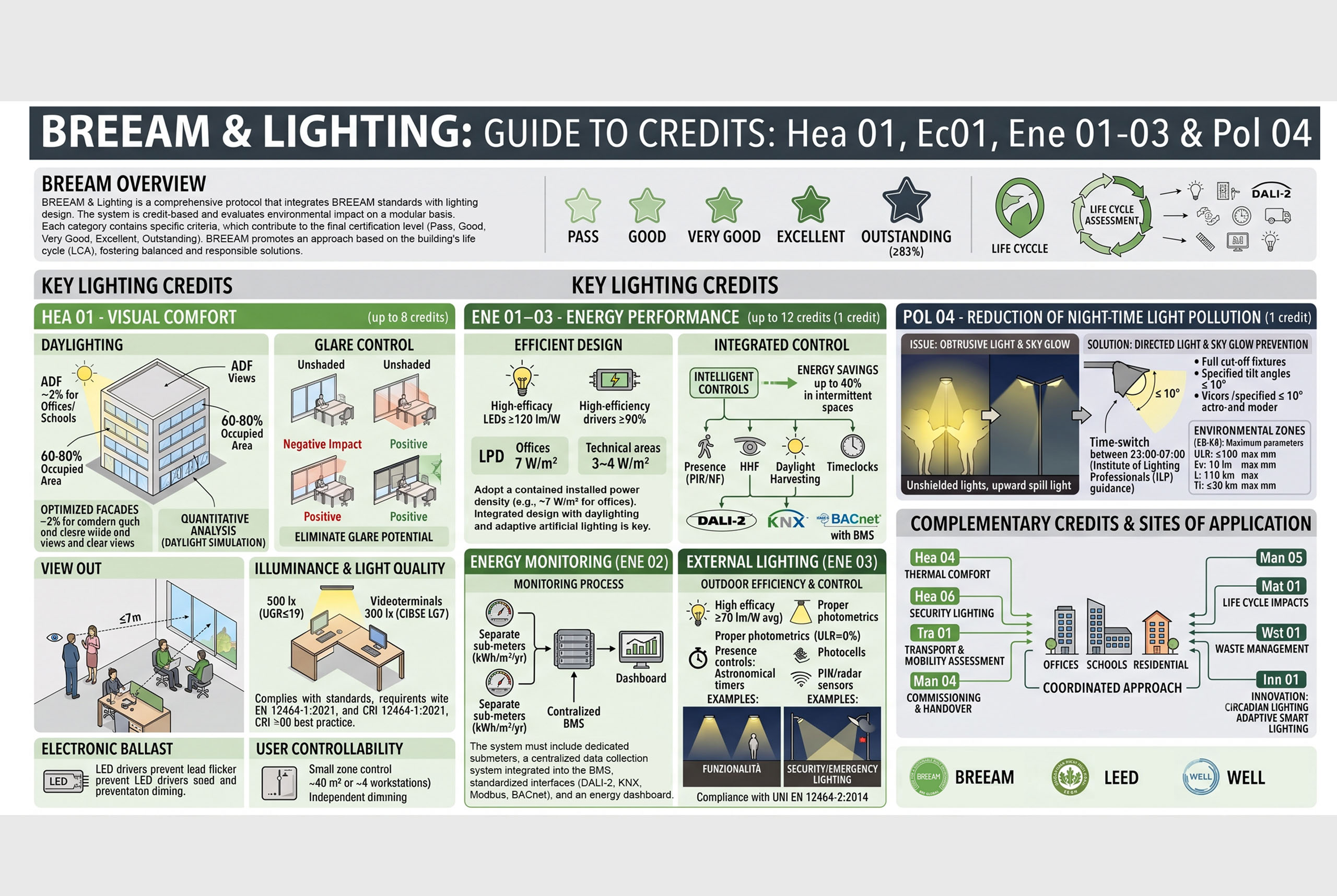
This section brings together a comprehensive body of theoretical, scientific, and design insights into the theory of light applied to lighting design, systematically addressing the complex relationship between light, visual perception, and spatial design. The content develops the physical foundations of light, an understanding of the mechanisms of human vision, the differences between photopic and melanopic illuminance, and the biological impact of artificial light, integrating advanced metrics and contemporary interpretation criteria.
The page also explores the functioning of LED sources, the spectral and perceptual implications of solid-state light, the evolution of color rendering criteria, and the growing role of light as an informational and perceptual system, capable of influencing behavior, comfort, and the quality of spatial experience.
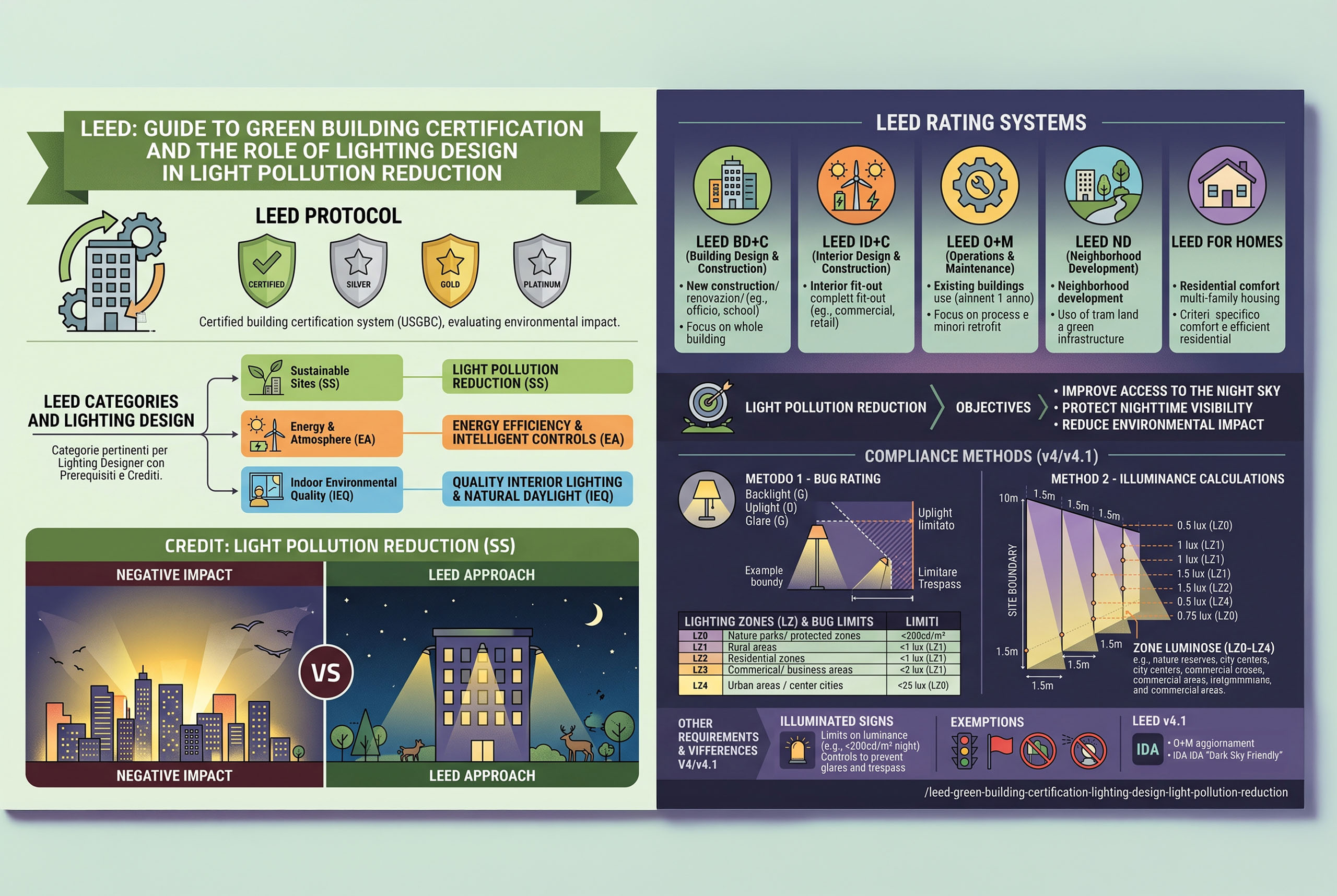
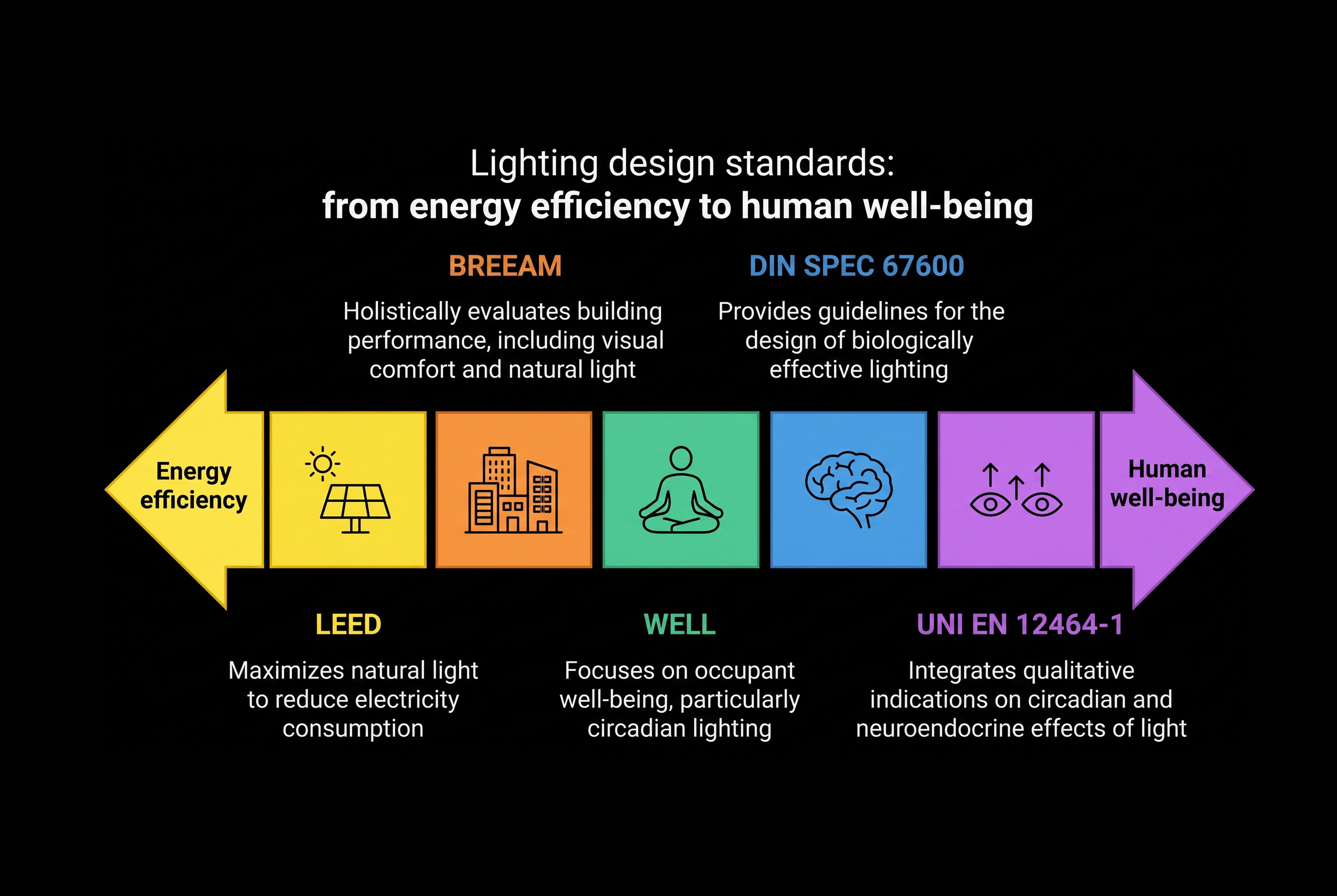
Ample space is dedicated to the relevant regulatory and technical framework, international standards, sustainability protocols, and control systems, understood as essential tools for rigorous, measurable, and consistent design.
Overall, the section provides a vision of the theory of light as the cultural and operational basis of lighting design, in which scientific knowledge, perceptual awareness, and design method converge to guide the lighting designer in the construction of balanced, legible, and qualitatively significant spaces.
This section brings together a comprehensive body of theoretical, scientific, and design insights into the theory of light applied to lighting design, systematically addressing the complex relationship between light, visual perception, and spatial design. The content develops the physical foundations of light, an understanding of the mechanisms of human vision, the differences between photopic and melanopic illuminance, and the biological impact of artificial light, integrating advanced metrics and contemporary interpretation criteria.
The page also explores the functioning of LED sources, the spectral and perceptual implications of solid-state light, the evolution of color rendering criteria, and the growing role of light as an informational and perceptual system, capable of influencing behavior, comfort, and the quality of spatial experience.
Ample space is dedicated to the relevant regulatory and technical framework, international standards, sustainability protocols, and control systems, understood as essential tools for rigorous, measurable, and consistent design.
Overall, the section provides a vision of the theory of light as the cultural and operational basis of lighting design, in which scientific knowledge, perceptual awareness, and design method converge to guide the lighting designer in the construction of balanced, legible, and qualitatively significant spaces.