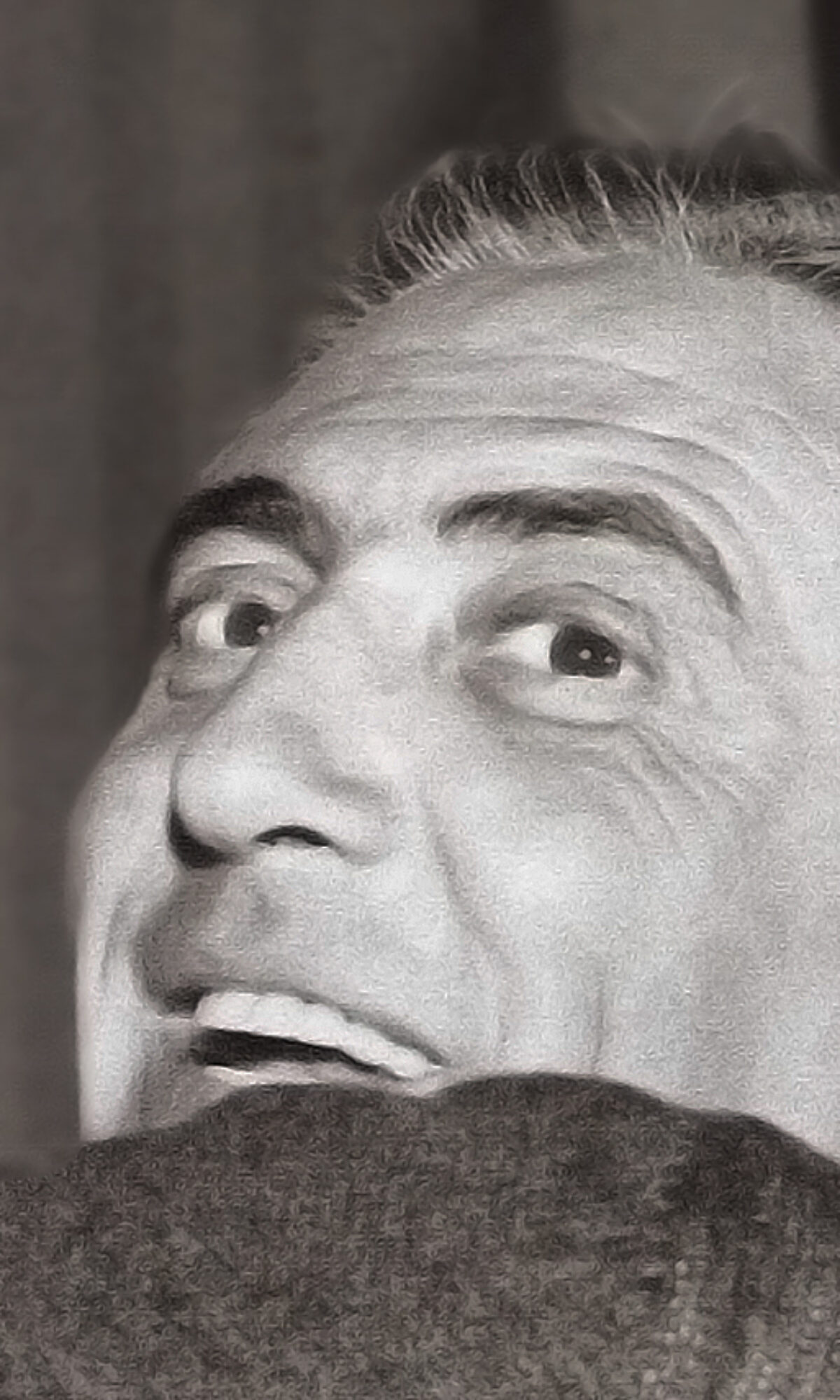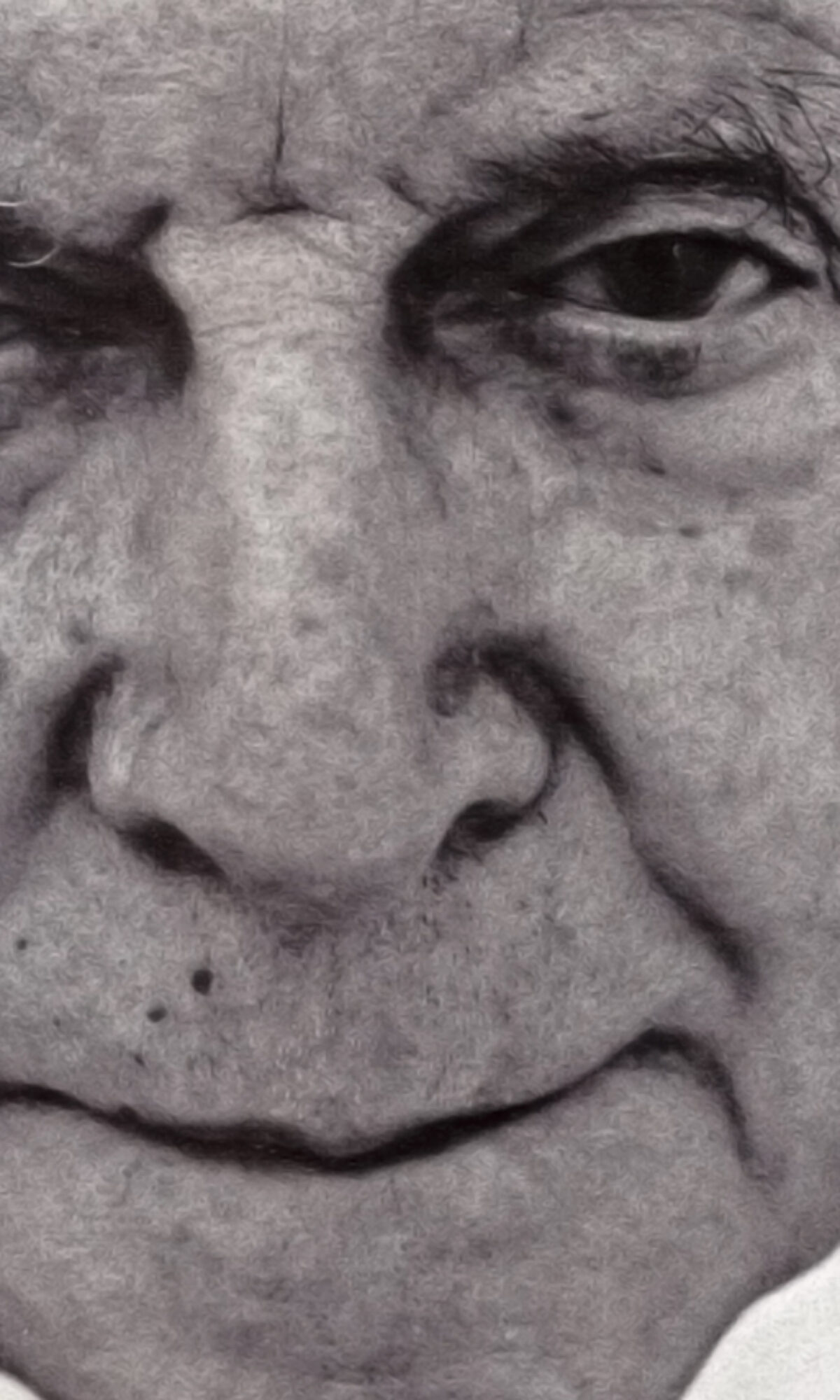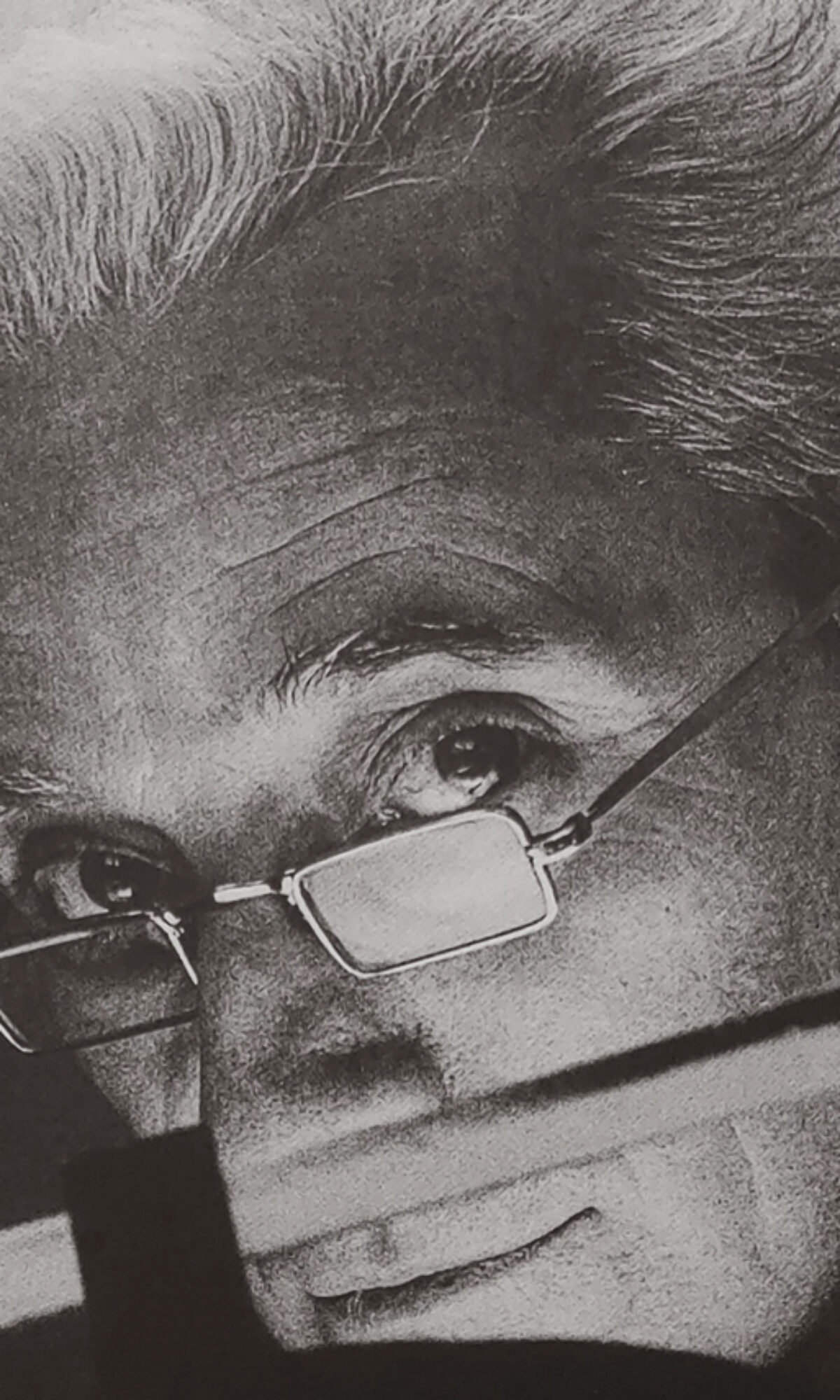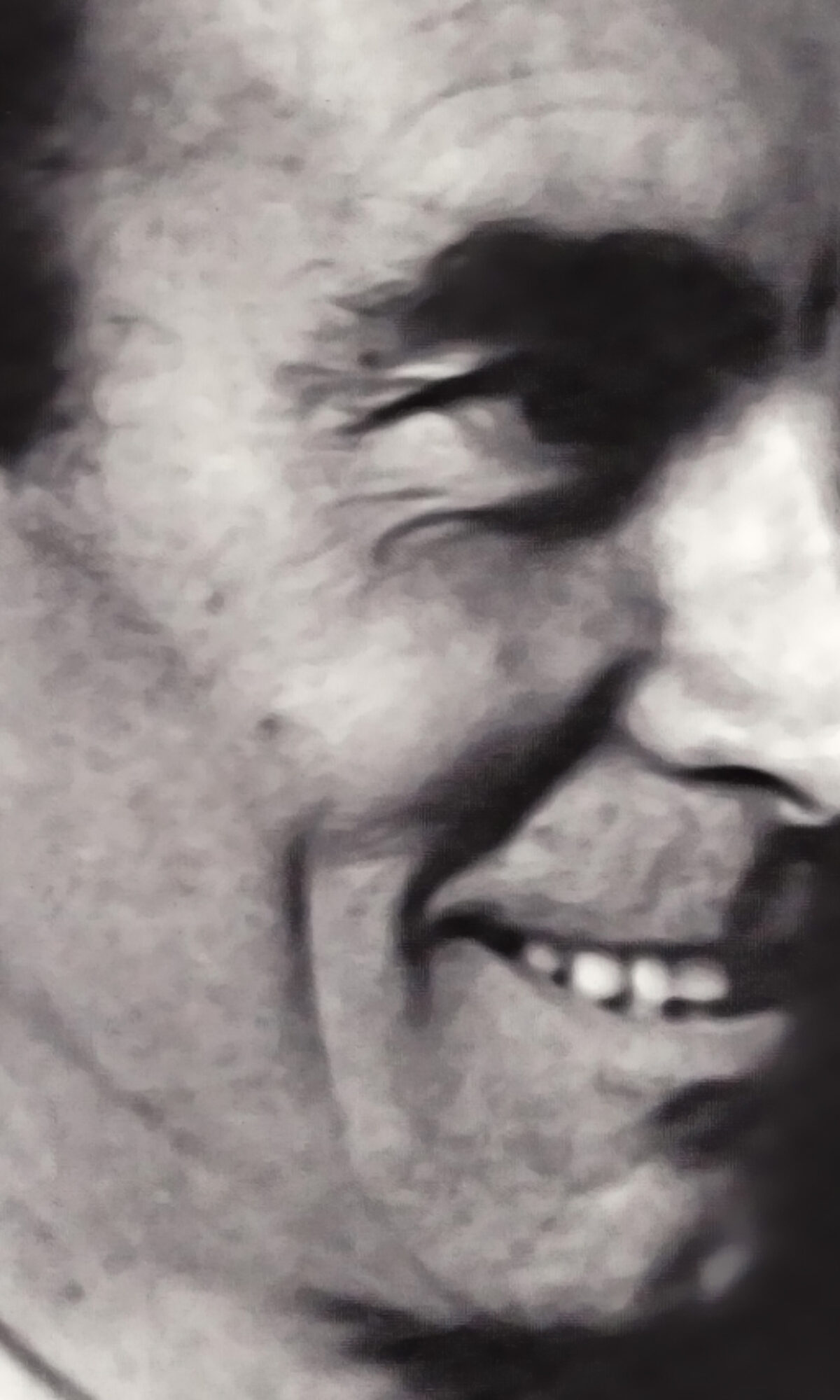
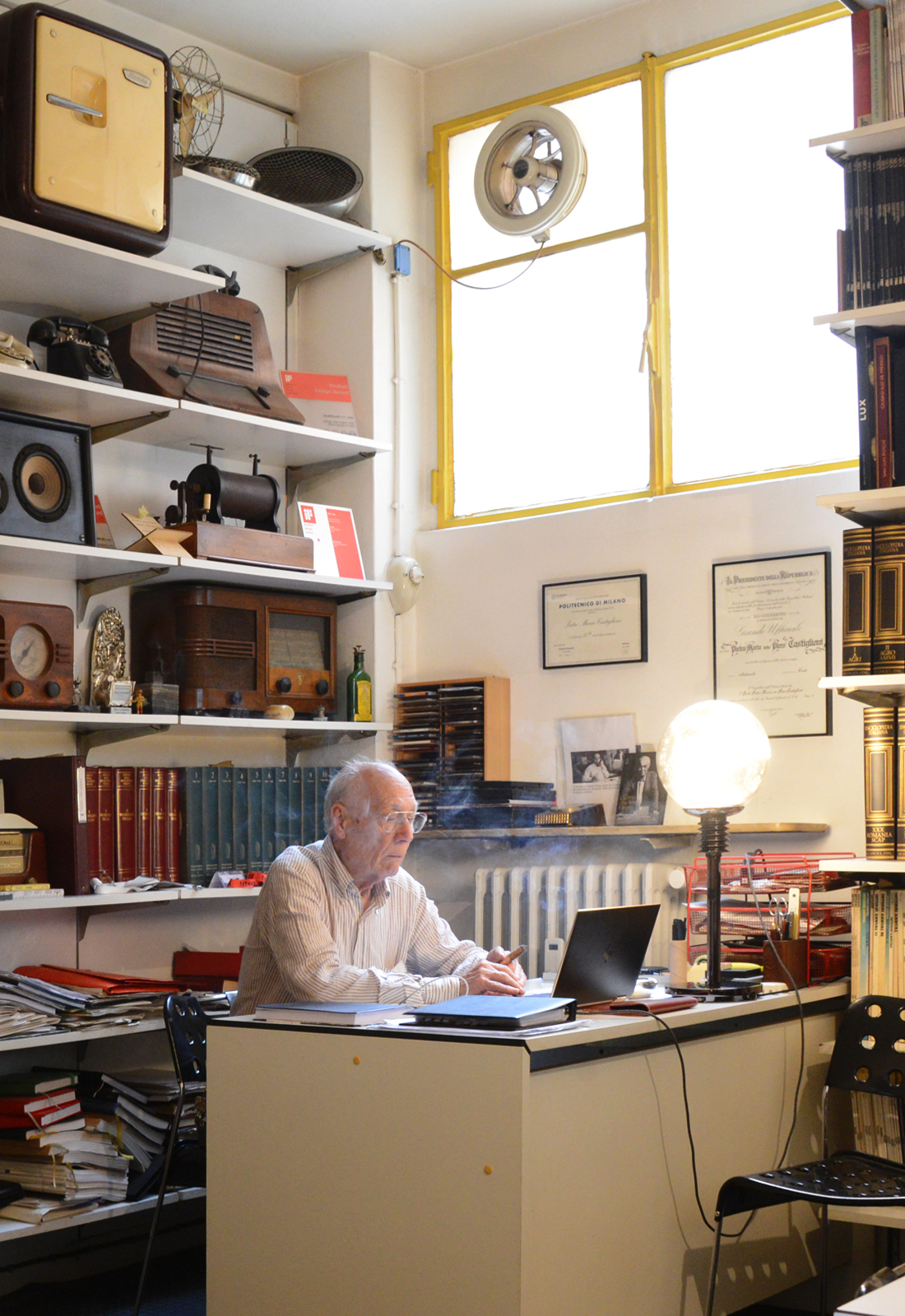
Piero Castiglioni: Architect and Lighting Designer
When design meets light: the affirmation of lighting design as an independent discipline
Design meets light and creates, for the first time in Italy, the role of the lighting designer. Piero Castiglioni's career began in the late 1960s and early 1970s, a time of profound transformation in the conditions that had fueled and supported the development of the Italian design system for at least two decades. It was a time of crisis and redefinition, in which the role of the designer, the function of the client, the mass market, and industrial logic came into conflict. In 1970, Marco Zanuso, in one of his most lucid reflections, bitterly summarized the designer's condition at that time, emphasizing how the complexities of the issues to be addressed—sociological, economic, technological—were far beyond the operational capabilities of individual designers or traditional corporate structures. His perspective highlights the growing rift between production and society, between advertising and genuine consumer engagement, between modern objects and collective needs. Modern furniture, once an elitist phenomenon, is becoming a mass-produced object, and precisely for this reason it demonstrates its disconnect with the expectations and experiences of the user.
In the 1970s, this fracture manifested itself on multiple levels: in the relationship between industry and emerging markets, in the disconnect between designers and businesses, and in the growing self-criticism that architects themselves directed at their own profession. New generations of designers sought to interpret new needs and often found themselves in open conflict with corporate strategies. The design landscape diversified and fragmented: from the futuristic and utopian visions of Joe Colombo to the ethical and radical distance of Enzo Mari, from the Situationist provocations of Ugo La Pietra to the conceptual explorations of Gaetano Pesce, and even the experience of radical design in Florence. A new design approach emerged that sought its own discursive autonomy, even at the cost of isolation from the commercial and media system of design. The 1972 exhibition at MoMA in New York, Italy: The New Domestic Landscape, on the one hand celebrated the vitality of Italian research, but on the other it confirmed the dispersion of languages and the distancing of the new generations from a productive condition perceived as inadequate.
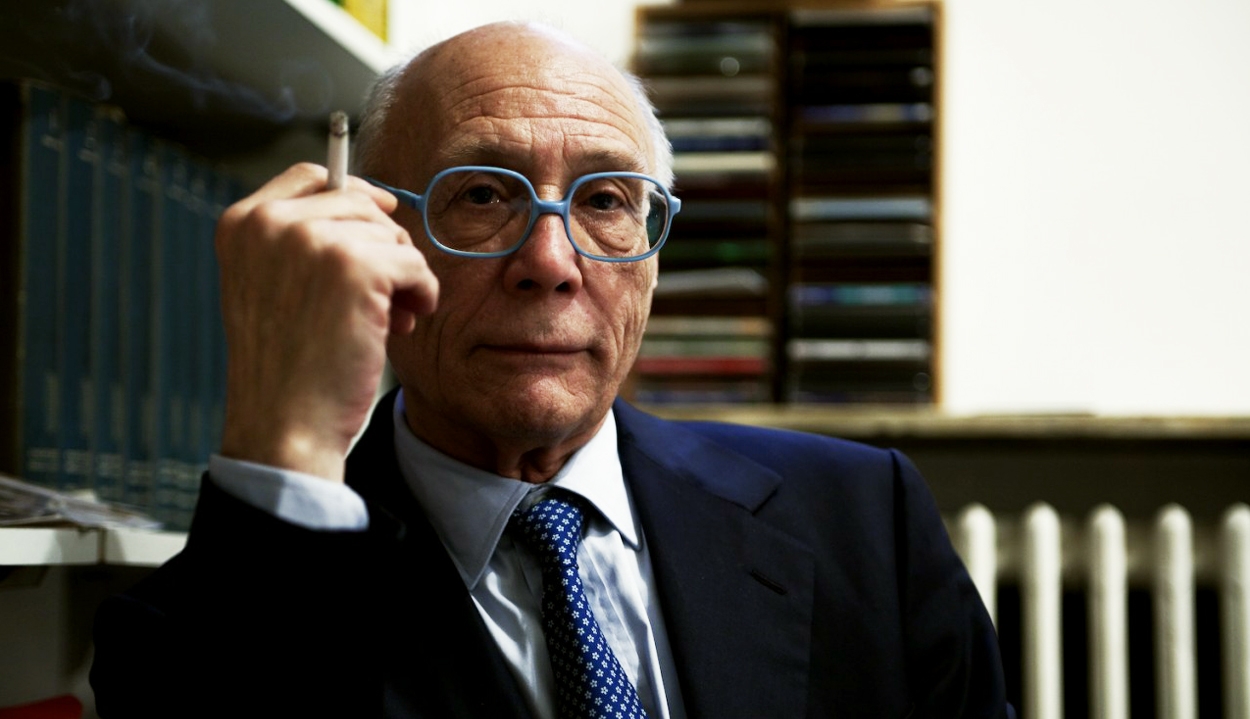
Video: "Pier Giacomo 100 Times Castiglioni," produced by ISAI Design Academy, curated by Piero Puggina. Video interview with Piero Castiglioni, architect and lighting designer, son of Livio Castiglioni - Milan, June 2013, produced for the exhibition: 1913-2013. Event of "The City of Architecture No. 1," September 6 - October 6, 2013, Vicenza, Basilica Palladiana. Photo courtesy: Andrea Vailetti
In this scenario, the designer's ability to present himself as the guarantor of project complexity comes into crisis, especially within the construction and industrial production systems. Humanism in design gives way to a growing fragmentation of skills, a stratification of technical specializations that struggle to communicate with each other. Added to this, starting with the 1973 energy crisis, is a renewed focus on the relationship between technology and resources, and a renewed centrality to the social dimension of space, also fostered by the emergence of new audiovisual media that shifted design attention from the domestic to the collective sphere.
These themes, already present in design culture, resurface forcefully in the early work of Piero Castiglioni. After training in the studio of his uncles Pier Giacomo and Achille Castiglioni, he began collaborating with his father Livio in the late 1960s on lighting projects for private homes, showrooms, and exhibitions. In 1972, together with Ugo La Pietra, he participated in the historic New York exhibition Italy: The New Domestic Landscape, considered the international manifesto of Italian design, which marked the critical and experimental turning point of the designer's project.
In those years, lighting technology was also seeking its own disciplinary recognition, attempting to redefine its scope and broaden its cultural legitimacy. Piero Castiglioni clearly chose to work on lighting design, transforming an initially playful and inventive approach into a critical practice of space. His focus was not on the lamp as an independent object to be catalogued, but on the manifestation of light in relation to architecture. In this sense, each lighting fixture was born as a response to a specific design requirement: it was not a formal exercise, but a device designed to display light, or to make it perceptible through different modalities—direction, intensity, diffusion, color, reflection.
For the designer, "displaying light" meant knowing how to select and modulate the lighting behavior in relation to the architectural context, the type of space, and the desired visual experience. Light can thus take on different characteristics: it can be diffused and enveloping, direct and bold, grazing, reflected, or dynamic, becoming an active part of the narrative of the space. Each technical choice therefore becomes an expressive form that defines the way in which light makes itself present, articulates itself and interacts with surfaces.
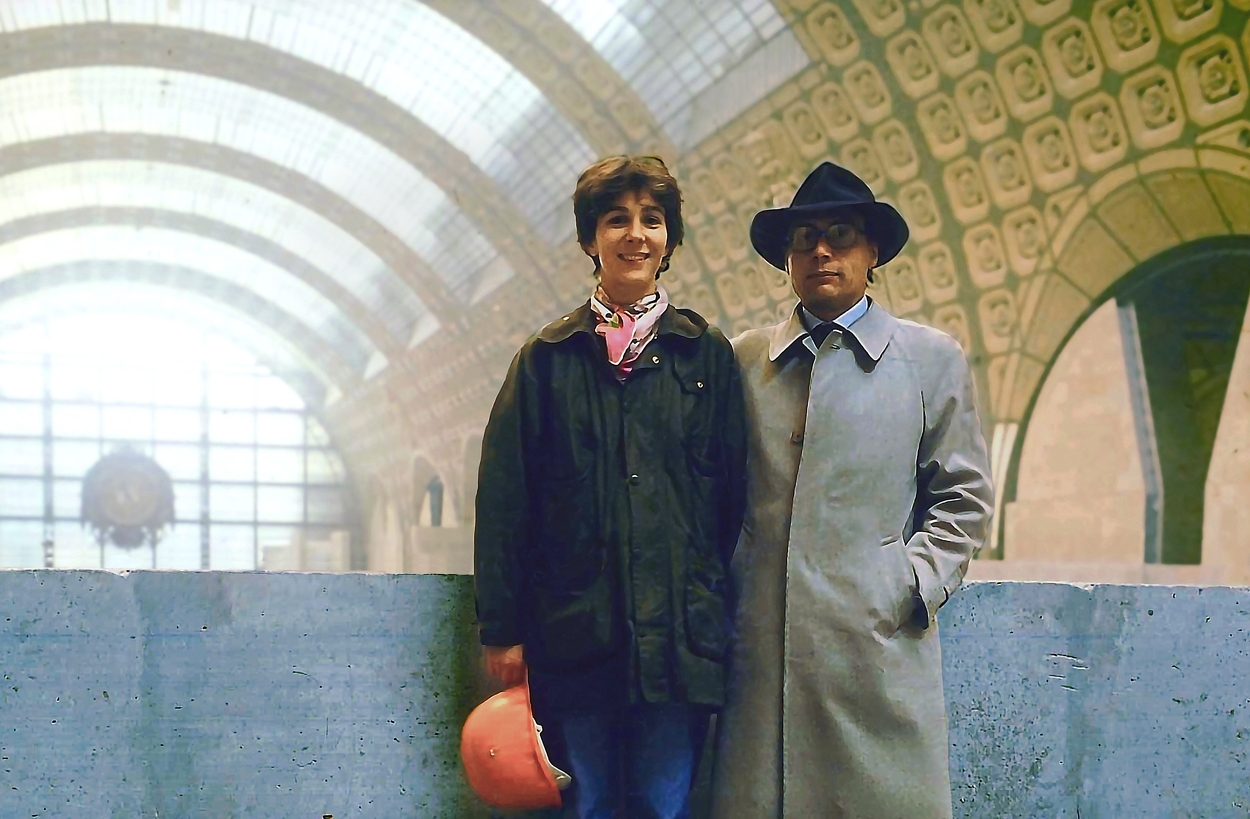
Paris, 1983 – Piero Castiglioni and Monique Bonadei, portrayed during the construction phase of the Musée d’Orsay, inside the historic Parisian railway station currently being transformed into a museum, as part of the architectural project designed by Gae Aulenti.
Unlike other specialists in the field, Piero Castiglioni consistently works on other people's projects, in a collaborative approach that represents a direct legacy from his father. Both Livio and Piero reject the idea of problem solving as an autonomous practice and instead advocate an attitude of adherence and integration with the profound meaning of architectural design. The notion of integral design that Livio applied in his relationships with industry is transferred by Piero to his relationship with built spaces and their creators.
Over the course of the twentieth century, lighting design evolved from a simple technical application to a conscious cultural practice, capable of influencing the way we inhabit, perceive, and construct space. Parallel to the evolution of light sources and available technologies, a broader reflection on the significance of light in architectural design developed. On the one hand, the experiments of the first modernist architects with the naked light source paved the way for an expressive and unmediated use of electric light; on the other, lighting technology sought its own disciplinary status, emancipating itself from a merely functional role. It is within this dual historical-technological and critical-design trajectory that the work of Livio and Piero Castiglioni is situated. From the 1950s for Livio and the late 1960s for Piero, their work on light was not limited to the creation of luminaires, but presented itself as a true investigation into the manifestation of light in space. Light is no longer an accessory or complement, but becomes a design material, the object of a thought integrated with architecture.
The true innovation of the Scintilla system lies not simply in leaving the light source bare—a move already explored by others, as we'll see later—but in repeating it sequentially and giving it different types of application, transforming the space itself into an optical device. It is this rhythmic multiplication that defines a new paradigm: the environment does not host light, it generates it. Surfaces become reflectors, architecture becomes a luminous structure, and the space, as a whole, becomes the lighting fixture. This design gesture marks a turning point, shifting the focus of design from the form of the fixture to the immaterial construction of light itself.
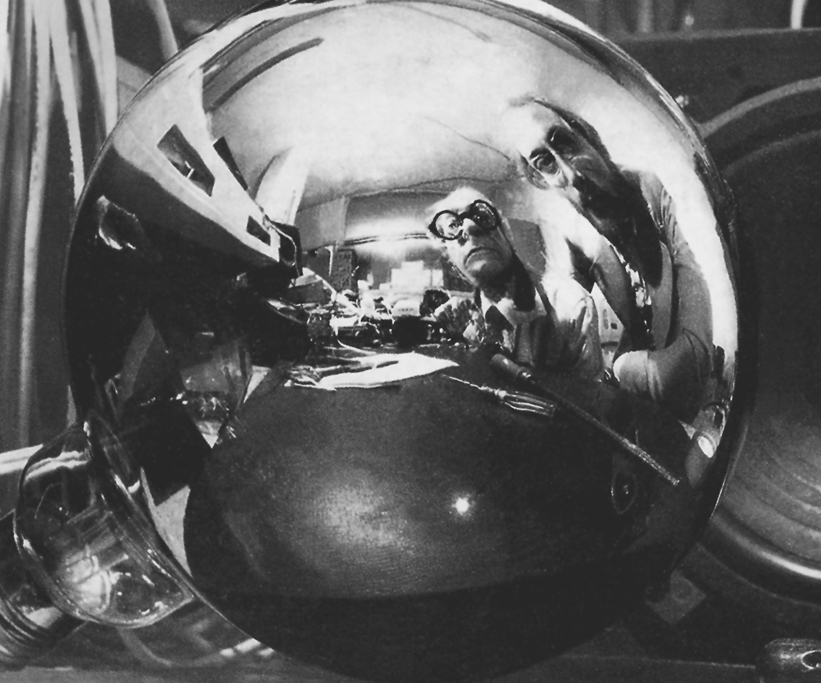
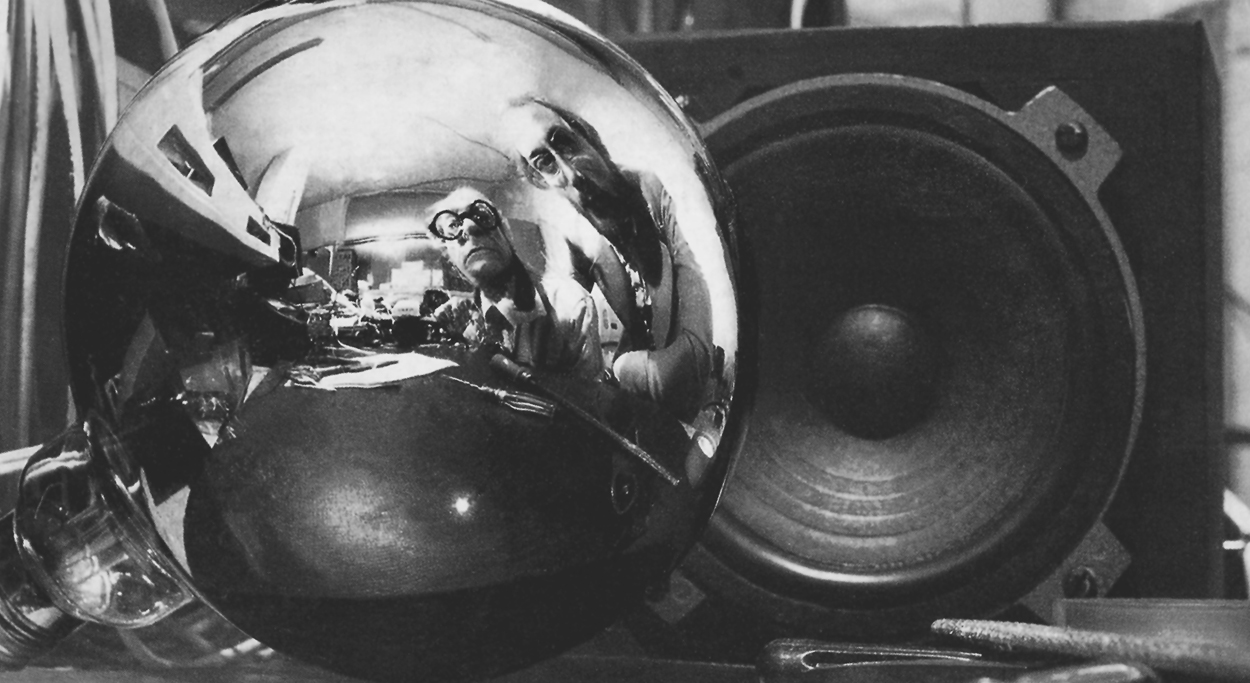
1975: Livio and Piero Castiglioni in their studio at Via Presolana 5, Milan. Reflected in the mirrored surface of a lamp, father and son appear immersed in the heart of their experimental laboratory, surrounded by instruments, sources, and speakers.
To fully understand this shift, it's necessary to return to the earliest insights developed between the late nineteenth and early twentieth centuries, when some pioneers of modern architecture began to consider the exposed light source not just as a technical element, but as an integral part of the aesthetic and spatial composition. It was in this context that the foundations were laid for a poetics of light that would find full expression in the following century.
At the end of the nineteenth century, with the introduction of the incandescent lamp, some modernist architects began to grasp the expressive potential of the light source, deliberately left uncovered, enhanced by its technical and essential presence. Henry van de Velde praised its formal purity, while Charles Rennie Mackintosh in the Glasgow School of Art (1896) and Adolf Loos in the Café Museum in Vienna (1899) used it without diffusers, with exposed or tensioned wires, anticipating an approach that would once again become central to twentieth-century design research. In the 1950s and 1960s, Pier Giacomo and Achille Castiglioni experimented with devices that used "naked" light sources with built-in reflectors, such as the "Reflector" of the Luminator or the "Par 56" in the famous Toio. Following this, at the 11th Triennale in 1957, they proposed a 1000 W industrial bulb lamp, without the screw base: a configuration that highlighted the filament, reducing glare to a minimum.
It is in this context that the Scintilla system was born, a project with which Livio and Piero Castiglioni—recently graduated in architecture from the Polytechnic University of Milan—give concrete form to their reflection on the naked lamp. The source is no longer hidden or filtered, but exposed in its essence. The fixture is reduced to a technical connection tool, while light is transformed into a visual event: pure energy that dialogues with the architectural material. Light is not designed, it is thought.
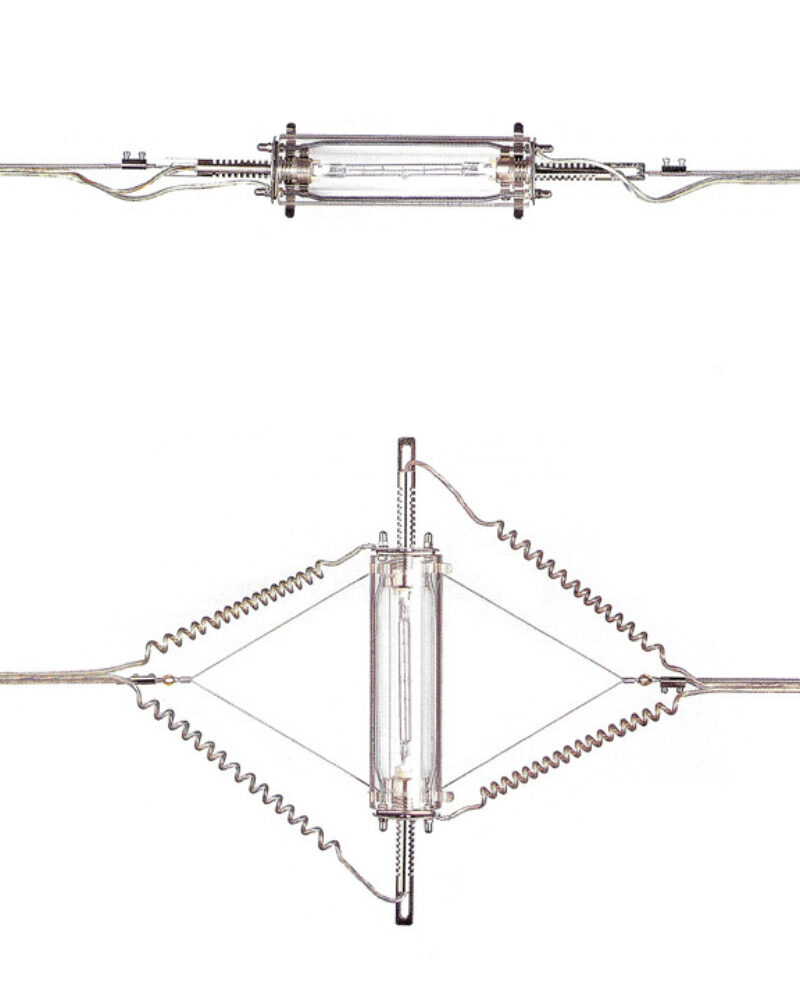
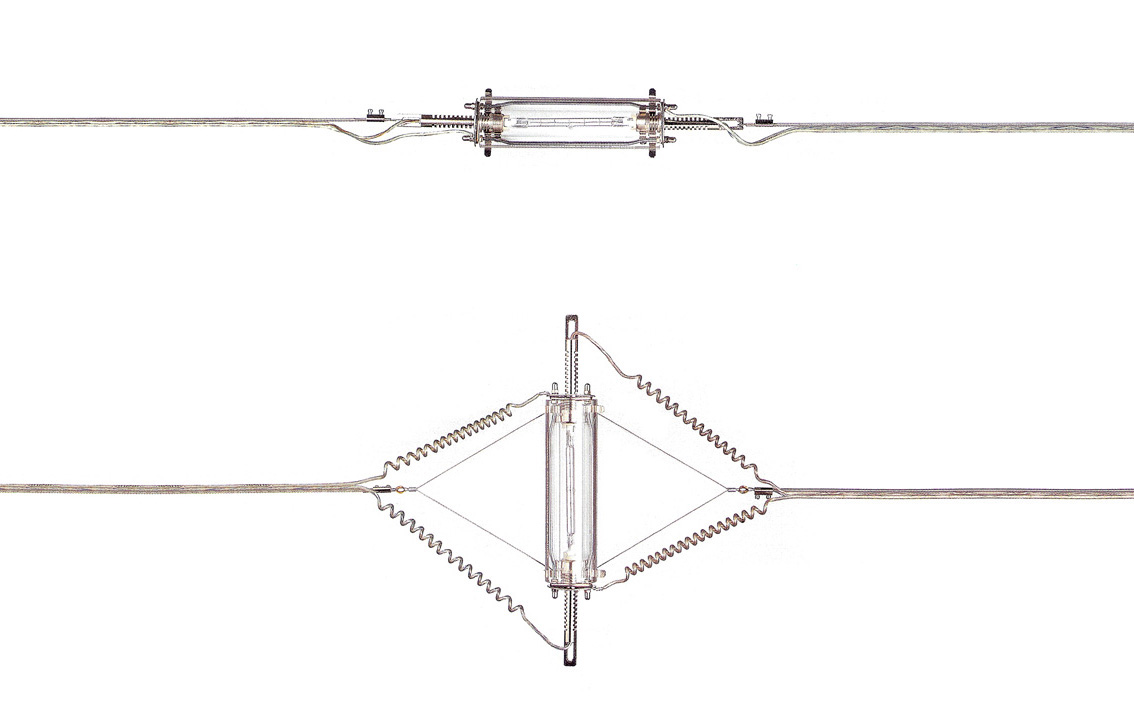
The Scintilla system, conceived, tested, and created by Livio and Piero Castiglioni in their laboratory on Via Presolana, was later industrialized by Piero, thanks to a production agreement with Fontana Arte, which recognized its innovative value and launched its large-scale distribution. The Scintilla was born from a radical concept: to produce a repeated and controlled glare, capable of generating a sparkling light, defined by Castiglioni himself as "sparkling light." The halogen lamps, intentionally left bare, follow one another in a rhythmic sequence, offering the eye not simple illumination, but a pulsating, dynamic optical material capable of shaping space through visual vibration.
This concept overturns the lighting orthodoxy of the time, which aimed for uniformity and invisibility. Instead, the sparkling light affirms light as an active, physical presence, almost acoustic in its rhythm, and gives the project an atmospheric power that fuses architecture, perception, and technique into a single, coherent gesture. It is a design breakthrough: the fixture is no longer an object, but a device for constructing perception.
Throughout the 1970s, this new grammar of light found application in shops, showrooms, and hotels, settings where Castiglioni, often in tandem with his father, experimented with a language capable of integrating space into lighting. From the Scintilla experience onward, Castiglioni developed targeted lighting strategies, always calibrated to the perceptual, functional, and material characteristics of each context. For him, light is a cultural act, a critical gesture, a form of interpretation of reality. Electric light is a material to be shaped: it is directed toward surfaces, it shapes the space, it guides its interpretation, it reinforces its meaning.
The figure of the architect of light, which Castiglioni embodies with coherence and rigor, is that of a designer capable of integrating the scientific measurement of light with the quality of perceived space, bringing together science and sensibility, technique and interpretation. Light, in his thinking, is not an addition to architecture: it is an integral part of its design, an integral component of its grammar.
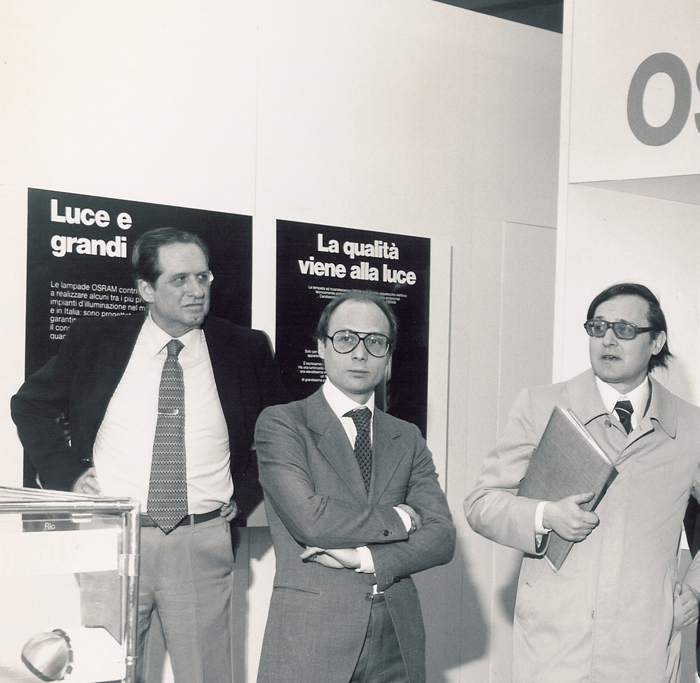
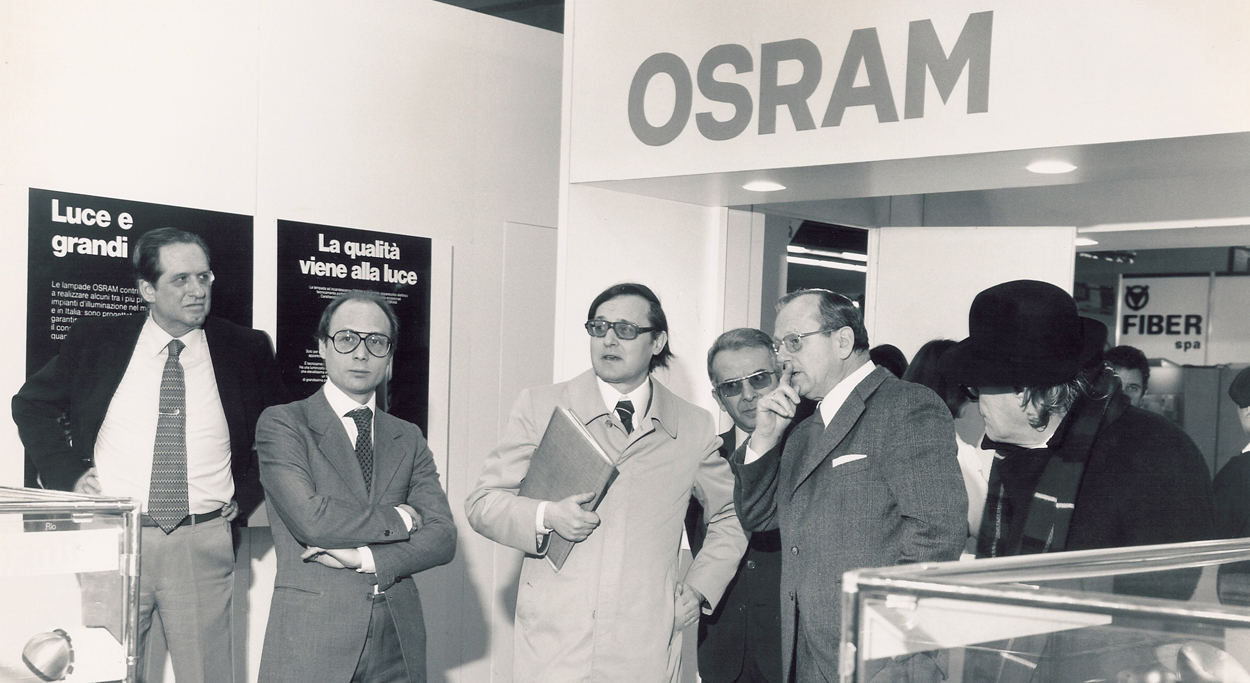
A fundamental contribution to Piero Castiglioni's technical training came from his consultancy with Osram, active since the 1970s. It was in this context that he deepened his study of light sources, exploring in detail the "technical alphabet of electric light" and the innovations of the time: from low-voltage halogen lamps with built-in reflectors to gas- and powder-discharge lamps with high color rendering. The evolution of these sources suggested to Piero Castiglioni the possibility of breaking free from the design of the fixture's casing, focusing instead on the design of systems with interchangeable optics. This further insight would find significant application, years later, in the project for Palazzo Grassi, where small light sources became a key element in the lighting design of the so-called "Cestelli."
An ethical and design approach that challenges established practices, always seeking ways of thinking and tools consistent with the complexity of our time. For Piero Castiglioni, reading volumes, historical knowledge of the context, and analysis of visual functions are the necessary prerequisites for every project. Lighting is first and foremost an operational tool, but it must develop in tandem with the overall architectural project, often influencing and, in some cases, redefining it. His approach is distinguished by uncompromising discretion: in the most delicate situations—historic buildings, restorations, complex spaces—he avoids any redundant elements, preferring solutions that integrate with the existing context and are minimally invasive.
One of the cornerstones of his design vision is the overcoming of hierarchies of scale, following a logic of continuity between object and architecture. This idea stems from the teachings of Ernesto Nathan Rogers, who argued that every element, from the lamp to the building, contributes to the definition of space. From this perspective, lighting is not an afterthought, but an integrated device, capable of shaping space with the same dignity and compositional responsibility as architecture.
In some cases, such as at Palazzo Grassi, the staircase becomes a true conceptual tool, adapting solutions designed for sports venues to the museum dimension, through "portioned" lighting systems that interact with walls and display surfaces. It is precisely this ability to treat architecture as a reflective optic that also constitutes the guiding principle in his work as a designer. Controlling electric light, for Piero Castiglioni, means conceiving it as a living material, arising from various sources, passing through optics, refracting on surfaces and materials, and only then manifesting itself. Light exists only if and when it materializes on volumes.
This principle was also applied in the project for the Musée d'Orsay in Paris, with Gae Aulenti, where the study of the relationship between light source, reflective surfaces, and colors led to a redefinition of the very section of the exhibition spaces. Unlike daylight, which distributes itself spontaneously throughout space, electric light requires a conscious and structured design capable of precisely defining the nature of the light source, its typology, the orientation of the light beam, and its placement within the architectural space. Only through this active design is it possible to manage the perceptual, functional, and aesthetic effects of electric light.
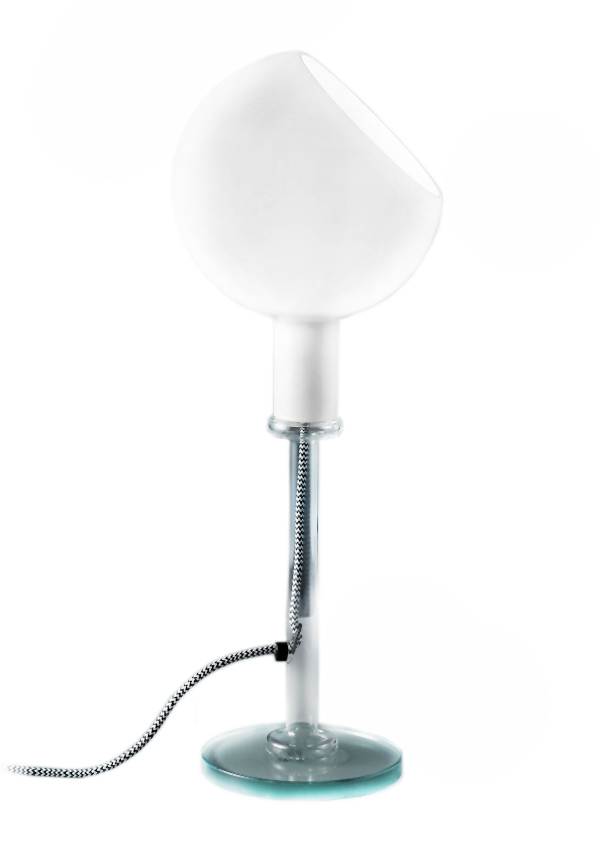
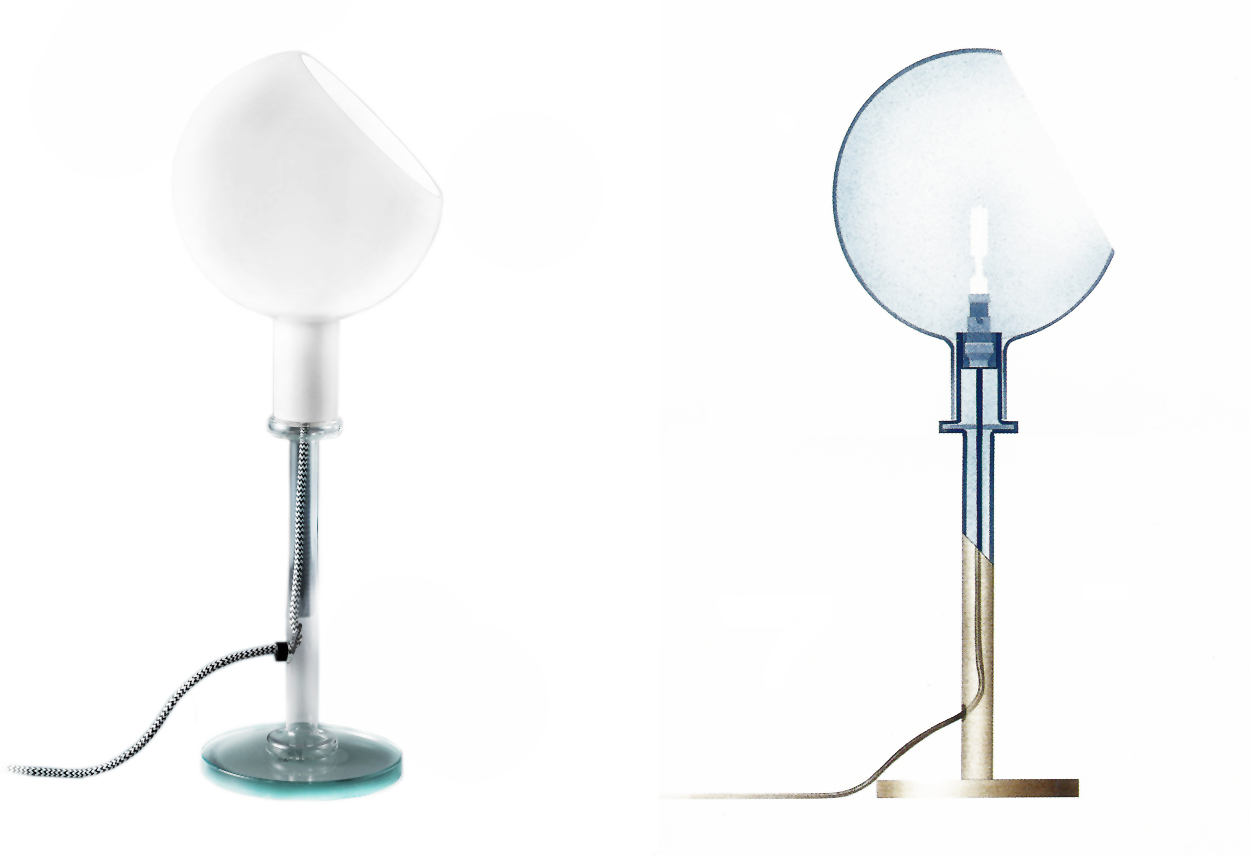
Parola Lamp, designed by Gae Aulenti and Piero Castiglioni for FontanaArte. The object represents an exemplary synthesis of the concepts of diffusion, reflection, and transparency, expressed through a simple formal language and the balanced use of glass in various processes.
The designer, Piero Castiglioni argues, must thoroughly understand the potential of the light source—light spectrum, flux, power, etc.—and the characteristics of the fixture—efficiency, photometric distribution, sizing, etc.—but above all, he or she should pay attention to the interpretation of space, its morphology and function, and then turn their attention to the observer: to their needs and their perception. It is this design dimension—at once technical, perceptive, and profoundly human—that guides every choice and remains the exclusive purview of the lighting designer. From this perspective, their role is similar to that of the director of photography, a key figure in the tradition of Italian cinema, capable of constructing visual narratives in which light is story, atmosphere, and intention.
In the 1980s, lighting design emerged as one of the key tools in the redefinition of exhibition and museum spaces, becoming a privileged area of research and experimentation. Light was no longer considered a simple technical or functional element, but assumed an active design role, capable of interpreting space, guiding its use, and enhancing the contents on display. This new focus on the dimension of light reflected and accompanied a broader transformation of the very idea of the museum, which evolved from the traditional conservative function—focused on the protection and archiving of heritage—toward a more dynamic and participatory vision. The museum thus became a multifunctional cultural space, open to the valorization and active enjoyment of artistic and historical heritage, integrating educational, performative, social, and recreational activities. In this context, light contributes not only to making the artwork visible, but also to building new ways of relating between the visitor, the space, and the content.
Light also began to assume a central role in strategies for enhancing cultural heritage. Superintendents, museum directors, curators, conservators, technicians, and architects expressed their opinions on the relationship between light and artworks—often with divergent opinions. In these years, Piero Castiglioni emerged as an interpreter capable of working with light, bridging the gap between architecture and exhibition design, mastering regulatory and technical-functional aspects and finding meaningful solutions to the problem of the relationship between daylight, artificial light, and the interpretation of the exhibited works.
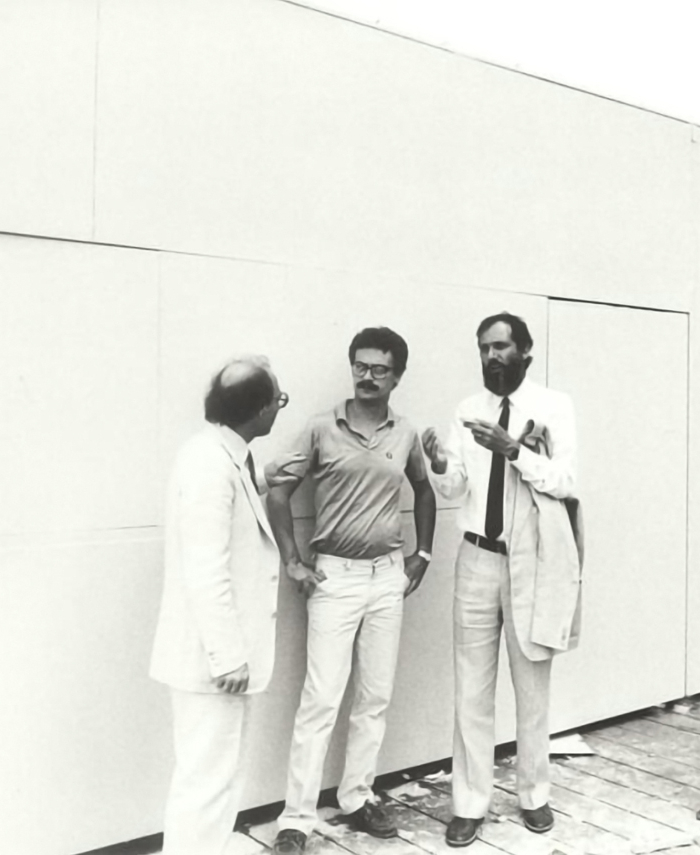
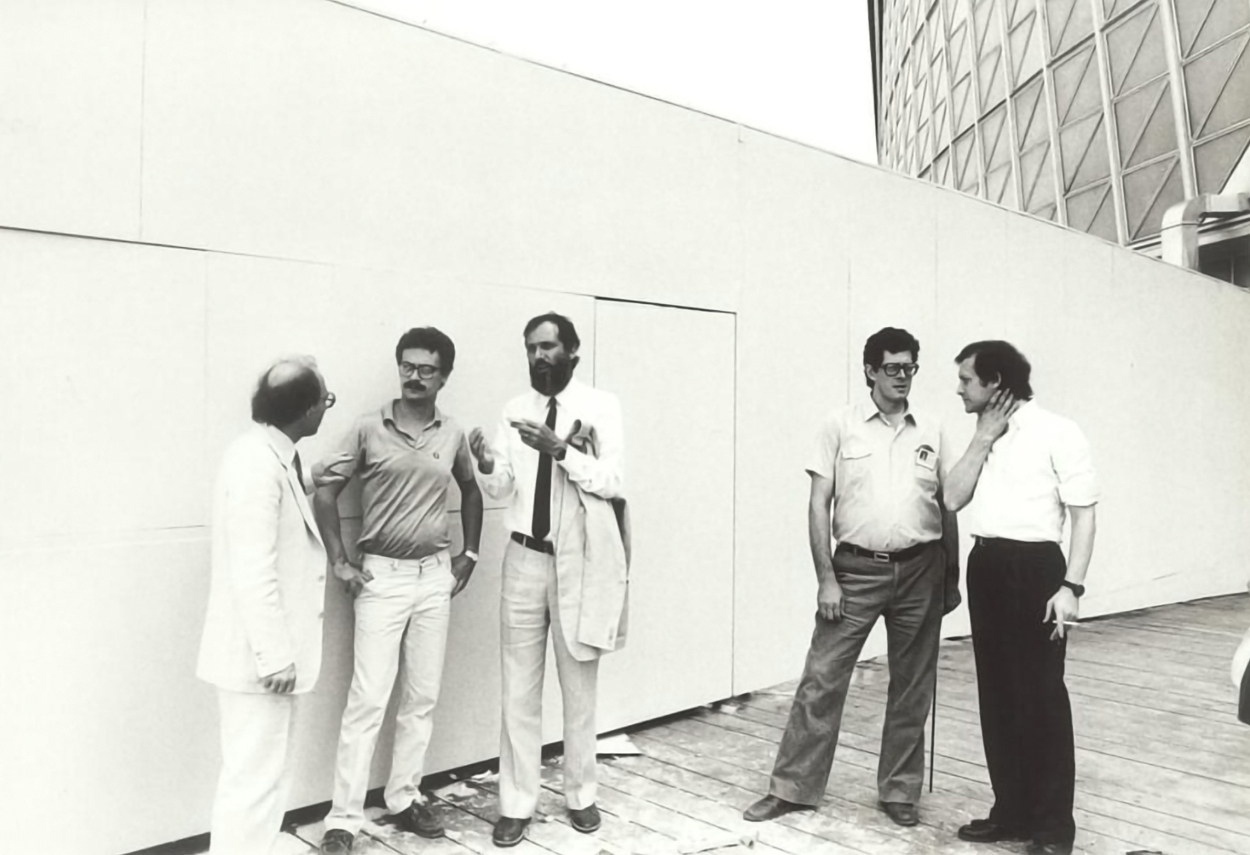
Turin, 1983 – A moment of confrontation between architecture and light. Architect Renzo Piano converses with lighting designer Piero Castiglioni.
Compared to temporary exhibitions, where interpretative freedom and experimentation with different languages are often fostered by the absence of daylight, permanent museum exhibitions require a much more rigorous approach. The stability of the space and the fixity of the artworks require consistent and long-lasting performance from the lighting design, both in terms of conservation and perception. In this context, the lighting system must meet stringent technical criteria, such as color temperature control, differentiation of illumination based on the type of artwork, uniformity of light across the exhibition floors, and glare management. Added to this is attention to the thermal components of light, which can influence the system design, and the need to formally integrate the fixtures with the architectural language of the exhibition. All these aspects make lighting design a complex design tool, in which form, function, and conservation converge in a coherent and controlled lighting language capable of defining the identity of the museum space.
Gae Aulenti states: "I don't think we can speak of a 'museum typology' in an abstract sense; what really matters is the museum's concrete architecture." In her view, the interior space of the museum is not a replicable formula, but rather a coherent system, with a stable structure and a well-defined spatial configuration, born from a specific project and responding precisely to the needs of the context and the exhibition content.
Gae Aulenti's reflections on museum space and her belief that light is a fundamental compositional element—as when she states that "the study of lighting and the control of daylight define the architecture of a museum"—find significant parallels with the ideas of Piero Castiglioni, for whom architecture itself can be conceived as a lighting fixture.
As Anty Pansera observes, "while international constraints and regulations have long governed the lighting of public spaces, particularly museums, daylight—which changes throughout the day and the seasons—requires new relationships and design solutions." In this context, Castiglioni has always responded by designing fixtures integrated into the architecture, capable of interacting with daylight and electric light. These elements, while maintaining their own expressive identity, are not hidden, but rather actively participate in the definition of space.
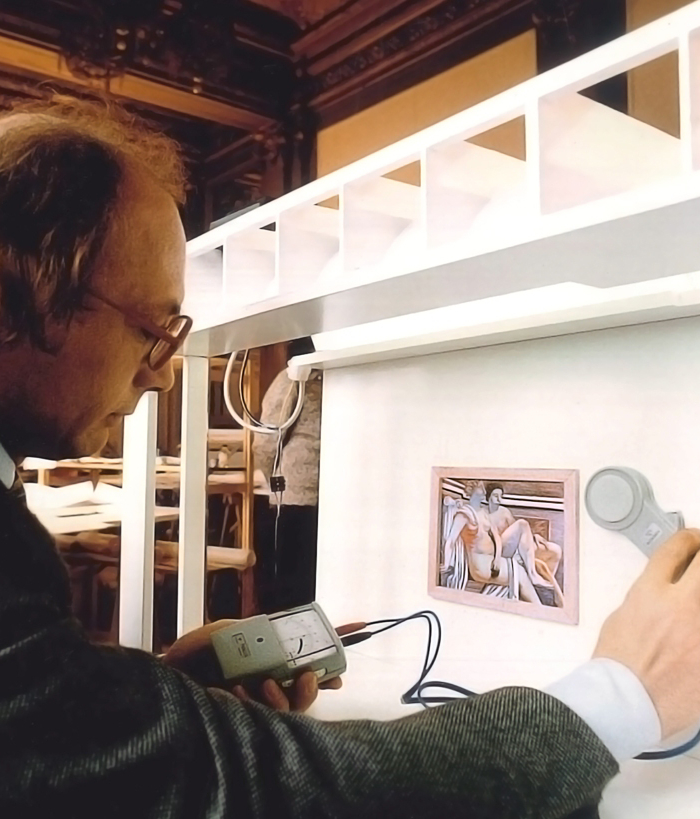
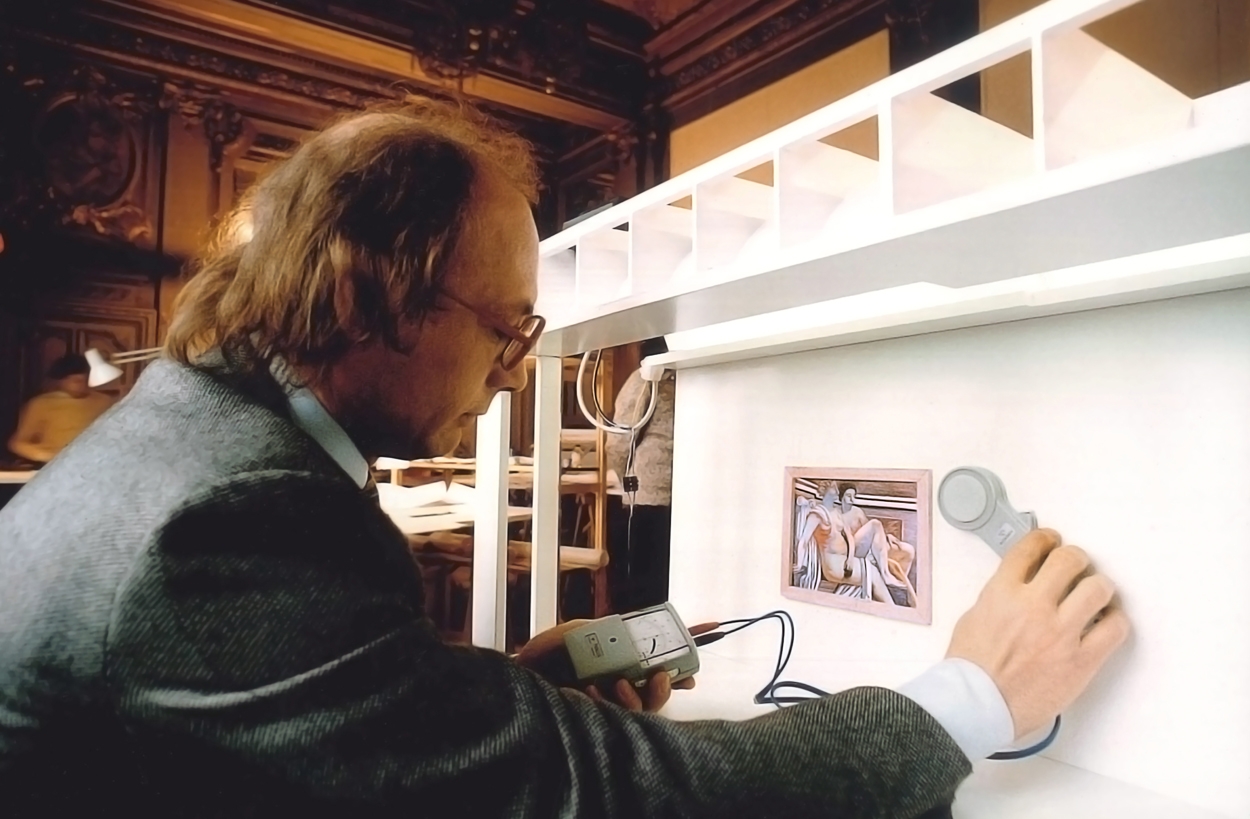
Piero Castiglioni checks the illuminance values for the exhibition walls in the test model for the Musée d’Orsay, in the early 1980s.
In May 1980, Gae Aulenti was invited to participate in the international competition for the redevelopment of the Gare d'Orsay, the former Parisian railway station destined to become one of Europe's most important museums. The key concept, guiding the architectural proposal from the outset, was the essential convergence between the museum space and the lighting design: an insight that prompted the designer to involve Piero Castiglioni from the very beginning of the project's conceptualization phase, entrusting him with the design of electrical lighting solutions.
Castiglioni's work at the Gare d'Orsay spanned six years, from 1980 to 1986, and represented a turning point in the history of museum lighting. It was not simply a matter of designing technical systems, but of developing a lighting strategy that respected the building's historical stratification, enhanced the exhibits, and created a new perception of space. In this context, light was not an accessory element, but a critical material, a means of interpretation, and a narrative device. The project at the Gare d'Orsay also stands out for the complexity and variety of the themes it addressed: large industrial volumes, glass and iron surfaces, temporary and permanent exhibitions, and a dialogue between daylight and electric light. It was a project that anticipated many contemporary reflections on museum lighting, integrating aesthetic, perceptive, and conservation values.
In parallel, Piero Castiglioni and Gae Aulenti collaborated on two other major projects, confirming the centrality of light as an integral component of architectural design. The first is the National Museum of Modern Art, inside the Centre Georges Pompidou in Paris, built between 1982 and 1985, where the challenge was to mediate between the hyper-rational technological system of Renzo Piano and Richard Rogers and the exhibition requirements of an ever-evolving art form. The second is the renovation of Palazzo Grassi in Venice, for exhibition purposes, completed in 1986, where light was called upon to dialogue with the historical memory of the site, with the noble surfaces of the materials, and with the flexible requirements of contemporary exhibition design.
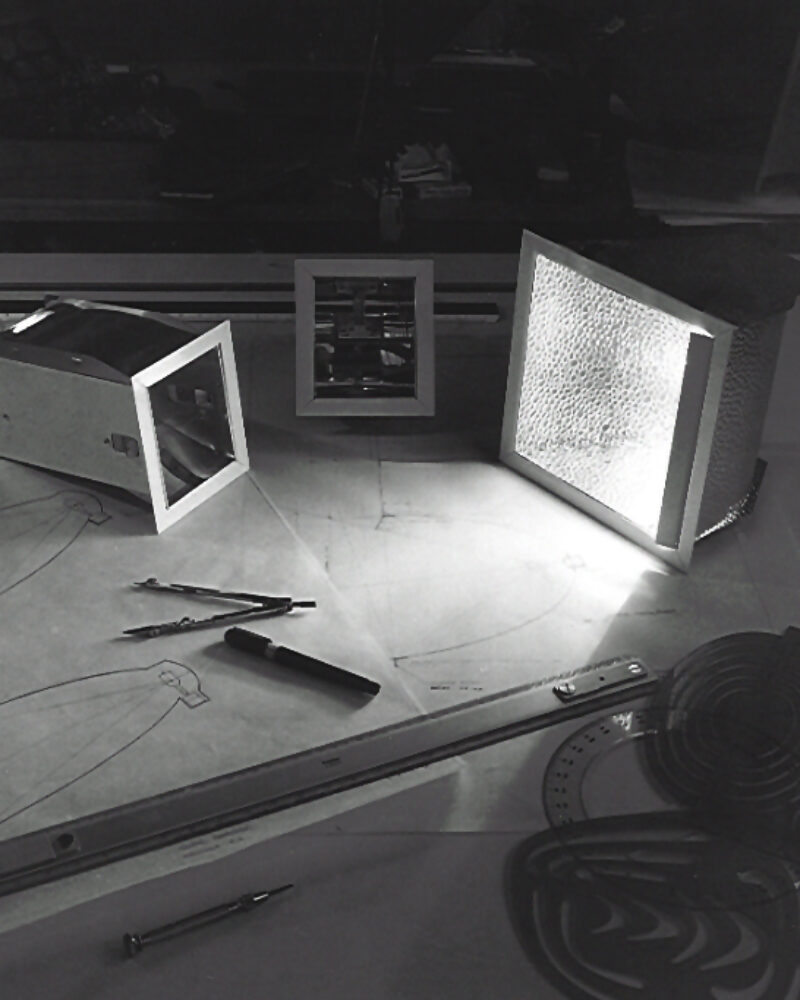
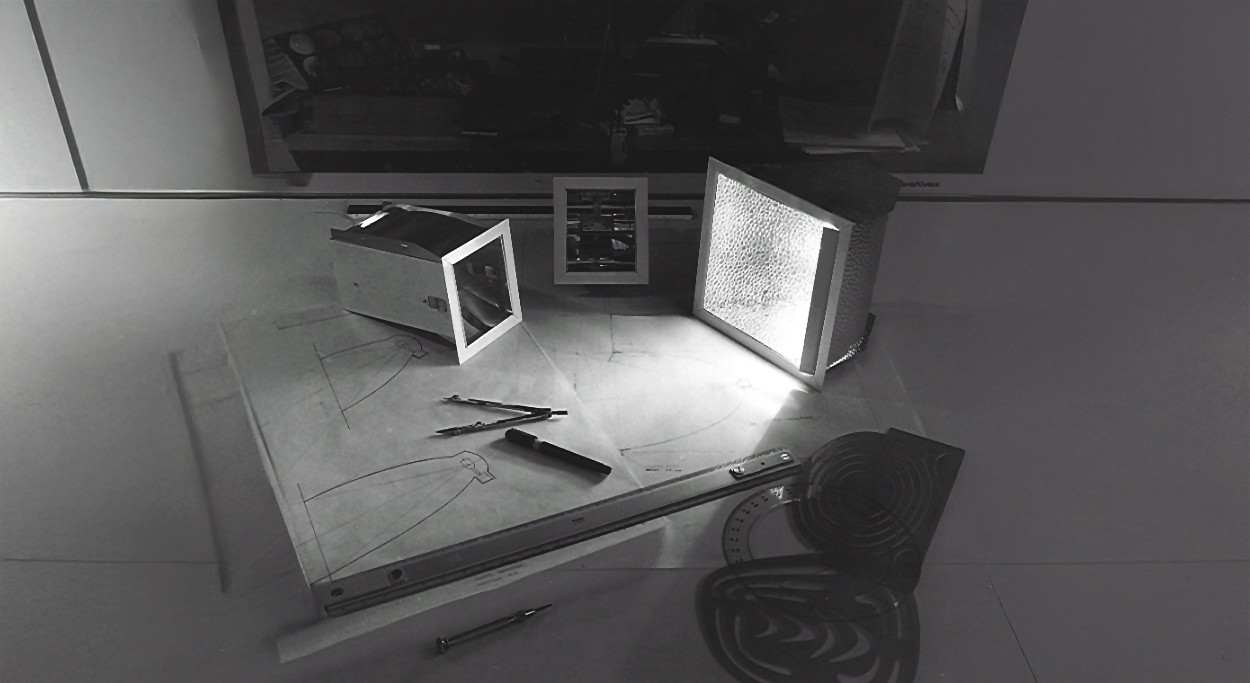
Study and prototype of a lighting fixture made specifically for the Musée National d’Art Moderne, Centre Georges Pompidou in Paris (1982–1985). On the workbench, technical drawings, tracing tools, and optical components highlight the integrated process between architectural design and lighting research conducted by Piero Castiglioni.
Piero Castiglioni states, "My experience at the Centre Georges Pompidou confirmed to me that there is no universal model for a museum, because every museum is the product of a specific context: what makes it unique is its location and, above all, the artworks it houses, which determine its form, function, and exhibition language."
These three experiences—Gare d'Orsay, Centre Pompidou, Palazzo Grassi—define a foundational moment in the history of lighting design applied to museums and indelibly mark Piero Castiglioni's professional career. They demonstrate how light can be a fully-fledged architectural design tool, capable of articulating space, layering time, and sparking new relationships between observer and artwork. During the 1980s, the projects for the Scuola Grande di San Rocco in Venice (1987) and the Groningen Museum in the Netherlands (1990–1991) were added, outlining a coherent research path aimed at redefining the role of light within contemporary exhibition design. At the heart of this approach are some constant principles, which constitute its methodological foundation.
Light plays a silent interpreter role for the exhibited artwork, maintaining an expressive neutrality similar to that of the architectural language, which in turn presents itself as a service structure and not as an overlay to the museum space. In this context, the artificial lighting project is not seen as an additional or decorative intervention, but as an integral part of the architectural project, with which it shares language, objectives, and functional logic.
The lighting device is not conceived as a stand-alone element, nor is it conventionally chosen from a catalog: on the contrary, it is conceived as a custom-made tool, a project within a project, functional to the overall logic of the exhibition.
From this perspective, the raw material of the project is light itself: lighting choices are based on the careful selection of the light source, based on its physical and perceptual characteristics, rather than the design of the fixture. This reversal of perspective highlights a clear priority: it is the distribution of light that determines the shape of the device, and not vice versa.
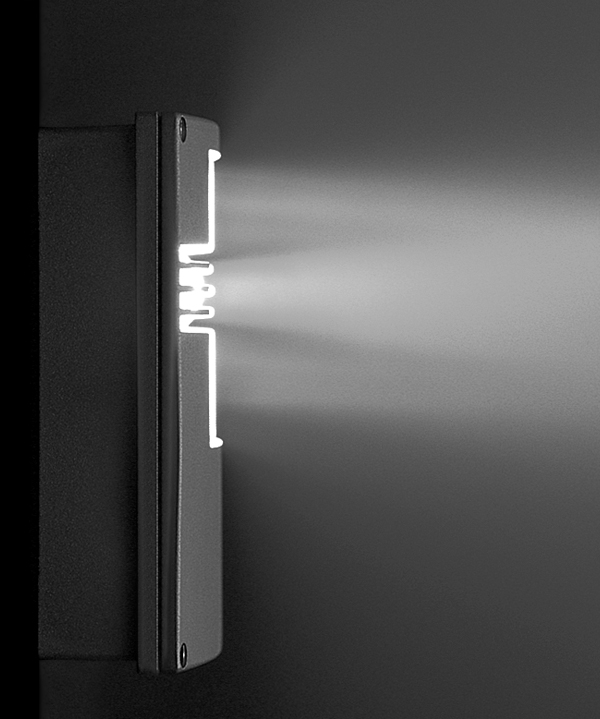
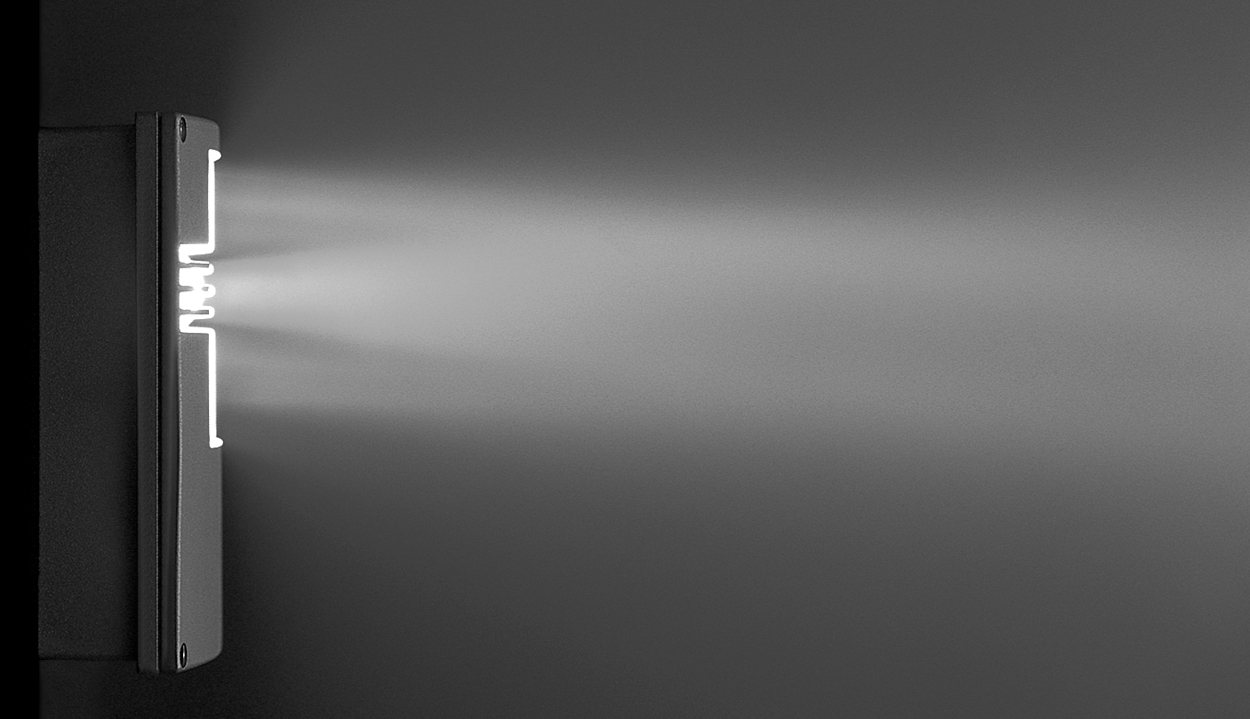
Radius, designed by Piero Castiglioni in 1997 for iGuzzini, is a spotlight that uses a light blade optic: a tempered glass lens at the top directs the beam, while an aluminum reflector positioned below modulates the light distribution. The result is a precise and controlled emission that sculpts space with elegance and rigor.
In his work on exhibition spaces, Piero Castiglioni clearly distinguishes the theme of the museum from that of the temporary exhibition. He wrote in this regard in a 1991 document: "Permanent creations, such as museums, art galleries, and art galleries, require precise and balanced planning in terms of spatial distribution, the choice of durable materials, and lighting that allows for an objective view of the exhibited works and pieces. This ensures a cultural service with strong educational overtones and can be used by a diverse and diverse audience of people of all ages, social backgrounds, and interests."
A widespread awareness of the importance of preserving historical and cultural heritage has led, in recent years, to the concept of the "microclimate museum" and the "museum machine," with studies focusing on materials, colors, era, and the perishability of objects, as well as their placement and organization in space. Lighting design, like architectural design in general, follows its own process, articulated through analysis of the space, the routes to be followed, and the materials to be displayed: from the story we intend to convey to the visitor/spectator using disparate elements that must blend into a harmonious and continuous spatial unity.
According to Castiglioni, museums must be as objective as possible; it is a service element: it must allow the artwork and individual pieces to be seen in the best possible light in relation to the other exhibits. "Lighting that guarantees the same color temperature across all vertical display surfaces, with constant and uniform illuminance levels, allows for the paintings to be presented and their chromatic interpretation to be objective and impartial, and for the internal and specific light of each painting to be revealed. This is particularly important for museums displaying representative works from different eras with different approaches to light."
Subjectivity, freedom of interpretation, and an interdisciplinary use of languages are the attitudes that guide the lighting design of temporary exhibitions. The defined temporal dimension offers the opportunity to employ specific fixtures (for theatrical, cinematic, and industrial applications), the possibility of employing unconventional lighting levels, altering colors through the use of light sources with unique chromatic emissions, and strongly contrasting the relationships between subject and background, accentuating a sense of experimentation.
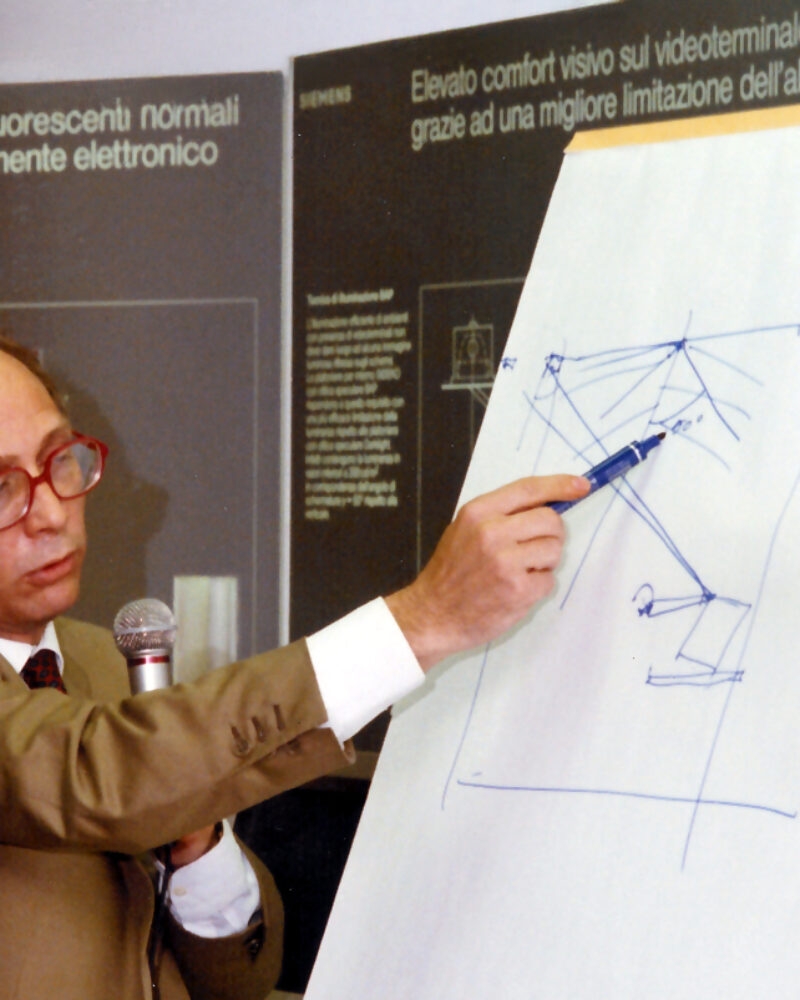
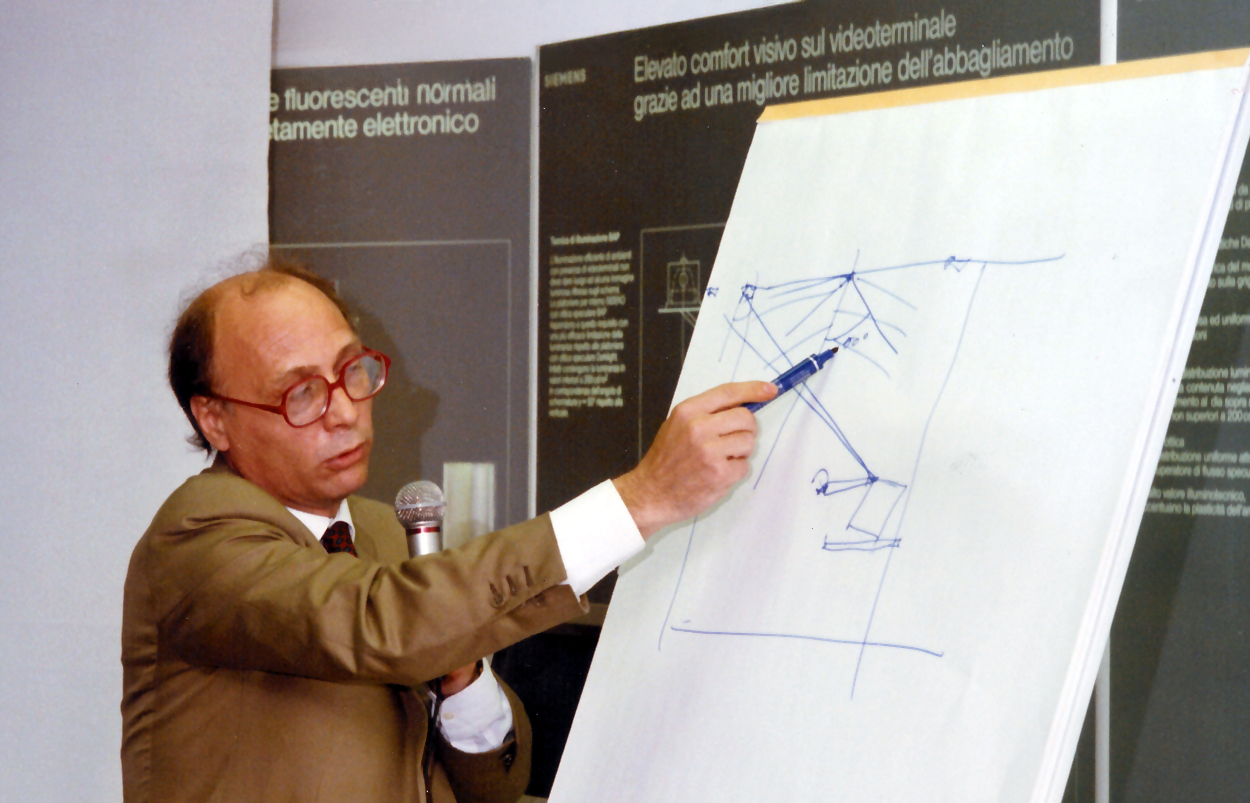
Piero Castiglioni al convegno Siemens del 1985. Durante l’intervento, illustra concetti legati al progetto della luce, sottolineando l’importanza dell’integrazione tra aspetti tecnici e spaziali nell’illuminazione architettonica.
Throughout this long journey, Piero Castiglioni's work demonstrates how lighting design can be much more than a technical discipline: it emerges as a form of design thinking, capable of interrogating space, its functions, and its symbolic and perceptual relationships. His approach integrates lighting engineering skills, architectural sensibility, and cultural vision, creating a new and pioneering professional figure: the Architect of Light. His work spans historical, artistic, urban, and museum contexts, restoring light to its foundational role in the construction of spatial experience. In an age of fragmented specialization, Castiglioni reaffirms the unity of design, making light a tool for critical interpretation, context engagement, and poetic expression.
His contribution is not limited to technical excellence or the formal quality of individual projects, but is rooted in a broader vision: that of a thoughtful, measured, and calibrated light, capable of engaging with architecture and time, with matter and with the gaze. A light that interprets rather than decorates. That transforms rather than adds. That discreetly and rigorously integrates into the life of spaces rather than imposes itself. With over fifty years of experience, more than a thousand completed projects, and a constant pursuit of research, Piero Castiglioni has made a decisive contribution to defining a culture of light in contemporary design. He represents an essential reference for anyone today who intends to work in the field of architectural lighting with awareness, responsibility, and critical intelligence.
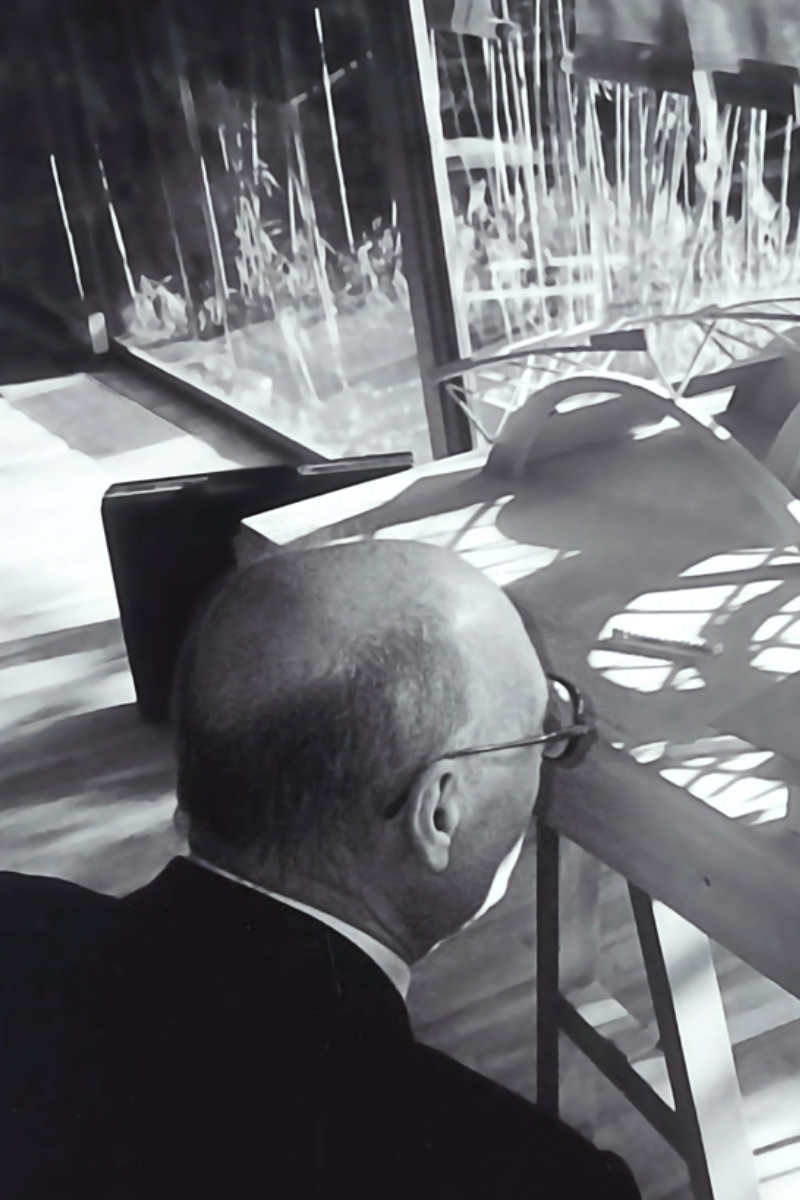
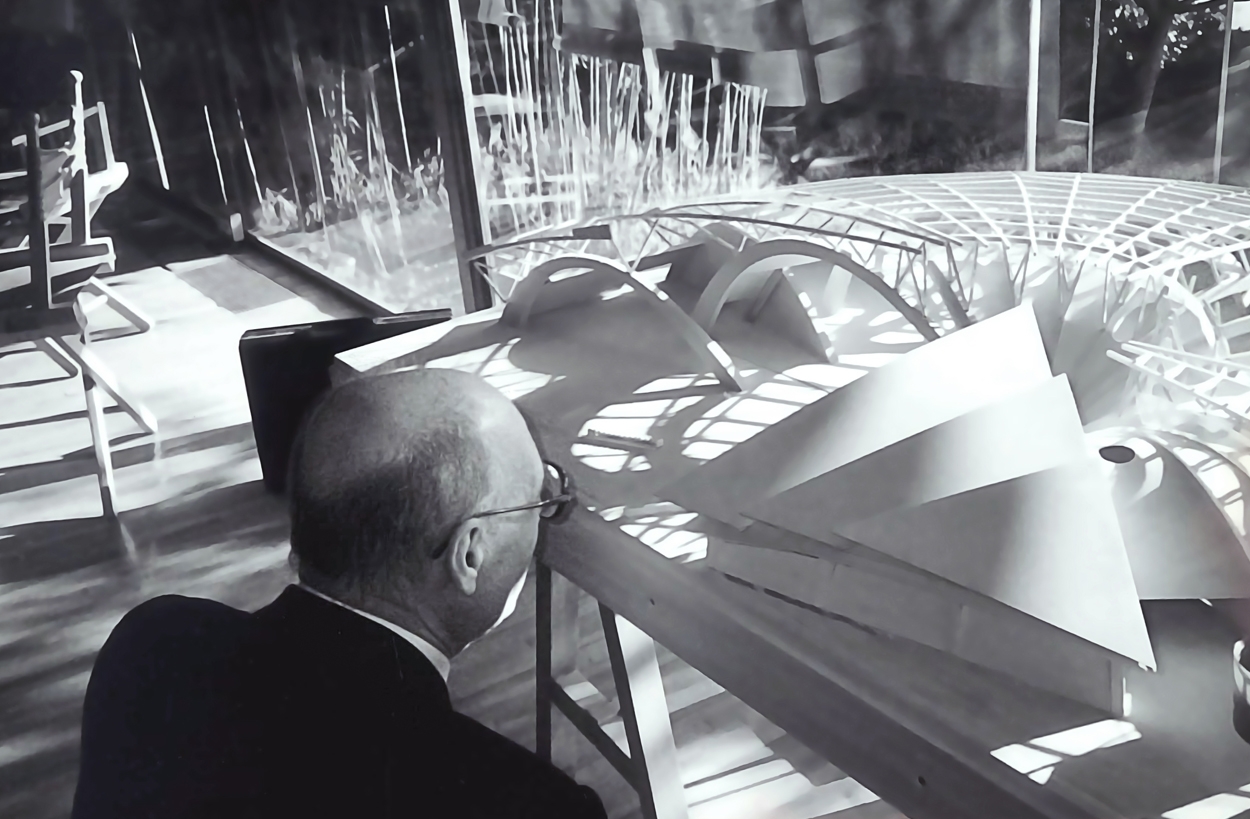
Italy, San Giovanni Rotondo, 2004 – Piero Castiglioni observes the model of the Sanctuary of Saint Pio of Pietrelcina, designed by architect Renzo Piano. A complex and symbolic work, in which architecture, light, and spirituality merge into a single vision.
Livio Castiglioni. Experimental Origins of Italian Lighting Design
Between waves and flashes: light and sound as invisible languages in Livio Castiglioni's design vision
Livio Castiglioni (1911–1979) is a central figure in the genealogy of twentieth-century Italian design. He is the father of Piero Castiglioni, one of the most important figures in the birth of lighting design in Italy, and he passed on to him a design legacy founded on an experimental, technical, and sensorial vision of light, but above all a conception of light as a phenomenon to be investigated, as a constantly transforming material. The studio-laboratory that father and son shared on Via Presolana in Milan in the 1970s became the place where a new way of understanding light took shape: no longer a simple technical function, but an architectural, perceptual, and cultural experience.
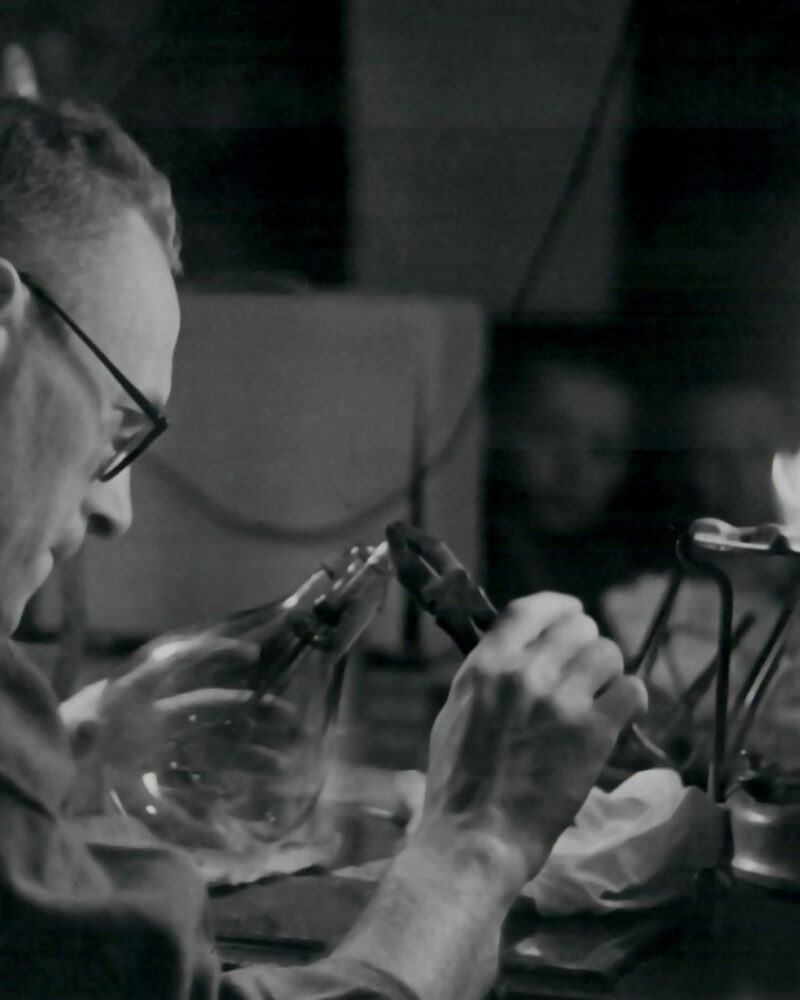
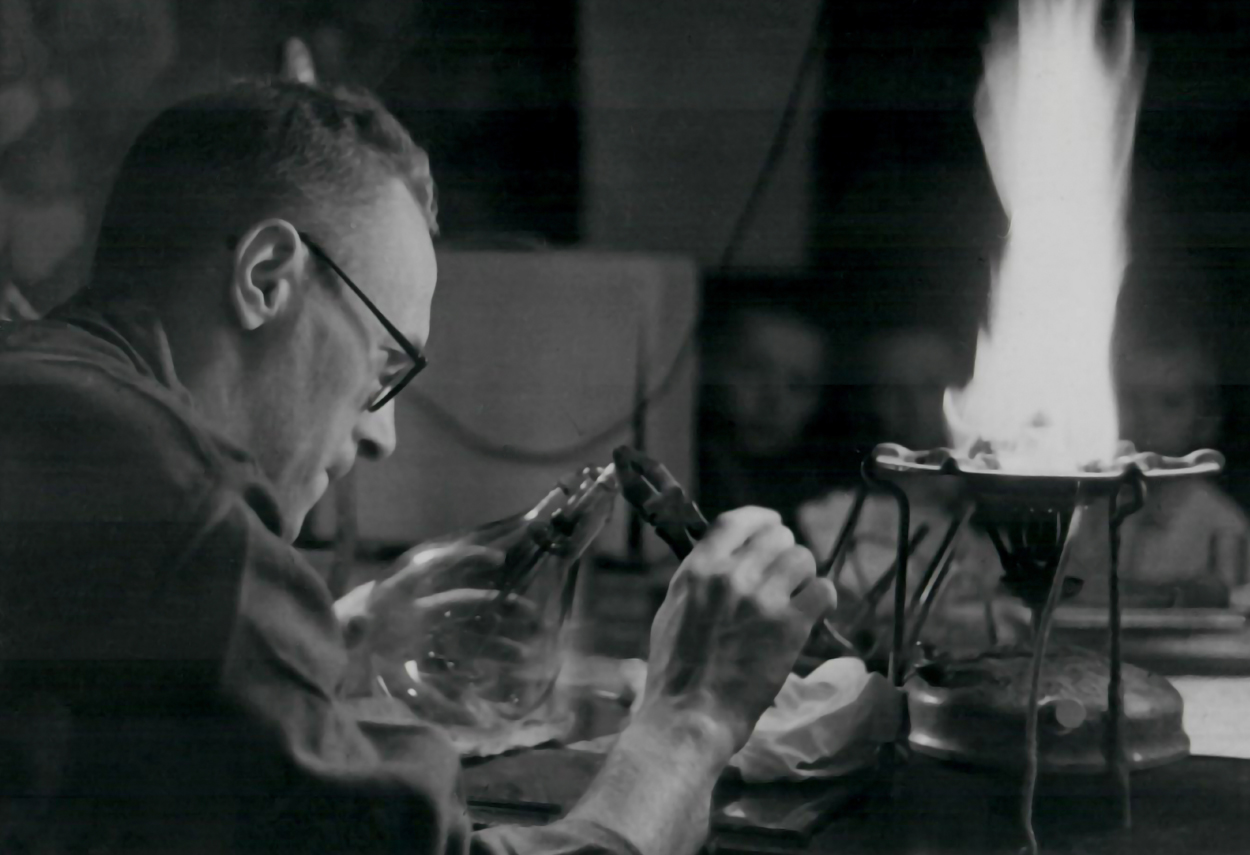
Livio Castiglioni, Russia, 1942. During the military campaign, using pliers and an improvised torch, Livio attempts to salvage an incandescent light bulb by removing its metal base. This rudimentary intervention anticipates, in a surprisingly visionary way, the concept of the giant, ferrule-less bulb, later developed with brothers Achille and Pier Giacomo for the installations at the 1951 Triennale: a technical gesture that becomes the involuntary prototype of an essential and radical poetics of light.
But even before that, Livio was the son of the Italian sculptor, painter, and architect Giannino Castiglioni (Milan, May 4, 1884 – Lierna, August 27, 1971), known for his solid and monumental figurative language, tied to the academic tradition but capable of dialoguing with the demands of modernity. Born in Milan and trained at the Brera Academy, he created important public works, celebratory monuments, and sculptural complexes, distinguishing himself for his attention to spatial composition and the plastic rendering of volumes. Among his best-known works are the War Memorial in Erba (1922), the Victory Monument in Bolzano (1928, designed with Marcello Piacentini), and the Crypt of the Ossuary in Redipuglia (1938). His poetics move between the representation of sacrifice, collective memory, and heroism, with a style that often fuses sculpture and architecture in a single scenographic vision.
He was also the older brother of Pier Giacomo (Milan, April 22, 1913 – Milan, November 27, 1968) and Achille Castiglioni (Milan, February 16, 1918 – Milan, December 2, 2002), with whom he shared a transdisciplinary approach since the 1930s, a vision that anticipated the emergence of design as an autonomous discipline in the postwar period. Livio Castiglioni is among the most eccentric and radical figures in twentieth-century Italian design. He forged a design path that escapes the established categories of object design and functionalist aesthetics. His work develops at the edges of the object, in that border zone where light, sound, energy, and perception become the living material of design.
Bruno Munari captured it perfectly when describing the essence of his work: "Livio Castiglioni achieves, with essential electrical means, a deliberate optical, thermal, dynamic, acoustic effect, without computers, without programming, without transistors, without micrological complexes, without electronic amplifiers." A statement that celebrates his poetics of the essential: a technological art made of sensorial transformations, achieved not through sophisticated devices, but with a manual, almost artisanal skill, capable of reinventing the ordinary.
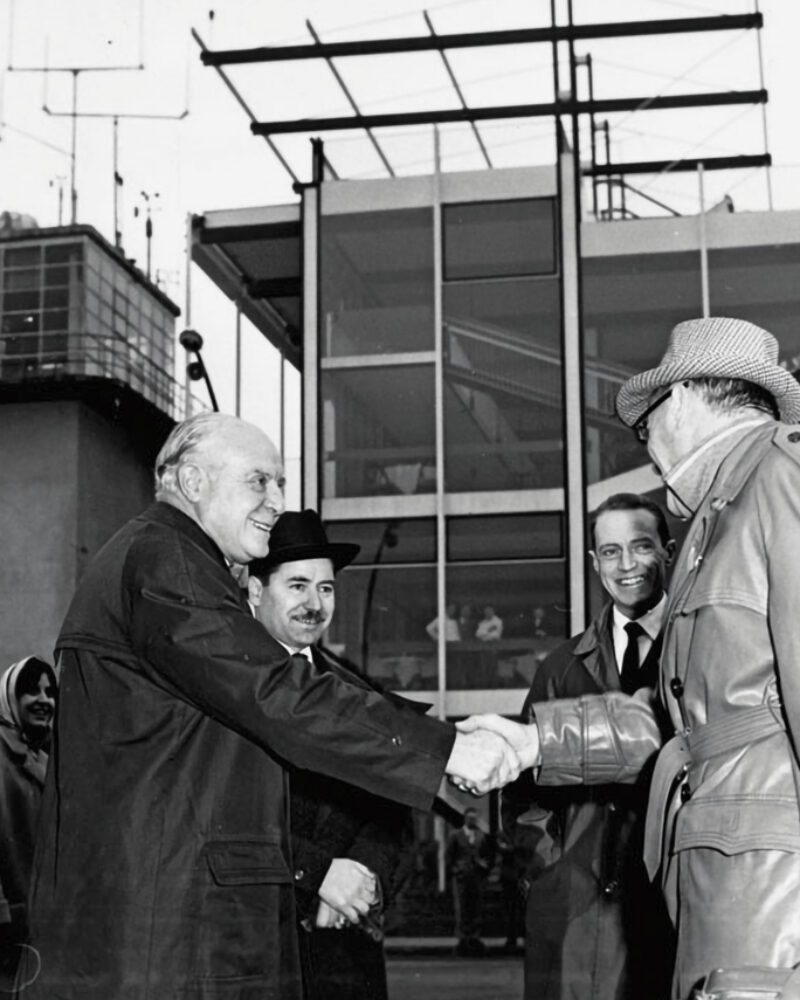
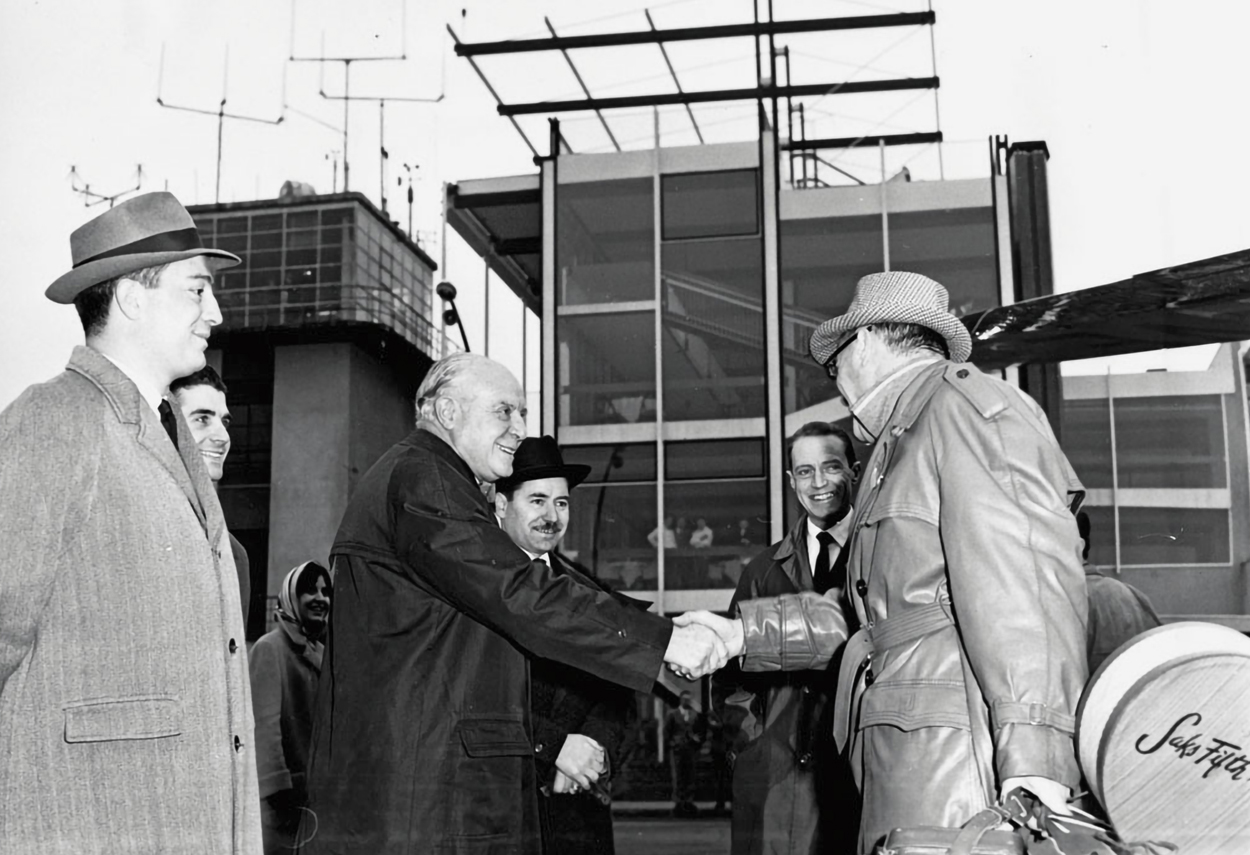
Livio Castiglioni meets Giò Ponti upon arrival at the airport, in a moment of exchange between two protagonists of twentieth-century Italian design culture. In the background, the rationalist architecture of the terminal reinforces the scene as a document of an era of dialogue between design, industry, and vision.
From a very young age, Livio was drawn to early communication technologies: he built crystal radio receivers, installed a transceiver antenna on his house in Lierna as early as 1946, and in 1934 won a national award for a 16 mm short film. His passion for the invisible wave—sound and image—immediately directed his projects toward the immaterial dimension of perception. His interest stems from a profound fascination with light as a visible manifestation of energy, to be explored rather than resolved. In this sense, Livio presents himself as a contemporary heir to the tradition of folk illuminations and fireworks, of which he was an avid collector and connoisseur. In his projects, light is never simply illumination: it is wonder, engagement, and visual pleasure. This aptitude was strengthened by his studies in engineering and architecture at the Milan Polytechnic, where he graduated in 1936. His penchant for electrical technologies translated, already in the 1930s, into a profound reflection on the form of the instrument: abandoning the decorative cabinet, Livio Castiglioni focused on the radio, reworking the relationship between form, function, and interface. The clarity of the dial, the position of the speaker, and the ergonomics of the controls became central elements of a new functional aesthetic, in which form served primarily to communicate.
But it is with light that Livio Castiglioni carries out his most personal exploration. In his projects from the 1940s and 1950s, and especially in his installations for the Milan Triennale, light manifests itself not as an object, but as an architectural phenomenon, removed from decorative emphasis. Castiglioni works by subtraction, reducing means and enhancing the phenomenon. In the famous "Hall of Italian Priorities in Art," overhead light falls from invisible openings in the ceiling, refracts on the walls, and reflects in the floor. Light shapes the space through veils, blades, and directional radiation.
With the "Lighting Exhibition" at the IX Triennale in 1951, in collaboration with Achille and Pier Giacomo, artificial light became a perceptual experience, somewhere between science and suggestion. This vision stood in stark contrast to the dominant practice of lighting design, where the lamp became an aesthetic fetish. For Livio (and later for Piero), the object was a tool, not an end: it was created to produce a specific type of light, responding to a precise visual need, and only then did it take shape.
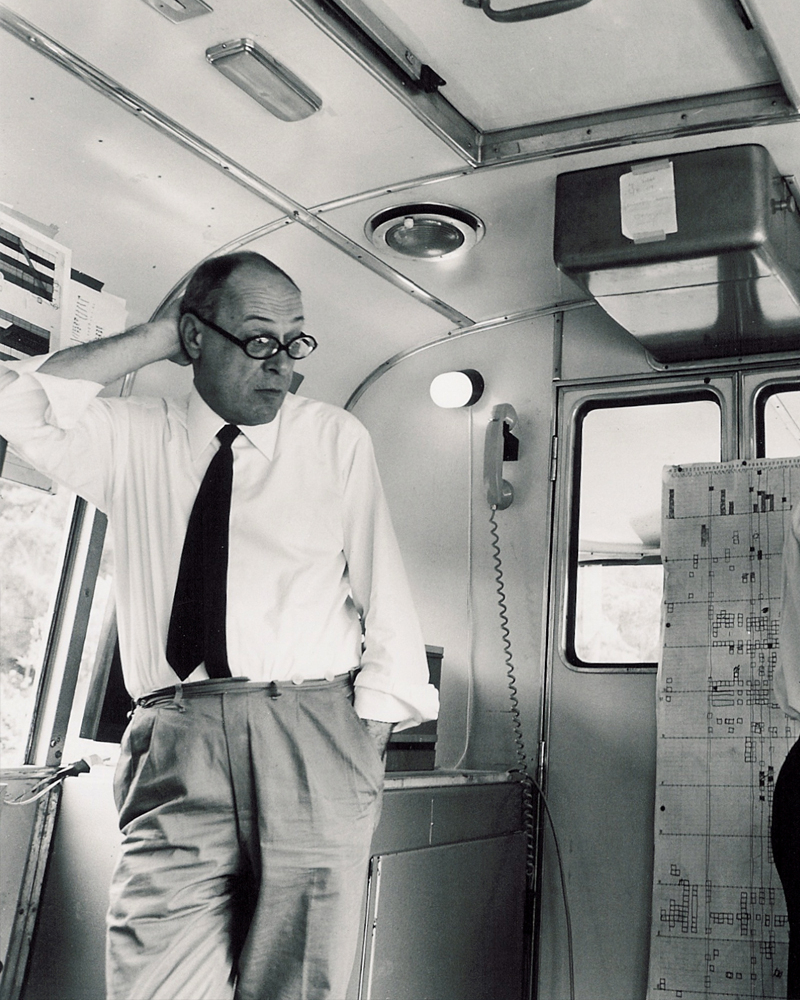
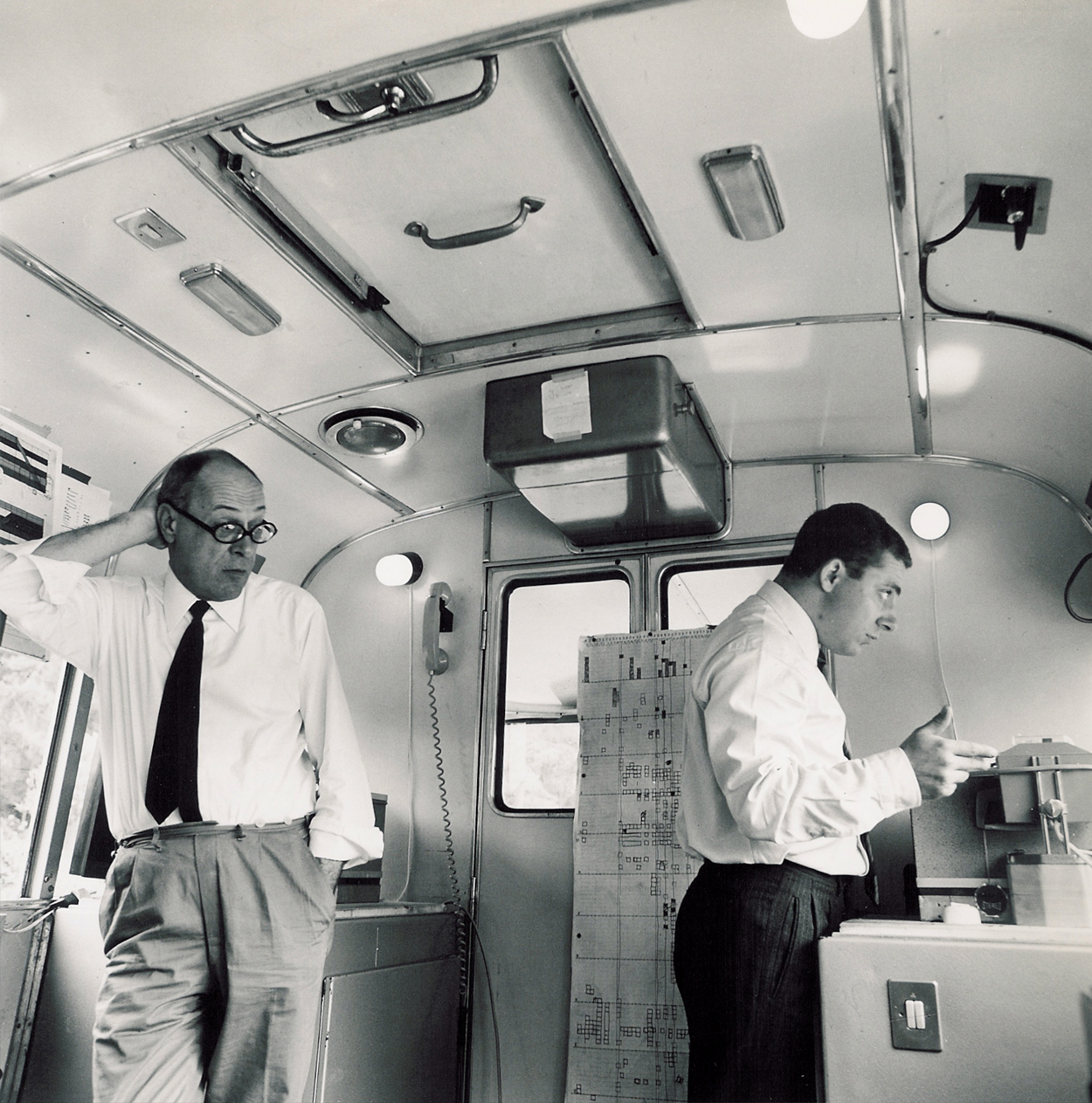
In the 1967 RAI traveling pavilion, created with his brothers and Davide Boriani, Livio designed an analog light and sound control system: a carillon control unit controlled hundreds of visual and acoustic events. It was an immersive performance ahead of its time, entirely mechanical, where light and sound become perceptual choreography. In other projects, such as Trepiù or the Collector's House with Gae Aulenti, light and sound intertwine: incandescent wires that "play," luminous ampoules that "crackle," synesthetic environments in which visual and aural perceptions mutually amplify each other.
In the 1970s, as electronics invaded design with spectacular effects, Livio responded with everyday technology grounded in design pragmatism and concrete function: mercury switches, electrical wires, and ordinary light bulbs were transformed with manual ingenuity into complex sensory experiences. All his work appears as a critique of the shortcuts of spectacular electronics.
It is to this logic that one of Livio's most emblematic inventions, the Boalum, designed with Richard Sapper for Artemide in 1969, belongs. Not a lamp, but a flexible luminous body, devoid of a definitive form, intended to change with the user's intervention. It is the object that more than any other expresses the situationist vocation of his design: the light is not imposed, but constructed in relation to space, the body, and gesture. Boalum is action light, participatory light. In promotional texts of the time, Boalum is described with irony and freedom: "Uses of the Boalum: light with many lights. Take the luminous cord and choose the right place for its placement: on the floor, hanging on the wall, or hanging from above with knots and sinuous returns. Suitable for the entrance or living room, it can be worn, in exceptional cases, by a young woman, preferably blonde and a little sexy." Behind this lightness lies a profound reflection on domestic space: no longer a static and regulated place, but a flexible, relational environment, where light becomes a companion to behaviors and transformations.
Achille Castiglioni remembers him like this: "Livio was always the most inventive and followed his own path [...] he was a bit of an inventor and liked to tinker, put together devices." Before the war, Livio had even built a device capable of picking up the first experimental television broadcasts from England: "they looked like ghosts, like magic."
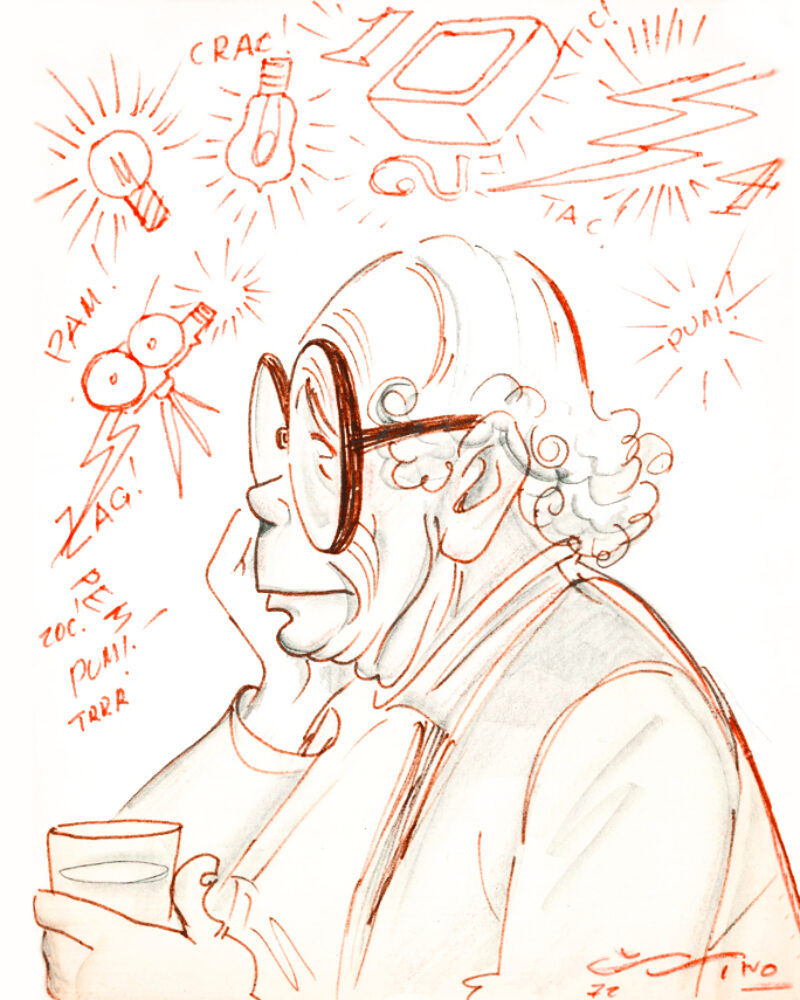
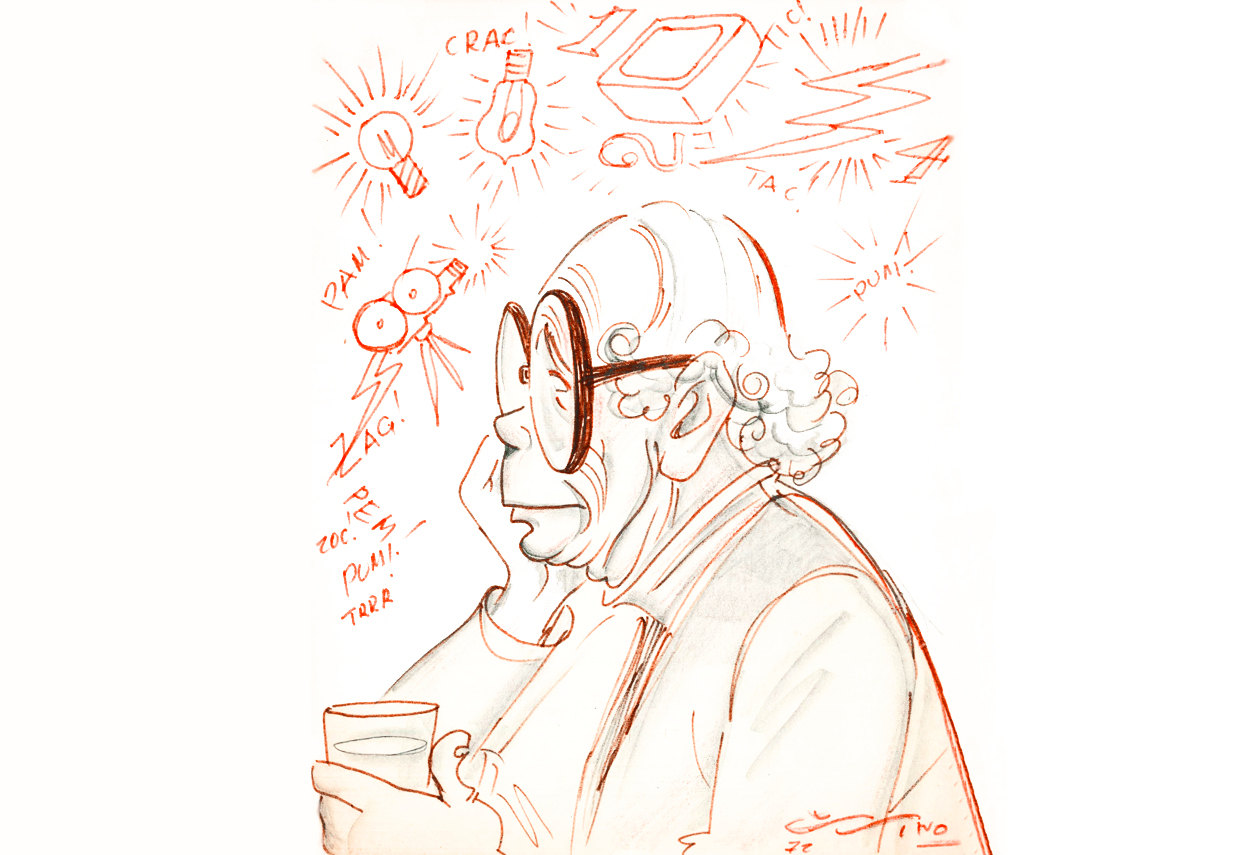
Cussino, caricature by Livio Castiglioni, 1972.
In his studio-workshop on Via Presolana, Livio works with amateur radio and filmmaking tools: reel-to-reel tape recorders, transformers, cables, amplifiers, loudspeakers. He is a modern alchemist who seeks form not as an icon, but as an experience. All his work is a critique of the shortcuts of technological spectacle. Faced with the effects achieved with sophisticated electronics, Livio responds with poetic everyday technology: mercury switches, stove wires, common sources, bent to generate effects of intense perceptual intensity. His research finds fulfillment precisely in this attitude: immaterial yet concrete, sensorial yet scientific, artisanal yet anticipatory. It is no coincidence that in 1979, on the eve of his sudden passing, he was working with Giovanni Klaus Koenig on an exhibition on the forms and designs of radio and television: the two media that, from a young age, had fascinated him and drawn him toward a design based on invisible communication.
Today, Livio Castiglioni's work still seems extraordinarily relevant. His oeuvre demonstrates that design can be thought, research, and a poetic act. That light, when liberated from the object, can become language, narration, and an emotional landscape. At a time when we are once again talking about sensitive environments, immersive spaces, and multisensory relationships, Livio Castiglioni's legacy is more alive than ever: he reminds us that designing means listening to the invisible substance of things, and shaping—with intelligence and freedom—our experience of the world.
Rethinking Livio Castiglioni today means recognizing the value of a project that eluded formalization, yet shaped a vision. He paved the way for a new generation, and in particular for Piero, who would transform that intuition about light into a true discipline: lighting design.
The Castiglioni Brothers: Masters of Italian Design, Amidst Invention, Irony, and Rigour
From 1930s Milan to industrial design: the cultural and design journey of the Castiglioni family
The three Castiglioni brothers—Livio, Pier Giacomo, and Achille—are firmly established within the Italian design tradition, making a decisive contribution to the definition of a design culture that, between the 1930s and the late 1900s, evolved from an emerging phenomenon into a mature, internationally recognized language. Sons of the sculptor Giannino Castiglioni, a leading interpreter of twentieth-century plastic art, the brothers grew up in an intellectually fertile environment, inheriting an artistic and industrial sensibility that ran through the family. This context also shaped the figure of Piero Castiglioni, Livio's son, born in Lierna in 1944. He focused his research exclusively on light, making this material the subject of in-depth theoretical and experimental exploration that placed him among the protagonists of contemporary lighting thought.
The three brothers graduated from the Polytechnic University of Milan, becoming part of the generation of designers entrusted with the interpretation of the new concept of the integral architect, developed by Gustavo Giovannoni as part of the reform of architecture education. This new model envisioned a combination of technical rigor and humanistic training, reinforced by the practice of composition and drawing. This approach allowed them to address the various scales of design—from urban to domestic—with methodological consistency.
The Castiglioni brothers' identity of thought stems from the interaction of three distinct personalities rooted in a shared vocation for experimentation. It is in this synthesis that the stylistic signature of the Castiglioni brothers is discernible, whose work has profoundly influenced both the practice and the imagination of Italian product design.
During Italy's transition toward the industrialization of design, the three brothers—Livio, Pier Giacomo, and Achille Castiglioni—established themselves as pioneers of a new way of conceiving everyday objects. A photograph taken in November 1961 shows them with some of their most iconic projects: a table and wall radio, and a set of cutlery created in collaboration with Luigi Caccia Dominioni, dating back to the pre-war period. These seemingly simple artifacts embody the founding essence of Italian industrial design, in which technical innovation, formal research, and attention to everyday use are harmoniously intertwined. The radio, in particular, represents a modernist reflection on the aesthetics of household appliances, while the cutlery represents one of the first cases in which function is translated into a design language that can be industrially replicated. The Castiglioni brothers' approach anticipates the logic of design as an autonomous discipline, shaping a methodological approach that will become a model for subsequent generations. It is in this period, suspended between analytical rigor and creative freedom, that the complex figure of the Italian designer begins to emerge, a synthesis between engineer, architect, and craftsman of modernity.
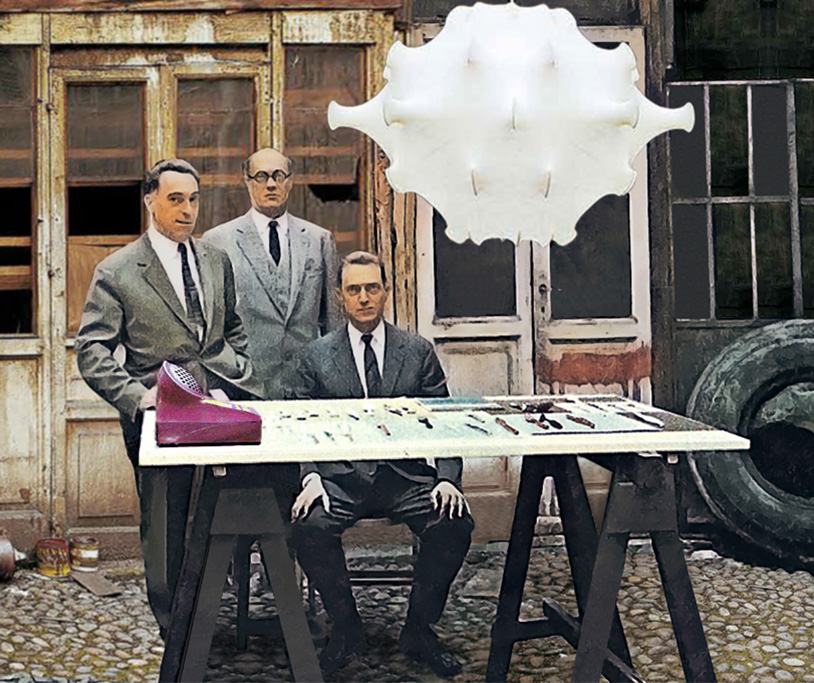
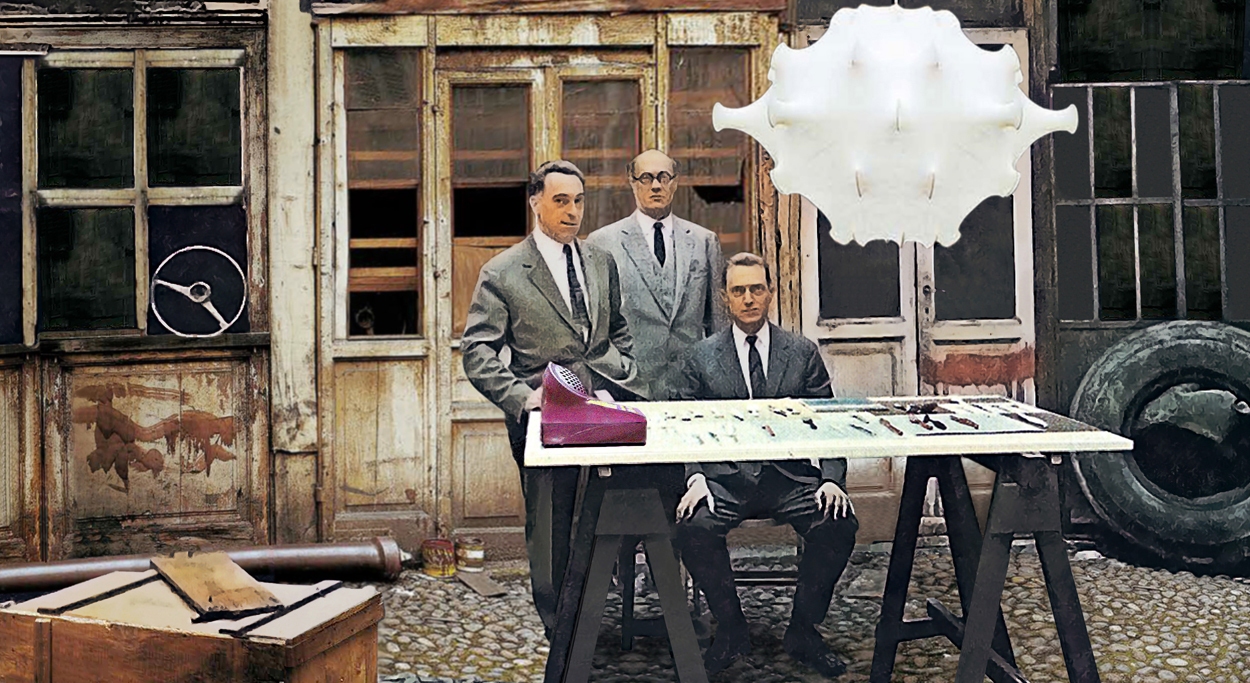
In Evaristo Fusar's famous 1961 photograph, the three brothers are portrayed in the courtyard of their Porta Nuova studio, behind a worktable with some of their early prototypes. Above, the Cocoon Taraxacum lamp, recently designed for Flos, softly illuminates their faces.
Livio Castiglioni's academic career ended in 1936, followed the following year by Pier Giacomo's, while Achille, the youngest, graduated in 1944, during the height of the war. The three worked together in the same studio until 1952; subsequently, Livio's professional career took a different direction, focusing primarily on consulting for companies such as Phonola and Brionvega, specializing in the design of electroacoustic technologies. The collaboration between Achille and Pier Giacomo intensified, culminating in an extraordinarily fruitful design season. After the premature death of Pier Giacomo in 1968, and that of Livio in 1979, Achille would continue his brothers' legacy, building on their wealth of experience and transposing it into his professional practice and teaching until the 1990s.
In the urban fabric of Milan, where the Martesana Canal once lapped the Porta Nuova Bastion, a street was recently named after the Castiglioni brothers, winding discreetly between the new vertical architecture. This recognition, though inserted into a now-altered landscape, restores continuity to a memory rooted in that very area: it was there that the brothers grew up and took their first steps as professionals. The area, already home to Milan's first railway station, experienced significant industrial development between the 19th and 20th centuries, with the presence of companies such as Grondona (later OM), Ernesto Breda's Elvetica, and the first Pirelli factory, later relocated to Bicocca.
The Milan where the Castiglioni family trained and worked was a booming metropolis, surpassing one million inhabitants in the early 1930s, becoming a central hub for European economic and cultural dynamics. The industrial landscape was diverse: mechanical engineering, metallurgy, textiles, publishing, chemicals, wood, and leather. Added to this was a network of small workshops and laboratories, especially in the central areas. In this context, the construction of the Trade Fair in 1923 and, ten years later, the inauguration of the Palazzo dell'Arte della Triennale designed by Giovanni Muzio, offered new opportunities for a generation of architects who identified with the magazines Domus and Casabella, edited respectively by Gio Ponti and Giuseppe Pagano with Edoardo Persico.
In both contexts—the Fiera and the Triennale—the Castiglioni brothers were key figures, shaping a design practice capable of combining experimentation and technical rigor, and forging significant relationships with manufacturing companies. The Porta Nuova area, where the brothers began their first collaborations, was densely connected to cultural institutions and cutting-edge businesses: from the Permanente, rebuilt after the war, to the Montecatini offices designed by Gio Ponti in 1938, equipped with the most modern communications technologies. A lasting relationship was forged with Montecatini, resulting in numerous trade fair displays. A short distance away, on Via Palermo, the Olivetti Advertising Office was established, a transit hub for Italy's finest graphic designers. The BBPR group also had its headquarters nearby. In 1936, the group won a competition sponsored by Domus for a new radio, championing the need to give the technological object an appearance consistent with its intended purpose, far removed from the logic of home furnishings.
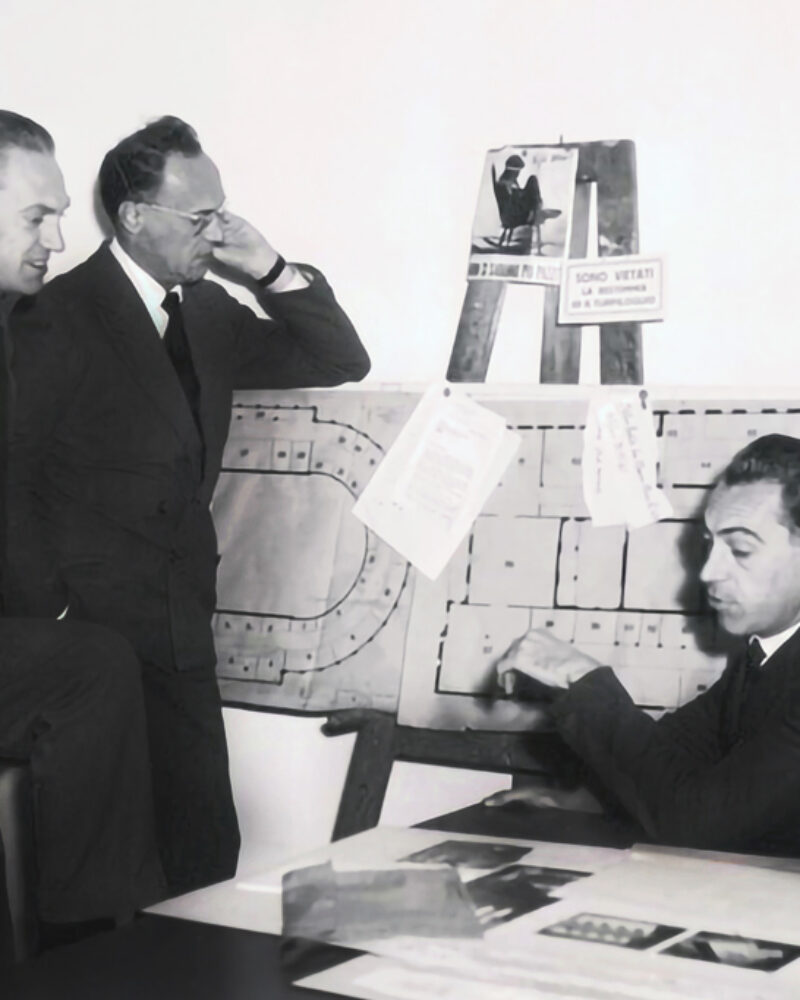
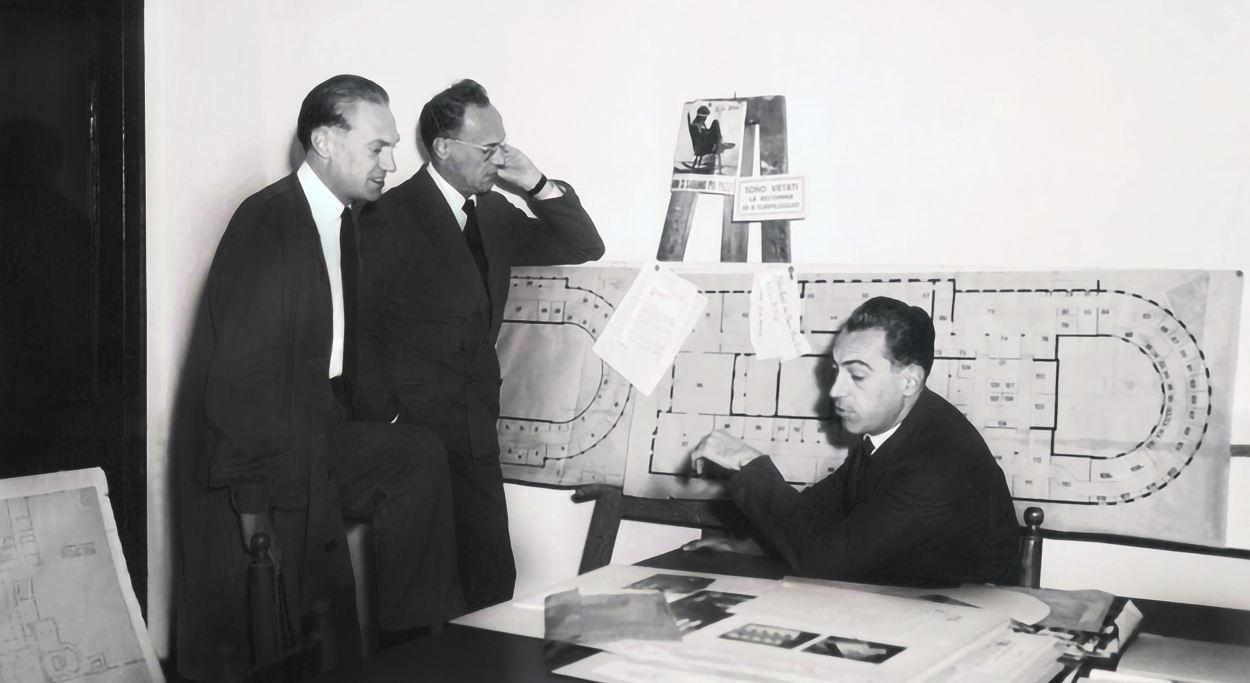
Under the supervision of BBPR, in 1936, Livio, together with Caccia Dominioni and Pier Giacomo, then still a student, designed the "Priorità italiche in arte" room at the VI Triennale di Milano. The light and sophisticated project introduced an original lighting solution, anticipating themes that would be central to their future research. In Lierna, at his father's second sculpture studio, the group developed their first projects for public buildings and private homes, drawing inspiration from the masters of Como rationalism, such as Giuseppe Terragni and Pietro Lingeri. At the same time, Livio, a passionate amateur radio operator, independently built radio sets, developing the idea that design should arise from a synthesis of functionality, construction, and interaction. This reflection led him, from 1938 onwards, to write for leading magazines in the field, contributing to the redefinition of the aesthetics of technological objects.
Within this design trajectory, Livio and Pier Giacomo decisively introduced an interest in sound and lighting technologies into the studio, laying the foundation for an increasingly close collaboration with the manufacturing industry. A concrete opportunity to explore the relationship between aesthetics and technology arose at the VII Triennale in 1940, with the Radio Equipment Exhibition. For that occasion, together with Luigi Caccia Dominioni, the two brothers created twenty working models of radios and radio-phonographs, anticipating the forms and languages of industrial design through devices that combined technical functionality and expressive rigor. It was during this phase that Fimi-Phonola of Saronno acquired two of the developed designs, transforming them into compact devices intended for serial production, available in numerous color variations. These experiments are in perfect harmony with other contemporary examples, such as the Summa Olivetti calculating machine by Marcello Nizzoli, and are welcomed by critics as archetypes of nascent Italian industrial design, in which form, function and mode of use are integrated into a coherent unity.
"The concepts expressed and implemented by the Milanese group of the VII Triennale," Livio writes, "were too far ahead of current taste, compared to the production techniques of the time [...]. More than a decade passed, partly due to the war and the difficulties of reconstruction, before the market's production structure incorporated the proposals being put forward at the time."
After the interruption caused by the war, the brothers reunited in Lierna, where the family had taken refuge following the bombing of Milan. At this point, their collaboration with Caccia Dominioni ended, and he would embark on his own path. With Achille's official entry into the studio, following his graduation in 1944, the specific aptitudes of the three brothers became clearly defined: Achille and Pier Giacomo jointly dedicated themselves to the design of spaces and objects, prioritizing the integration of form, function, and communication; Livio, on the other hand, focused his research on immaterial aspects such as sound, light, and technological interaction, anticipating many of the reflections that would characterize the design of the 1960s and 1970s.
It is in this climate of intense industriousness that one of the studio's most emblematic atmospheres was born: a disciplined and monastic place, described years later by Massimo Vignelli, then a young collaborator. He remembered Livio isolated in a side room, intent on listening to radio signals through headphones, surrounded by his instruments; while Achille and Pier Giacomo, seated at the large drawing table, enthusiastically and humorously discussed their ideas. The space was illuminated by white enameled industrial lamps and dominated by Lips Vago bookcases overflowing with prototypes and materials: among them, the Phonola radio, now a symbol of Italian style, and the legendary Moretti camp chairs.
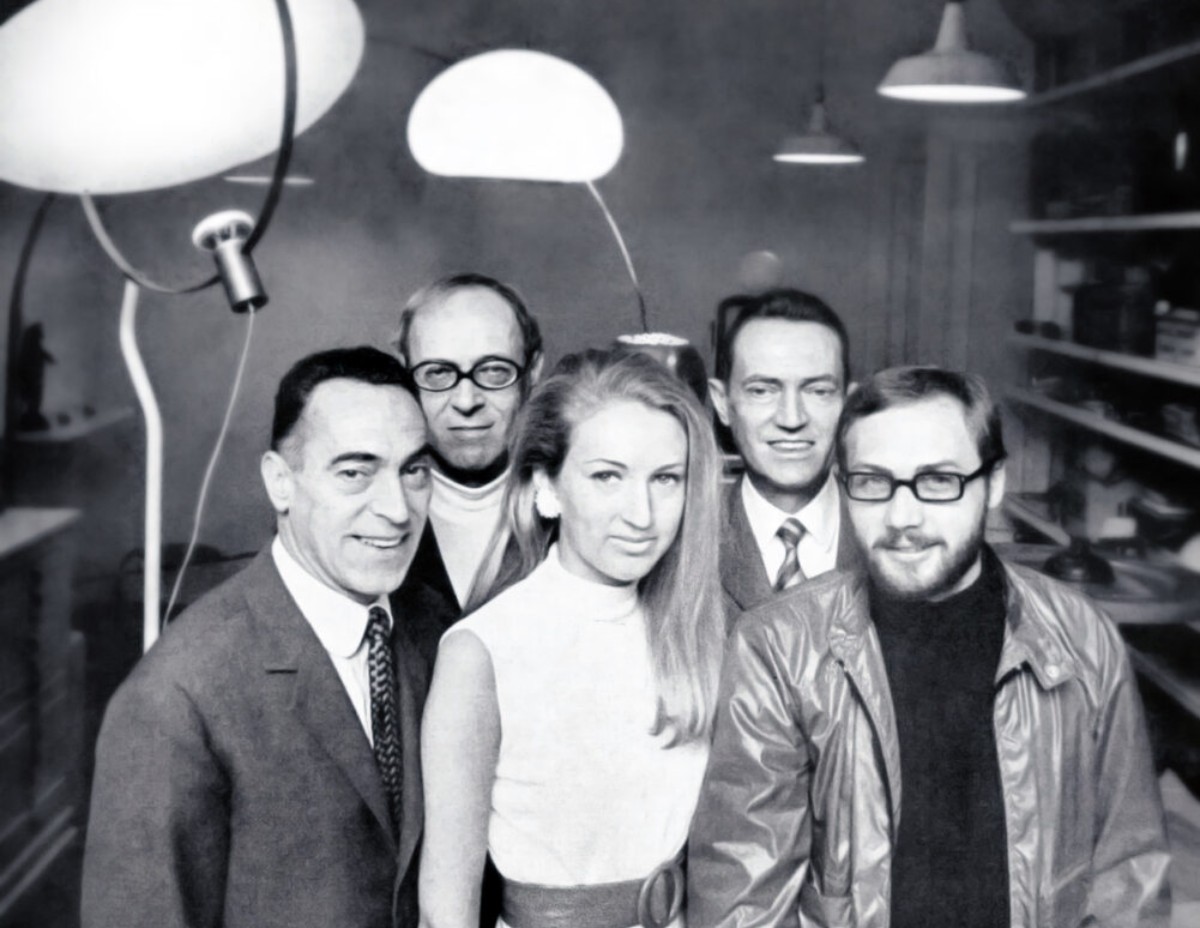
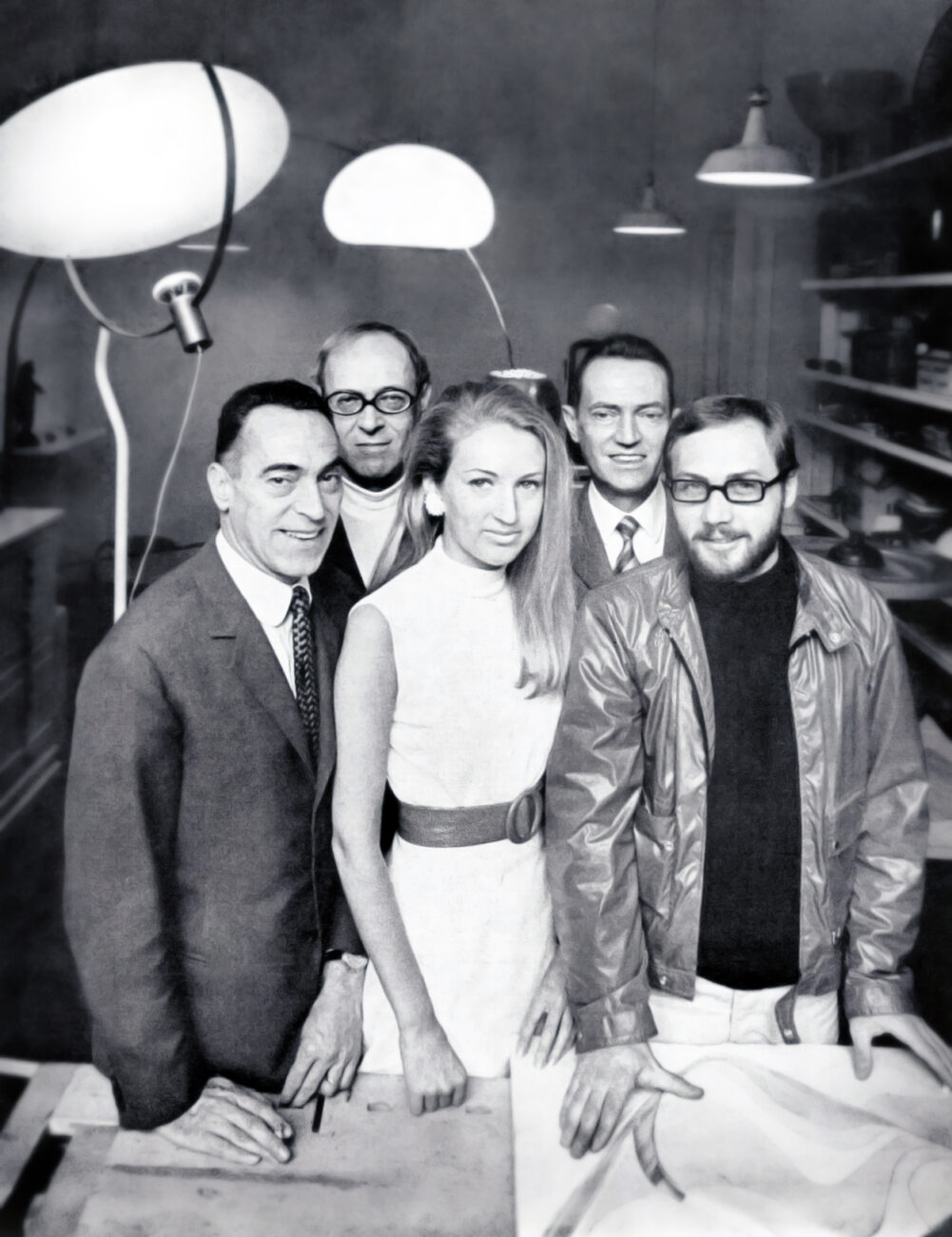
Milan, 1968 – In their studio in Piazza Castello, from left: architects Achille Castiglioni, Livio Castiglioni, Giorgina Castiglioni, Pier Giacomo Castiglioni, and Piero Castiglioni. A rare family portrait that captures three generations of designers, key figures in the birth of Italian design and the culture of lighting.
Pier Giacomo, a thoughtful and measured figure within the studio, and Achille, gifted with an ironic and irreverent creative streak, engaged in a constant dialogue about their creations, alternating between bursts of enthusiasm and moments of conscious sobriety, always guided by an attitude free from ostentation. Their exchange unfolded as a continuous dynamic, based on collaborative design and emblematic gestures, including that characteristic tilt of the face to the left, almost a reserved expressive code, a sort of nonverbal language that established the understanding and unity of purpose in their daily practice.
After World War II, the studio's activities expanded into various fields: urban planning, architecture, trade fair design, and corporate consulting. In particular, Pier Giacomo developed a theoretical reflection that led him to found the MSA – Movimento di Studi per l’Architettura (Movement of Studies for Architecture) in 1945, together with Ernesto Nathan Rogers, whom he would later serve as assistant to at the Milan Polytechnic, after working alongside Piero Portaluppi and Gio Ponti. In 1958, he earned a teaching position in Architectural Composition, and in 1964, a chair in Drawing and Surveying. His architectural projects, often in collaboration with Achille, reflect the dialectic between internationalism and regionalism, interpreting the tension between the legacy of the Modern Movement and Rogers's call—expressed in the pages of Casabella—to emancipate oneself from a rigidly Central European rationalist vision.
The studio's versatility is particularly evident in temporary installations, which became a favored field of experimentation from the 1950s onward. Their initial experiences stemmed from their relationship with ANIE – the National Association of Electrotechnical Industries – but quickly expanded to include companies operating in the chemical, energy, and communications sectors. The ephemeral nature of their installations, combined with the potential for abstract figuration, allowed the Castiglioni brothers to freely explore languages and formal solutions. This context led to collaborations with some of Italy's leading visual designers: Erberto Carboni, Bruno Munari, Max Huber, Pino Tovaglia, Heinz Waibl, Michele Provinciali, and Giancarlo Iliprandi.
The success achieved through the installations and participation in the 1951, 1954, and 1957 Triennales attracted the attention of a growing number of companies. It was in these projects that lighting solutions emerged as distinctive elements, prefiguring some of the lamps that would later be mass-produced. The first significant commission in the household appliance sector came from REM, a vacuum cleaner manufacturer, for which Pier Giacomo and Achille designed the Spalter model in 1956, an innovative solution in terms of both shape and technology.
During the same period, the Castiglioni family consolidated their partnership with entrepreneur Dino Gavina, promoted by Lucio Fontana, which would lead to long-lasting collaborations in the fields of furniture and lighting. Also in 1956, the Castiglionis participated in the founding of the ADI – Association for Industrial Design, where they held active roles in its steering committees. Livio Castiglioni served as its president between 1959 and 1960. The ADI was founded with the aim of promoting the professional recognition of designers and promoting design as a tool for economic and cultural growth. Among its most significant initiatives was the creation of the Compasso d'Oro Award, designed to recognize the excellence of Italian industrial products.
In 1955, Achille and Pier Giacomo received their first Compasso d'Oro for the Luminator lamp, followed by numerous other awards in subsequent years. Another key moment in this cultural era was the magazine Stile Industria, founded in 1954 by Alberto Rosselli, Gio Ponti's studio partner, which for nearly a decade served as an important platform for discussion between Italian design and the European and American contexts.
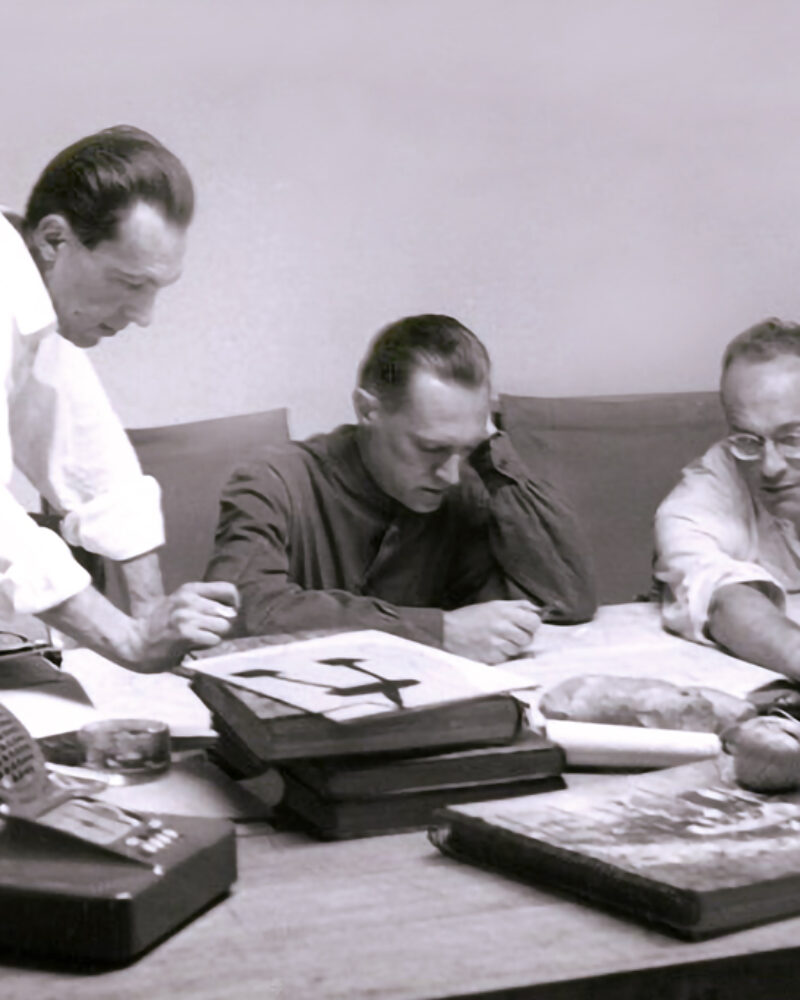
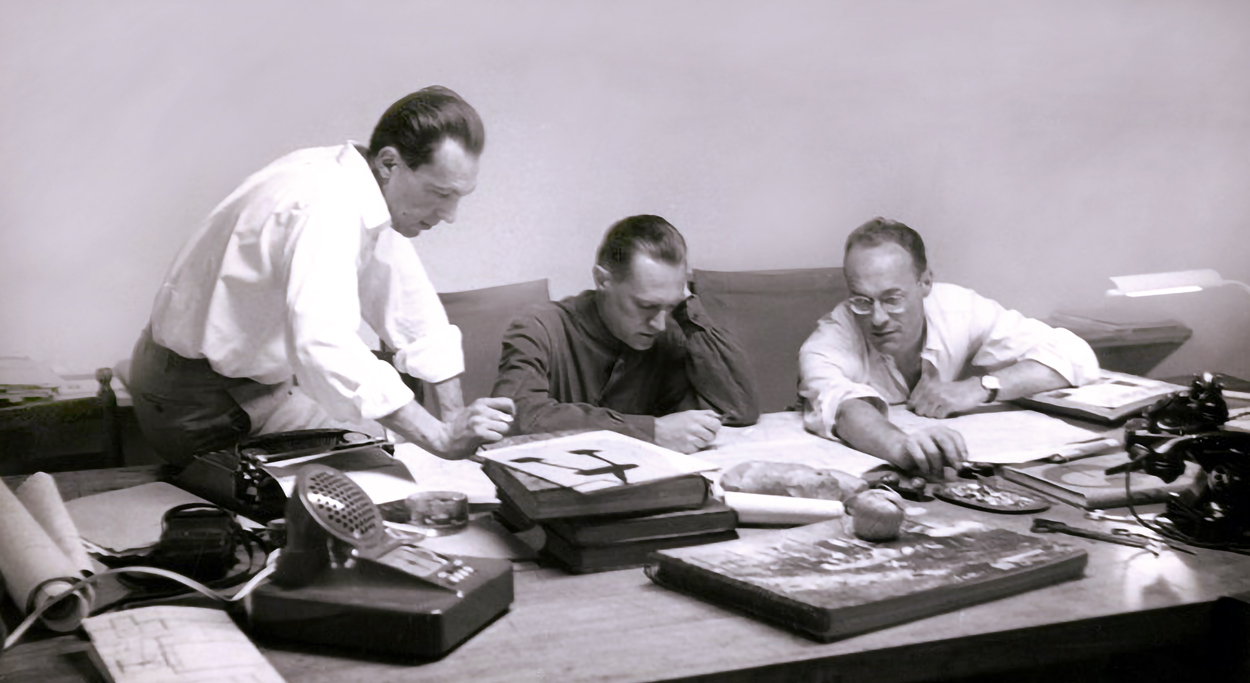
Milan, 1952 – Achille, Pier Giacomo, and Livio Castiglioni in their Porta Nuova studio. The image conveys the intense and industrious atmosphere of their shared method, founded on experimentation, direct comparison, and the integration of design, technology, and the artist's vision.
In 1959, during a trip to the United States organized by the College of Architects of Milan, the Castiglionis visited the Chicago Institute of Technology, where they presented their projects to students and faculty. That same year, they won the Design Competition for Italy, sponsored by the American firm Reed & Barton, with two sets of cutlery—Secco and Dolce—in which they applied industrial techniques such as extrusion profiling and punching, giving traditional forms a new functional and aesthetic coherence.
Towards the end of the 1950s and then in the early 1960s, the Castiglioni brothers' research took shape in the definition of a true design poetics, based on principles of reassembly, a plastic relationship with the human body, the recovery of anonymous design, and a strong playful component, intended as a strategy for engaging the user. In 1957, in the exhibition Colori e forme della casa d’oggi at Villa Olmo (Como), and in the subsequent installation of the Splügen Bräu restaurant (1960), they developed a grammar of prototype objects that would give rise to iconic products: among these, the Mezzadro stool, the Sella seat, the Pensile bookcase, the Cubo armchair, the Splügen Bräu lamp, the Spluga stool, and the first elements of the Servo system: Servofumo and Servopluvio. Starting from this intense creative season, the Castiglioni brothers also translated their design principles into the field of lighting, designing a series of lamps that became symbols of twentieth-century Italian design, many of which are still in production today.
Among the most emblematic is the Arco lamp (1962), designed by Achille and Pier Giacomo for Flos, inspired by street lamps and conceived to illuminate a table without the bulk of a ceiling lamp: the steel arch and the solid Carrara marble base represent a perfect balance between function and material. The Taccia (1958-1962), also for Flos, was born from a provocative idea: an inverted diffuser that acts as a reflector, returning an indirect and sophisticated light. The Toio (1962), a hybrid between a car headlamp and a minimal structure, embodies the poetics of functional reuse, just as the Luminator (1954), awarded the Compasso d'Oro, stands out for its essential form and technical innovation in the cooling of the source. Also of great importance is the Lampadina (1972), which deliberately exposes the luminous element, making fun of the lamp-object; Fuchsia (1996), later created by Achille alone, represents a mature reflection on the luminous effect and formal lightness.
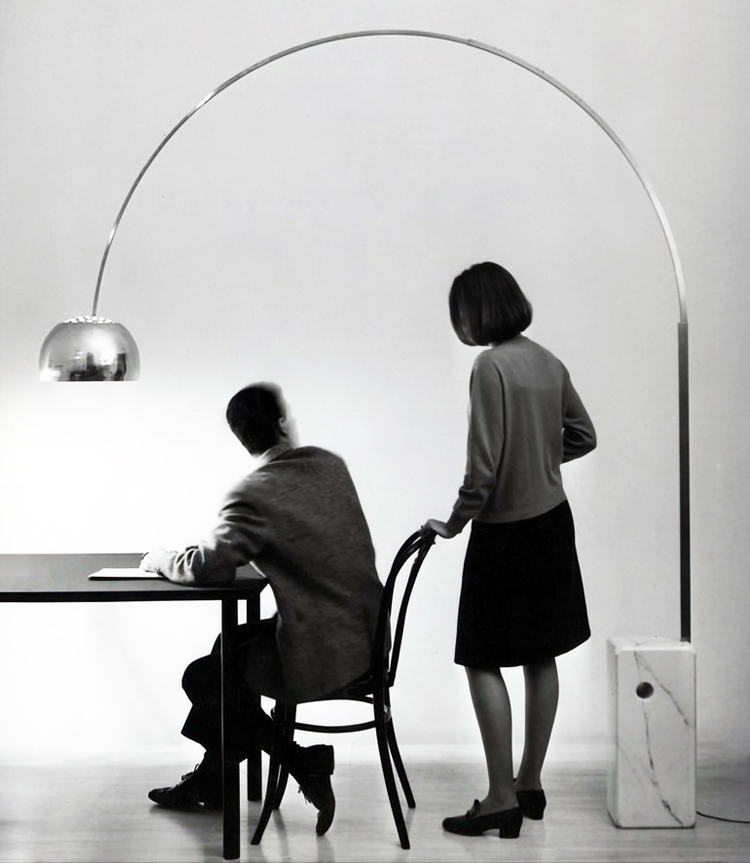
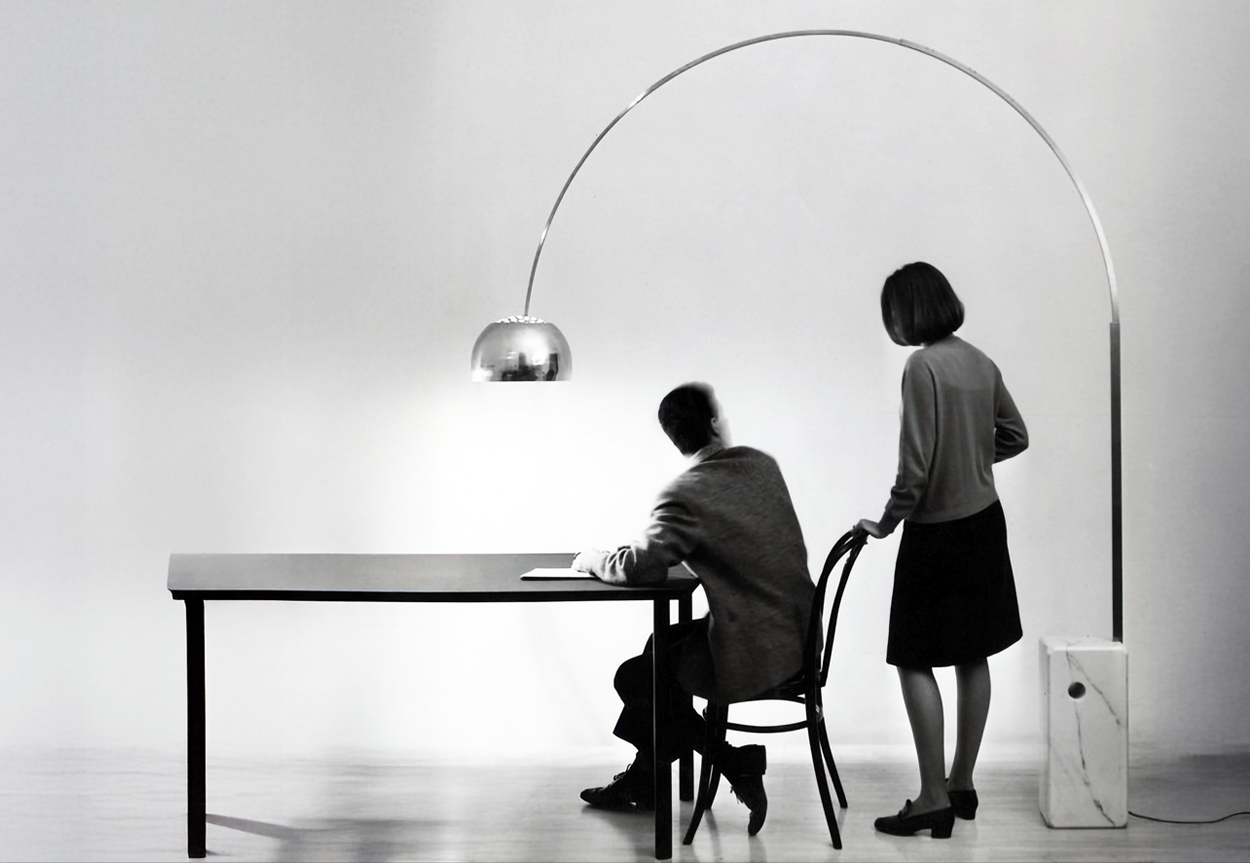
The Arco lamp, designed by Achille and Pier Giacomo Castiglioni in 1962 for Flos. Designed to provide pendant lighting without a ceiling installation, it features a Carrara marble base, an arched stainless steel stem, and an adjustable aluminum reflector. An icon of Italian design, it combines technical ingenuity and understated formal elegance.
These seemingly simple projects express a sophisticated compositional intelligence and a radically functionalist vision, capable of elevating light to a narrative and cultural device. According to architect Vittorio Gregotti, the question of the lighting designer, as well as the treatment of light and, even more so, the interest in electricity and its conduction and diffusion techniques, held a fascination for the Castiglioni brothers that was not only technical but also symbolic and evocative. Their approach, Gregotti states, is rooted in a Futurist sensibility: not so much in aesthetic rendering as in the conception of light as a technical miracle, flexible and radiant, capable of embodying the expressive potential of modernity.
In 1962, following the demolition of the historic Porta Nuova studio building, Achille and Pier Giacomo moved their studio to Piazza Castello 27, now the headquarters of the Achille Castiglioni Foundation. Livio, however, continued his work in the workshop on Via Presolana, where his son Piero Castiglioni now works.
Milan Lighting Studio on Via Presolana
Since 1957, the studio-laboratory on Via Presolana has trained a generation of lighting designers, combining experimentation, design culture, and architectural vision.
The history of the lighting studio on Via Presolana in Milan unfolds around a fruitful and unique relationship between father and son: Livio and Piero Castiglioni. It is through this relationship—based on transmission, exchange, and design continuity—that one of the most significant experiences in Italian lighting culture has emerged. The origins and influences that shaped Livio Castiglioni form the foundation for a shared yet evolving vision, where the father's experimentation intertwines with the son's architectural vision, giving rise to a studio that is not just a workplace, but an intergenerational laboratory of lighting design thinking.
A Milanese architect born in 1911, Livio trained at the Milan Polytechnic and quickly emerged in the vibrant postwar Italian design scene. But his curiosity extended beyond this: he was fascinated by the sensorial dimension of design, exploring the boundaries between technology and perception, taking an interest in the phenomena of sound and light and new audiovisual tools. This eclecticism led him to collaborate with the electronics industry: in the 1940s and 1950s, he was a consultant for Phonola (for which he designed innovative radios with unique shapes) and in the early 1960s for Brionvega, contributing to the aesthetic evolution of radios and hi-fi equipment.
After collaborating with brothers Achille and Pier Giacomo in their studio on Via Porta Nuova—a polyphonic space where architecture, urban planning, and industrial design intertwined—Livio chose, in the mid-1950s, to pursue an independent career. A desire to experiment with new forms of expression led him to open his own atelier-workshop on Via Presolana, Milan, in 1957. Initially dedicated to research on sound, light, and electronic devices, this space gradually transformed, thanks in part to the active involvement of his son Piero, into a hub for integrated lighting design. It was a small artisanal workshop, destined to become a hotbed of ideas that anticipated the modern concept of light in architecture.
From the very beginning of his new studio, Livio Castiglioni adopted a pioneering approach that we might call The Castiglioni Method. In his laboratory, lighting design was conceived as a continuous experimentation, in which the technical component merged with the aesthetic and sensorial. In the 1960s, Livio created his first sound and light environments, anticipating the era of multimedia installations: his participation in the Milan Triennials, where he combined lighting and sound to create immersive experiences, is famous. For the 14th Milan Triennial (1968), for example, he and his son Piero designed integrated lighting systems and audio-video devices, putting his synaesthetic vision of space into practice.
Light thus becomes a design material like any other: something to be shaped to define the atmosphere of a space. This method, founded on inventive play and rigorous analysis, leads Livio to conceive "tailor-made" lighting solutions—handcrafted devices adapted to the specific needs of each project, rather than standard catalogue products. A shining example of this approach is the experimental Boalum lamp (1970), a flexible luminous tube designed with Gianfranco Frattini and produced by Artemide: an object combining technology and poetry, still considered an icon of Italian design. In the laboratory on Via Presolana, in short, technological research and creativity go hand in hand, outlining the key principles of the Castiglioni method: continuous innovation, artisanal attention to detail, and the integration of light into architectural space.
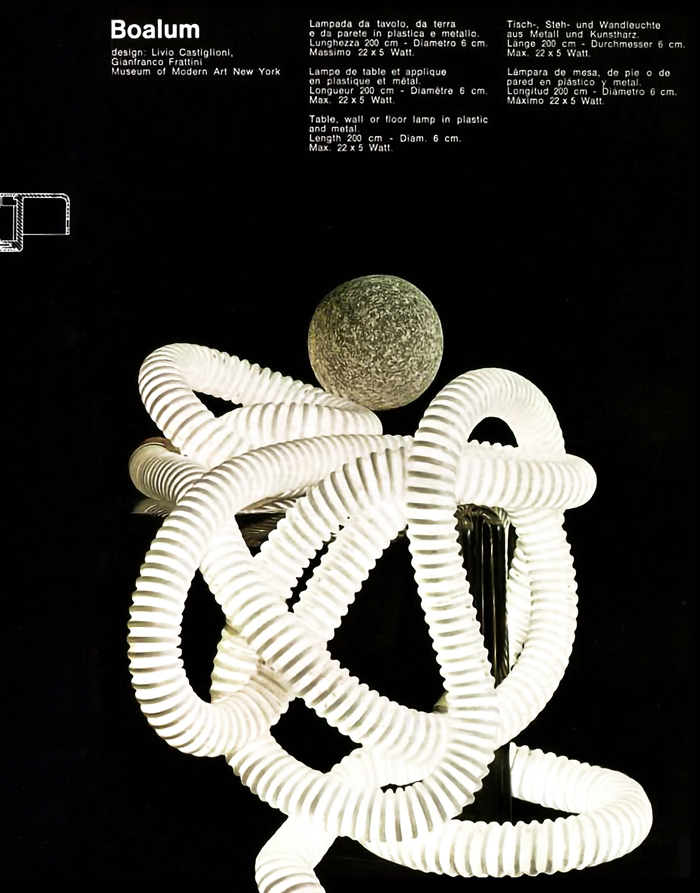
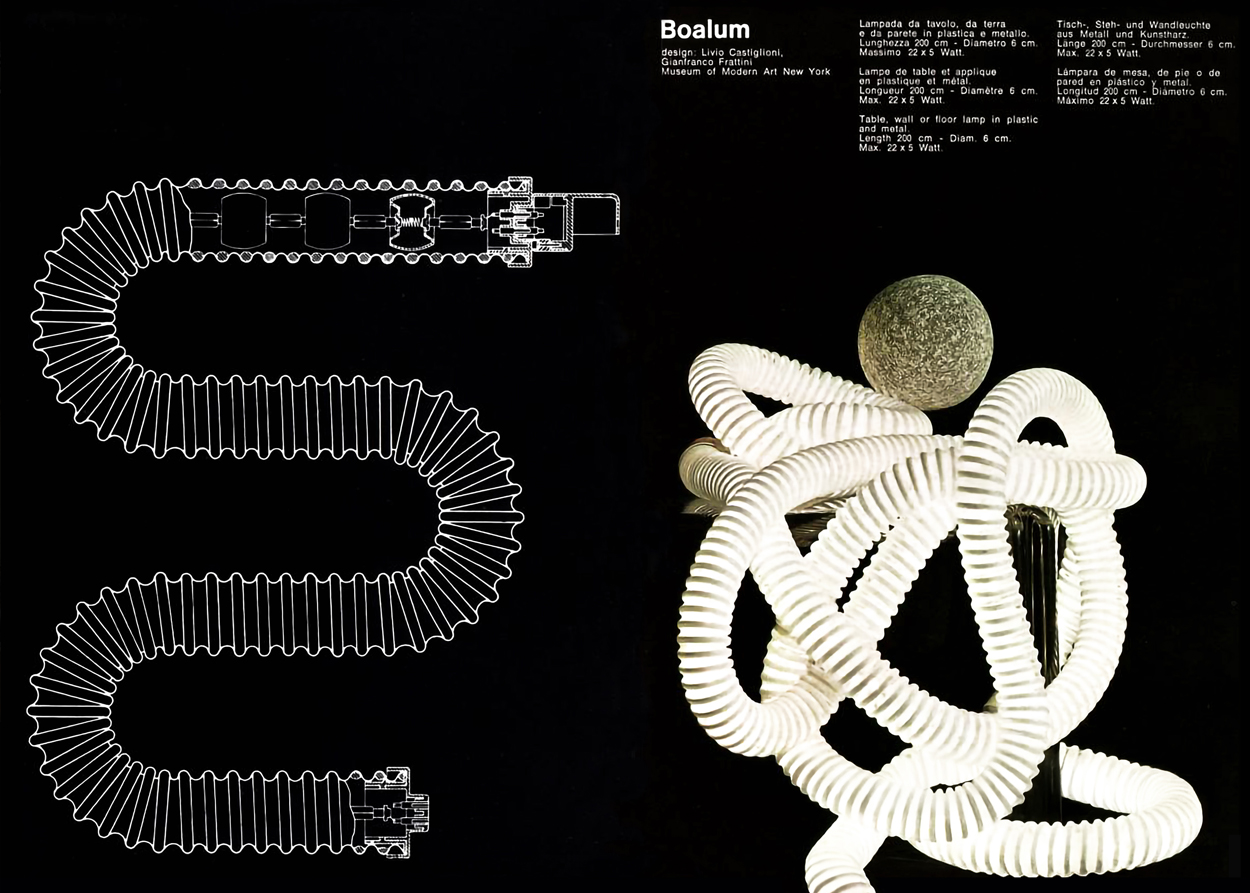
Boalum, a lamp designed by Livio Castiglioni and Gianfranco Frattini in 1970 for Artemide, presented here in the 1973 catalog, is an emblematic example of formal and technological experimentation. Composed of a flexible translucent plastic body containing a series of modular light sources, it can be freely shaped, becoming a table, floor, or wall lamp. Light and matter merge into a seamless device, playful and innovative in spirit, which pioneered the logic of relational design. Included in the collections of the Museum of Modern Art in New York, it represents one of the most radical objects of Italian design of the 1970s.
With the arrival of Piero Castiglioni, Livio's son, the Via Presolana studio embraces generational continuity and a new phase of growth. Piero was born in 1944 and, following in his father's footsteps, graduated in Architecture from the Milan Polytechnic in 1970. As a student, he attended the studio of his uncles Achille and Pier Giacomo in Piazza Castello, absorbing the playful wit and pragmatic approach typical of the family. After graduating, he officially joined the Via Presolana studio alongside his father, bringing fresh ideas and a new architectural perspective on light. Father and son worked side by side for nearly a decade, from 1972 to 1979, sharing projects and insights.
These were years of intense activity, during which the studio created custom lighting for art galleries, showrooms, hotels, offices, and homes, both in Italy and abroad. During this period, special fixtures designed specifically for each setting were produced in small series, cementing the "made-to-measure" philosophy that distinguishes the Castiglioni school. It was in the heart of the laboratory that inventions destined to leave their mark were born: here, the Scintilla system was conceived and physically assembled, an innovative modular cable-and-track structure for halogen lamps, with its extremely clean lines. Scintilla embodies the Castiglioni vision: it combines the essential versatility of a decorative element with the lighting power of a professional technical system.
Initially handcrafted on request, the Scintilla system was so successful that in 1983 it was sold to Fontana Arte for large-scale production. At the same time, Livio and Piero's collaboration with other designers led to new lighting projects: in the 1970s, they participated in the creation of lighting and audiovisual displays for exhibitions such as Eurodomus and other events, cementing the studio's reputation as a benchmark in spatial lighting design.
After Livio's passing in 1979, Piero Castiglioni continued his work with determination, dedicating himself exclusively to lighting and leading the studio into a new era. The 1980s saw a marked evolution: from the design of individual lighting objects to the conception of complete lighting systems integrated into architecture. The workshop on Via Presolana became a meeting place for an ever-expanding network of prestigious collaborations. Piero, building on his father's legacy but with an eye to the future, established professional relationships and friendships with leading figures in Italian and international design.
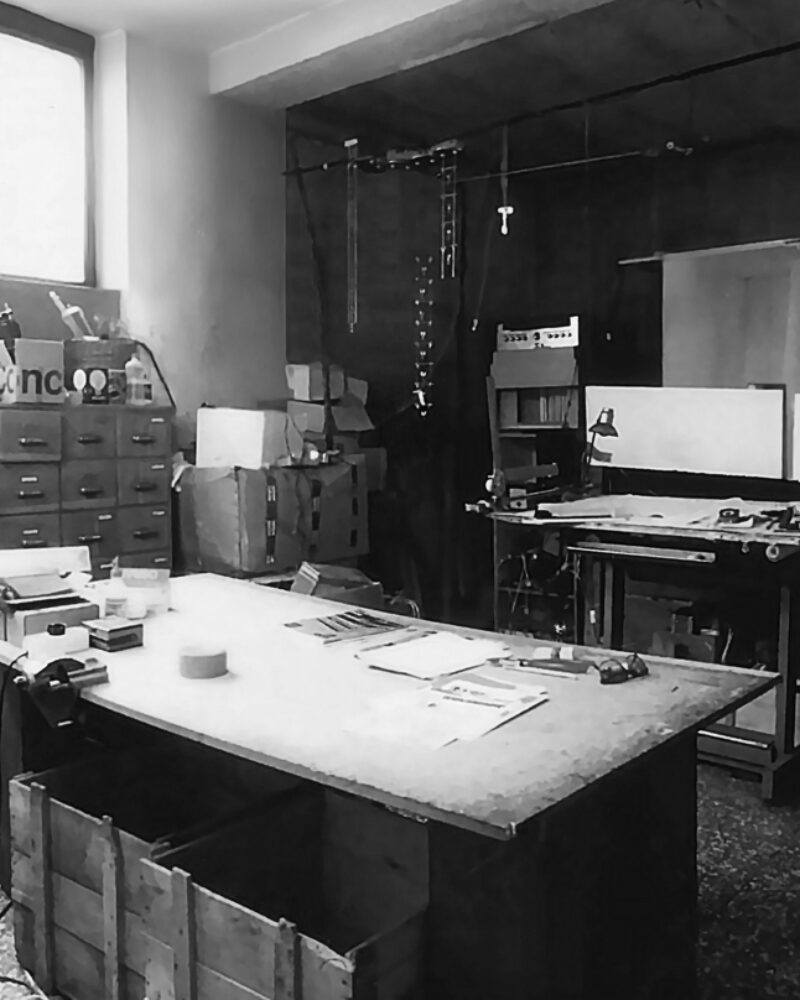
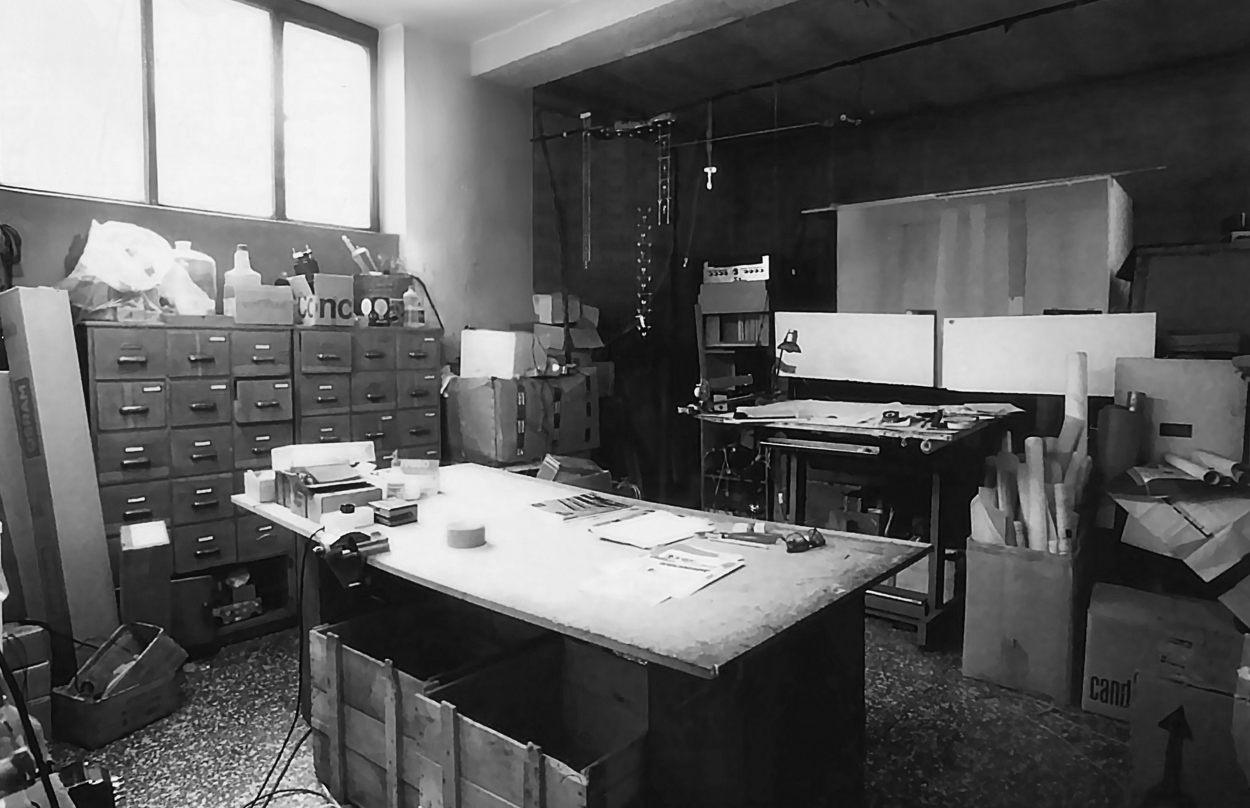
The workshop on Via Presolana in 1979, the operational and creative heart of the Castiglioni studio: an artisanal environment where materials, prototypes, technical drawings, measuring instruments, and electrical components coexist.
In the intimate spaces of that Milanese laboratory, architects and designers such as Gae Aulenti, Bruno Munari, Gianfranco Frattini, Vittorio Gregotti, Cini Boeri, Cesare Casati, Vico Magistretti, Nanda Vigo, Marco Zanuso, and many others met to converse and work together. Each brought their own unique contribution: some, like Aulenti, shared a focus on history and setting (this encounter would lead to a long collaboration on museum projects), others, like Munari, fostered a playful and experimental dimension, and others, like Frattini, brought their experience in product design. This interdisciplinary ferment further enriched the Castiglioni method, which assimilated new stimuli while remaining faithful to its cornerstones: technical rigor, functional simplicity, and formal elegance at the service of the space to be illuminated.
During these same years, Piero Castiglioni designed several emblematic projects that propelled Milanese lighting onto the international stage. In 1986, in collaboration with architect Aulenti, he created the new lighting project for the Musée d'Orsay in Paris, converting the monumental former train station into a temple of masterfully calibrated natural and artificial light. Also in Paris, he contributed to the lighting of the Centre Georges Pompidou, a futuristic space where light was used to emphasize the building's high-tech structure while simultaneously showcasing the works on display. In Venice, Piero was commissioned to design the lighting for the renovated Palazzo Grassi (mid-1980s), where he experimented with innovative solutions to combine respect for the historical context with modern exhibition requirements.
It was precisely within Palazzo Grassi that another creation destined to become a classic was born: the Cestello system, designed by Piero together with Gae Aulenti to flexibly illuminate exhibition spaces. Cestello introduced the concept—revolutionary at the time—of a fixture with multiple, individually adjustable light sources, capable of combining diffused and accent lighting in a single, versatile solution. Presented in 1985 during the inauguration of Palazzo Grassi and subsequently developed industrially by iGuzzini (1988), Cestello became an archetype in the sector: a system that combined typological innovation, technological quality, and aesthetic purity, fully reflecting Castiglioni's approach to light as a modular tool.
Meanwhile, Piero continued to leave his mark on his homeland: among his numerous commissions, the new lighting for the Sala dei Corazzieri at the Quirinale Palace, the most solemn state room of the Presidency of the Republic in Rome, stands out. In that project (completed in the 1990s), Piero worked with architects Mario Bellini, Cini Boeri, and others, expertly combining direct and indirect lighting to enhance the decorative richness without glare, transforming the perception of a historic space through discreet yet highly dramatic solutions. The lighting of the Quirinale Palace in Rome, as well as that of the Galleria Vittorio Emanuele II in Milan a few years later, confirmed Castiglioni's role as a point of reference for high-profile institutional lighting projects.
The story of the Via Presolana workshop, however, isn't limited to its extraordinary projects: its true legacy lies in being a place where one learns the craft, where knowledge of light comes through direct experience, working side by side, in a slow and rigorous process of trial, error, and continuous refinement. Via Presolana represents a true school of design, where theory and practice merge in a unified process, both artisanal and intellectual. An environment where light is approached not only as a technical tool, but as a living material of design culture, in a continuous dialogue between invention, function, and construction. An educational model that has successfully combined rigor and freedom, discipline and vision, leaving a profound mark on the teaching of lighting design and on the generations that have emerged from it.
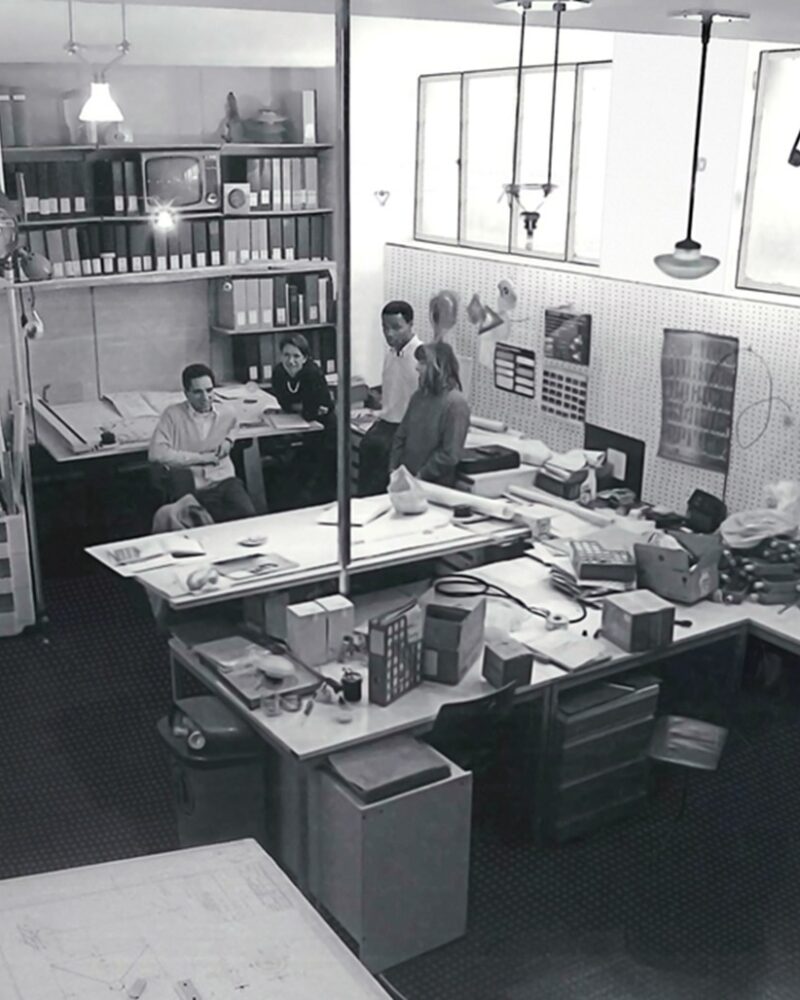
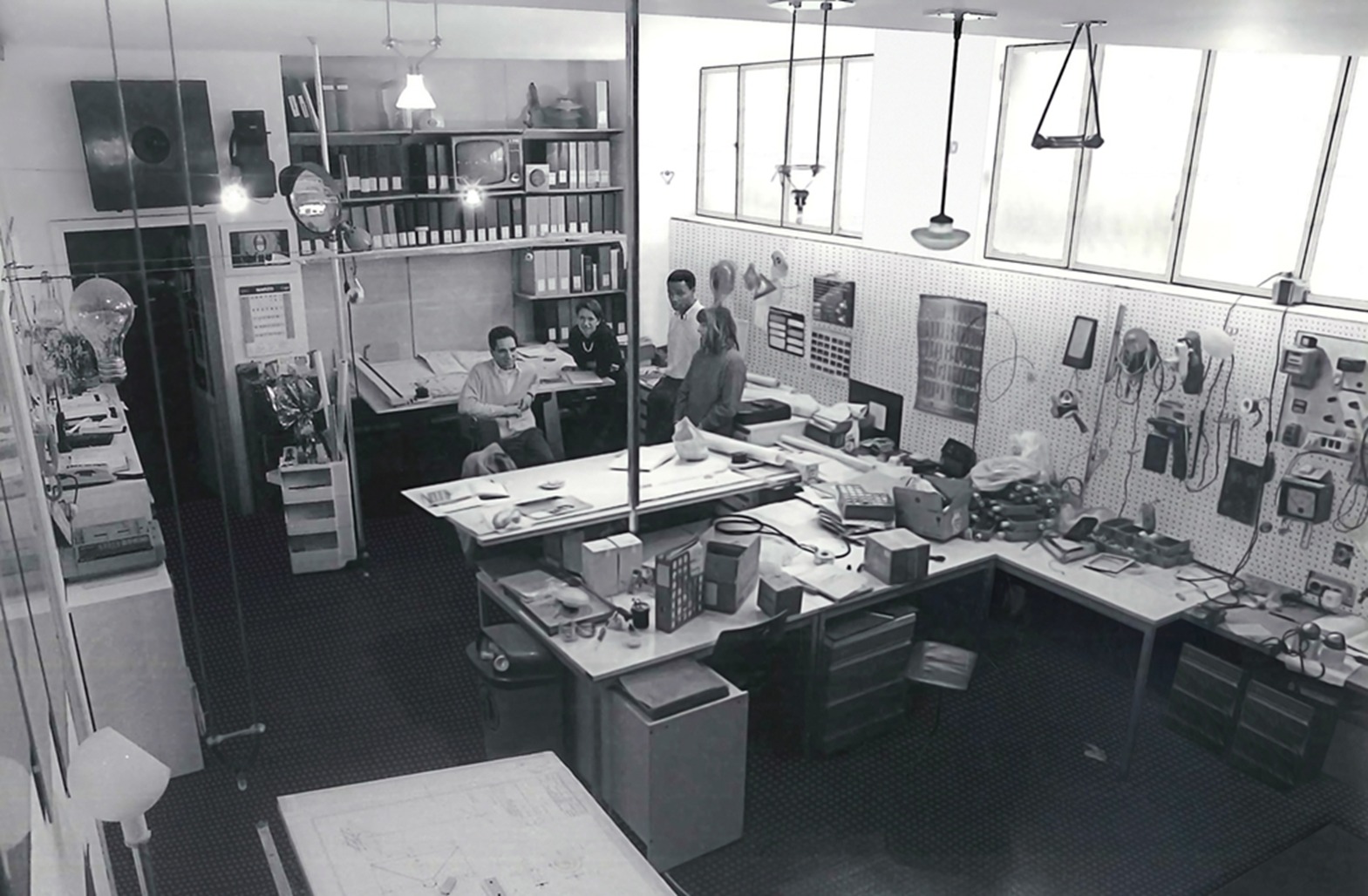
Milan, 1988 – Interior of Piero Castiglioni's studio on Via Presolana. A place of technical and design experimentation, where lighting intertwines with research into materials, light sources, and optical solutions. Among drawing boards, prototypes, and measuring instruments, a rigorous and interdisciplinary working method takes shape, destined to profoundly impact the evolution of Italian lighting design.
From the mid-1980s onward, Studio Castiglioni increasingly became an educational as well as design workshop. Piero, aware of the formative value of hands-on work, opened the doors of the laboratory to young architects eager to specialize in lighting, transforming the studio into a truly contemporary workshop. Here, collaborators learned not from books but by working alongside the master on construction sites, in darkened museums before installation, and during evening lighting tests; they experimented, made mistakes, and improved, breathing in an atmosphere of continuous research.
Among the key collaborators who trained at the studio are names now well-established in the independent lighting design scene. For example, Marinella Patetta and Claudio Valent: both architects with master's degrees in lighting, they joined the Castiglioni studio at a young age and worked there for several years, mastering the "custom lighting" method. Building on this shared experience, in 1989 the couple decided to branch out on their own, founding the Metis Lighting studio in Milan, dedicated exclusively to lighting design and destined to achieve international success.
Likewise, in the 1990s, the Castiglioni studio continued to attract and develop talent: architect Nicoletta Rossi began collaborating with Piero in 1989, followed a few years later by Florentine architect Guido Bianchi (from 2001). For over fifteen years, Rossi and Bianchi contributed to projects in Italy and abroad within the studio, until 2006, when they too embarked on the path to independence, founding Rossi Bianchi Lighting Design in Milan. In their new direction, they continued to develop criteria for innovation and lighting research, capitalizing on the experience gained "in the workshop" on Via Presolana.
Architect Jacopo Acciaro followed a similar path. After working side by side with Piero Castiglioni between 1998 and 2001, he founded his own firm, Voltaire Lighting Design, with which he explored lighting design in international contexts. During his years of collaboration with Piero Castiglioni, Jacopo Acciaro developed a way of understanding light based on the balance between function, technique, and space, gradually developing his own design vision, which he would continue in his subsequent works.
Giovanna Olgiati, who also trained at Studio Castiglioni, continues her career today as an independent lighting designer, helping to spread the approach she learned during her years in the studio. Alongside her professional work, she continues to teach at the Polytechnic University of Milan, where she teaches in the Master's program in Lighting Design and Technologies, passing on to new generations of designers the principles she learned in the field, between the studio and the construction site.
Each of these figures testifies to how the Via Presolana studio functioned as a true Castiglioni school: a place where knowledge was passed on daily, through example and hands-on experience, creating a sort of extended professional family. From Livio's original workshop in 1957 to the current activities of Piero and his professional heirs, the Castiglioni family's history is more than a family story: it is the story of a method and a vision that revolutionized the world of lighting.
Today, Piero Castiglioni is recognized as one of the masters of lighting design, awarded numerous honors (Grand Officer of Merit of the Italian Republic in 2020) and lifetime achievement awards, while his studio continues to develop projects with a systemic and tailor-made approach. But perhaps the greatest tribute to the Castiglioni method lies in the community of lighting designers trained on Via Presolana and the ideas they champion. The legacy of this Milanese atelier, built on passion, experimentation, and sharing, continues to illuminate the contemporary design landscape, confirming that light, as Piero loved to say, "is another material of architecture," to be shaped with technical expertise and artistic sensitivity to transform space and the lives of those who inhabit it.
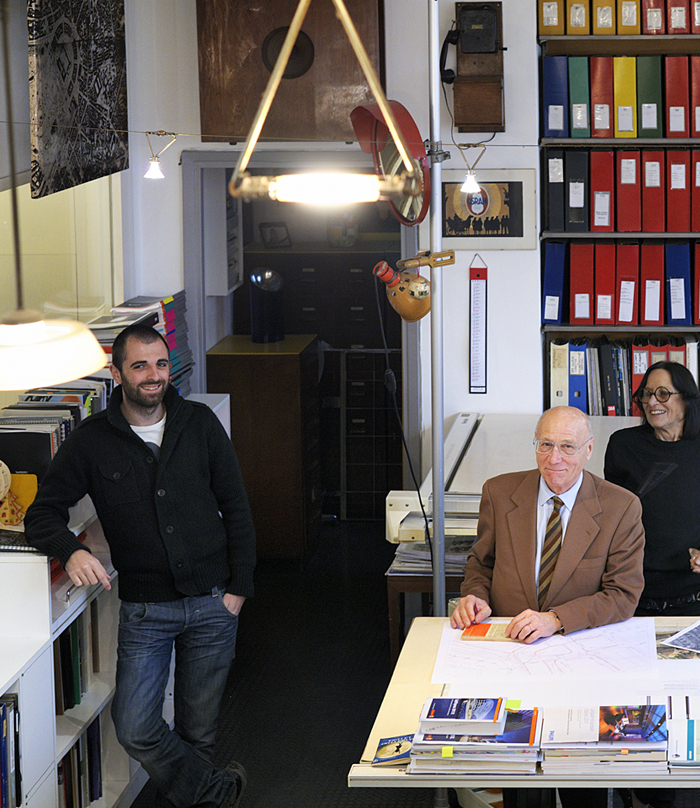
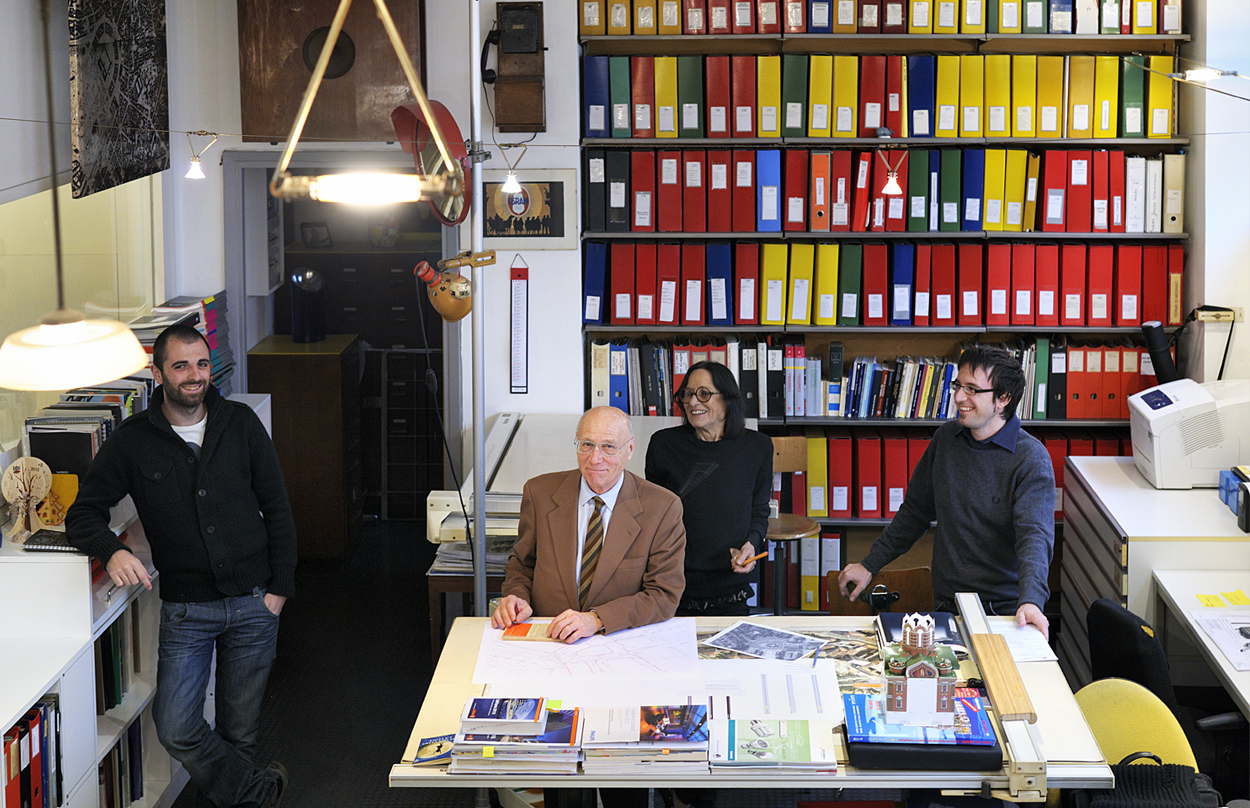
The laboratory on Via Presolana in 2014, fifty years after its founding: around the work table, architect Piero Castiglioni, with his collaborators Chiara Baldacci, Marco Petrucci, and Mauro Zani, testifies to the continuity of a studio that is both a design workshop and a place for the transmission of knowledge.
Piero Castiglioni: The Lighting Architect
Over fifty years of projects, experiments and integration of light in contemporary architecture
Piero Castiglioni's professional career began in the 1970s in his studio at Via Presolana 5 in Milan. He immediately defined himself as an Architect of Light. It was in this context that he developed a novel design vision, in which artificial light was no longer merely a technical or decorative element, but became an integral part of the architectural language, an active component of the built space, capable of transforming, revealing, and interpreting it.
His interest in light translated from the outset into a design practice grounded in experimentation and disciplinary integration, where architecture was interpreted as a reflective surface, an optical structure, and a field of operation for a luminous narrative. The design of light in his work was never artificial or accessory, but rather a cultural and technical device at the service of the perception, function, and meaning of space.
Piero Castiglioni's work clearly delineates methodological guidelines, despite his consistently specific and adaptive design approach. Light, in his work, is never a neutral or decorative element, but rather takes on the role of a critical tool capable of building relationships between architecture, urban space, and perception. Each project stems from a careful analysis of the context and a reflection on how light can alter its interpretation, differentiate spaces, reveal their geometry, or suggest new interpretations. A key aspect is the control of artificial light, understood not as simple functional illumination but as a design element that structures the use of space. The lighting design is the result of a careful study of the relationships between the light source and the reflective surfaces (ceilings, walls, floors), which determine the choice of type, placement, and orientation of the sources. The goal is not simply to illuminate, but to design with light, integrating it into the volumes and architectural grammar. Three emblematic projects are set within this framework, marking a methodological turning point in the conception of the lighting fixture as an architectural device.
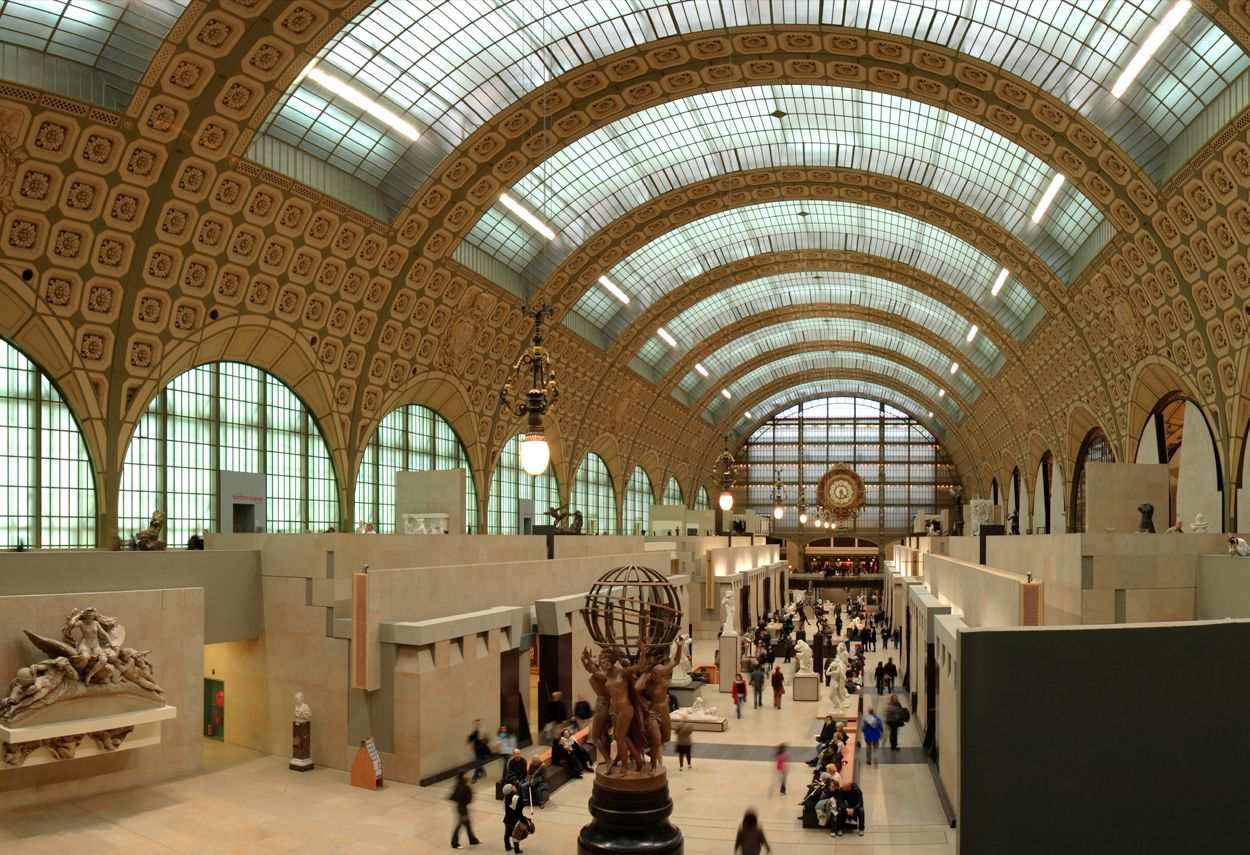
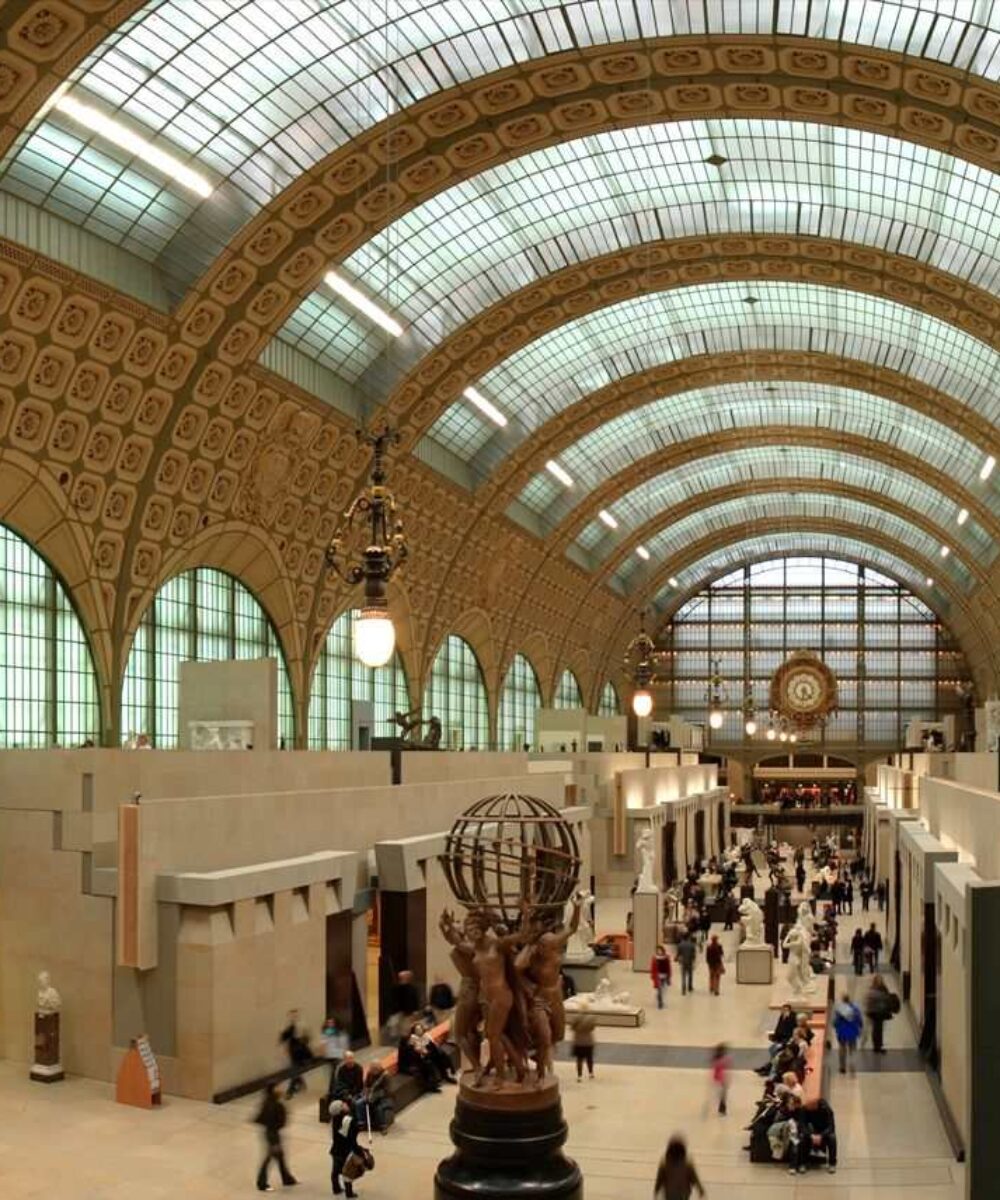
At the Musée d’Orsay in Paris, artificial lighting is designed in symbiosis with the existing architectural structure, in a constant dialogue between illumination and space. Selected portions of walls and architectural surfaces are used as active reflectors, capable of modulating and uniformly reflecting light. Through a careful balance between direct emission and controlled reflection, the lighting diffuses without casting invasive shadows, ensuring perceptual uniformity and enhancing the works without altering their chromatic interpretation. This approach transforms the architecture itself into an optical instrument, capable of controlling light with precision and coherence, in a harmonious synthesis between exhibition function and spatial quality.

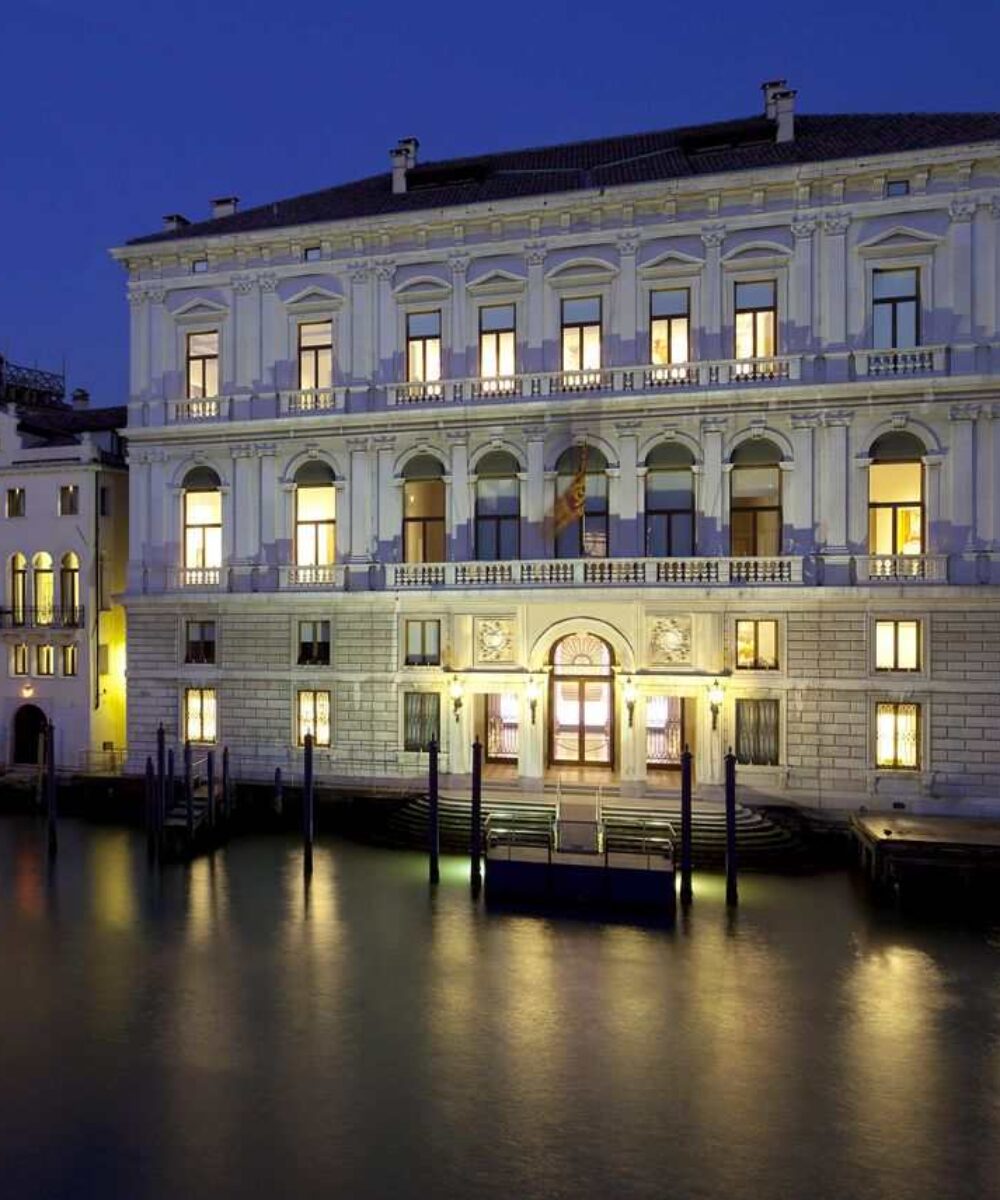
At Palazzo Grassi in Venice, light is used according to a logic derived from sports facilities, where the distribution of lighting occurs in distinct and controllable luminous areas. This principle, adapted to the scale of the museum space, allows for calibrated lighting management, respecting the architectural structure and exhibition requirements. From this vision was born the famous "Cestello" fixture, consisting of groups of individually adjustable lamps, allowing for precise lighting shaping for each portion of the space. A synthesis of functional modularity and formal elegance, the Cestello embodies an approach in which light becomes an active instrument of staging, capable of enhancing the works without imposing itself as an independent presence.
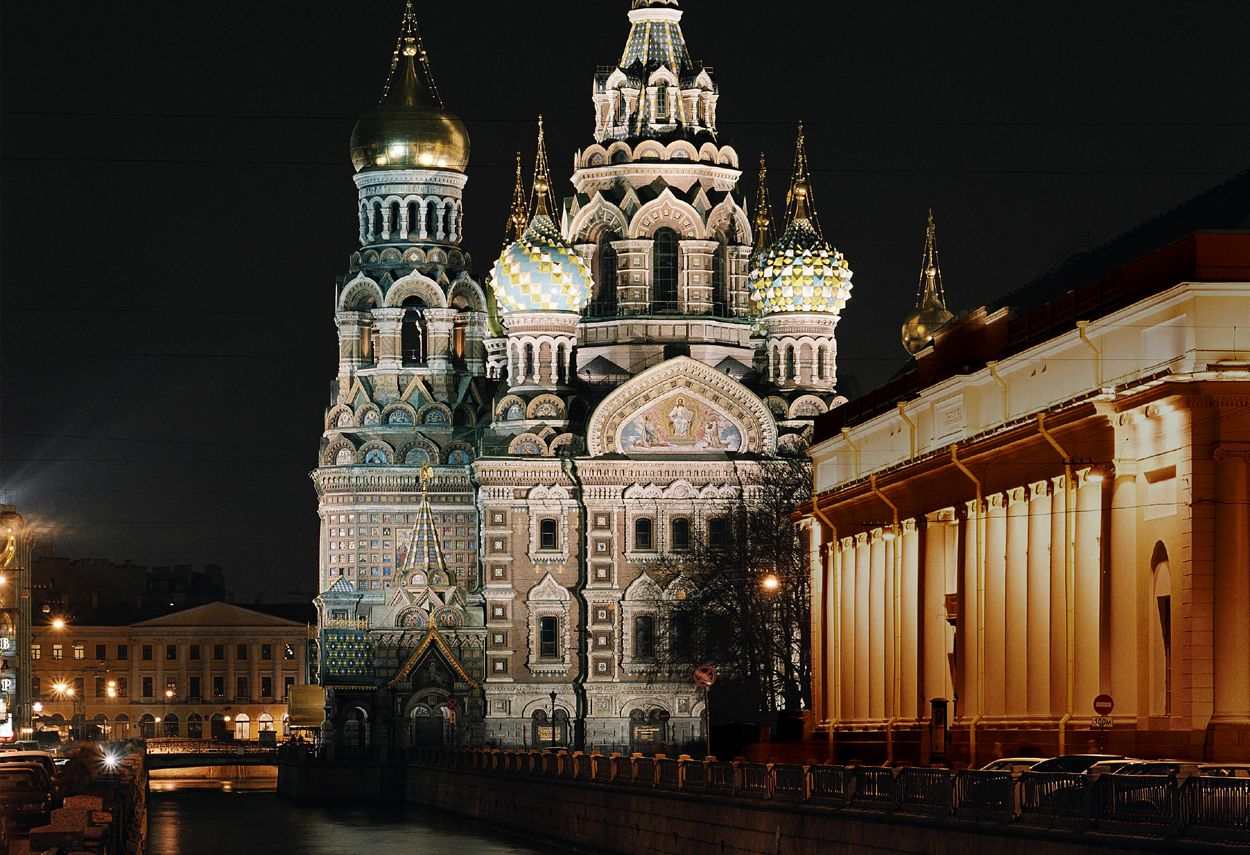
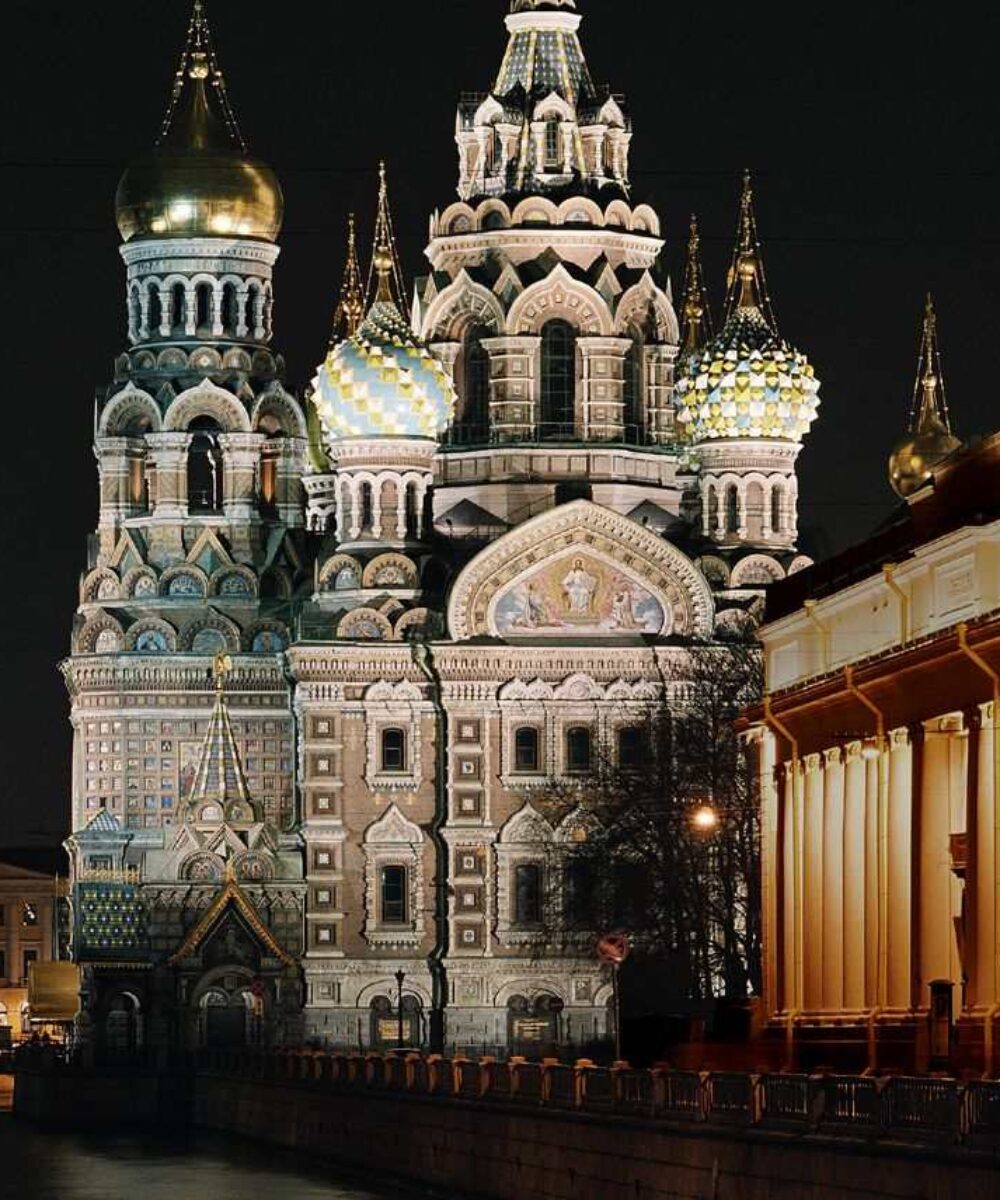
The Church of the Savior on Spilled Blood (Spas Na Krovi) in St. Petersburg features one of the most advanced applications of the method based on the composition of distinct and controlled light beams. The project is based on a fundamental principle: reducing the dimensional proportions of individual projectors while increasing the overall number of sources, thus achieving more uniform and targeted light coverage. This allows each beam to be precisely directed toward the surfaces to be illuminated, avoiding lateral dispersion and minimizing light pollution. The light does not invade the space, but follows it with moderation, respecting the iconographic and material complexity of the façade. The result is a calibrated and discreet system that preserves the integrity of the building and restores its decorative richness with perceptual clarity and environmental control.
In all these cases, the lighting device is no longer conceived as an isolated object, but as an active element of the project, called upon to dialogue with the construction material, its function, and the perceptual rhythm of the space. Light, in Piero Castiglioni's hands, thus becomes a tool for architectural interpretation, capable of activating space, directing the gaze, and restoring environmental and cultural value to the work. In Piero Castiglioni's work, light is never an autonomous presence or an accessory element, but rather constitutes the fulcrum of a complex design method, founded on clearly recognizable operational guidelines.
This set of guidelines defines an integrated approach to lighting design, in which light becomes a tool for reading, interpreting, and establishing a relationship between architecture, space, and use. The urban context plays a central role: since the 1980s, Castiglioni has been critically reflecting on the city's nocturnal image, developing projects that prioritize controlled intensity and a dialogue with the context. A prime example is the 1990 project for the AEM headquarters in Milan, where light does not invade but retreats, working on edges, cavities, solids and voids, thanks to the "Edge" projector developed specifically for iGuzzini. A similar logic informs the project on the façade of Palazzo Grassi in Venice, where the subtle, flickering light from submerged projectors reflects the motion of the water, making the architecture a living part of the lagoon landscape.
This sensitivity to the environmental value of light recurs in the most recent projects on the Galleria and Corso Vittorio Emanuele in Milan, where light does not assert but accompanies, suggests, and structures. The same principle extends to the relationship with architectural space: in the projects for the Belém Theater, the Banca Popolare di Lodi auditorium, the Opéra de la Bastille, and the Termini station in Rome, light takes on the role of a narrative element. It works on geometries, enhances volumes, articulates paths, and creates depth. It is not simply a support, but a design material capable of expressing the intentions of the architecture.
Finally, in its relationship with function, lighting is shaped by the perceptual and operational needs of users. It is calibrated, discreet yet effective, always capable of adapting to the context. This creates a method that combines technical rigor, aesthetic awareness, and attention to the user experience, transforming light into a cultural device capable of generating meaning, belonging, and quality in the built space.
In these projects, light is neither decoration nor ornamentation: it is architectural material, a means of orientation, hierarchy, and narrative. Its ability to articulate depth, to generate continuity or fractures between parts, to activate relationships between solids and voids, makes it an active and strategic element in defining the interior dimension of the built space.
In his approach to lighting design, Piero Castiglioni adopts a critical stance towards any formal excess, favoring a respectful dialogue between illumination, space, and content. This attitude is exemplarily reflected in his approach to light in museum settings, where lighting design engages not only with the architecture, but above all with the artwork and its enjoyment. In the relationship between light and artwork, Piero Castiglioni rejects any form of architectural mannerism. As Dominique Bozo, director of the Musée National d'Art Moderne at the Centre Georges Pompidou, states: "Museum architecture must be modest, at the service of the artwork. In this sense, light becomes a silent presence, a narrative function, a support for vision, without ever imposing itself as an autonomous or spectacular element."
To date, with over a thousand projects completed worldwide, Piero Castiglioni's work encompasses a vast and diverse body of work: exhibition spaces, museums, theaters, public and private buildings, urban infrastructure, restorations, and contemporary architecture. A career spanning over fifty years of continuous activity, marked by a constant dialogue with the technological evolution of light sources and a critical vision of conventional lighting methods.
As evidence of this journey, the studio maintains a project gallery that represents not only a collection of significant interventions but also an operational manifesto of its design method. Each project documents a rigorous yet poetic process, based on spatial analysis, attentiveness to the context, and technical mastery of light, considered as a living, fluid, and structuring material. In Piero Castiglioni's work, each intervention is a critical act, a compositional and ethical choice, restoring light to its fundamental role in the experience of space.


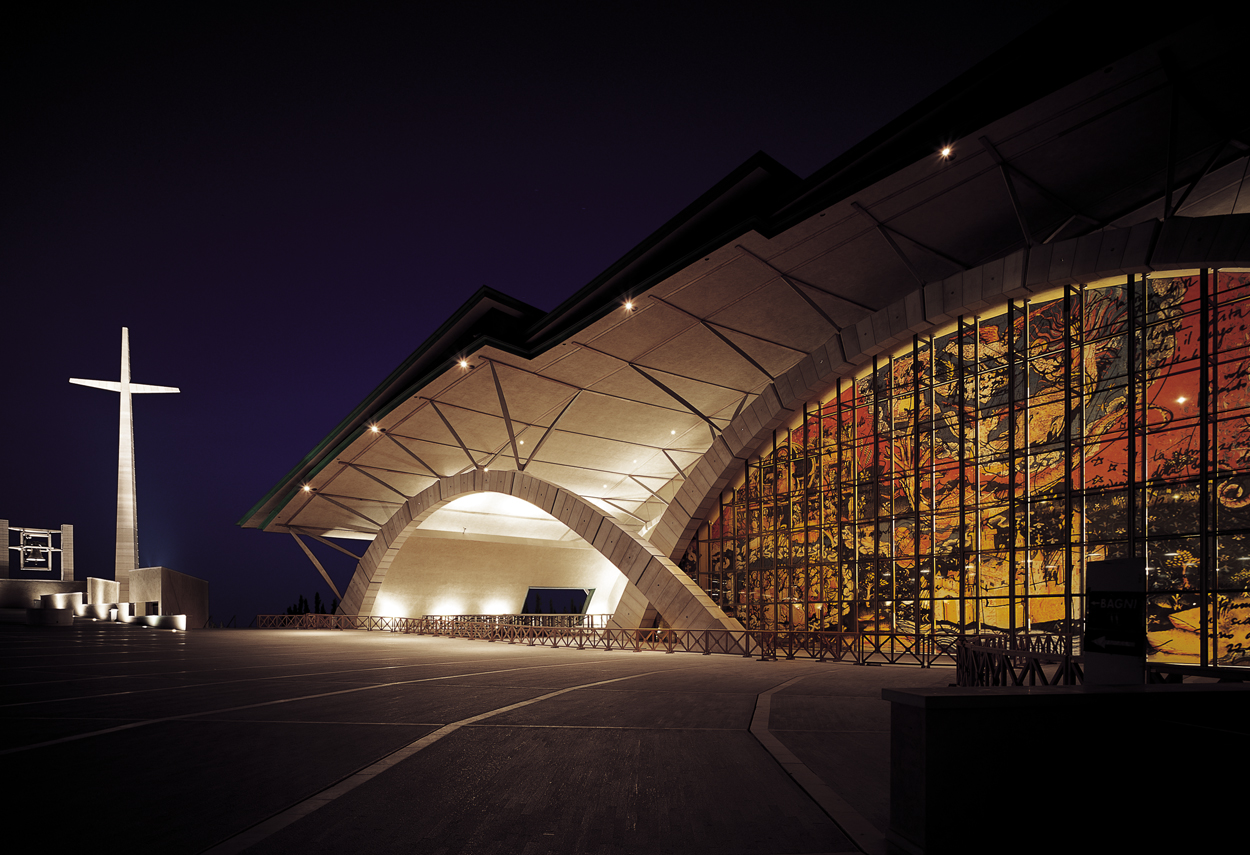


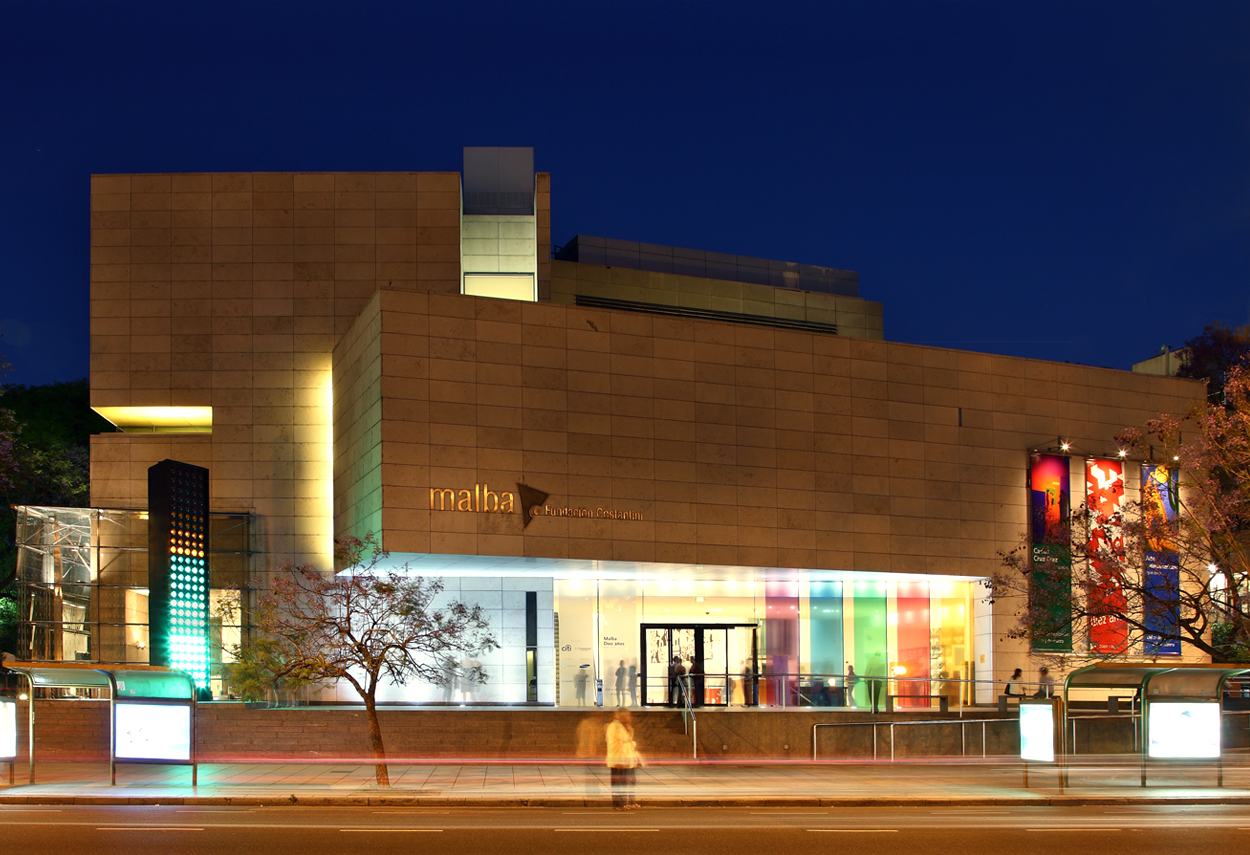
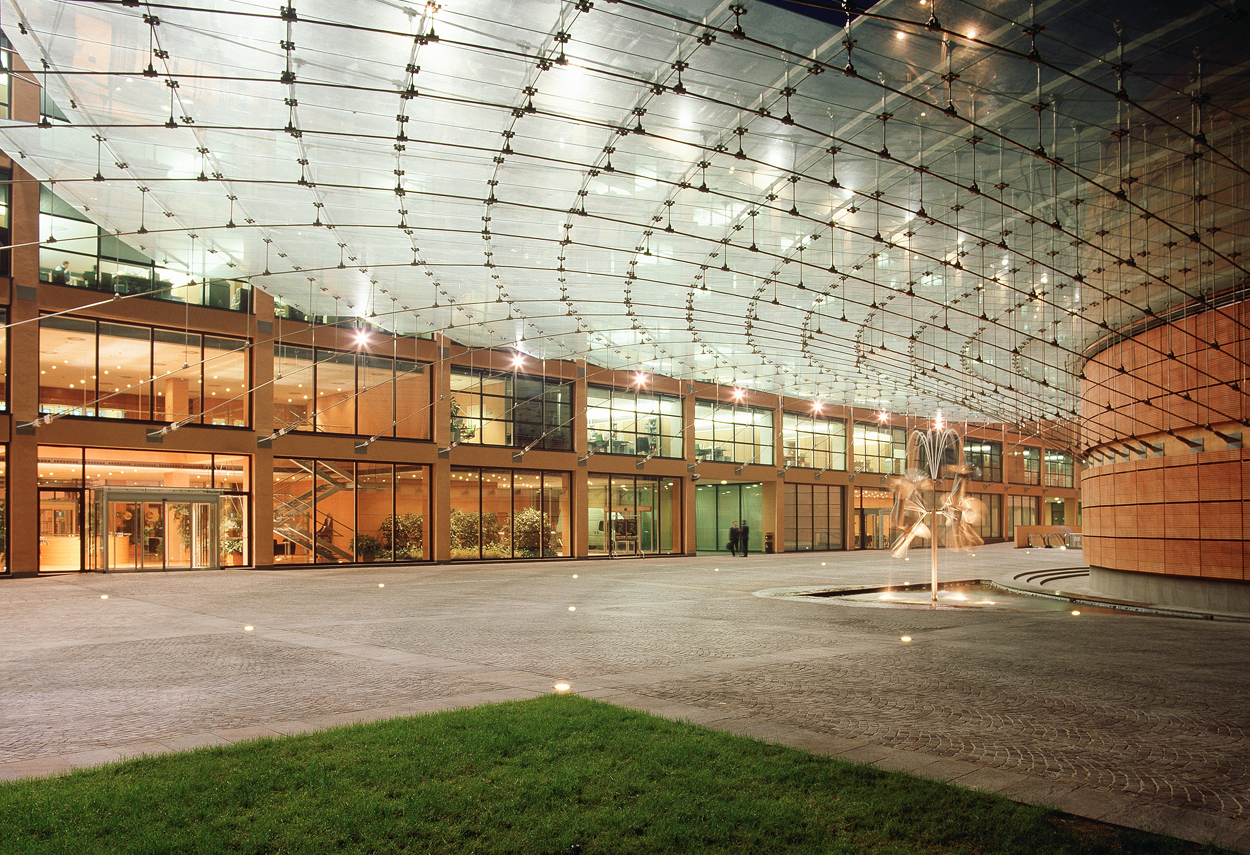
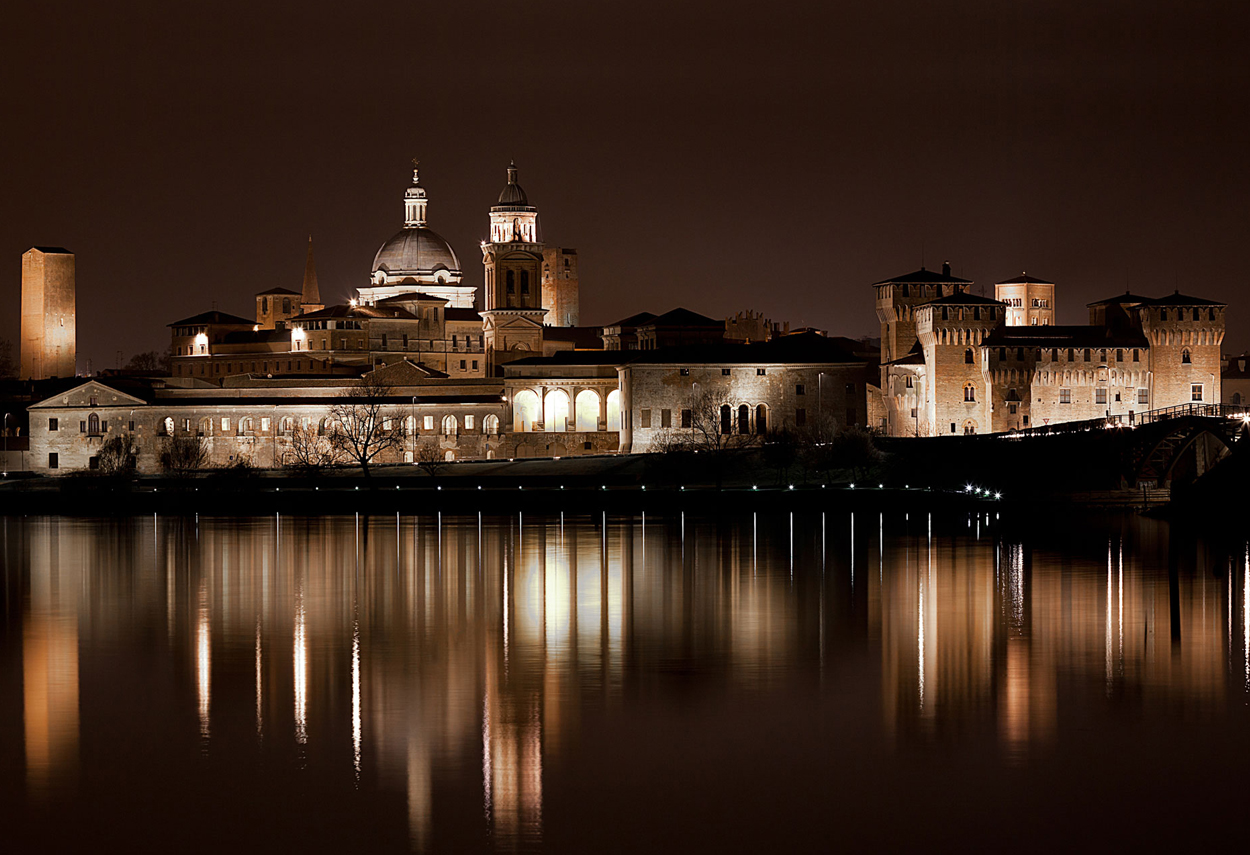
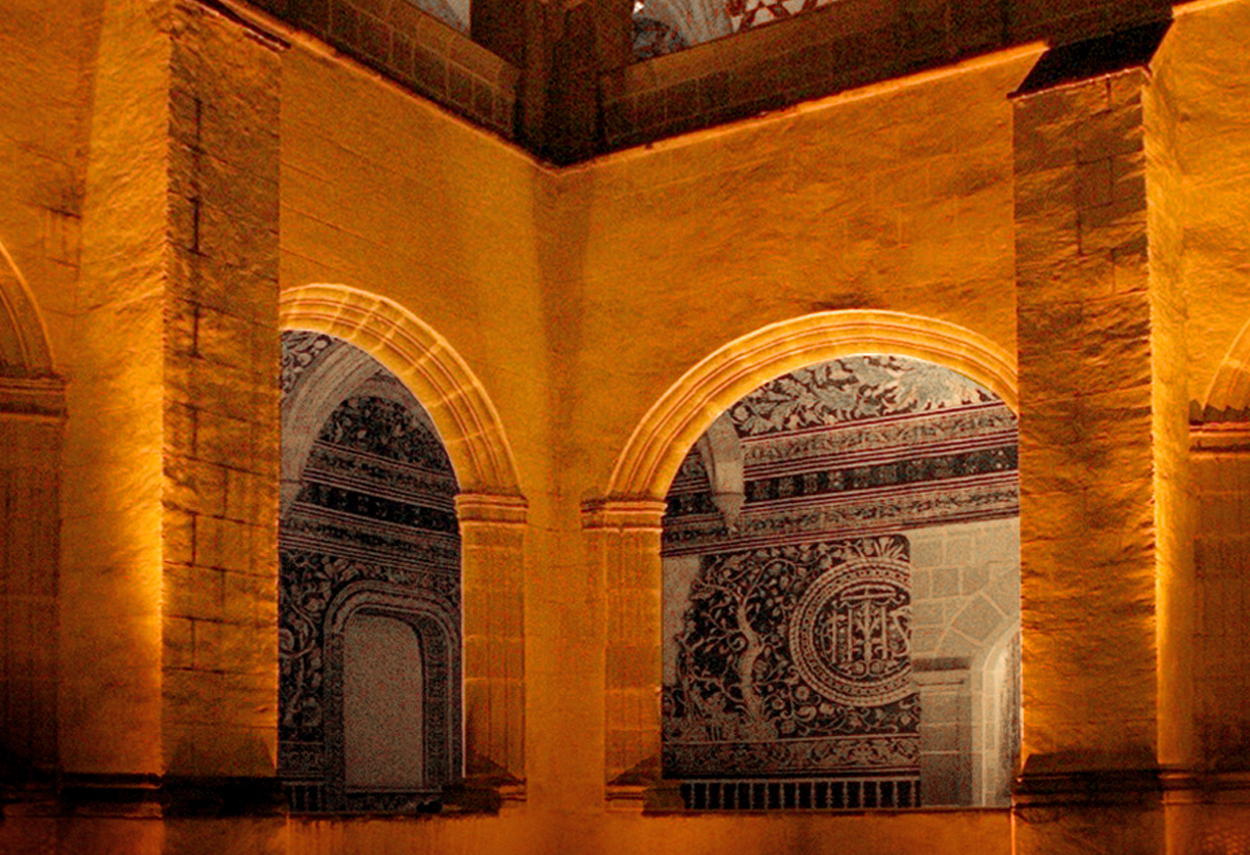
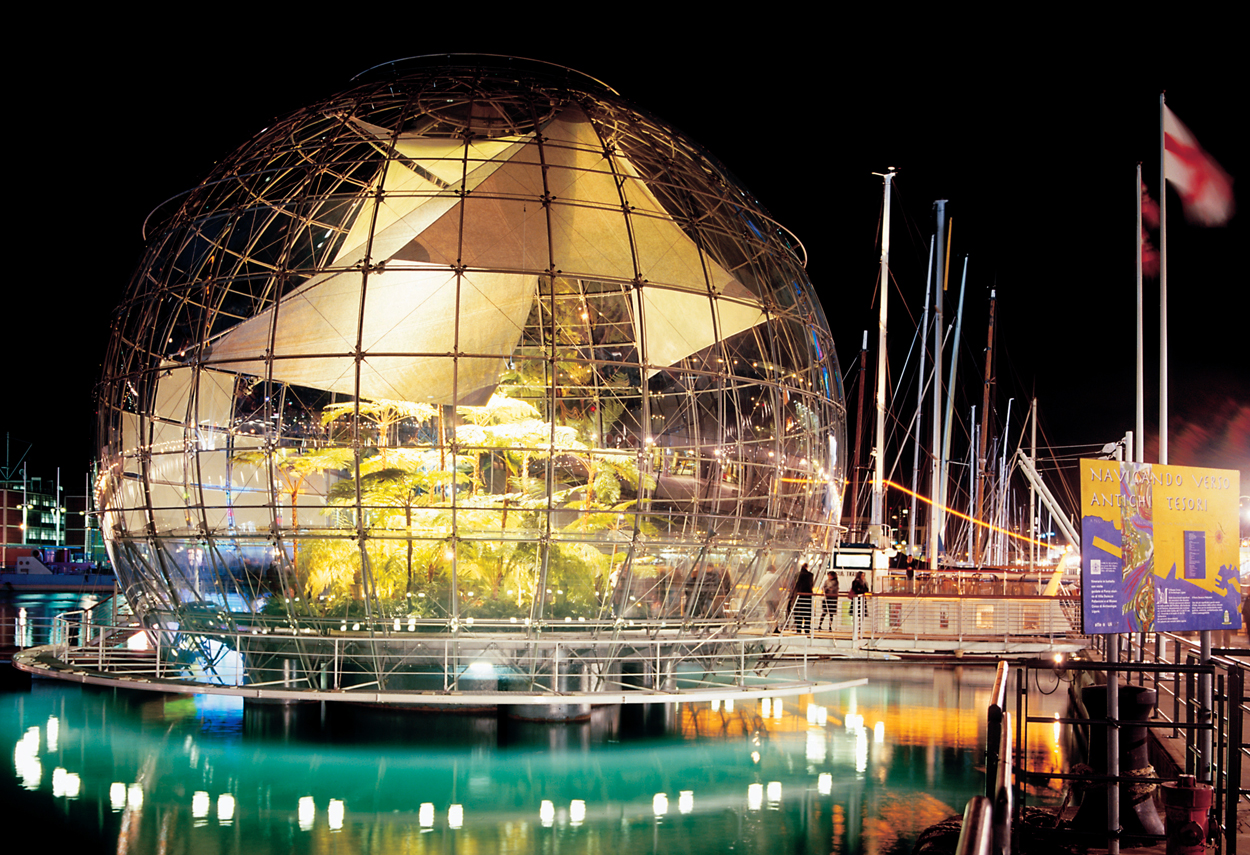
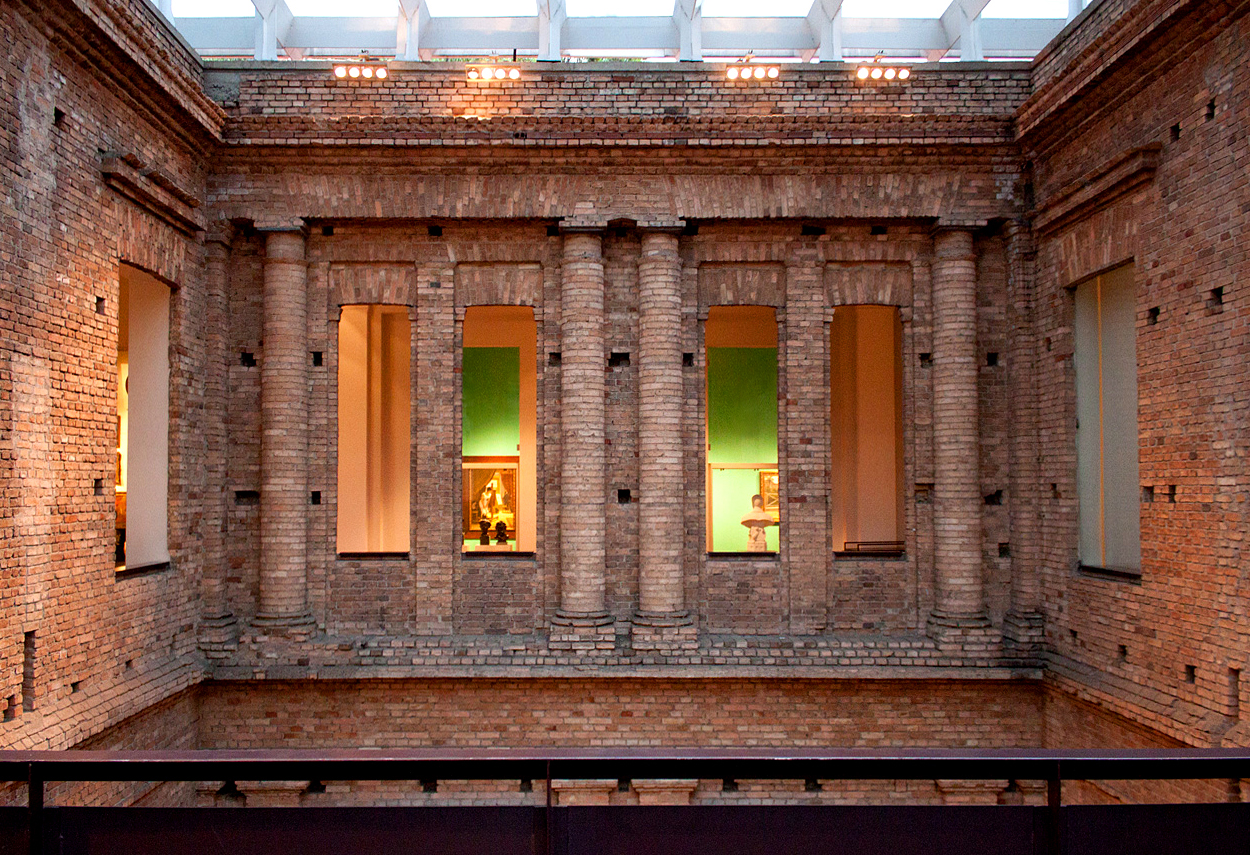

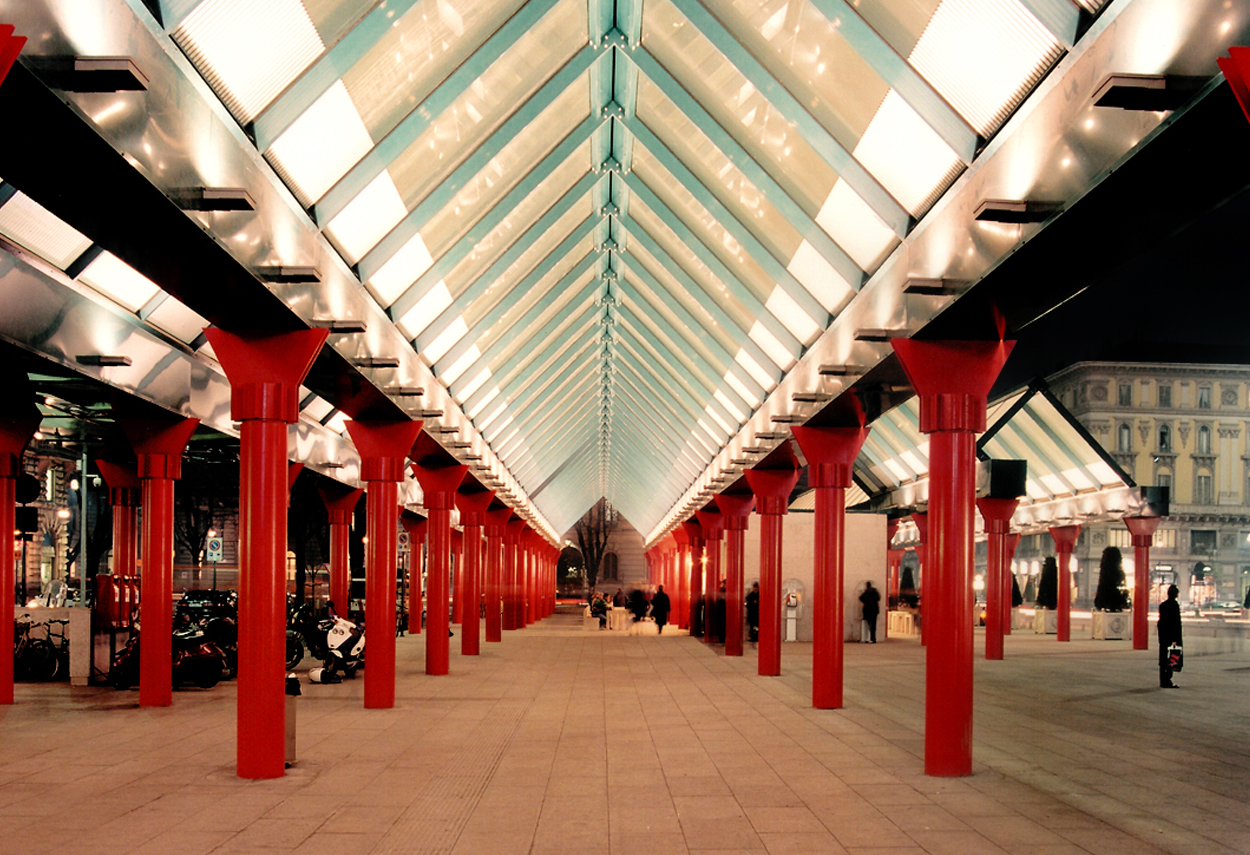
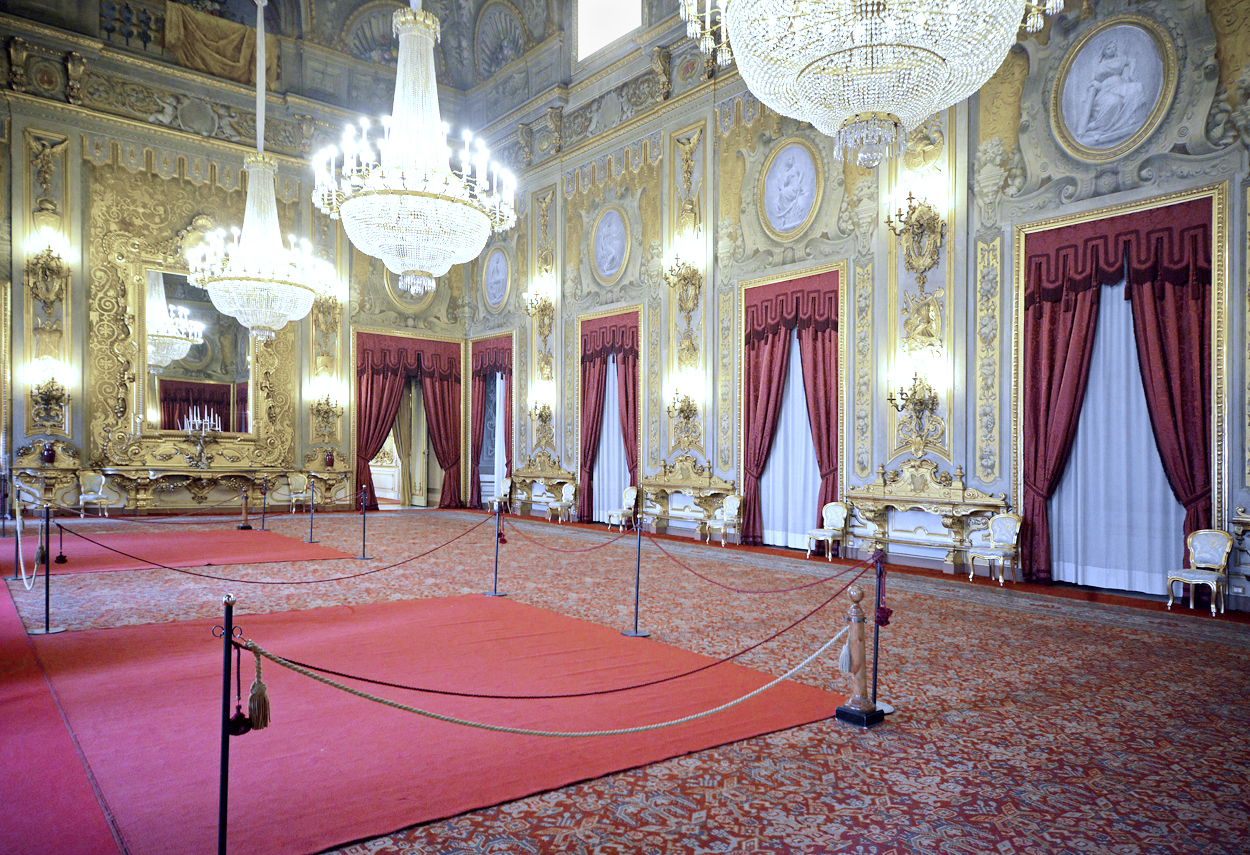
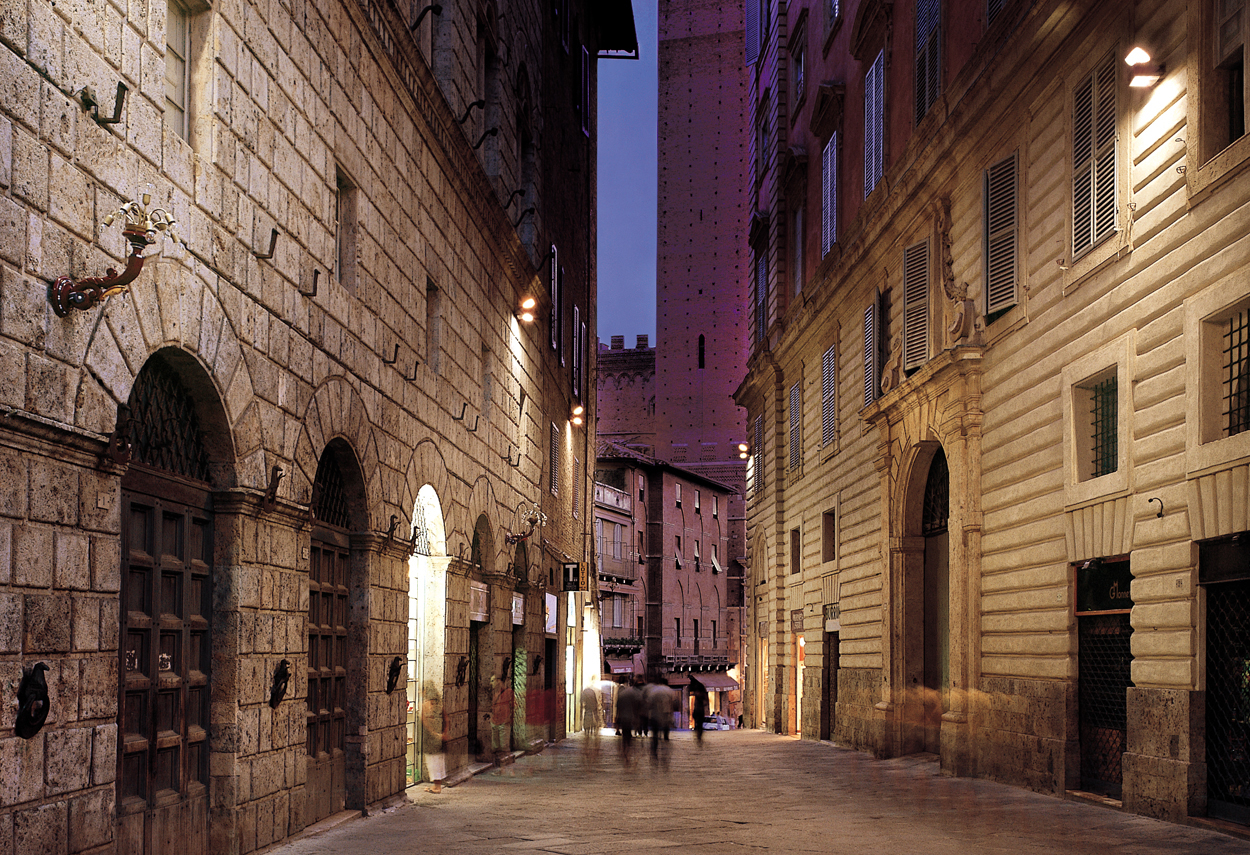
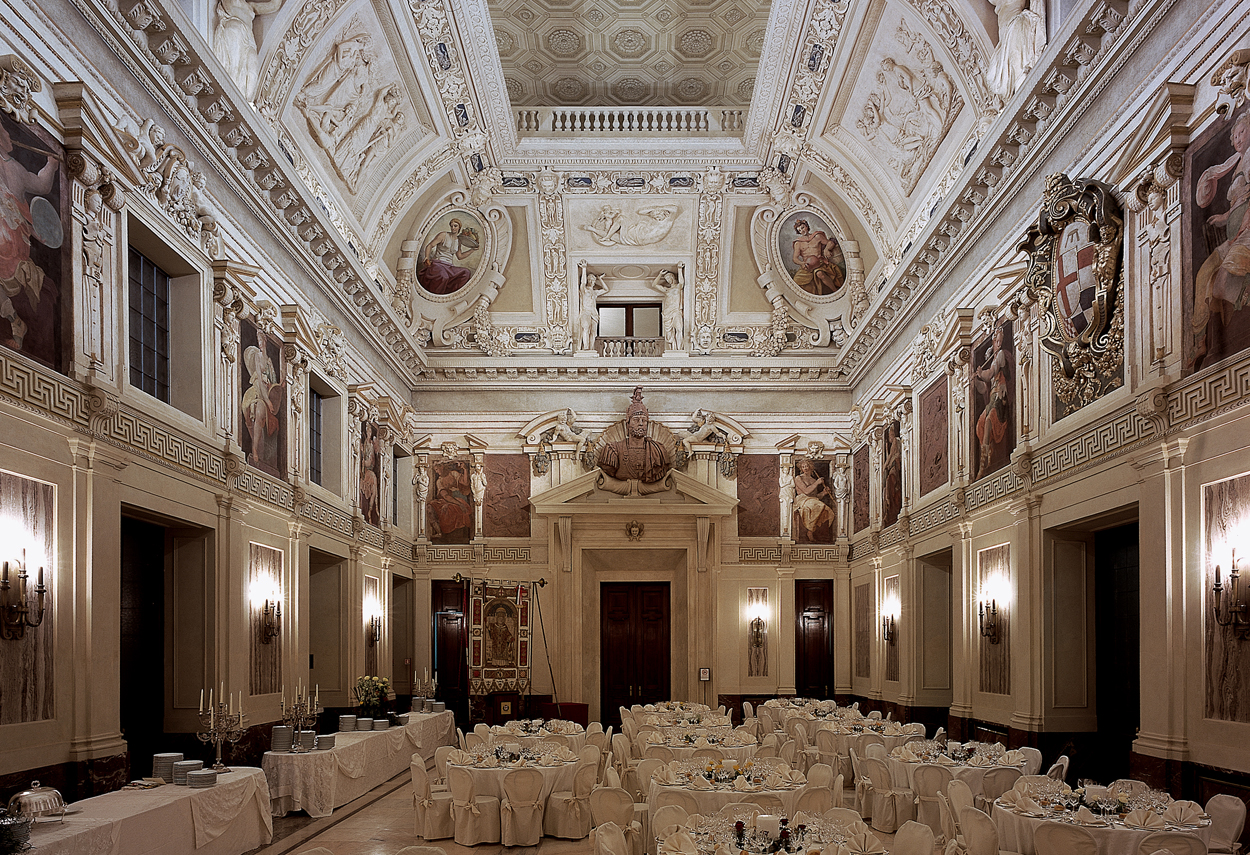
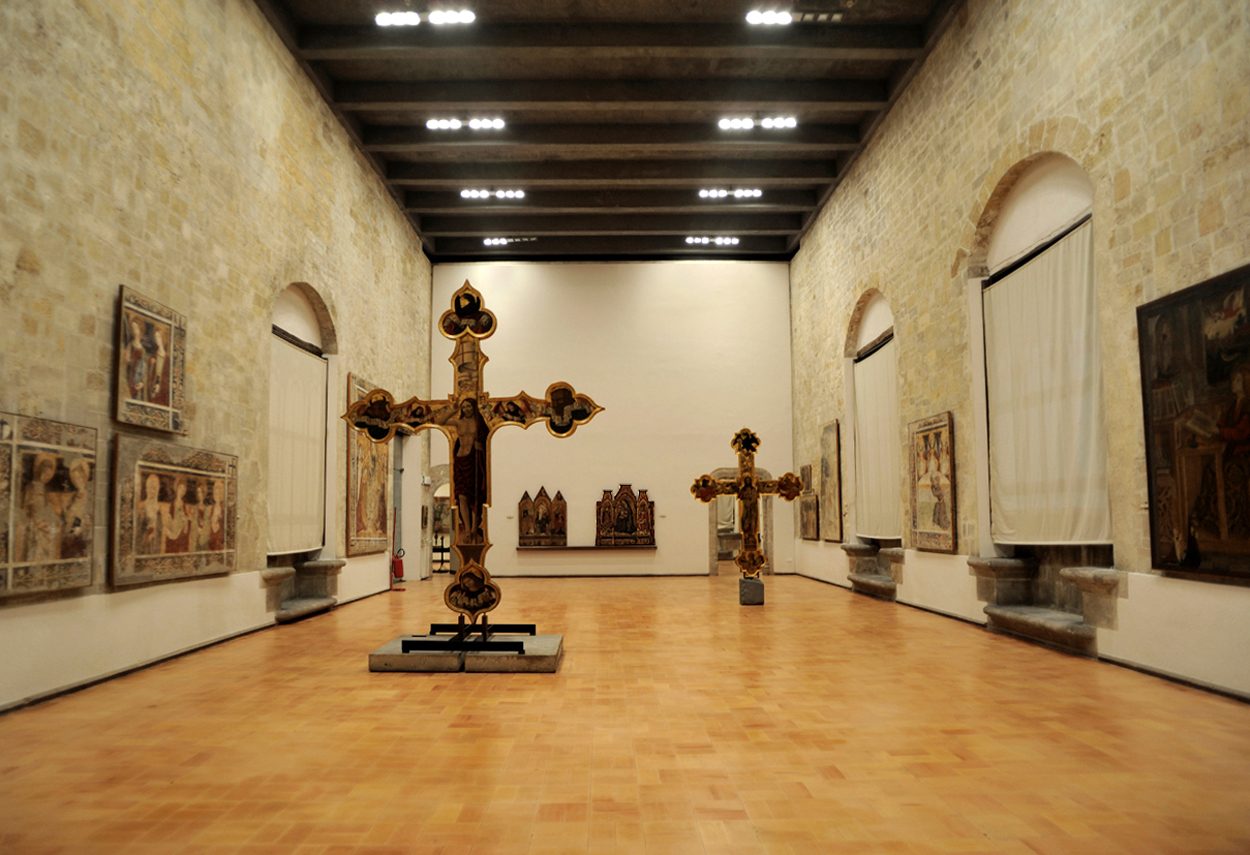
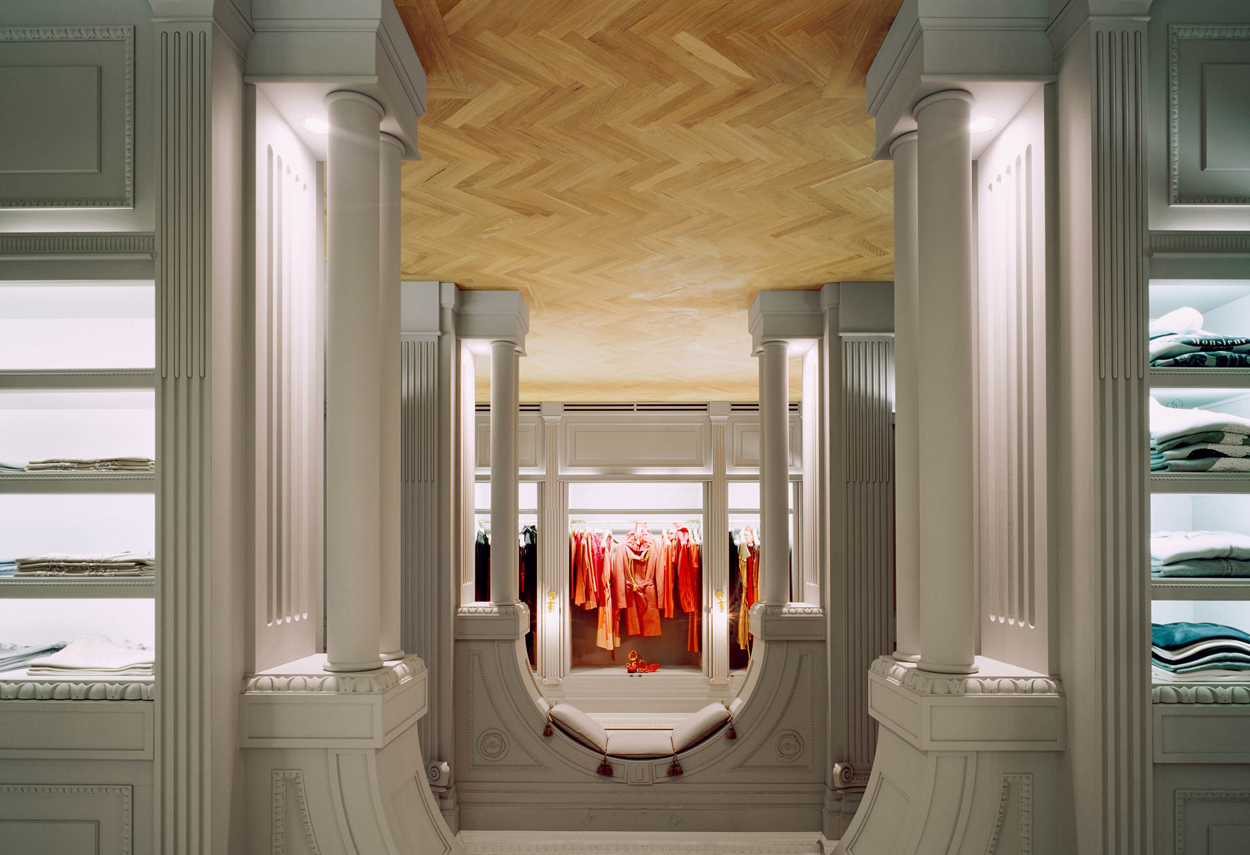
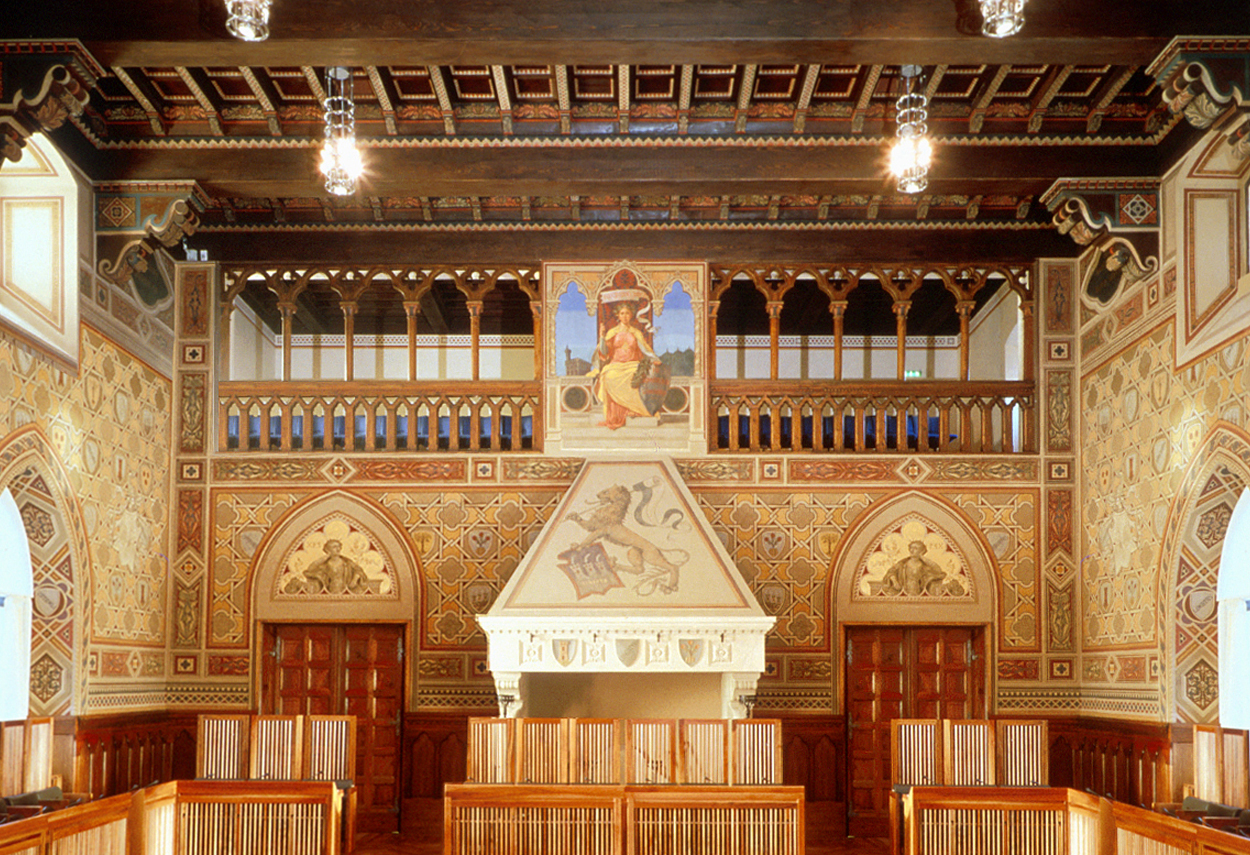
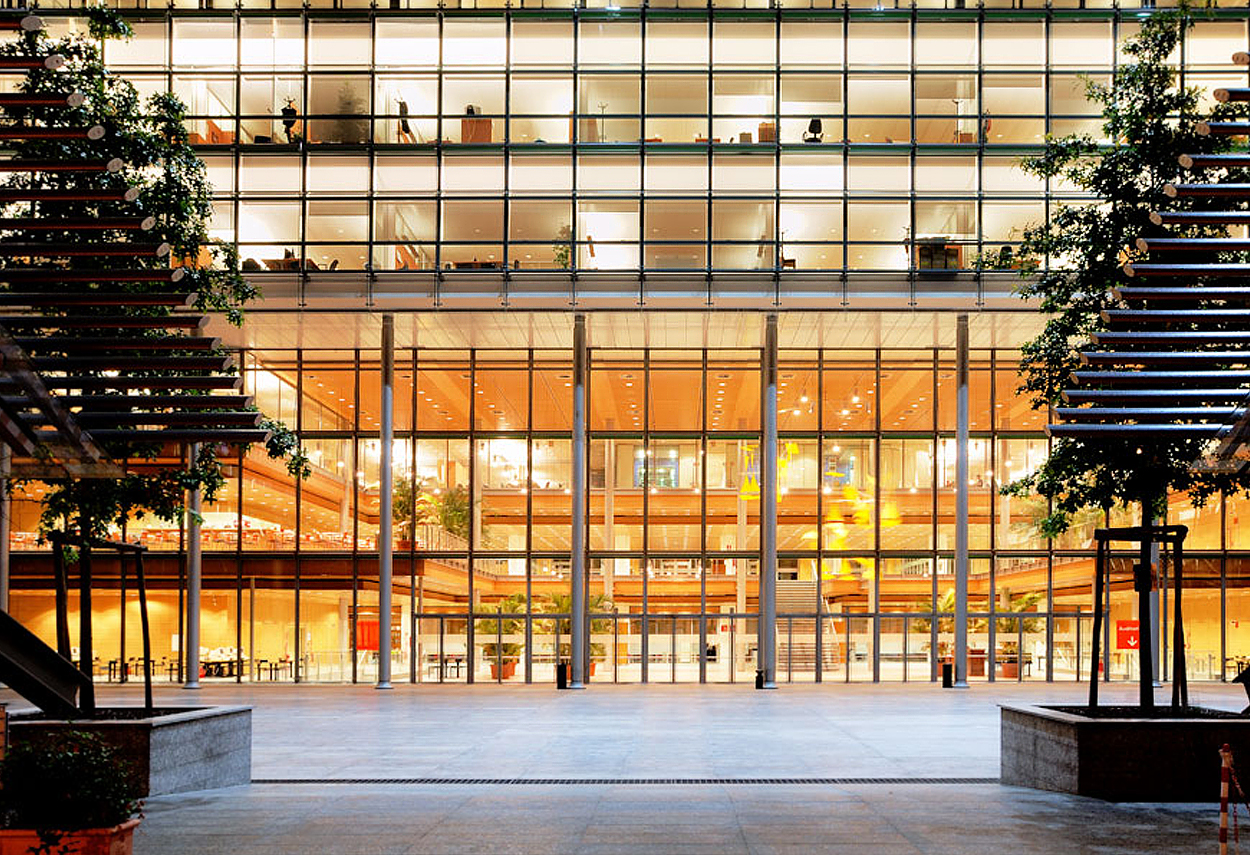
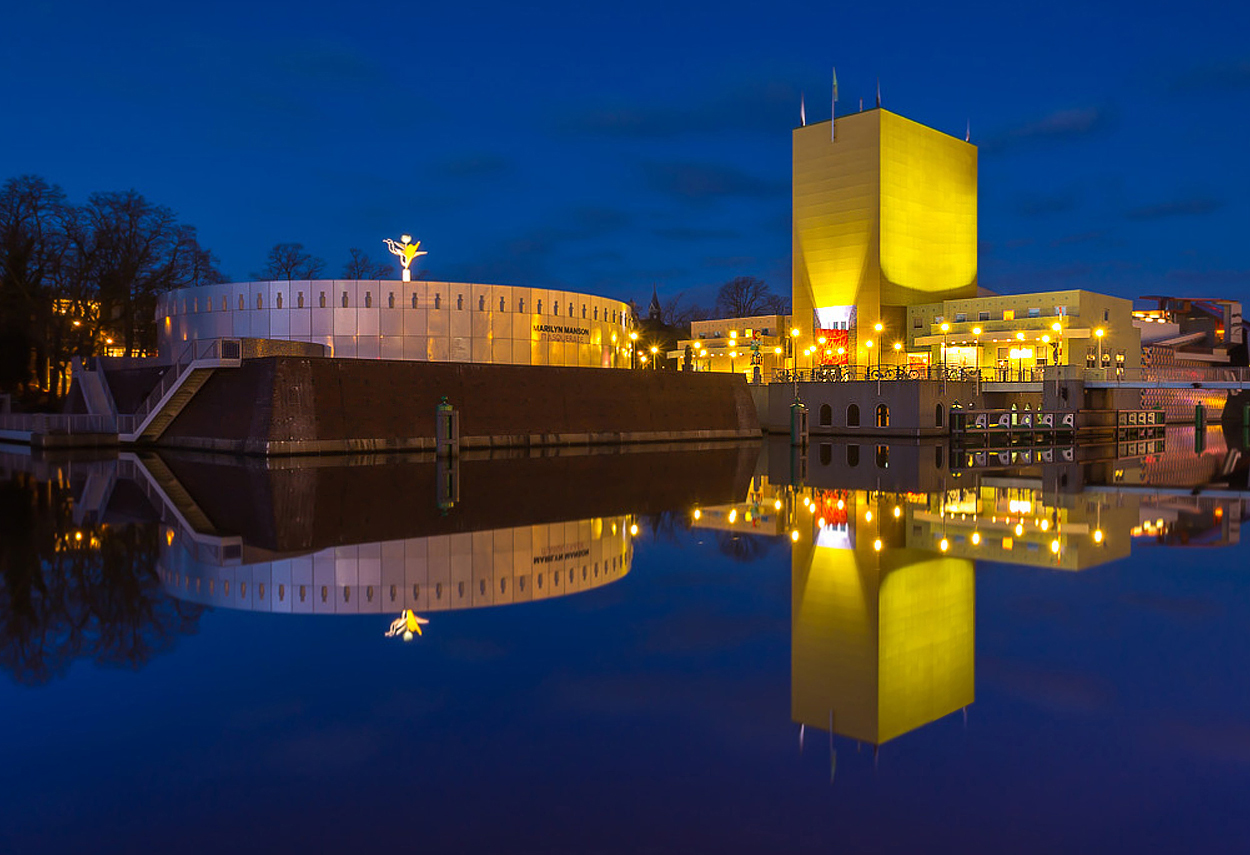
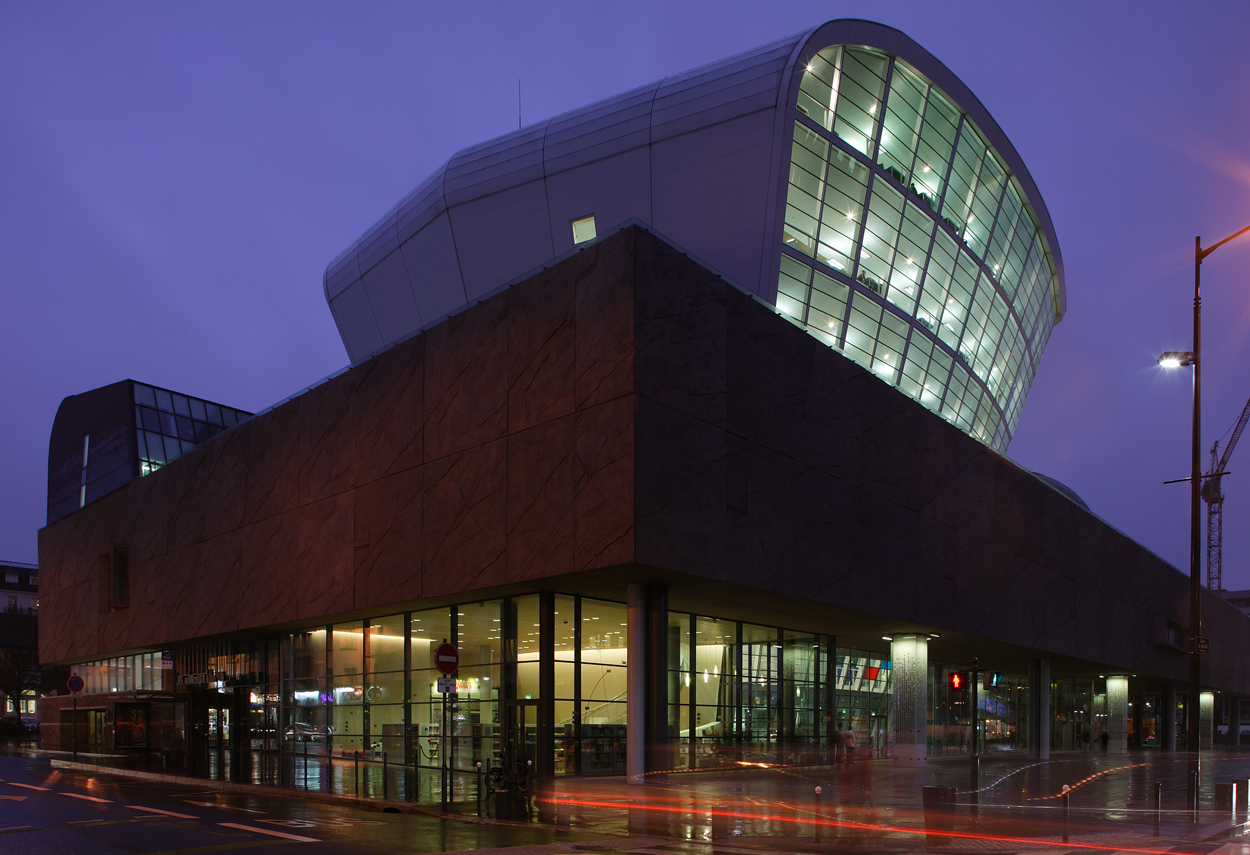
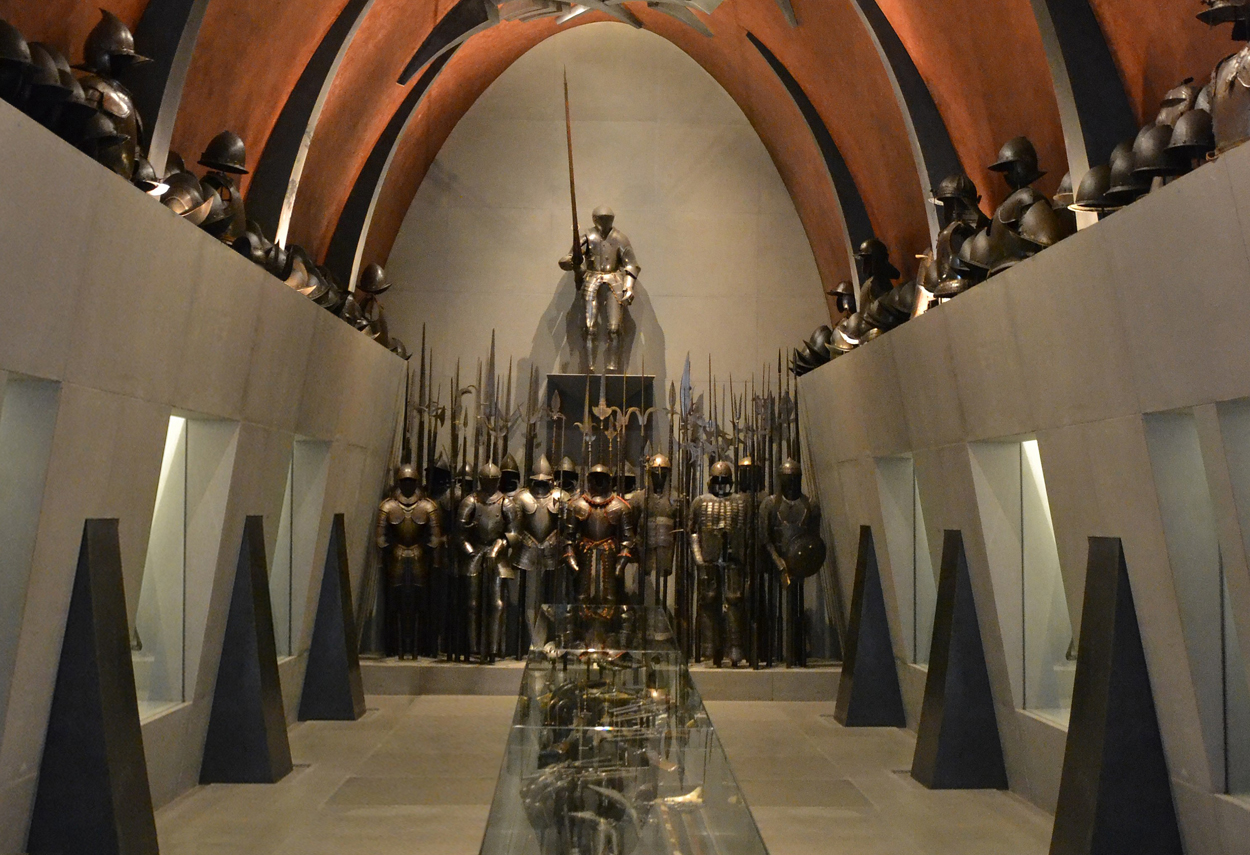
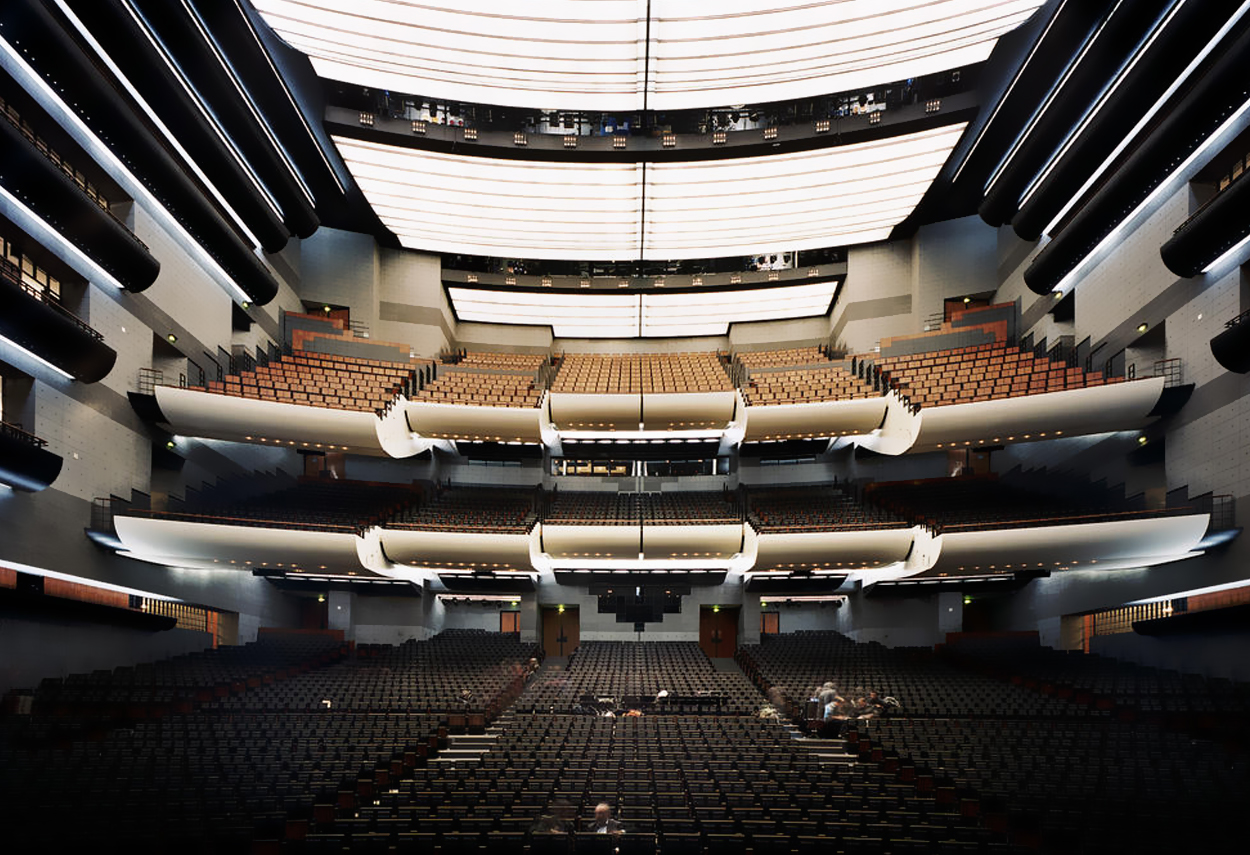
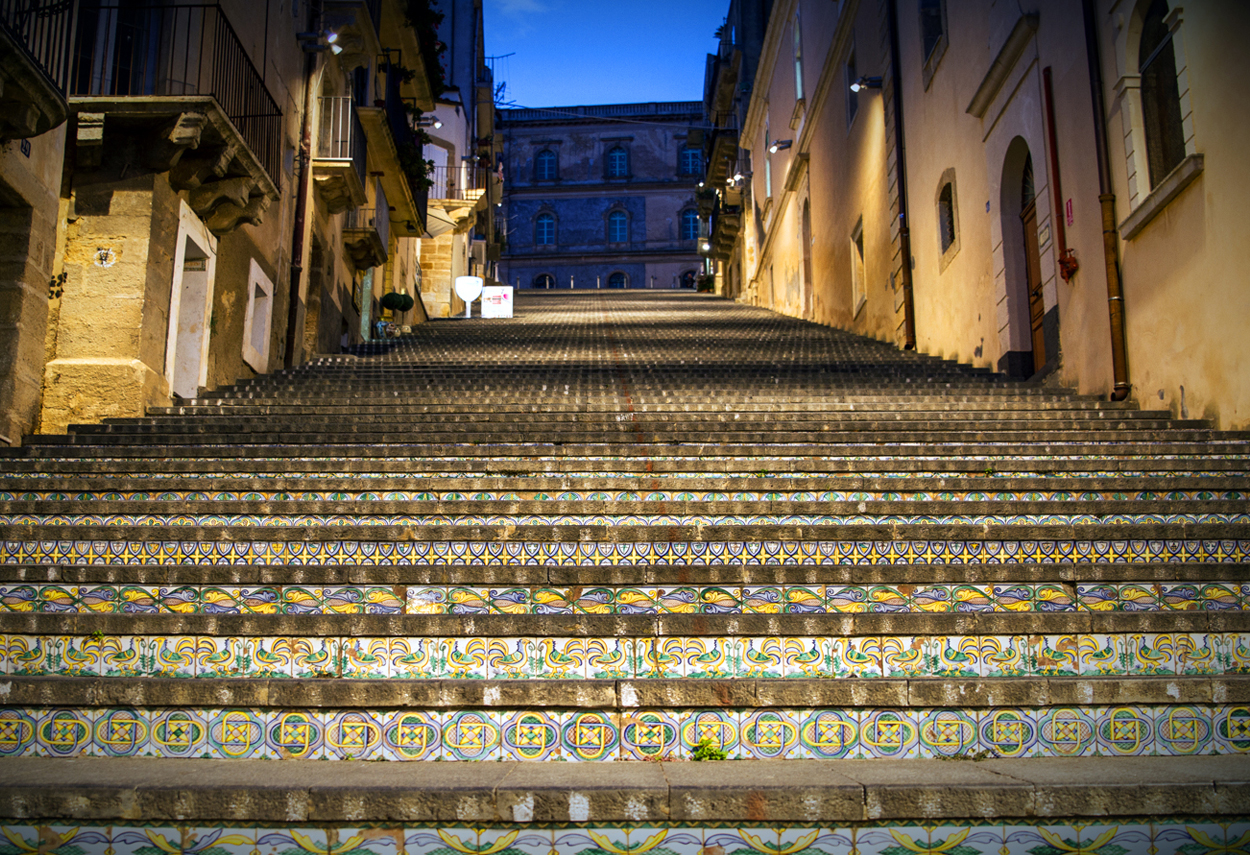
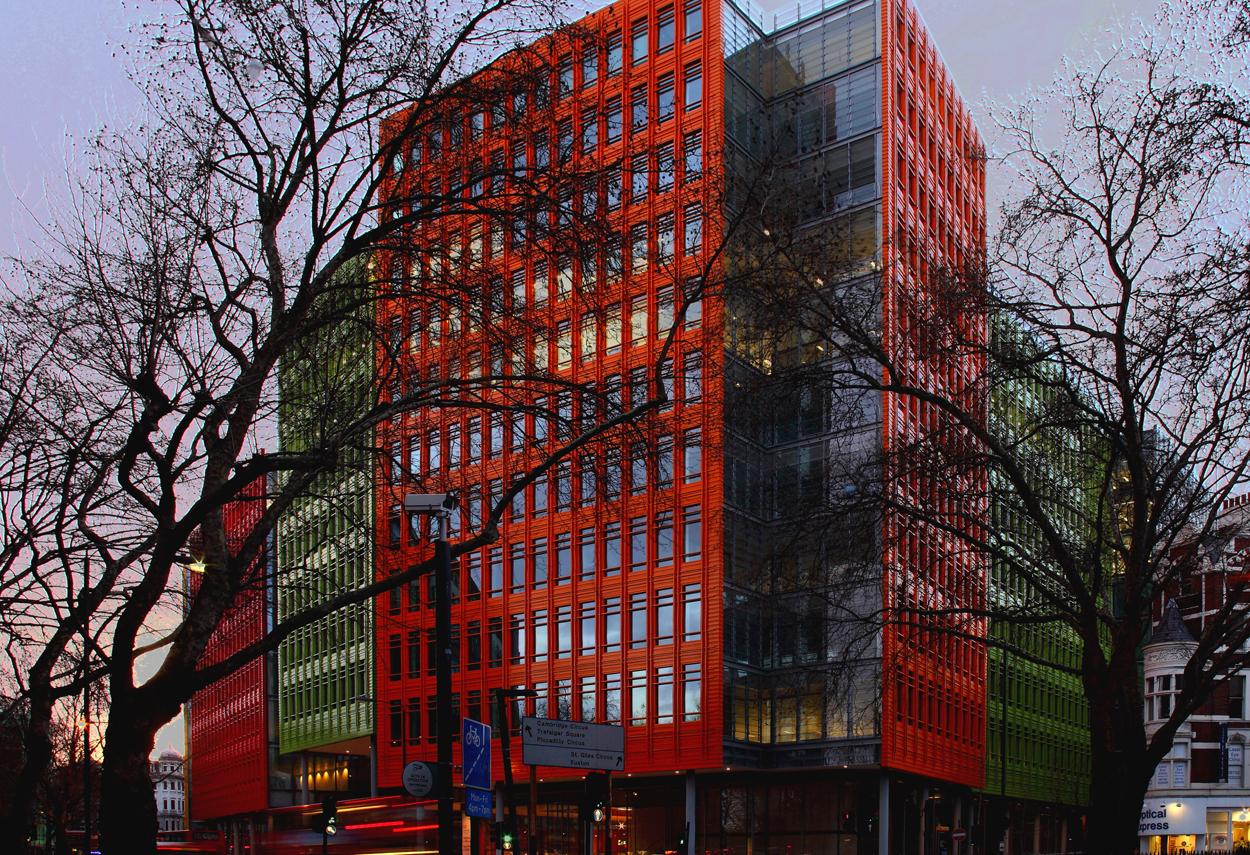
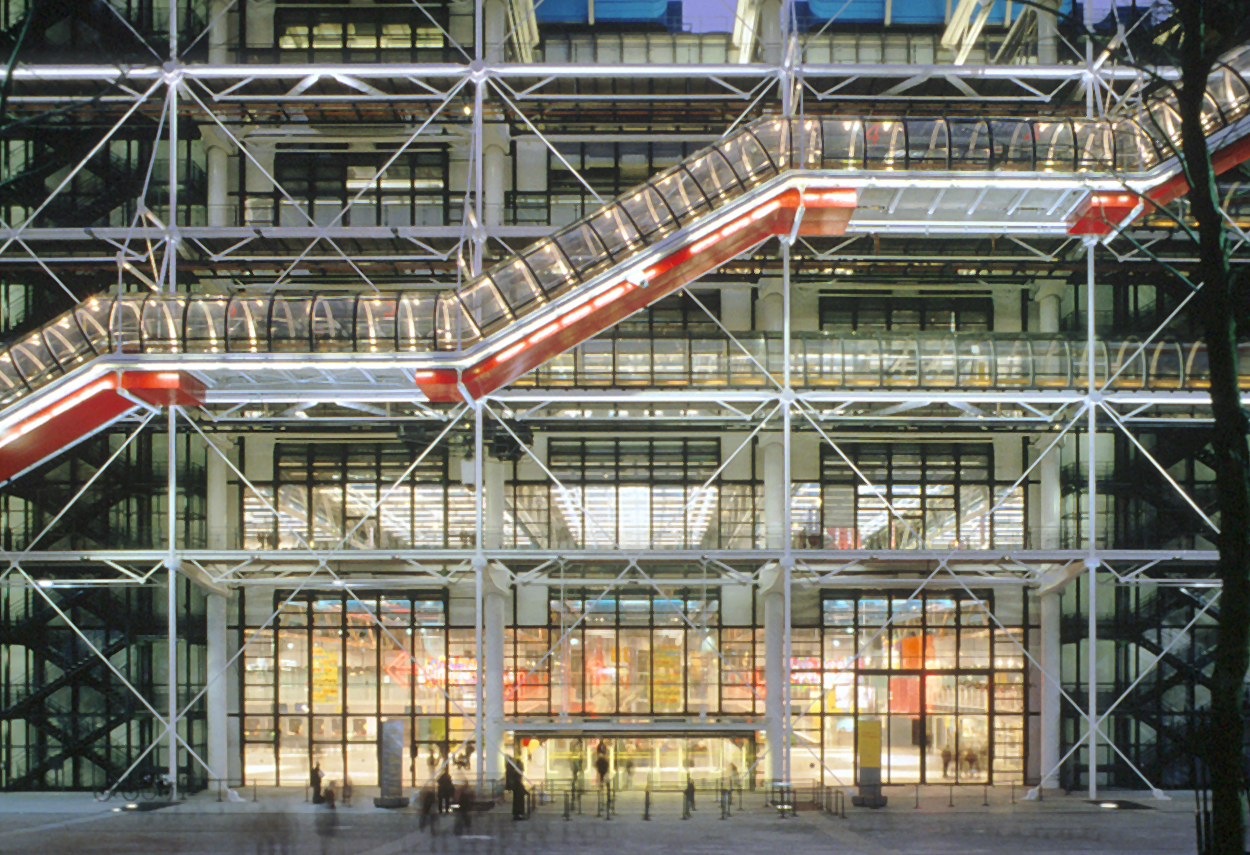
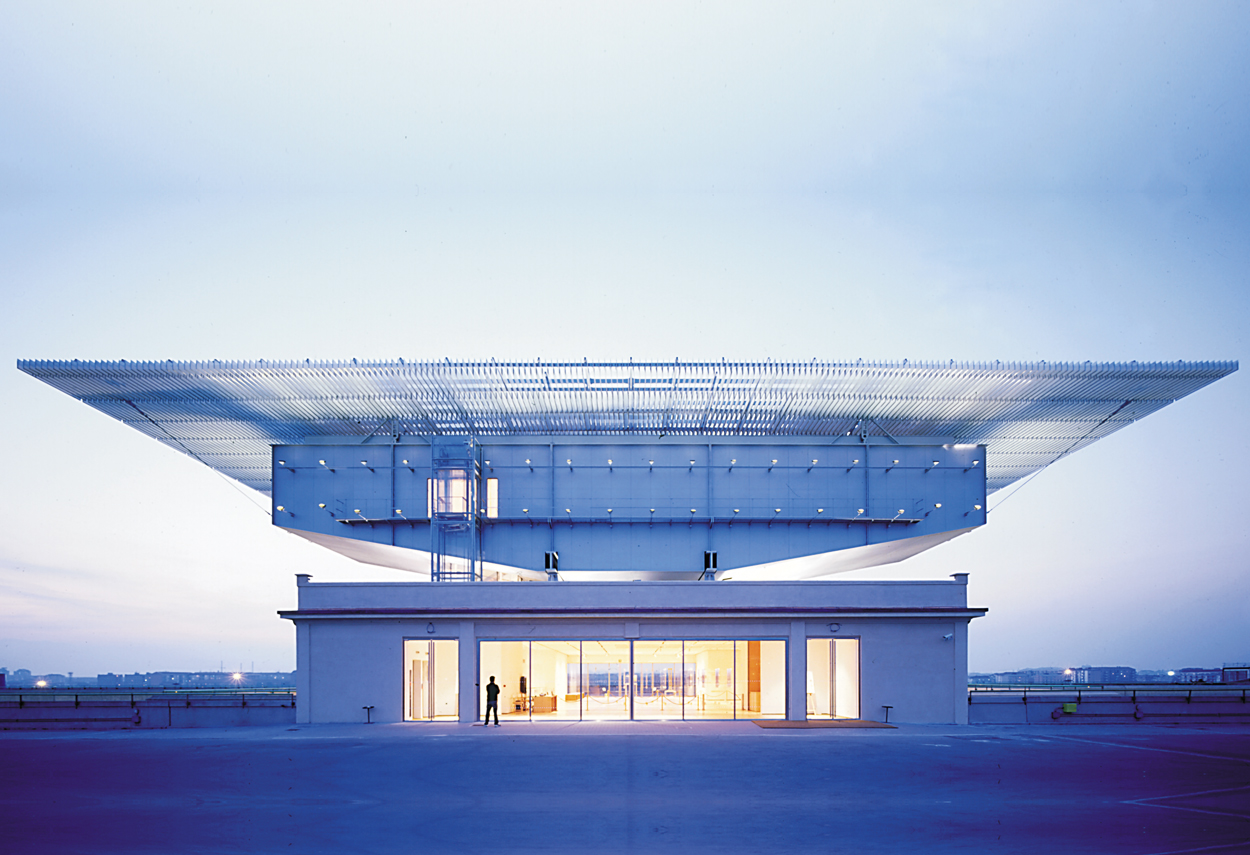
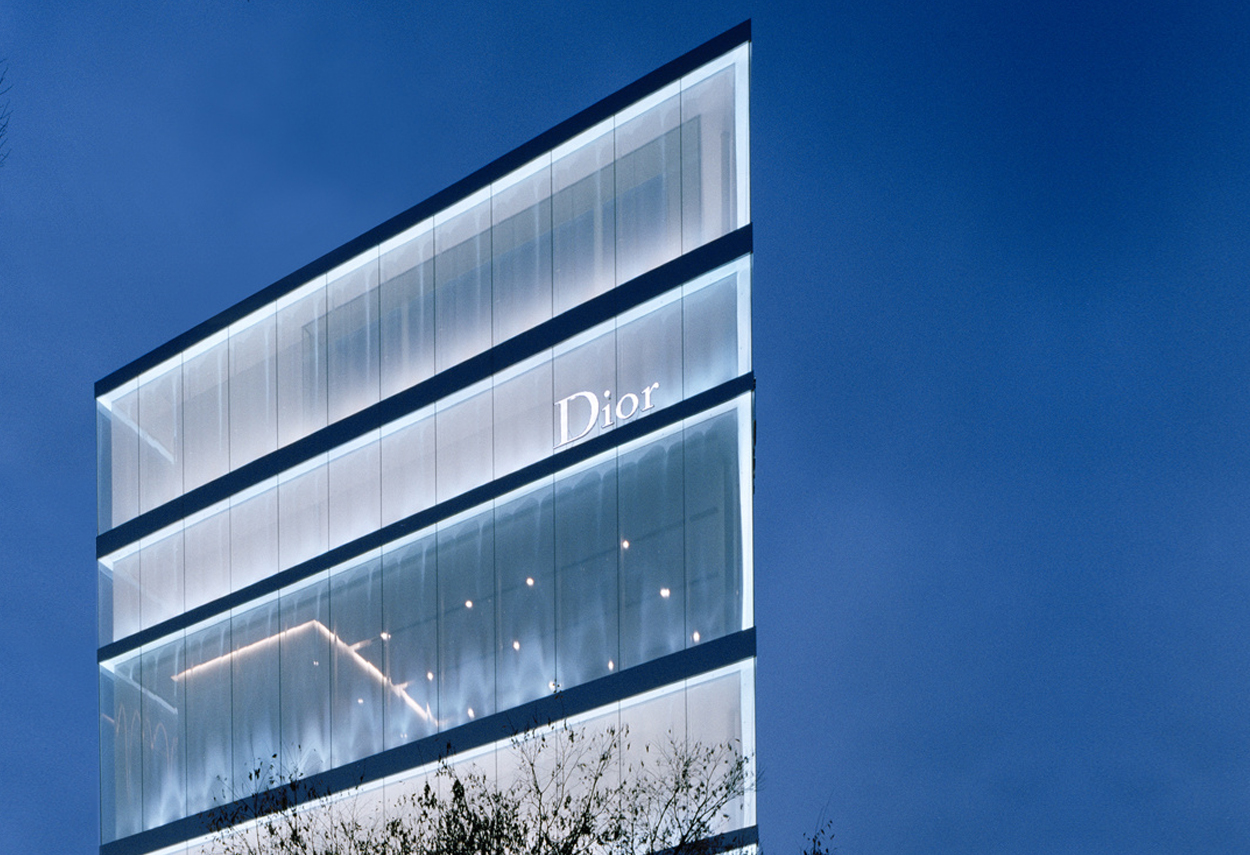
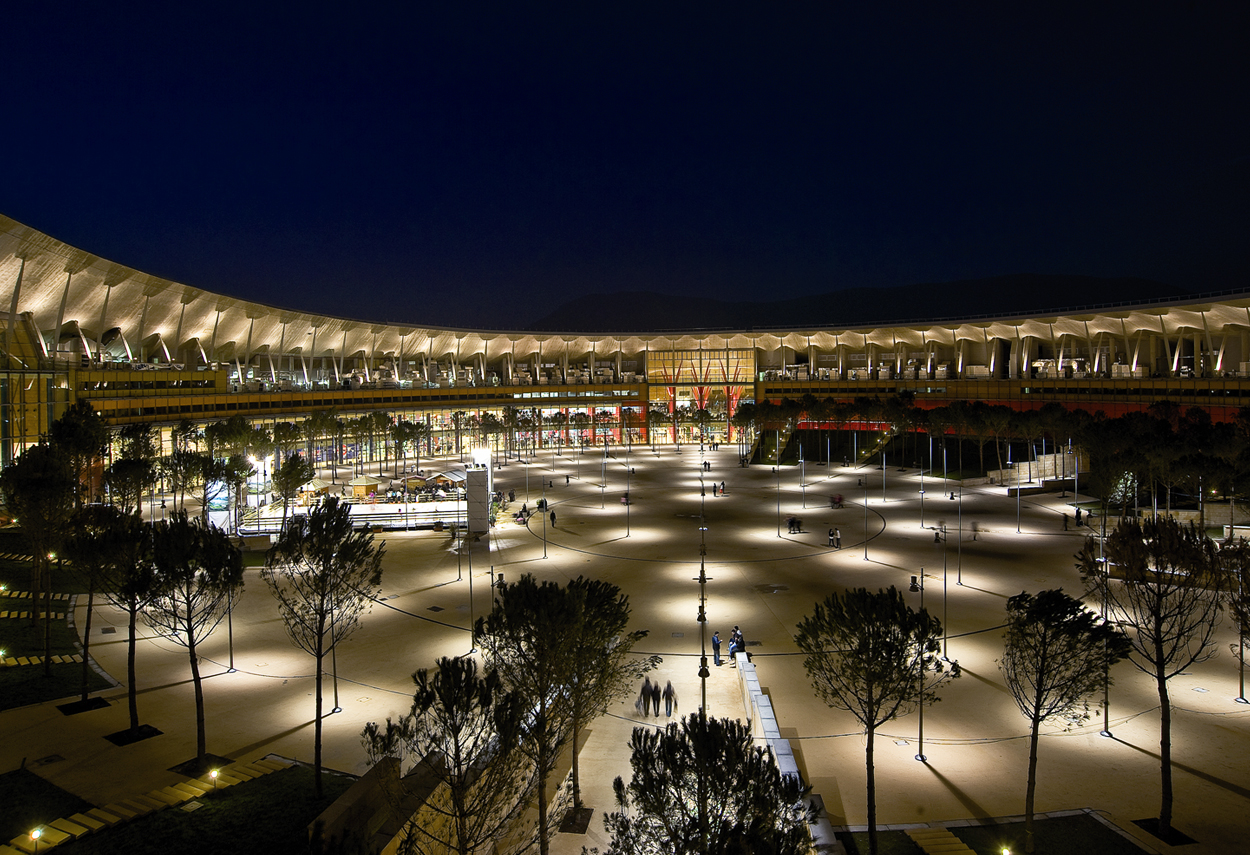
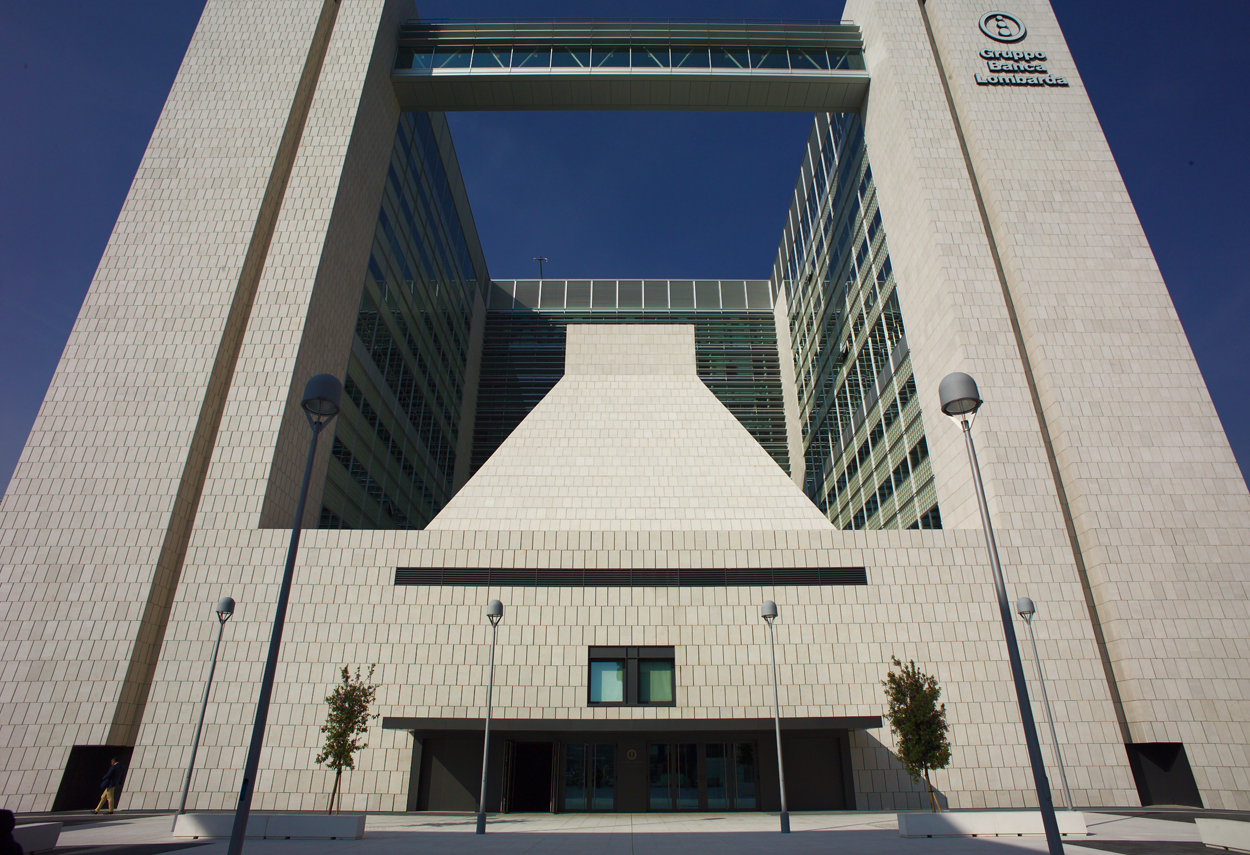
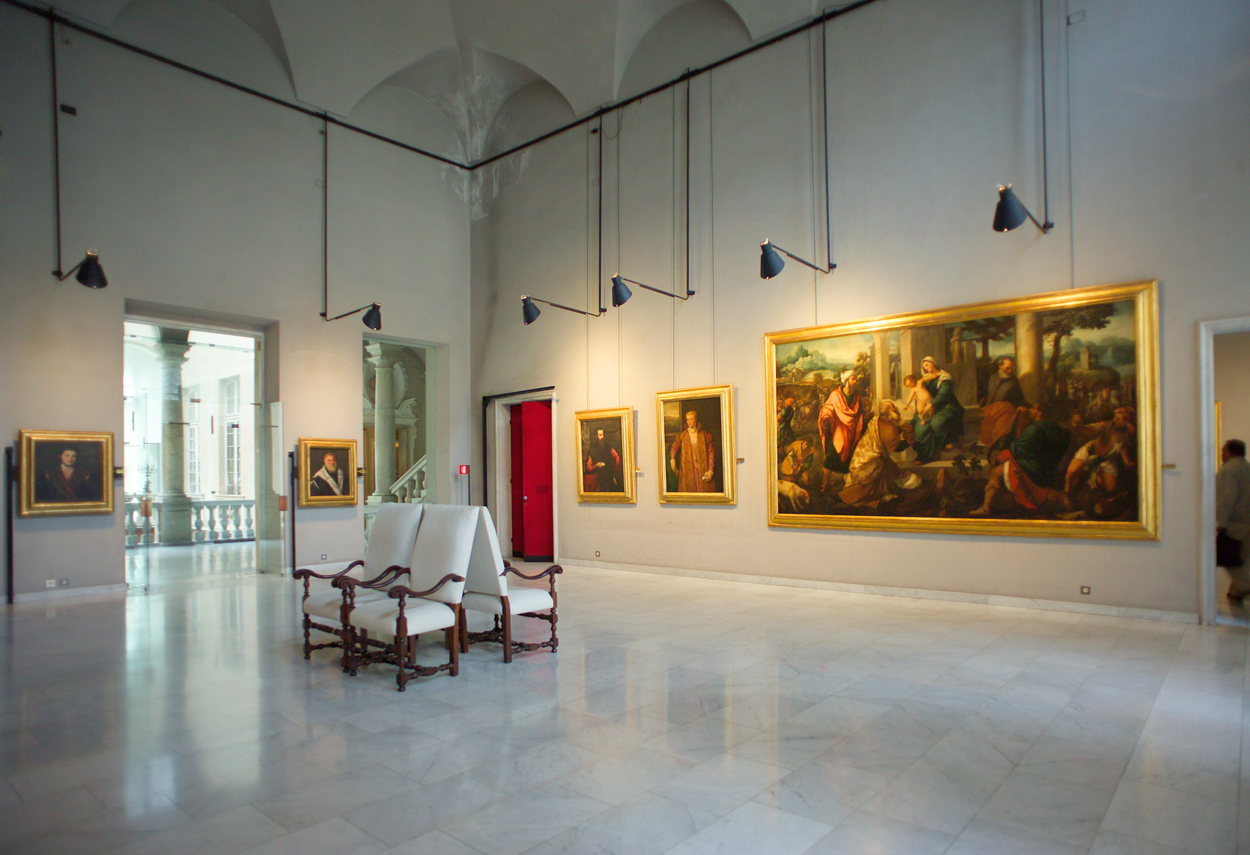
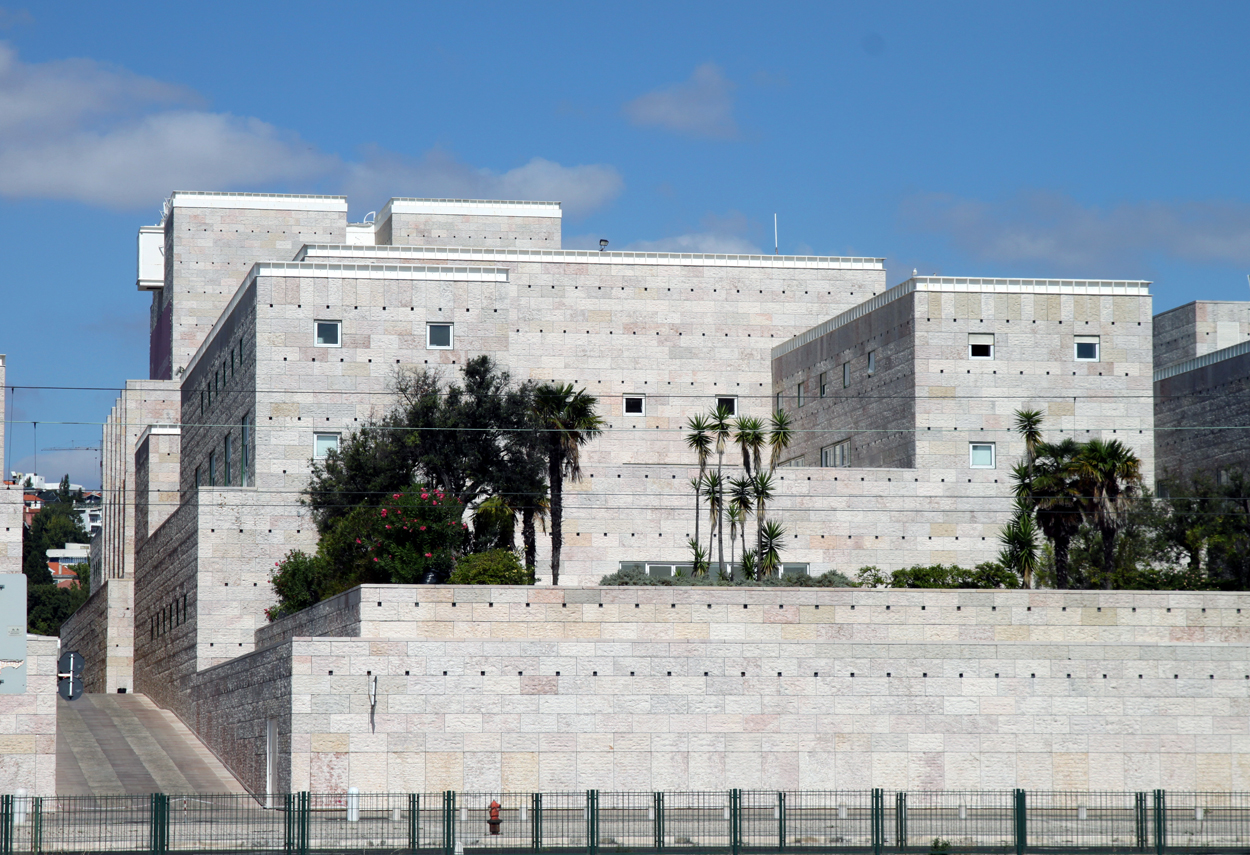
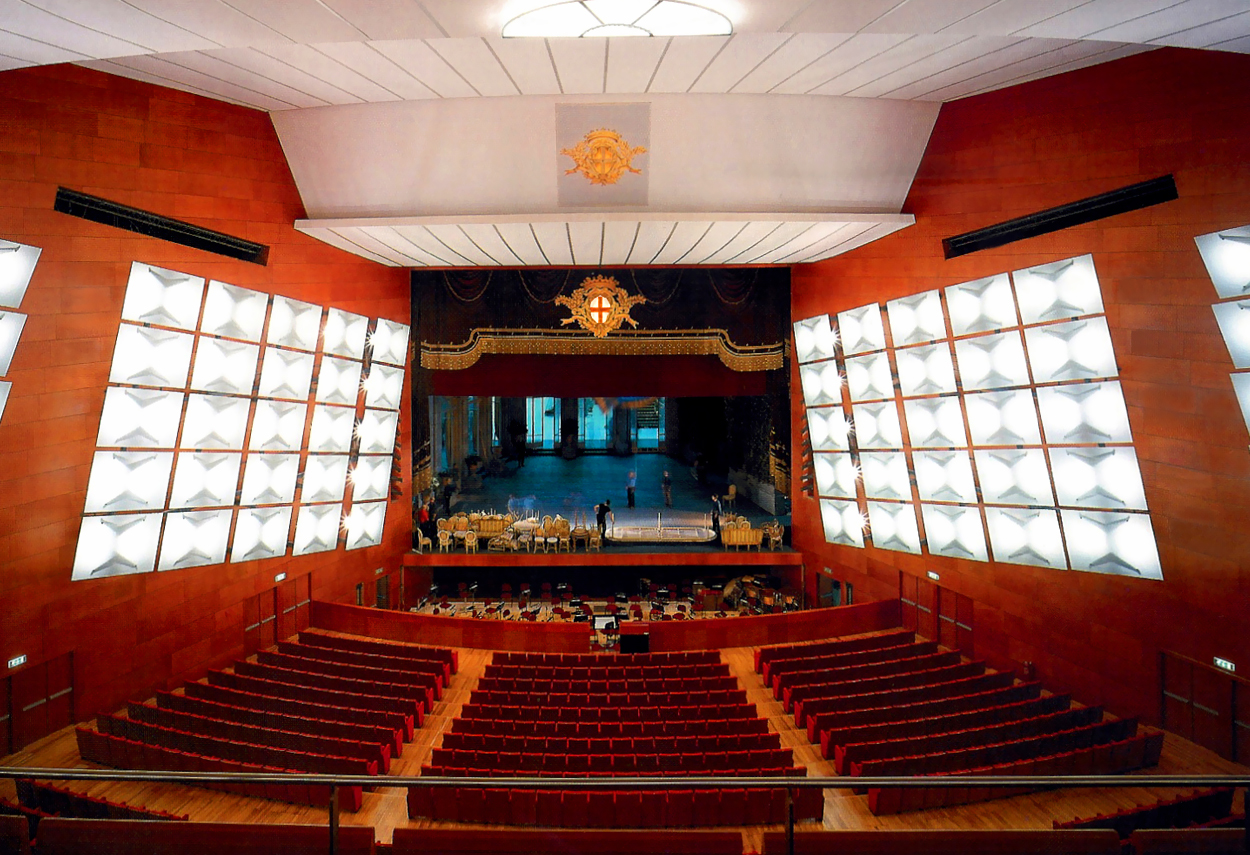
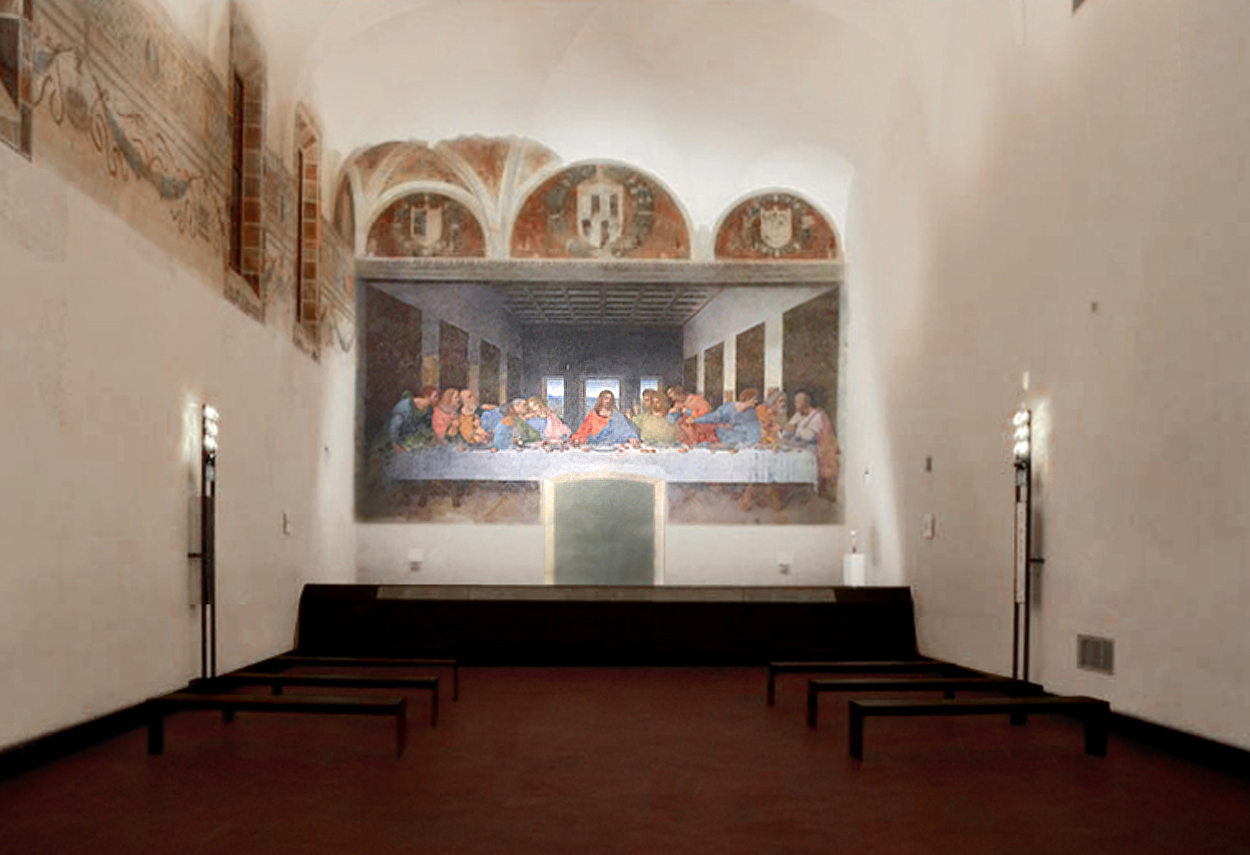
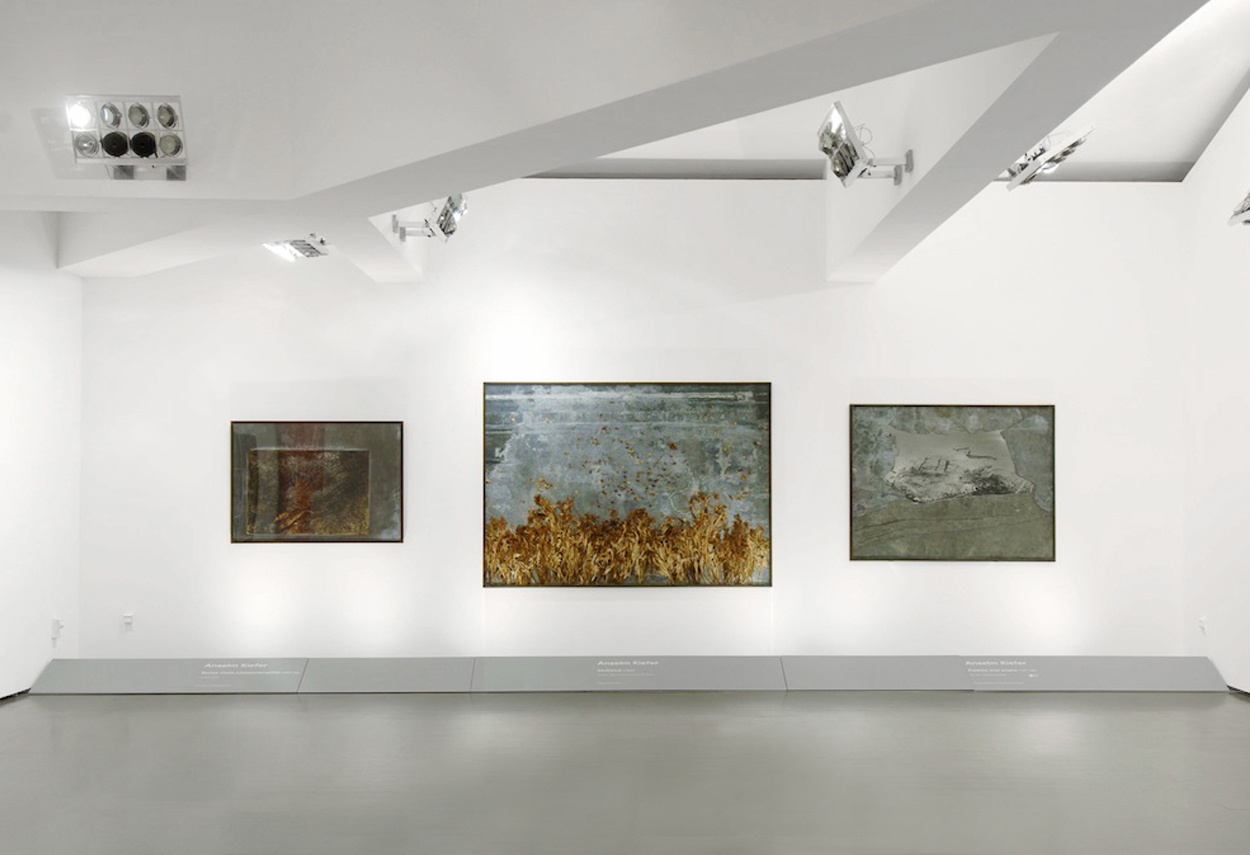
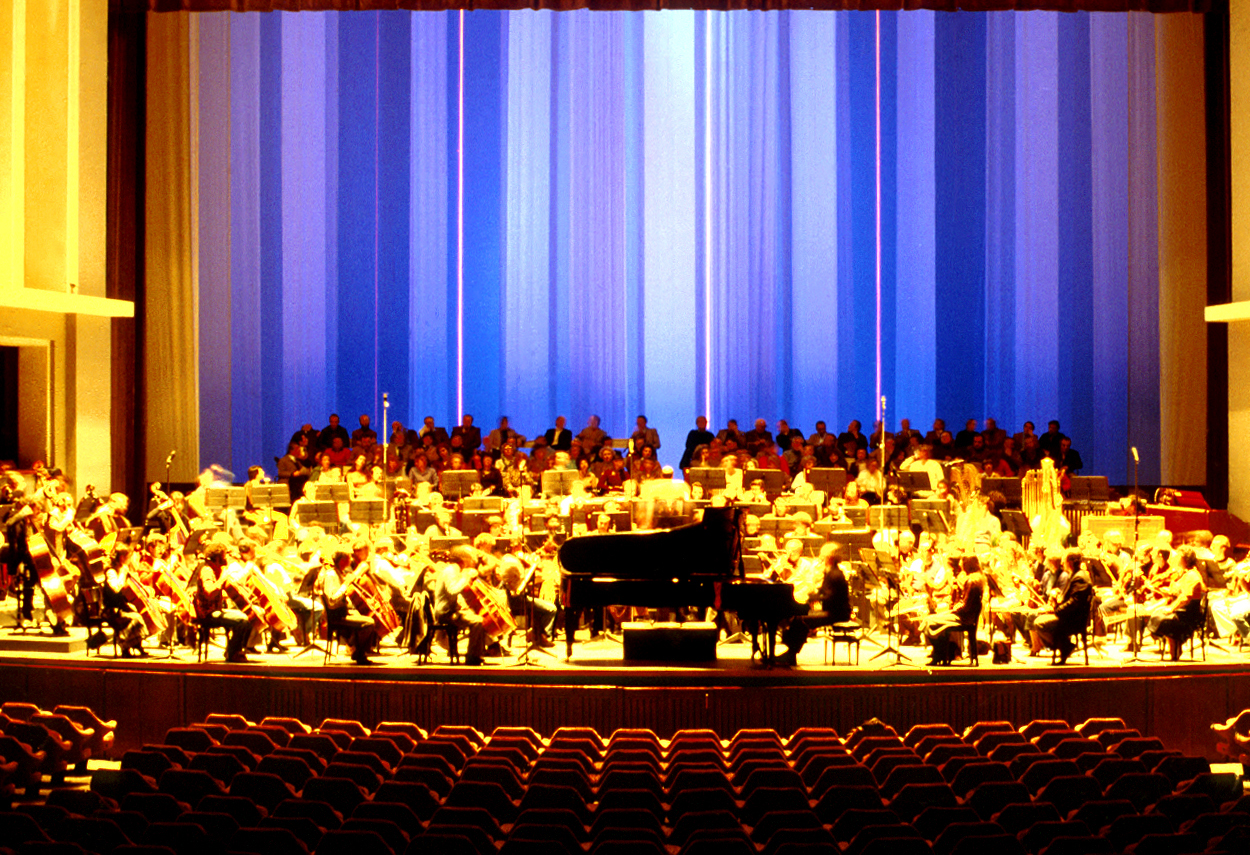
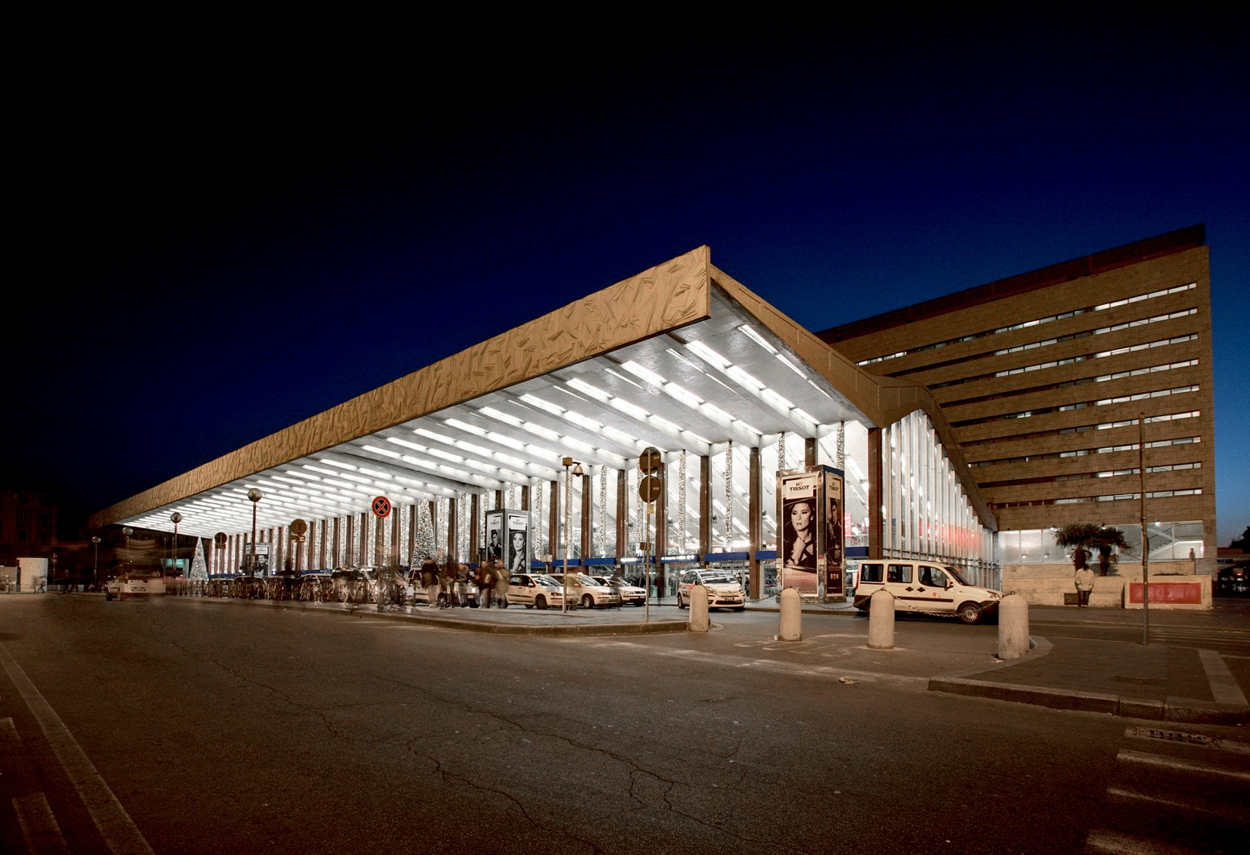
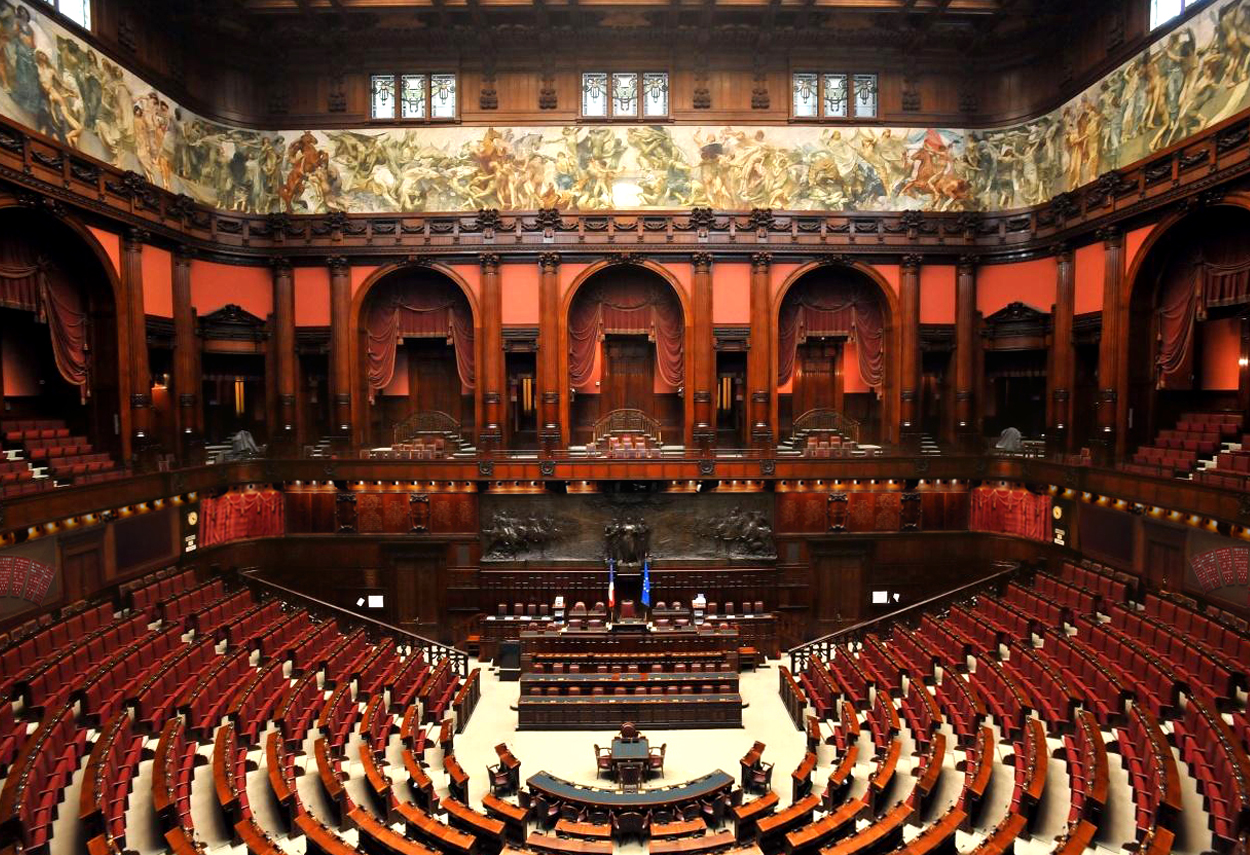
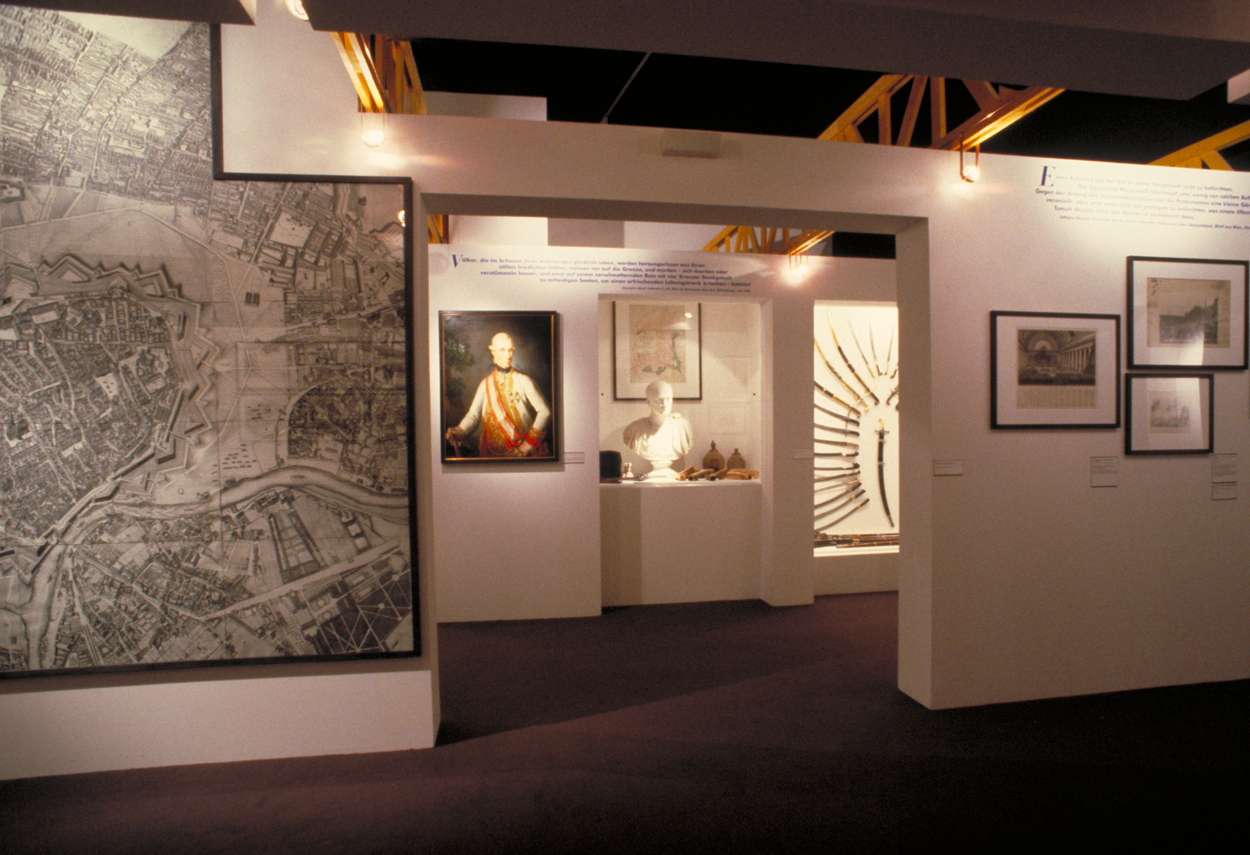
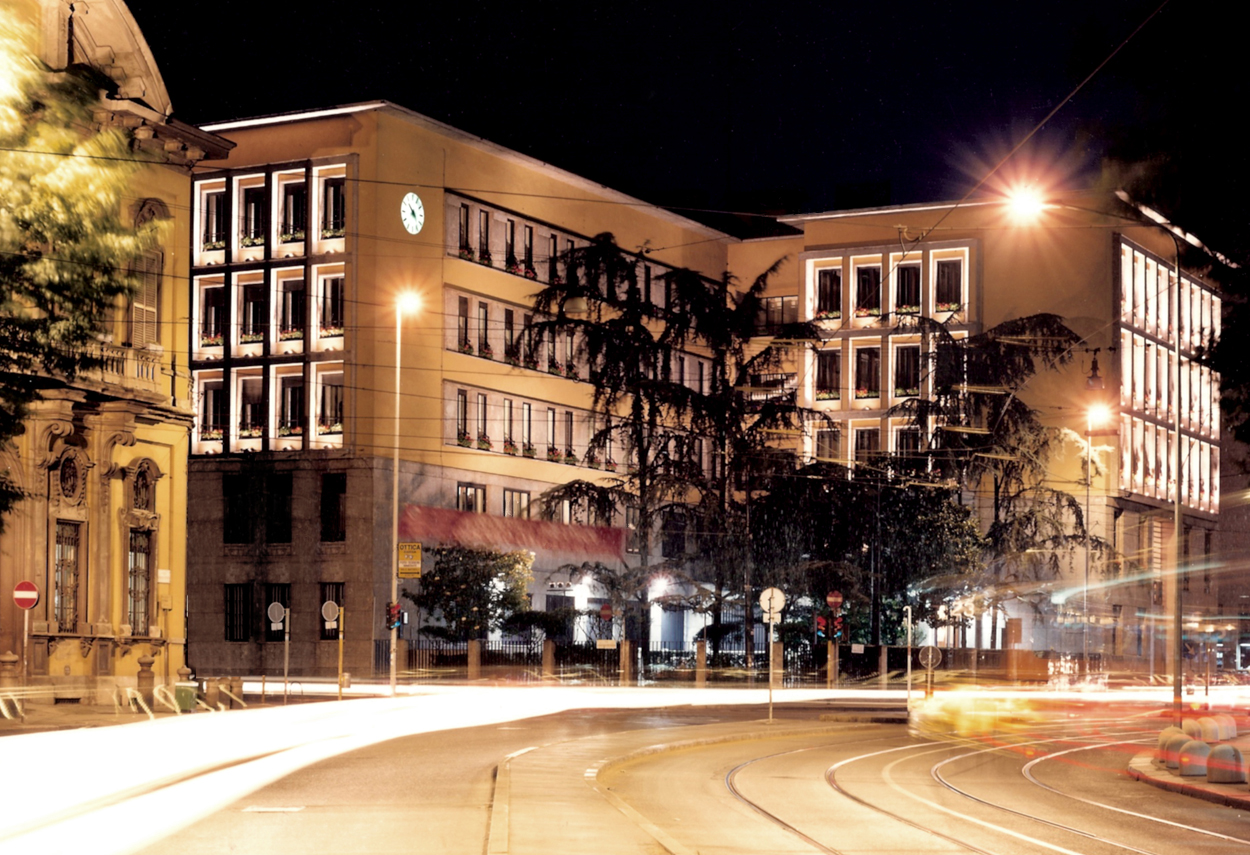
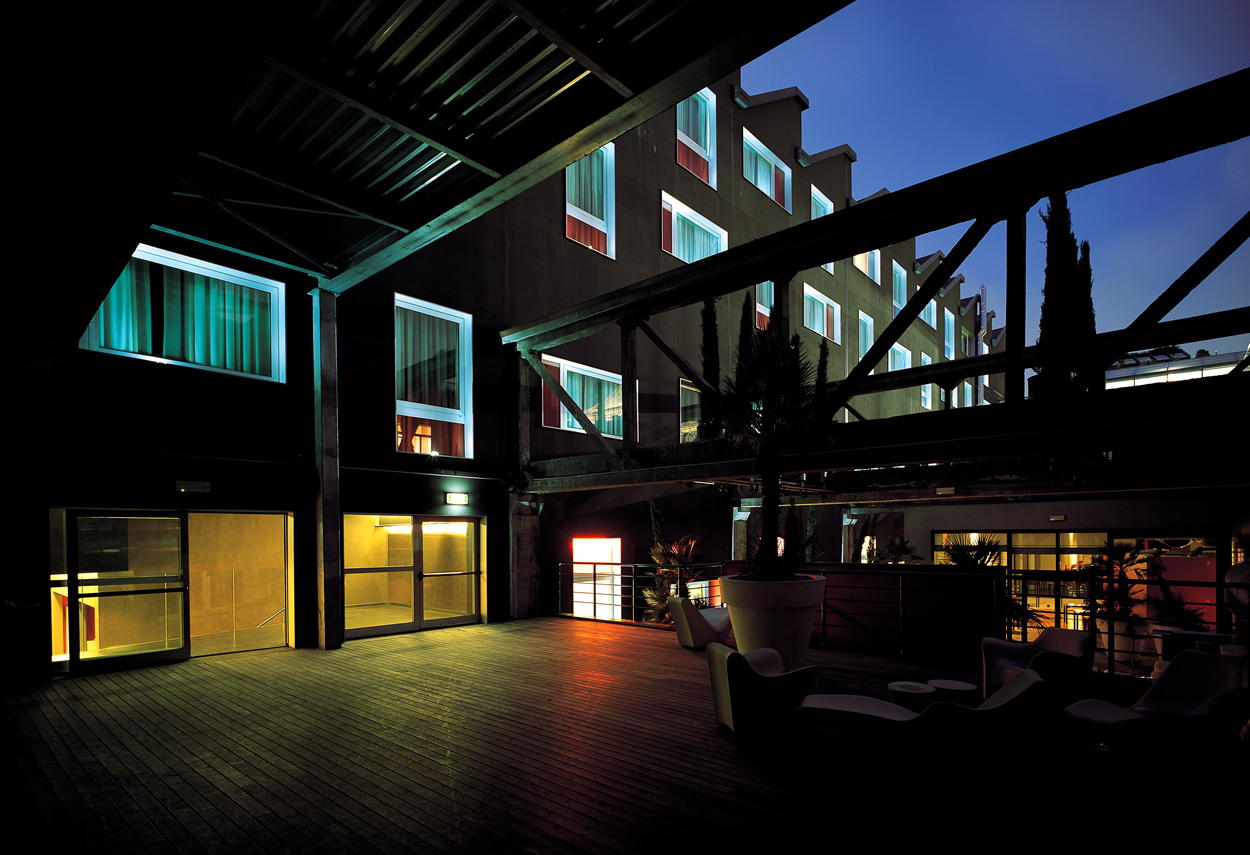
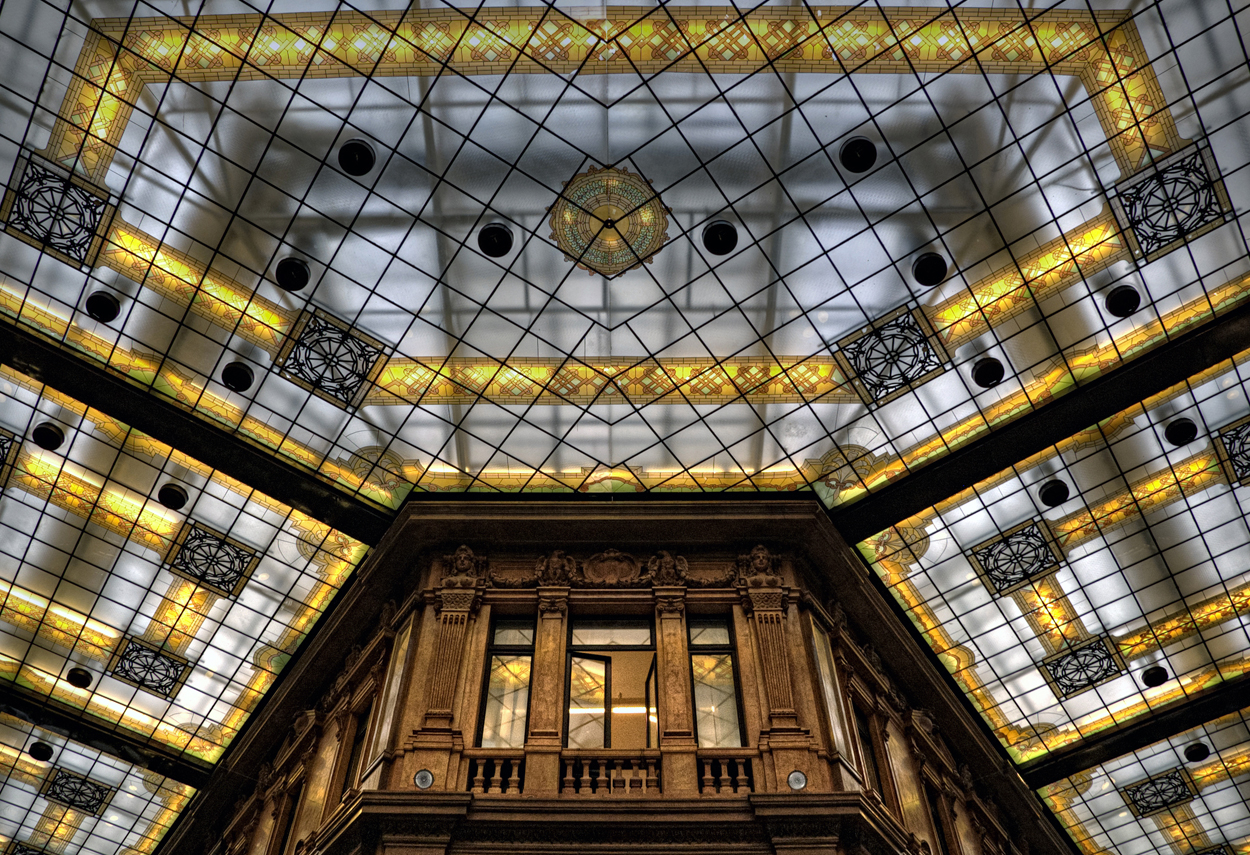
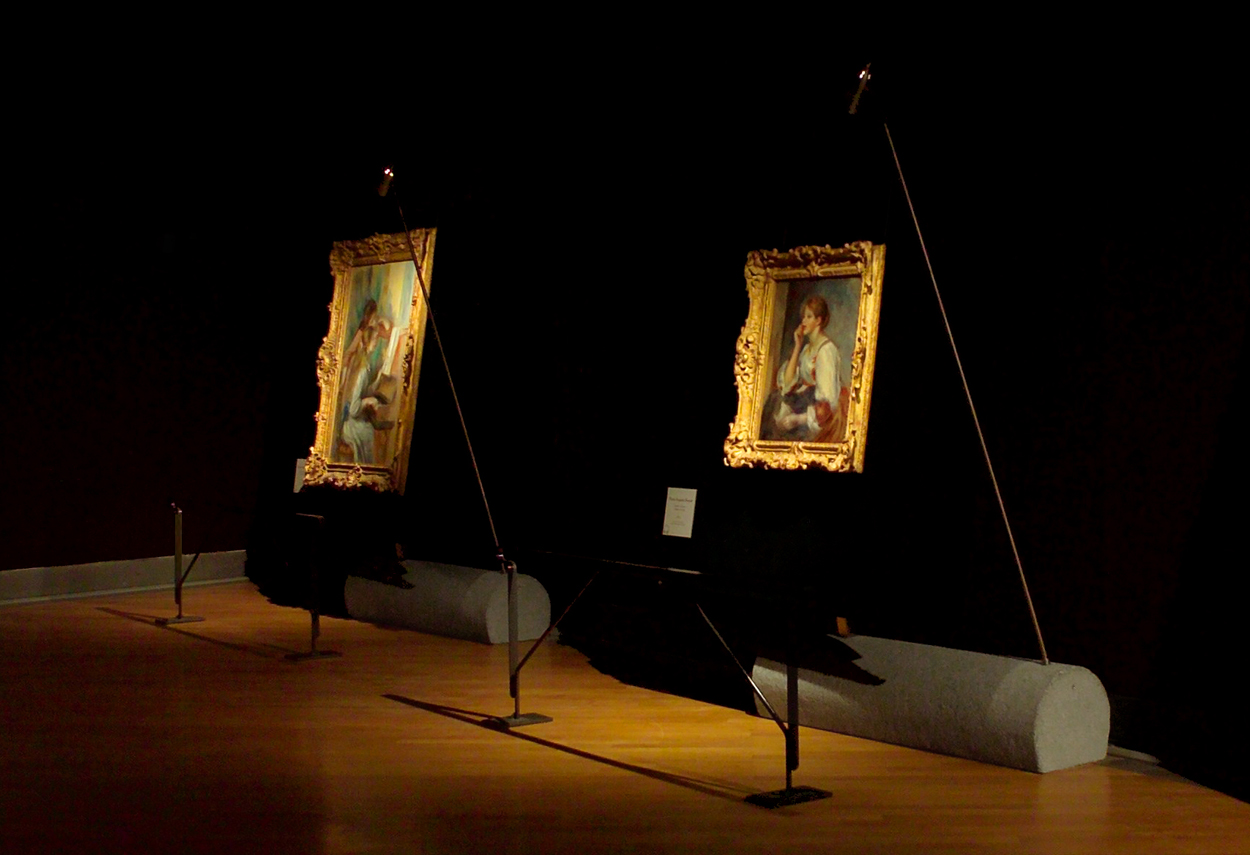
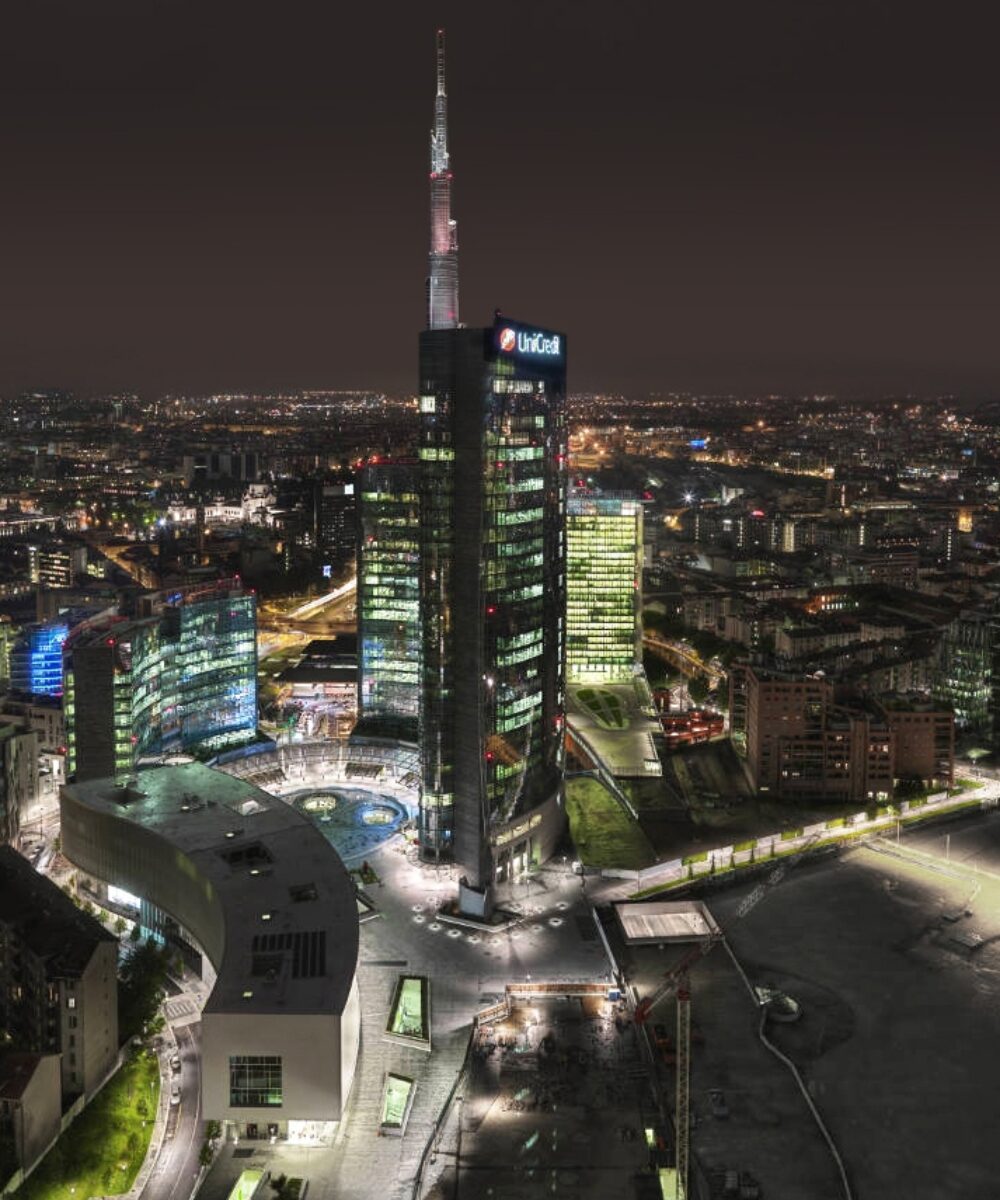


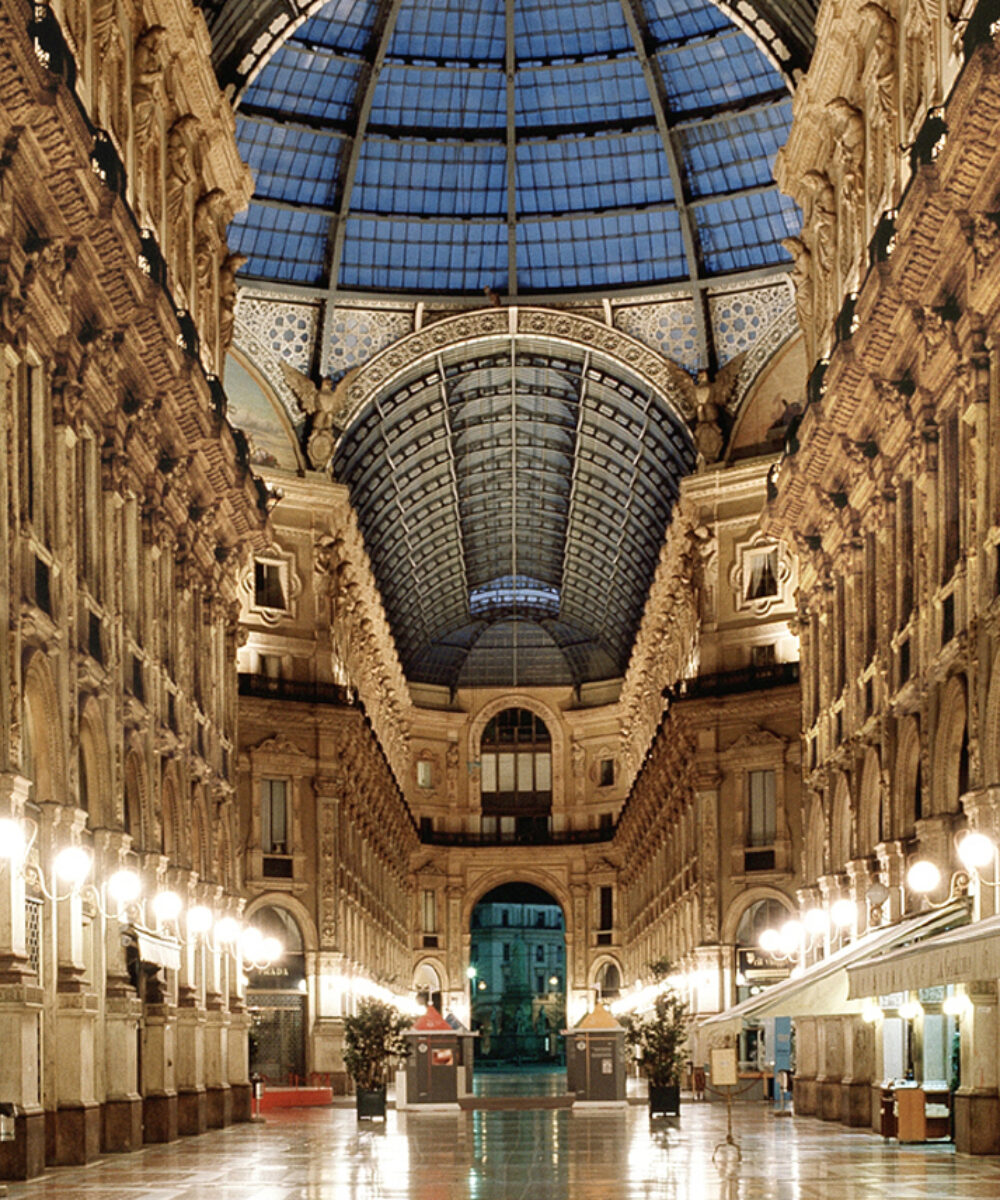
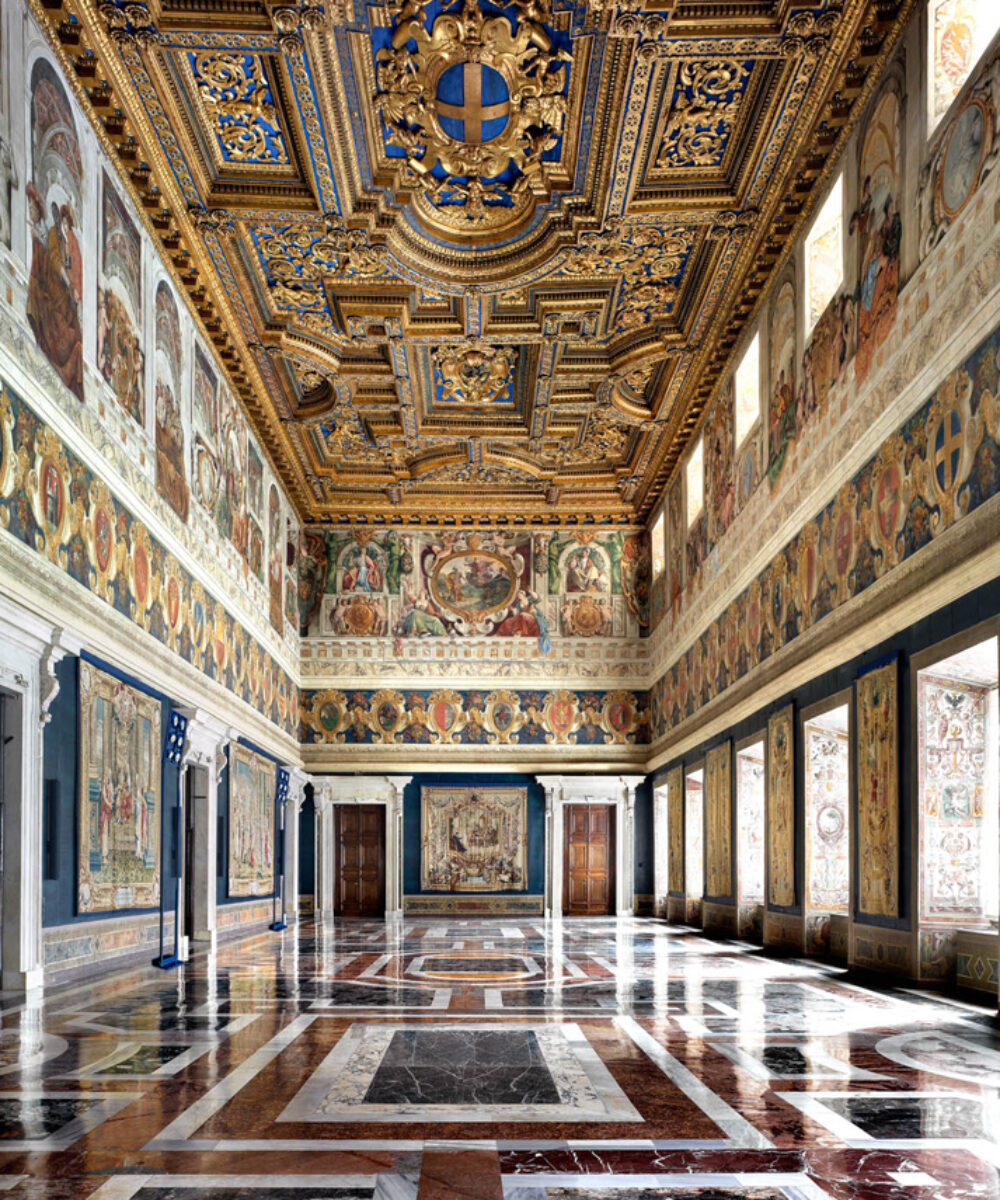


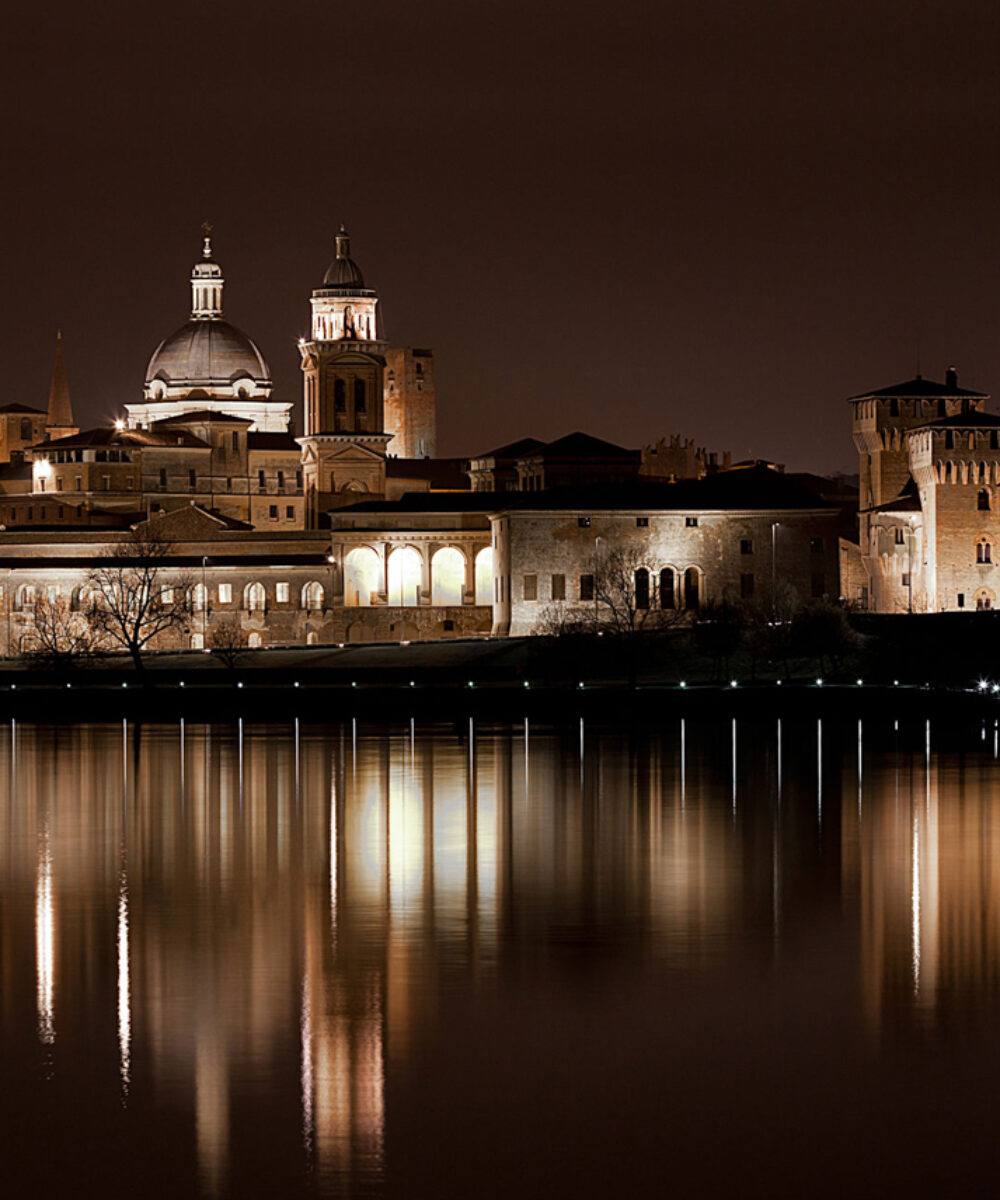


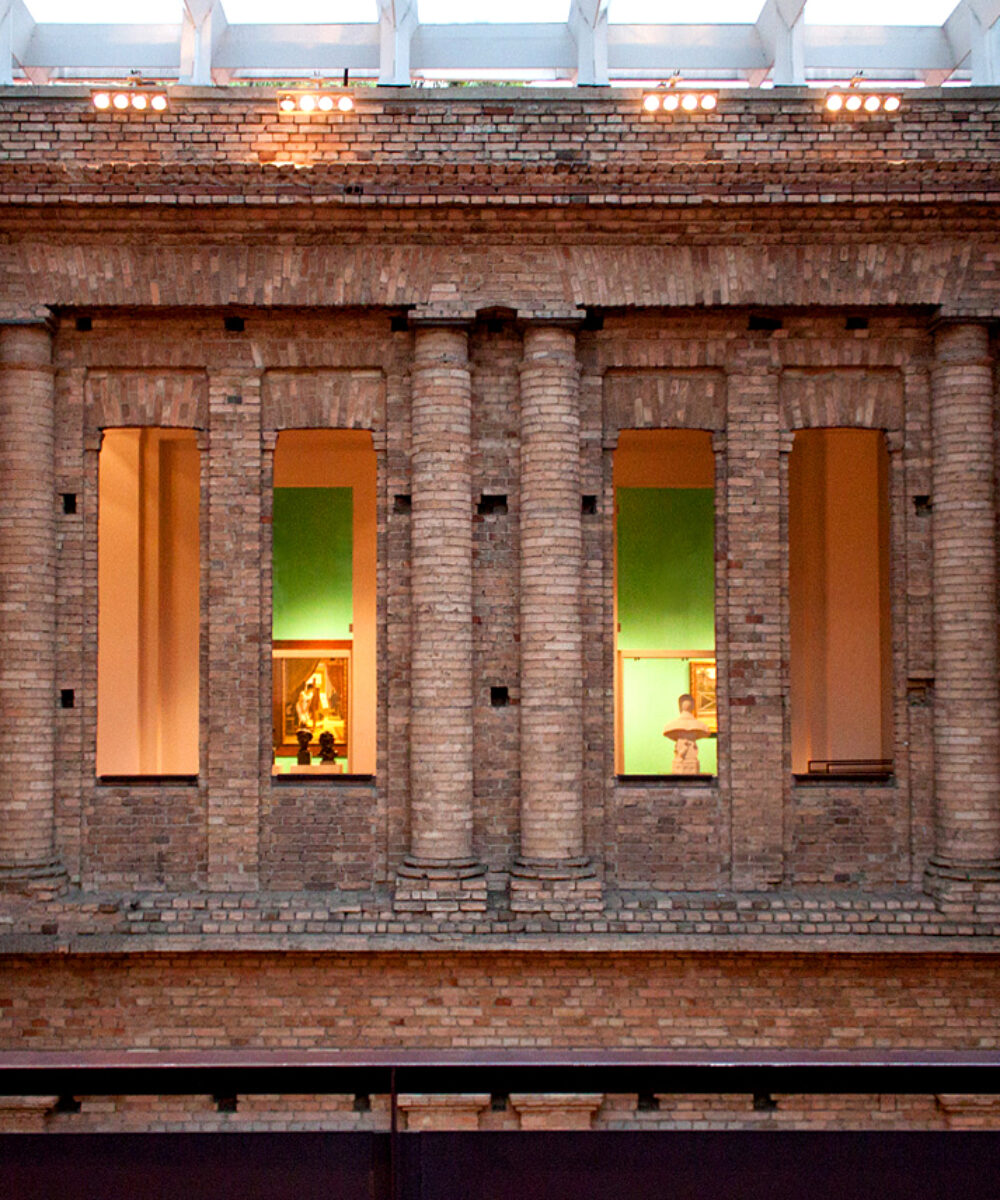

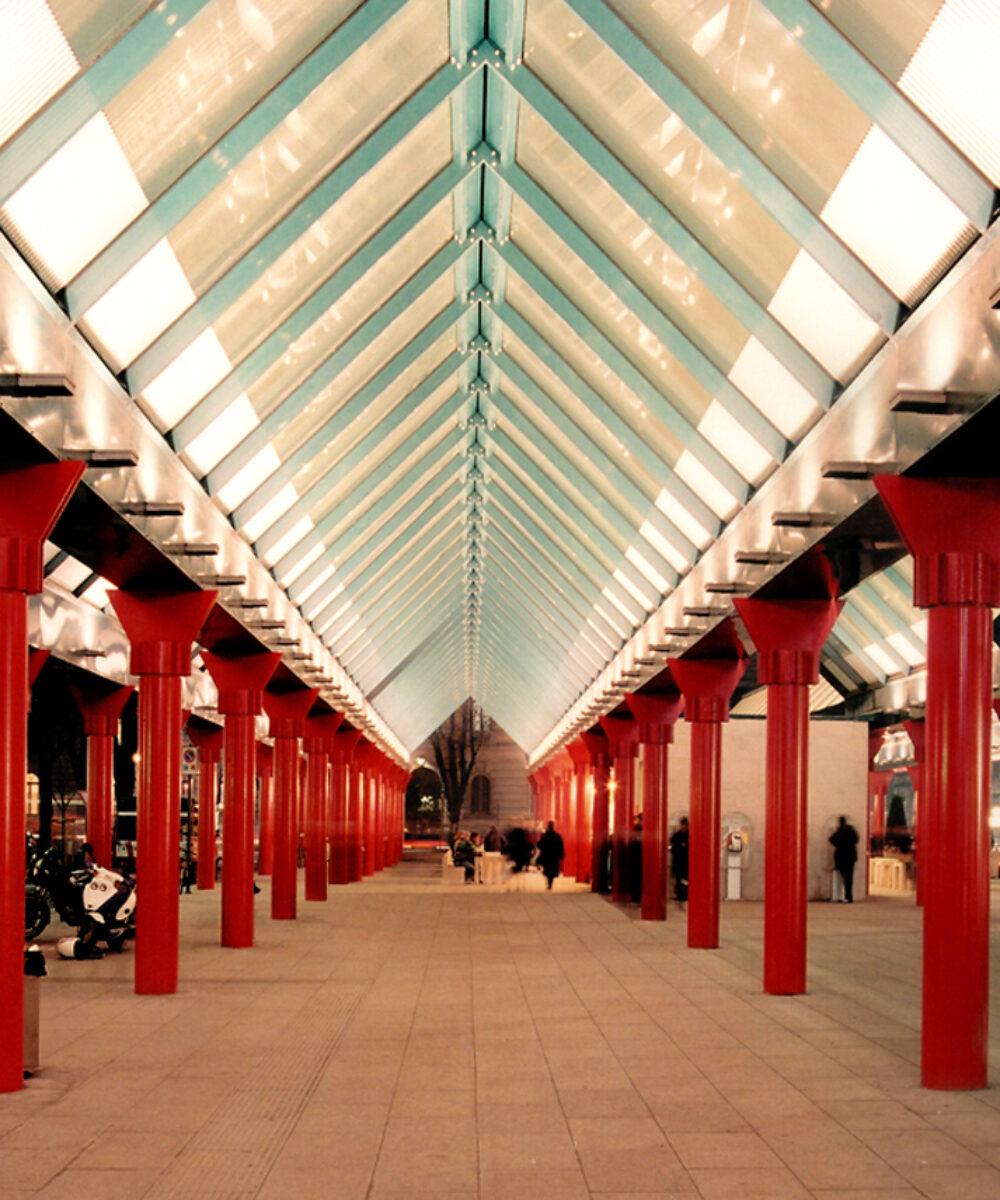
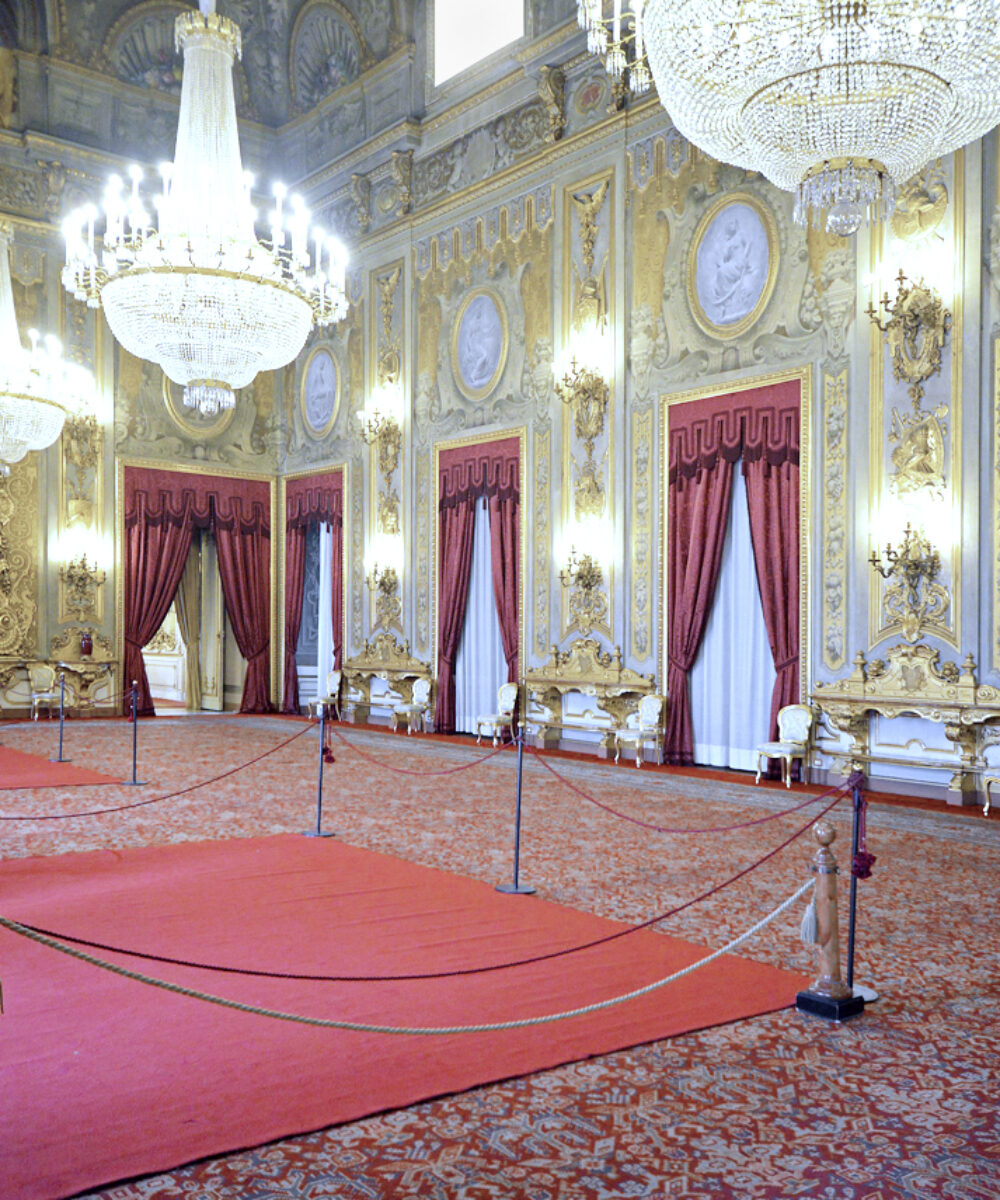


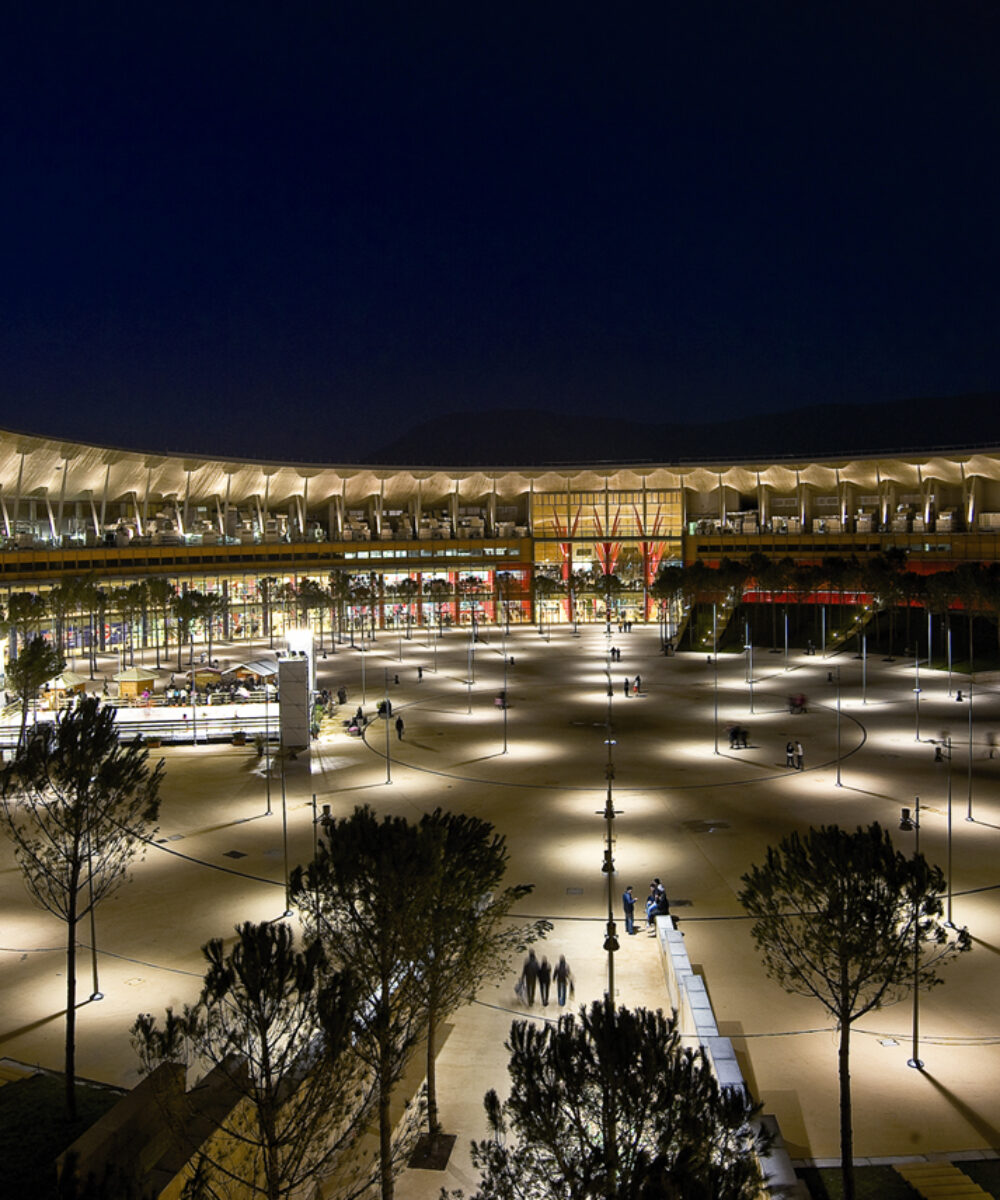


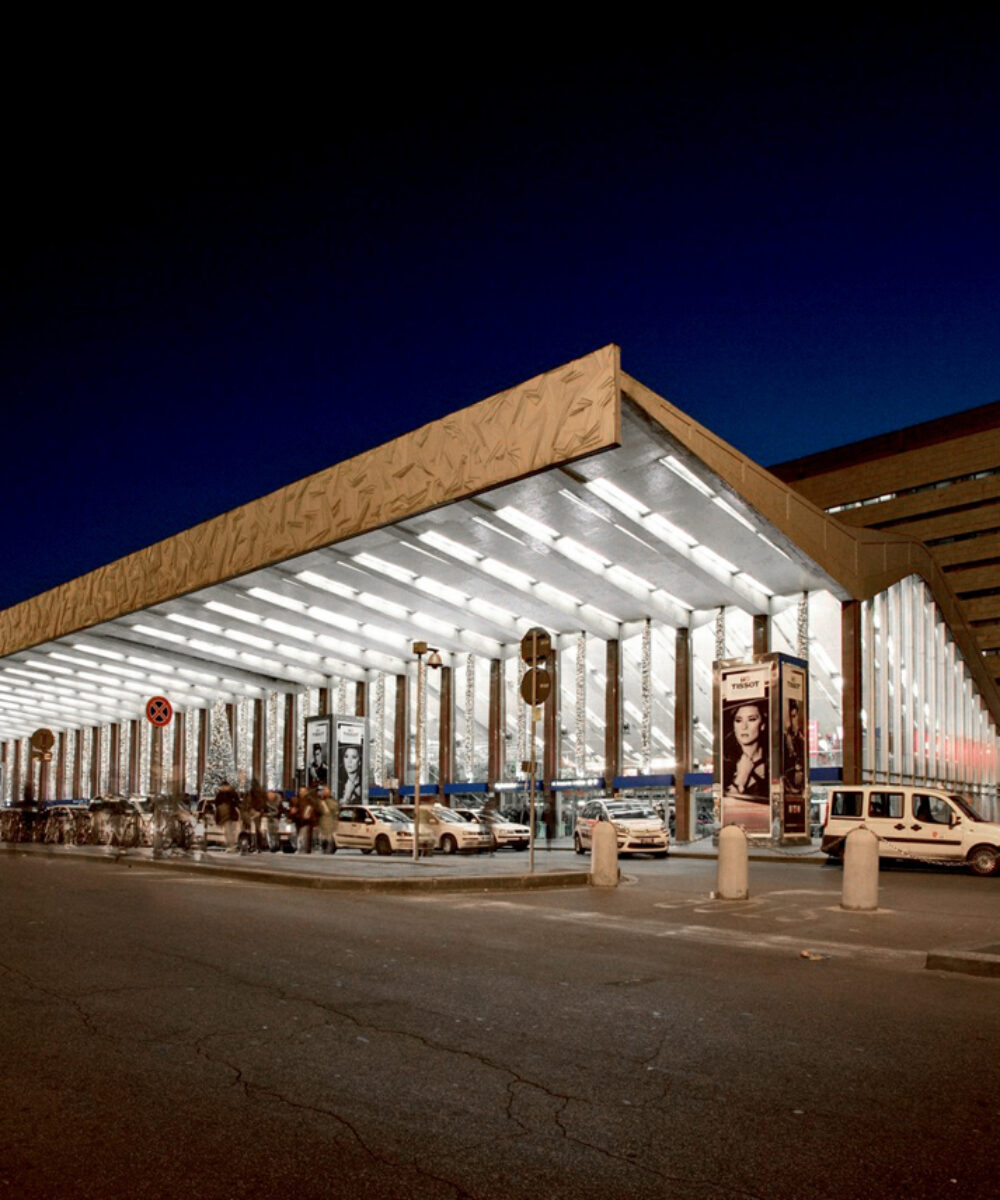


Piero Castiglioni's work is part of a broader design tradition, deeply rooted in the Italian design culture of the twentieth century, of which he represents one of the most mature and conscious expressions. His vision of light as an architectural material, as a critical tool capable of building meaning, relationships and spatial quality, was not born in isolation, but is grafted onto a shared cultural terrain, fueled by the constant dialogue between architecture, industrial design, applied arts and theoretical reflection on the social role of design.
In this context, light becomes one of the privileged places in which a conception of the project is manifested, understood not as a formal exercise, but as a responsible act, capable of responding to changes in society, to the transformations of living and to new technical and production conditions. Castiglioni's lighting practice, with its balance between methodological rigor and perceptual sensitivity, can thus be read as part of a broader cultural heritage, shared with other masters who have contributed to redefining the relationship between space, object, function and experience.
The transition from the architectural and urban scale to the broader reflection on twentieth-century Italian design allows us to understand how light, far from being a specialized or sectoral theme, has represented – and continues to represent – a transversal device, capable of crossing disciplines, languages and historical periods. It is in this context that the contribution of the great Italian designers is configured as a common heritage, made up of method, ethics and interpretative skills, in which light takes on a central role in the construction of the quality of space and the experience of living.
The Great Masters
From Rationalism to Postmodernism: The Design Legacy That Redefined Living Culture
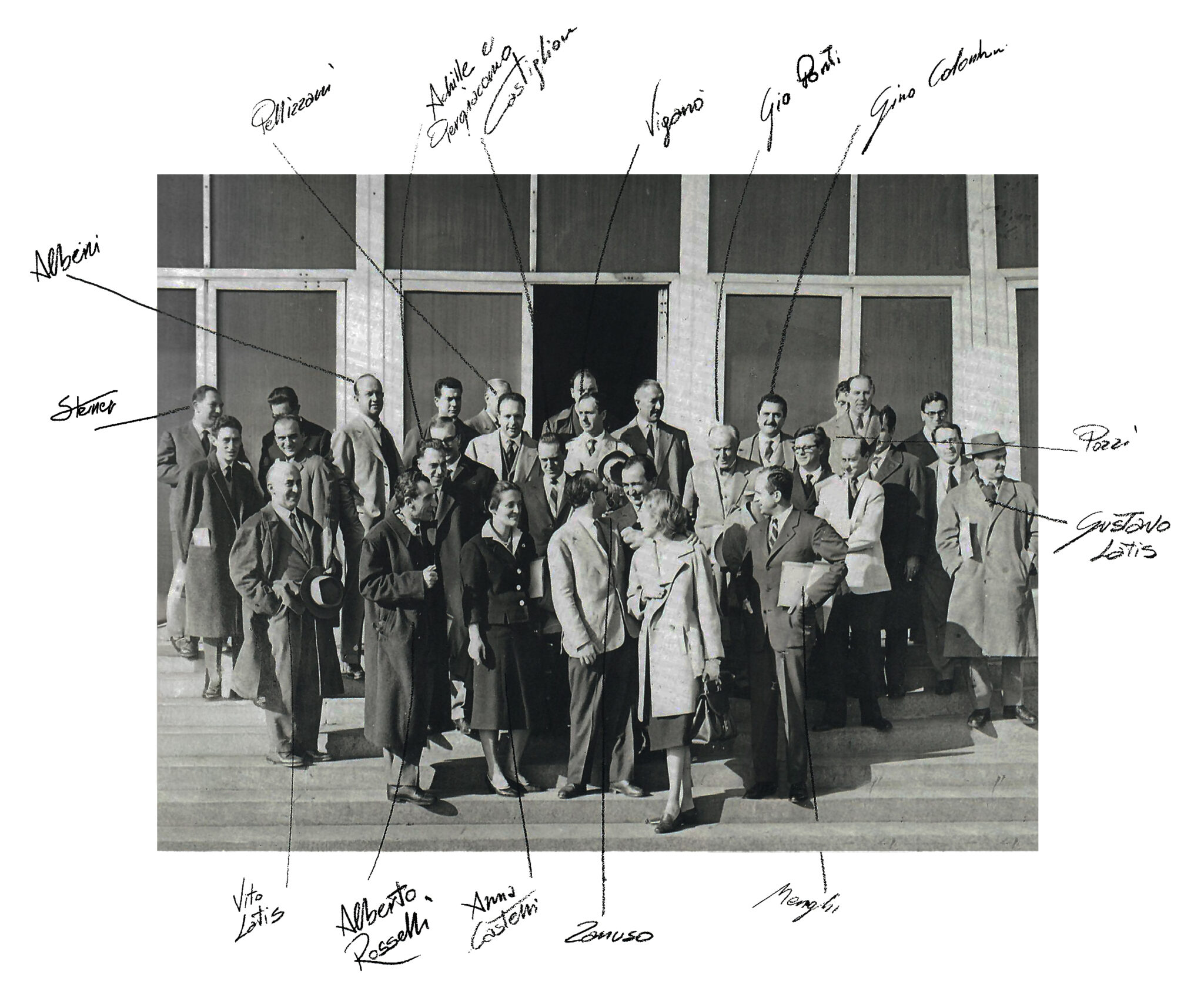
During the twentieth century, Italy underwent profound transformations, marked by social, political, economic, and cultural changes that redefined not only the morphology of its cities but also the very meaning of living. This scenario saw the extraordinary contribution of designers such as Franco Albini, Giò Ponti, Pietro Chiesa, Luigi Caccia Dominioni, Marco Zanuso, Joe Colombo, the Castiglioni brothers, Ettore Sottsass, Enzo Mari, Bruno Munari, Angelo Mangiarotti, Vico Magistretti, and Alessandro Mendini. These great masters of Italian design were not simply creators of iconic objects or innovative architecture: they were conscious interpreters of their time, capable of interpreting society's needs and transforming them into design language.
Since the 1930s and 1940s, at the height of the Rationalist era, some of them developed a vision of living based on functionality, formal rigor, and a synthesis of art and technology, contributing to the creation of a modern material culture that reflected the values of efficiency and order inherent in the society of the time. As Franco Albini declared, "rigour is not a limitation, but a condition for the freedom of design," expressing a poetics of functional sobriety that eschews any purely ornamentalism.
With post-war reconstruction and the subsequent economic boom, Italian design entered a phase of growth and consolidation, marked by confidence in industrial production, serial production, and the potential to improve the quality of life through accessible and well-calibrated design solutions. It is in this context that Marco Zanuso's thinking emerges, for whom "design is not form but method," highlighting the centrality of process as a tool for rationalizing living.
Design thus becomes a language and a provocation, capable not only of solving functional problems but also of stimulating reflection, breaking down established habits, and proposing new behavioral models. "I've never designed a lamp, I've always designed light," Joe Colombo stated, suggesting a vision of domestic space as a dynamic, transformable, and futuristic organism.
With the 1980s and the rise of postmodern thought, design regained a narrative, symbolic, and emotional dimension. Living is no longer merely a rational expression, but becomes a cultural act, a memory and an identity. "Design is a form of narration," wrote Alessandro Mendini, placing imagination, irony, cultured reference, and the emotional dimension at the heart of the project. Similarly, Ettore Sottsass maintained: "I have never thought that objects serve only to solve problems. Objects also serve to communicate emotions."
With the 1980s and the rise of postmodern thought, design regained a narrative, symbolic, and emotional dimension. Living is no longer merely a rational expression, but becomes a cultural act, a memory and an identity. "Design is a form of narration," wrote Alessandro Mendini, placing imagination, irony, cultured reference, and the emotional dimension at the heart of the project. Similarly, Ettore Sottsass maintained: "I have never thought that objects serve only to solve problems. Objects also serve to communicate emotions."
The legacy of the great masters of Italian design proves more relevant today than ever. Their works—born in dialogue with the epochal changes of the twentieth century, from post-war reconstruction to the radical utopias of the 1960s, up until the advent of post-industrial society—tell us of a project understood as an act of civil, cultural, and aesthetic responsibility. Objects, spaces, and visions thus become cultural manifestos, capable of combining ethics and function, industry and art, tradition and avant-garde.
Reflecting on their contribution means rediscovering the value of industrial design as a tool for interpreting the present and consciously planning the future. In an age where technology permeates every gesture and light defines the quality of our daily experience, their teachings prove to be a source of inspiration and critical guidance, capable of shaping behaviors, generating meaning, and building identities.